Listening to Beethoven #74 – Seufzer eines Ungeliebten und Gegenliebe


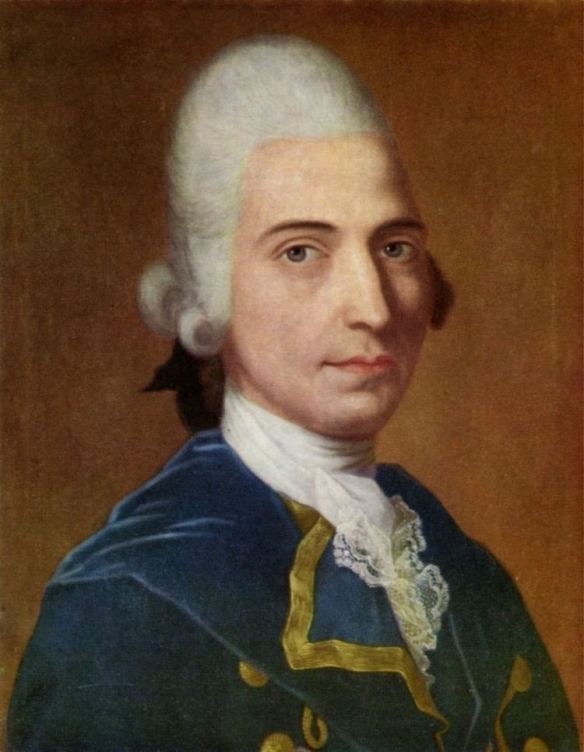
Gottfried August Bürger

Seufzer eines Ungeliebten und Gegenliebe WoO 118 for voice and piano (1794-5, Beethoven aged 24)

Dedication not known
Text Gottfried August Bürger
Duration 6’30”

Listen

Background and Critical Reception

This is one of Beethoven’s biggest solo vocal works to date, setting a pair of poems by Gottfried August Bürger. The first, Seufzer eines Ungeliebten (Plaint of a Loveless Man), is set out as an operatic recitative, while the second, Gegenliebe (Requited Love) is more of an aria with a broad, flowing profile. Commentators immediately noted the similarity of the melody in the second poem not just to the Choral Fantasy Op.80 but to the Ode to Joy from the Choral Symphony.

Susan Youens, writing for the recording made by Roderick Williams and Iain Burnside for Signum Classics, notes that ‘if the prosody leaves something to be desired, it is nonetheless fascinating that this melodic idea was brewing in Beethoven’s brain literally for decades and that the song’s impulse gave rise to the mighty symphony’.

Amanda Glauert, in The Cambridge Companion to Beethoven, draws a strong parallel with the forthcoming concert aria Ah, Perfido! For her Beethoven ‘chose to adopt an exaggeratedly operatic idiom for his setting of the first poem’, concluding that ‘the gracious triple-meter melodies in E flat into which both song and aria resolve are so similar in contour that one can sense how Beethoven must have borrowed the style from his teacher (Salieri) or other Italianate models. In Gegenliebe, ‘the awkward text setting…when heard in context…becomes the natural consequence of the voice being pushed forwards by the piano’s rhythmic intensity.’

Meanwhile in The Beethoven Companion, Leslie Orrey finds the piano writing ‘suggests a transcription of an orchestral score.’

Thoughts

Just as his studies with Albrechtsberger have been blooming, so Beethoven’s education with Salieri appears to be bearing bigger and greater fruit. The songs we are hearing now are more substantial and adventurous, and this two-parter is one borne of the stage rather than the recital room.

From the first notes it is clear this is substantial and meaningful vocal work for Beethoven. There is an immediate sense of drama, maybe exaggerated a bit but ideally suited to the male singer. Tension surrounds the music from the off, but is resolved beautifully into the Requited Love, where we first hear the memorable theme. Its similarity to the Ode To Joy is uncanny, and as Susan Youens says it must have meant a lot to the composer, a melody whose profile stayed at the front of his thoughts for decades.

Once heard it is the tune that dominates, and the aria finishes in a resilient and triumphant mood.

Recordings used

Dietrich Fischer-Dieskau (baritone), Jörg Demus (piano) (Deutsche Grammophon)
Hermann Prey (baritone), Leonard Hokanson (piano) (Capriccio)

Peter Schreier (tenor), Walter Olbertz (piano)

Anne Sofie von Otter (mezzo-soprano), Melvyn Tan (fortepiano) (Archiv)

An imperious performance from the great baritone Fischer-Dieskau, with a dramatic introduction and ideal phrasing on the big tune. Hermann Prey and Leonard Hokanson are even more expansive, clocking in at nearly seven minutes. Peter Schreier moves the music up in pitch (in C minor rather than B flat minor) but his version also carries a sense of occasion. Anne Sofie von Otter does too, though not quite as full bodied in tone. Melvyn Tan’s fortepiano provides ideal support.

Spotify links

Dietrich Fischer-Dieskau, Jörg Demus

Hermann Prey, Leonard Hokanson

Peter Schreier & Werner Olbertz

Anne Sofie von Otter, Melvyn Tan

You can chart the Arcana Beethoven playlist as it grows, with one recommended version of each piece we listen to. Catch up here!

Also written in 1795 Reicha –  Concerto Concertant Op.3

Next up O care selve (first version)
Listening to Beethoven #73 – Fugue for string quartet in D minor (fragment)

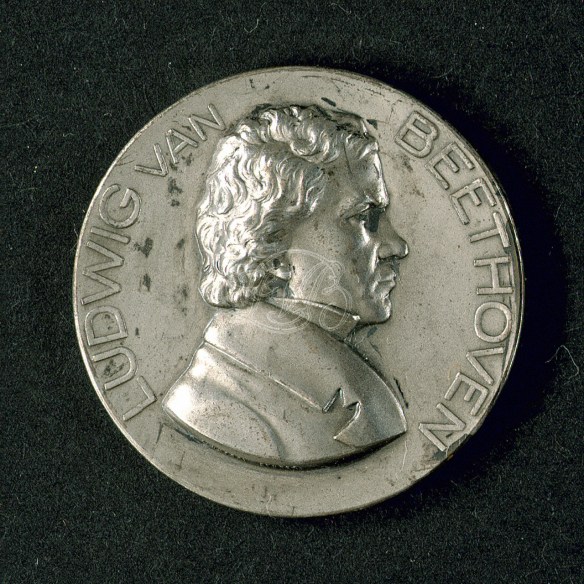
Commemorative medal for Ludwig van Beethoven – silver medal, probably based on a design by Fritz Schwerdt © Beethoven-Haus Bonn

Fugue in D minor, Hess 245 for string quartet (1794-5, Beethoven aged 24)

Dedication not known
Duration 0’45”

Listen

Background and Critical Reception

A ‘fragmentary fugue’ is not necessarily a phrase to get the musical pulse racing, but since we are trying to cover everything Beethoven wrote, even the snippets are worth a listen.

This short excerpt also hails from Beethoven’s lessons with Albrechtsberger.

Thoughts

We return to the key of D minor, a popular selection for output from these lessons – but when the excerpt starts it feels like we have walked into a performance half way through.

Even at the end, in spite of the busy part writing, there is no resolution – so this is very much a scrap from the cutting room floor rather than something you would expect to see included in a concert.

Recordings used

Fine Arts Quartet (Naxos)

A very well played version – though it is far from complete, so difficult to judge.

Spotify links

Fine Arts Quartet

You can chart the Arcana Beethoven playlist as it grows, with one recommended version of each piece we listen to. Catch up here!

Also written in 1795 Hyacinth Jadin 3 Piano Sonatas Op.4

Next up Prelude and Fugue in C major Hess 31

Listening to Beethoven #72 – Prelude and Fugue in C major

Commemorative medal for Ludwig van Beethoven, 1927 – Silver medal from the Bavarian Main Mint based on a design by Josef Bernhart, Munich, 1927 © Beethoven-Haus Bonn

Prelude and fugue in C major, Hess 31 for string quartet (1794-5, Beethoven aged 24)

Dedication not known
Duration 5′

Listen

Background and Critical Reception

A third Prelude and Fugue from Beethoven’s lessons with Albrechtsberger in Vienna, 1794-5. By way of a reminder, Beethoven was taking lessons from the Austrian composer, whose relatively rigorous approach to working with counterpoint complemented the vocal teaching he was receiving from Salieri.

Beethoven had worked writing fugues in two or more parts, and here is another in four – with a short prelude added to the front.

Thoughts

During his lessons with Albrechtsberger it seems that Beethoven opens up a little more with every piece. This attractive Prelude and Fugue are outgoing from the start, with a very solid ground note on the cello beginning proceedings. After that the Prelude proceeds on its genial way, compact and very approachable. It ends on an open chord (G major)…

…which allows Beethoven to lead straight into the energetic fugu, back in C major. There is a strong pointer here towards one of his true masterpieces of counterpoint, the String Quartet in C major Op.59/3 ‘Razumovsky’, which he would publish in eleven years’ time.

Recordings used

Fine Arts Quartet (Naxos)

Endellion Quartet (Deutsche Grammophon)

Both ensembles give a full-bodied account of this piece, the Fine Arts noticeably louder while the Endellion have a bit more light and shade.

Spotify links

Fine Arts Quartet

Endellion Quartet

You can chart the Arcana Beethoven playlist as it grows, with one recommended version of each piece we listen to. Catch up here!

Also written in 1795 Hyacinth Jadin 3 Piano Sonatas Op.4

Next up Prelude and Fugue in C major Hess 31

Listening to Beethoven #71 – Prelude and Fugue in F major

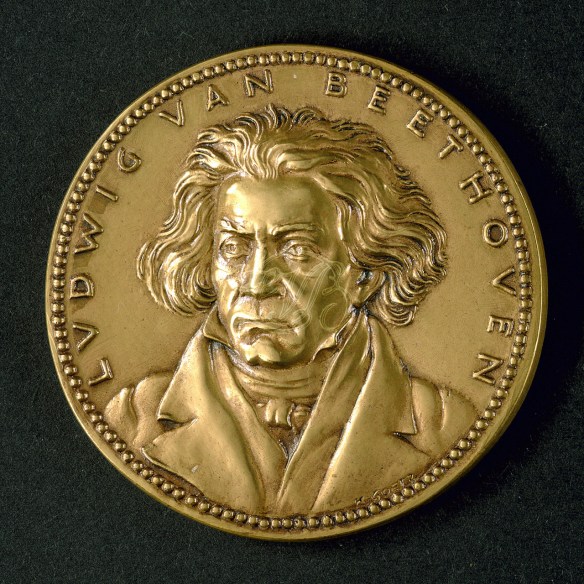
Commemorative medal for Ludwig van Beethoven, 1927 – silver medal based on a design by Karl Goetz © Beethoven-Haus Bonn
Prelude and fugue in F major, Hess 30 for string quartet (1794-5, Beethoven aged 24)

Dedication not known
Duration 6′

Listen

Background and Critical Reception

Here we have more from the pen of Beethoven via the careful scrutiny of Johann Georg Albrechtsberger. This is another more substantial piece suggesting he has reached the required standard of counterpoint writing and that his teacher is now encouraging him to apply it to a bigger scale.

Thoughts

Beethoven must have studied the organ works of J.S. Bach at some point while under Albrechtsberger – at least, that is the natural conclusion of thought while enjoying the busy, breezy prelude to this pair of movements. The music bustles along happily, each of the four instruments interacting closely but with the whole piece in mind.

The fugue is equally upright, Beethoven’s confidence in his part writing clear for all to hear. The main subject is bold and colourful, and dominates proceedings – but there is plenty going on behind the scenes, the accompaniment full of references to the main tune.

Recordings used

Fine Arts Quartet (Naxos)

Endellion Quartet (Deutsche Grammophon)

The Fine Arts Quartet give a clearly voiced account of the Prelude, with plenty of gusto – which they also apply to the Fugue. Their new Naxos recording is brightly lit, more so than the Endellion Quartet, who are a little bit more relaxed at the start of the Prelude, allowing the energy to build over a greater span.

Spotify links

Fine Arts Quartet

Endellion Quartet

You can chart the Arcana Beethoven playlist as it grows, with one recommended version of each piece we listen to. Catch up here!

Also written in 1795 Friedrich Witt Horn Concerto in E flat major

Next up Prelude and Fugue in C major Hess 31

Listening to Beethoven #70 – Prelude and Fugue in E minor


Commemorative medal for Ludwig van Beethoven, 1927 – bronze medal based on a design by Karl Goetz © Beethoven-Haus Bonn

Prelude and fugue in E minor, Hess 29 for string trio (1794-5, Beethoven aged 24)

Dedication not known
Duration 6′

Listen

Background and Critical Reception

Beethoven’s counterpoint lessons with Albrechtsberger were starting to bear substantial fruit, the composer now producing fugues he considered to be public-facing, rather than the dutiful exercises we have witnessed up until now. This example sees quite a meaty prelude added to the front of a such an exercise to make a relatively substantial piece for string trio.

The excellent Unknown Beethoven resource goes into impressive detail on the unpublished work, recognising that the theme of the fugue itself must be by Beethoven, since ‘it does not occur on the list of themes which Albrechtsberger gave to his pupils’.

Thoughts

Beethoven’s prelude gives a hint of what is to come in the fugue. There may only be three instruments on show but the writing is dense enough to simulate at least four. The trio exchange their ideas but as the prelude moves on so the viola’s longer notes become both prominent and profound.

The fugue has a great deal of nervous energy, a tentative subject floated by the violin but gradually exerting itself with greater authority. Beethoven works his ideas through several chromatic harmonies, with a compact design and some neat trickery between the parts. The pair make an impressive and convincing piece that could easily be used as a concert opener or encore with rarity value.

Recordings used

Lukas Hagen, Rainer Schmidt (violins), Clemens Hagen (cello) (Deutsche Grammophon)

An excellent performance, rich in sound but with impressive clarity too.

Spotify links

Lukas Hagen, Rainer Schmidt, Clemens Hagen

You can chart the Arcana Beethoven playlist as it grows, with one recommended version of each piece we listen to. Catch up here!

Also written in 1795 Hummel Piano Sonata no.8

Next up Prelude and Fugue in F major Hess 30