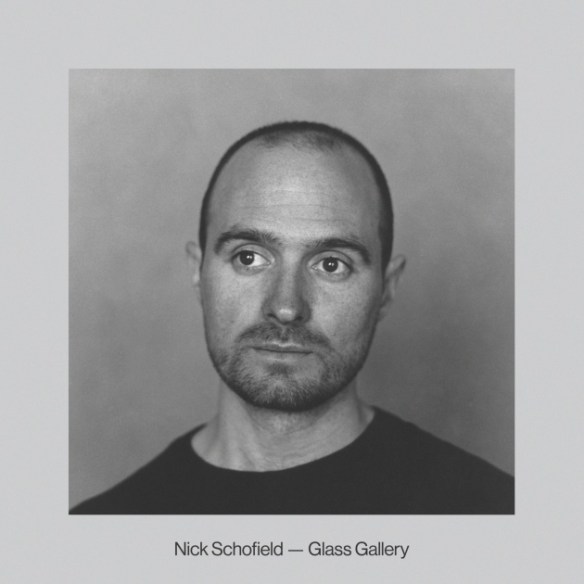
On Record: Nick Schofield: Glass Gallery (Backward Music)

reviewed by Ben Hogwood

What’s the story?

This is the second album from Montreal-based musician Nick Schofield, who has taken two very specific points of reference for Glass Gallery.

The first is a building – the National Gallery of Canada in Ottawa, to be precise. Schofield draws on its glass atrium for inspiration, depicting in musical form the play of light through its transparent windows.
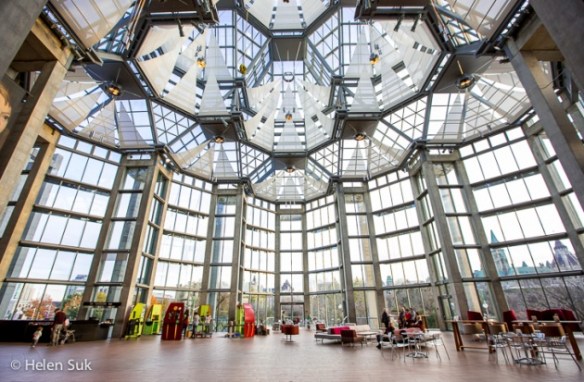
The second is an instrument, specifically the vintage Prophet-600 synthesizer, on which the whole album was composed. Schofield uses it to paint the different images he has seen through the gallery’s atrium, but also refers to artist Guido Molinari, whose paintings can be seen in the gallery.

What’s the music like?

With so many points of inspiration, it is perhaps inevitable that there is plenty for the ear to hone in on in this album, but like a good art exhibition it also leaves you in a very settled state of mind.

Schofield’s textures with the synth are like the falling of powdery snow – unhurried, never straight, sometimes going up before they come down again, always subtly moving. The melodic cells are beautifully worked, often dovetailing with each other, and the whole album is put together with the assurance that runs through the best ambient music – where a little goes a long way.

Central Atrium sets the scene with its soft oscillations, while Mirror Image has a hint of Eastern promise in its undulating figure, Schofield showing the possibilities of orchestration with just the one instrument. The musical emphasis tends towards the treble, evoking the clear and bright view up through the gallery’s transparent roof.

Molinarism is the standout composition, with pinpricks of musical light against a darker background, like shooting stars – and uncannily portraying the style of the pictures Schofield is evoking. The lightness of touch continues here and throughout, with a lasting elegance and poise to the music, like a flexible slow dancer.

Does it all work?

It does, provided you listen to the whole of Glass Gallery – for again, to use the exhibition parallel, you don’t get the full benefit from just concentrating on highlights. Having listened to it in the middle of softly falling snow, I can confidently say it is the ideal environment for this music.

Is it recommended?

It is. Schofield has made a lovely cold weather album, but one with a warm heart too.

Stream & Buy

Playlist – Aria Rostami & Daniel Blomquist

It is our great pleasure to welcome Aria Rostami and Daniel Blomquist to the Arcana playlist section.

They have been working together on a second collaboration for the Glacial Movements label. Still is the culmination of years of work and musical shapeshifting, the resultant six-track album the ideal companion to our cold weather isolation here in the northern hemisphere

Still was reviewed on Arcana here, but the playlist the pair have put together reflects a little more of their listening, as well as including a couple of tracks from the album. Sit back and get horizontal with a tracklisting that includes stellar works from Bryce Hackford – the gorgeous Coast (maybe) – Mica Levi and Popul Vuh.

Our thanks to Aria and Daniel for this wonderful hour of music:

https://soundcloud.com/ariarostami/aria-rostami-and-daniel-blomquist-mix-arcana/s-qL21jUAxTUx

Listening to Beethoven #115 – Allegretto in C minor, WoO 53


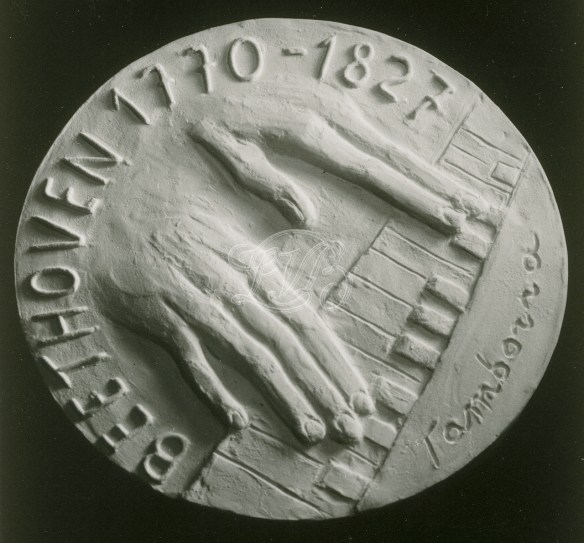
Commemorative medal for Ludwig van Beethoven, around 1970. Photography, probably by Giandavide Tamborra after his plaster model for a medal, probably from 1970, Reproduced from the Beethoven-Haus Bonn with thanks.

Allegretto in C minor WoO 53 for piano (thought to be from 1796-7, Beethoven aged 26)

Dedication not known
Duration 4′

Listen

Background and Critical Reception

There is very little written about this piece, but the few surviving notes suggest it might be an unpublished movement intended for the Piano Sonata no.5 in C minor, published as the first in the Op.10 set around this time.

Thoughts

The mood is pensive and quite downcast for the main theme of this short movement, and Beethoven develops it with the serious mood intact. Set in C minor, it is a thoughtful piece and on occasion has a bit of angst, especially when the heavier left-hand writing appears.

Having said that the clouds part beautifully for a theme in C major around half way through, where the darkness to light transition is very clear. Towards the end the music nearly stops, poised as though pondering its next move…before resolving in the minor key, in downbeat contemplation.

The Allegretto certainly feels like a piece without a home – and given the finished product that is Op.10/1 it is difficult to see where it would have fitted in. It makes a good miniature, though!

Recordings used and Spotify links

Alfred Brendel (Decca)
Gianluca Cascioli (Deutsche Grammophon)
Ronald Brautigam (BIS)
Jenő Jandó (Naxos)
Rudolf Buchbinder (Teldec)
Olli Mustonen (BMG)

Alfred Brendel is compelling in his version, turning the frowns to smiles as the C major theme appears. Gianluca Cascioli starts very deliberately before unleashing a considerable amount of angst around the 1 minute mark. Ronald Brautigam is swift, his phrasing clipped but urgent.

The attached playlist has six very different accounts of the Allegretto, from Brautigam to Jandó via Brendel, Cascioli, Buchbinder and Olli Mustonen:

You can chart the Arcana Beethoven playlist as it grows, with one recommended version of each piece we listen to. Catch up here!

Also written in 1797 James Hewitt Piano Sonata in D major ‘The Battle of Trenton’

Next up Fra tutte le pene WoO 99/3b

Listening to Beethoven #114 – 12 Variations on the Russian Dance from ‘Das Waldmädchen’, WoO 71

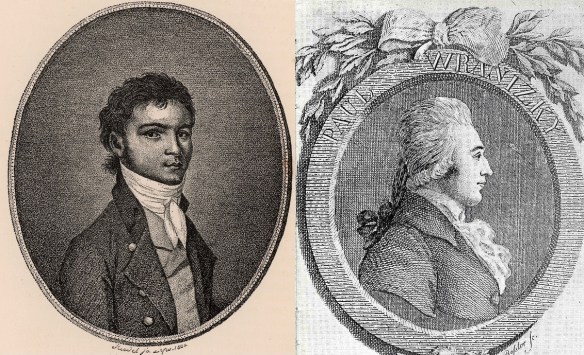
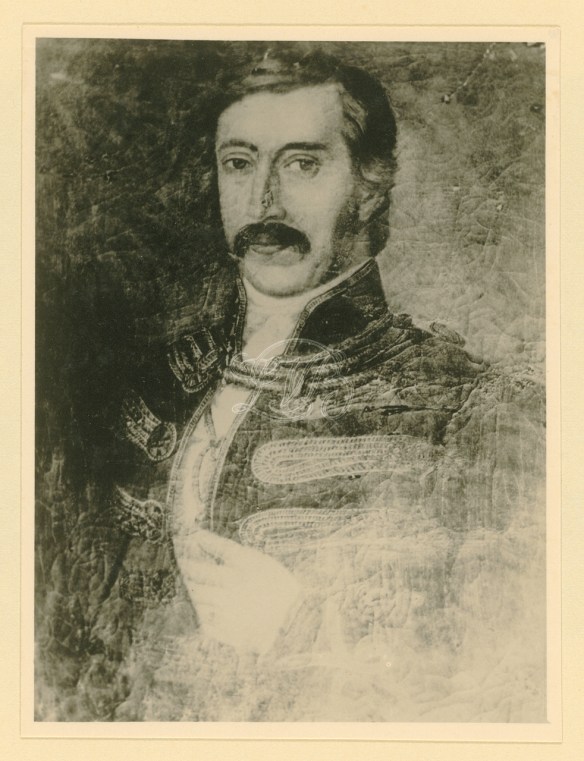
Ludwig van Beethoven and Paul Wranitzky (right, in a portrait by Johann Georg Edlinger)
12 Variations on the Russian Dance from Wranitzky’s ‘Das Waldmädchen’, WoO 71 for piano (1797, Beethoven aged 26)

Dedication Countess Anna Margarete von Browne
Duration 10′

Listen

What’s the theme like?

The theme is a Russian Dance from Paul Wranitzky‘s ballet Das Waldmädchen (The Forest Maiden), completed in 1796. Wranitzky, a Czech composer, moved to Vienna in the 1770s and was reportedly given the task of conducting the premiere of Beethoven’s First Symphony in 1800.

Background and Critical Reception

This is another set of variations from Beethoven with links to the ballet, a trait noted by Daniel Heartz. The theme is from a contemporary of the composer’s, Paul Wranitzky – resident in Vienna for a number of years having moved from Prague.

Writing about the variations in the booklet note for Cécile Ousset‘s account, Jean-Charles Hoffelé notes some unusual qualities. ‘The theme…has an irregular rhythm that Beethoven clearly cherishes, composing a set whose harmonic experiments go far enough for one to see the beginning of a new stylistic phase.’

Thoughts

Once again Beethoven serves up a dramatic set of twelve variations on a theme, with a satisfying ebb and flow, all of them wrapped up in ten minutes – even allowing for quite a substantial coda with the twelfth variation.

Initially the mood is quite restless, with the changing harmonies, but Beethoven can also be celebratory (the garland of the right hand in the fourth variation for instance.

This set of 12 is also notable for the appearance of three minor-key variations. The third is quite serious, but the seventh is a flurry of virtuosity. The penultimate variation is the most striking of the set, Beethoven leaning very heavily on one particular note – an ‘F’ natural – to create an atmosphere of uncertainty. This is dissipated in the final variation and coda. Beethoven begins with a Bach-style dialogue between the parts but develops to what sounds like the cadenza of a solo concerto, before ending gracefully.

Recordings used and Spotify links

Emil Gilels (piano) (EMI)
Vladimir Ashkenazy (piano) (Deutsche Grammophon)
Cécile Ousset (piano) (Eloquence)
Ronald Brautigam (fortepiano) (BIS)

The Spotify playlist below includes all of the versions listed above. There are some terrific accounts here. Gilels and Ousset, among the older guard, generate a terrific sense of occasion. Ronald Brautigam’s fortepiano account recreates something of the wonder Beethoven’s original audiences would have felt when presented with this music. Vladimir Ashkenazy seemingly has a soft spot for this set, pairing it with his Diabelli Variations recorded in 2007.

Also written in 1797 Dussek Piano Trio in E flat major Op.37

Next up 2 Rondos Op.51

Listening to Beethoven #113 – Duo for viola and cello in E flat major WoO 32, ‘Eyeglass Duo’


Nikolaus Zmeskall von Domanovecz, courtesy of Beethoven-Haus, Bonn

Duo for viola and cello in E flat major WoO 32, ‘Eyeglass Duo’ (1797, Beethoven aged 26)

1 Allegro
2 Minuetto

Dedication Nikolaus Zmeskall
Duration 14′

Listen

Background and Critical Reception

This is a title to raise the eyebrows – and is one of the curious corners of Beethoven’s output for sure. Perhaps fortunately the eyeglasses are not used to make any music – not directly, at any rate – rather, they refer to the wearers of the eyeglasses, Beethoven himself (viola) and Nikolaus Zmeskall (cello).

Baron Zmeskall was an accomplished cellist and a good friend of Beethoven, and the piece seems to have been written for domestic use only. It is in two lopsided movements, with a substantial first movement full of interaction between the players and a much shorter Minuetto. Richard Wigmore writes of how ‘in the minuet, with its pawky canonic trio, Beethoven suddenly pulls the rug from under the listener’s feet, by veering from E flat to a remote C flat – just the kind of comic-mysterious effect he had learnt from Haydn’.

Thoughts

Beethoven would surely have been aware that Mozart wrote two accomplished – and underrated – duos for violin and viola, and possibly of the four sonatas Michael Haydn published for the combination in the same year, 1797. Working lower down the range, Mozart also wrote a Sonata for bassoon and cello, lasting roughly the same length as this piece.

Perhaps Beethoven was aware of these when writing this highly amenable duo – which presumably appeared in large print, given the sight limitations of the players! Listening to the bright and busy Allegro, the first movement of this piece, the listener can imagine how much pleasure it brought to the bespectacled music makers. It is a lively discourse where the two instruments are treated completely as equals. The writing could easily be lifted from a string quartet, and several times I found my ear was expecting two violins to appear in harmony. The Minuetto is good fun too, including the harmonic trick noted above.

It may be intended for domestic music making only but Beethoven’s craft is all too evident, and his wit too, in this enjoyable miniature.

Recordings used

Veronika Hagen (viola), Clemens Hagen (DG)
Lawrence Power (viola), Paul Watkins (Hyperion)
Jürgen Kussmaul (viola), Anner Bylsma (cello) (Sony Classical)

Three excellent performances, bringing through the elegance of the piece, its genial nature, and also its humourous touches. Kussmaul and Bylsma, on period instruments, have a relatively grainy sound which is still appealing.

Spotify link

Veronika & Clemens Hagen

Jürgen Kussmaul, Anner Bylsma

You can listen to clips from Lawrence Power and Paul Watkins’ version on the Hyperion website

written by Ben Hogwood

You can chart the Arcana Beethoven playlist as it grows, with one recommended version of each piece we listen to. Catch up here!

Also written in 1797 Michael Haydn 4 Sonatas for Violin and Viola

Next up 12 Variations on the Russian Dance from ‘Das Waldmädchen’