
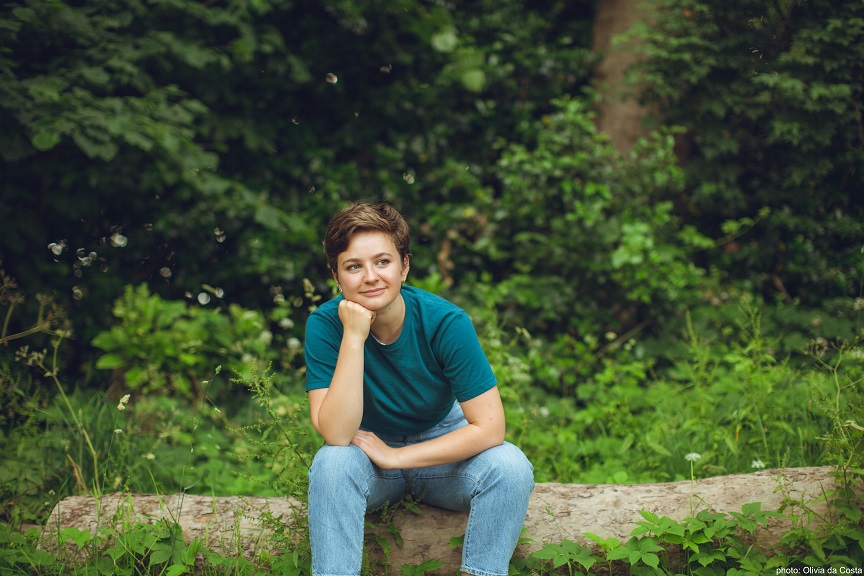
Laura van der Heijden (cello, above), City of Birmingham Symphony Orchestra / Richard Egarr (harpsichord)
J.S. Bach Orchestral Suite no.3 in D major BWV1068 (1730)
Haydn Cello Concerto in D major Hob.VIIb/2 (1784)
J.S. Bach Fuga a tre sogetti BWV1080 no.19 (1748-9)
Schumann Symphony no.2 in C major Op.61 (1845-6)
Symphony Hall, Birmingham
Tuesday 14 November 2023
Reviewed by Richard Whitehouse
The City of Birmingham Symphony Orchestra has put on smaller-scale concerts over several seasons, and tonight’s wide-ranging programme saw the players being conducted or directed – and frequently at the same time – by the personable and always enthusiastic Richard Egarr.
Egarr and Laura van der Heijden ensured Haydn’s Cello Concerto in D remained unaffected by that understatement, bordering on somnolence, which so often used to characterize it in performance. Although a staple of its repertoire from the outset, it was only discovery of its autograph in 1951 that confirmed it as by Haydn rather than Anton Kraft who had reworked the solo part extensively. Here the initial Allegro had a vibrancy that never wavered, and if Van der Heijden’s tone was not always flattering, the impetus instilled into its development and cadenza (by Colin Matthews?) ensured this movement’s vivid projection. The brief yet eloquent Adagio was enticingly rendered, while the final Rondo had an agility maintained from the first appearance of its indelible theme through to the buoyancy of its closing bars.
Egarr had opened proceedings with Bach’s Third Orchestral Suite, welcome not least because this composer’s orchestral works (other than his Violin Concertos) are seldom encountered at ‘mainstream’ concerts these days. Although its Aria (Air on the G string) – rendered so that its pathos never cloyed – will always be its chief attraction, the Ouverture had grandeur and energy redolent of Handel, then the alternate Gavotte movements evinced a genial humour to which the boisterous Gigue with its clarion-like trumpet writing made an admirable foil. After the interval, an unexpected but absorbing take on the final and unfinished fugue from Bach’s The Art of Fugue. Once more speculated on than actually heard, Contrapunctus XIV remains a fete of technical and imaginative dexterity arguably intensified by its breaking off just after the appearance of the B-A-C-H motif. Whether abandoned from failing eyesight or for reasons of intellectual game-playing, its fascination remains endless and, as heard in this lucid if dour transcription for strings, its fusing of the visceral with the arcane is not in doubt.

Not an inappropriate entrée, moreover, to Schumann’s Second Symphony: formally the most rigorous of this composer’s cycle, and one whose historical or aesthetic lineage is evident at every level. Egarr ensured the first movement’s lengthy introduction, pensive yet expectant, led seamlessly into a main Allegro whose momentum carried through to a propulsive close; then into a Scherzo whose pivoting between the agitated and whimsical was not resolved by its headlong coda – superbly articulated here. Nor was there any lack of emotional gravitas in the Adagio, surely among Schumann’s most potent creations, though Egarr’s not always tacit encouragement of applause between movements rather undermined the expectancy of a coda being fulfilled by the final Allegro as this sets out on its joyous while always eventful course.
Just on occasion the inevitability of that course seemed to lose focus, most likely as Egarr’s concept of ‘authenticity’ tended to impede more seamless formal cohesion – but, as the piece headed to its close, a sense of affirmation in the face of daunting odds could hardly be denied.
You can read all about the 2023/24 season and book tickets at the CBSO website. Click on the artist names for more information on cellist Laura van der Heijden and conductor / harpsichordist Richard Egarr
Published post no.1,998 – Friday 3 November 2023
 Arcana.fm