
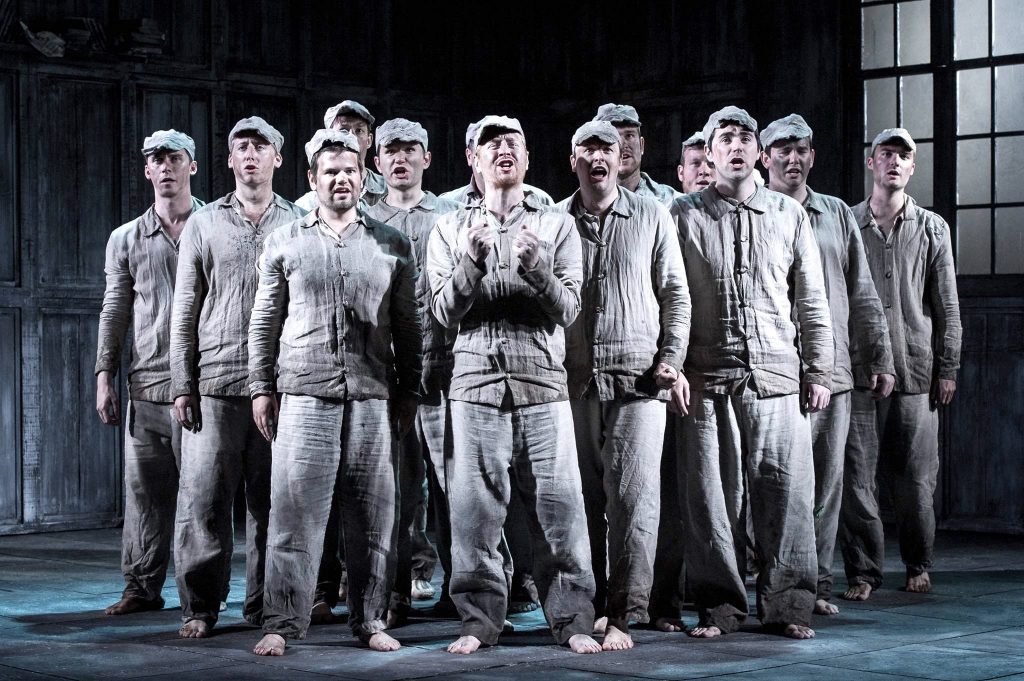
Beethoven’s Leonore as seen in a production by Buxton Opera, 2016
Leonore Overture no.2 Op.72b, used by Beethoven for a revision of his opera in three acts (1804-05, Beethoven aged 34)
Duration 14’30”
by Ben Hogwood
Background and Critical Reception
As the writer Herbert Glass points out, in program notes written for a concert by the Los Angeles Philharmonic, “Beethoven spent more time writing the overture to Fidelio than Rossini and Donizetti spent on entire operas, overture included”! He goes on to qualify this investment of time, asserting that “No. 3…distils the essence of the opera itself, transmitting its power in less than a quarter-hour’s playing time’.
No.3 – confusingly – is the second in order of composition, following no.2 which was used in the first performance of the opera. No.1 – a heavily trimmed version – would follow later, with the Fidelio overture itself a reinvented prelude to the finalised opera.
Robert Simpson, in an essay about Leonore and the resultant Fidelio, points out that the advantage of this overture over its predecessor is “its very accurate delineation of all these key relationships” – by which he means the conflict between the opera’s ‘home’ key of ‘C’ and the ‘prison’ key of B flat major, where the malevolent character Pizarro is found. He describes Beethoven using C major as “an open sky”, and B flat as “the oppressive atmosphere of the jail”, then discussing at length the key of Florestan (A flat major) and Leonore herself (E major). His conclusion is that “no-one will ever exhaust all this great music, surely the greatest ever written for the theatre”.
Thoughts
While listening to the Leonore Overture no.2 I noted that the orchestral dialogue ‘operates on the scope more of a symphonic poem than an overture’ – and that is even more a case in point with the third overture. As an orchestral piece it may be longer but it is a thrilling listen, especially when Beethoven’s ‘open sky’, as Simpson calls it, is found.
To get there we have to traverse the awful claustrophobia of the prison, but there are always shafts of light – the flute solo in Florestan’s key around two-thirds of the way through, and the offstage trumpets that set an incredibly vivid scene. After the uncertain groping in the dark, the blazing light of C major. On the way there we experience some trials, most noticeably a striking dischord right before the end – a wonderful dramatic touch that carries the deepest possible impact.
Recordings used
Berliner Philharmoniker / Herbert von Karajan (DG)
Cleveland Orchestra / George Szell (Sony)
Orchestre Lamoureux, Igor Markevitch (DG)
Chamber Orchestra of Europe / Nikolaus Harnoncourt (Teldec)
Philadelphia Orchestra / Riccardo Muti (EMI)
Once again Herbert von Karajan, with the silvery strings of his Berliner Philharmoniker machine, comes up trumps with a wholly satisfying version. Yet Igor Markevitch is arguably more dramatic still, his final pages a terrific release of tension built up earlier, in a reading that undercuts most others by a minute. Any of the other three serve as ideal guides, too.
You can listen on the links below:
Also written in 1805 Carafa Il Fantasma
Next up 32 Variations in C minor, WoO80
 Arcana.fm