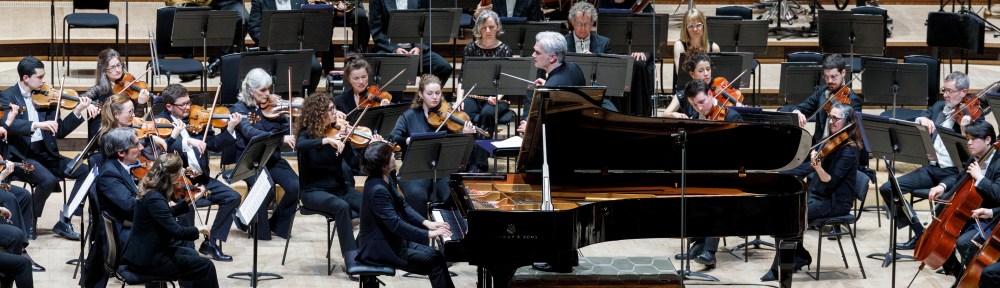

Simon Desbruslais (trumpet), English Symphony Orchestra / Kenneth Woods
Sibelius Rakastava Op.14 (1893, arr. 1912)
Sawyers Concerto for Trumpet, Strings and Timpani (2015)
Dvořák Notturno in B major Op.40 (1870, arr. 1883)
Fribbins Soliloquies (2012, arr. 2017)
Elgar Introduction and Allegro for strings Op.47 (1905)
Hall One, Kings Place, London
Sunday 15 April 2024
Reviewed by Richard Whitehouse
Concerts by the English Symphony Orchestra in the London Chamber Music Society’s season are always a worthwhile fixture and this early-evening event, in its mixing established classics with contemporary pieces, demonstrated the stylistic range and sympathies of this ensemble.
A pity that Sibelius’s Rakastava has never been taken up by many British conductors – John Barbirolli and Sir Colin Davis excepted – as this extensive reworking for strings and timpani of an early choral work should be a staple of its repertoire. Kenneth Woods duly brought out the wistful poise of The Lover, and if the stealthiness which underpins The Way of the Lover seemed just a little tentative, the bittersweet pathos that permeates Good evening, Farewell then came through unabated in what is as moving a leave-taking as its composer ever penned.
The music of Philip Sawyers has been a constant feature of the ESO’s programming this past decade, and his Trumpet Concerto more than deserved revival. The outward Classicism of its formal trajectory should not belie the deftness by which Sawyers modifies the sonata design of its opening Allegro, the impetus and reflectiveness of its main themes finding accord prior to a trenchant cadenza with timpani at the fore, or a central Andante that exuded an emotional breadth and fervour in advance of the excellent recording by these artists. Among the leading trumpeters of his generation, Simon Desbruslais – placed high to the rear of the auditorium, to potent effect – was wholly unfazed by its demands; nor those of a final Allegro in which more reflective elements leaven the initial energy, only to be outdone in the virtuosic closing bars.
Next, a welcome hearing for the Notturno that Dvořák salvaged from an early (and reckless) quartet. Its relative swiftness here recalled its intermediate reworking as an intermezzo in the second of his string quintets, so emphasizing its appealing lilt over any more ethereal quality.

Desbrulais (above) returned after a brief hiatus for Soliloquies by Peter Fribbins. A composer as adept on a symphonic as on a miniature scale, these brief if affecting pieces draw on three earlier songs – the recasting of whose vocal line encourages the soloist to an eloquence that, after the relative restraint of the initial Adagio and central Tranquillo, comes to the fore in a final Adagio where evocation takes on an almost cinematic aura. With impressive concertos for piano and violin to his credit, Fribbins ought to consider a full-length work for trumpet.
Elgar’s Introduction and Allegro has not unexpectedly been key to the ESO’s repertoire since its founding some 45 years ago, and this performance did not disappoint. Most admirable was the variety and depth of string tone that Woods (a one-time professional cellist) secured from only 19 players, so ensuring a vitality and impact in the more animated sections together with the requisite delicacy in those passages where the composer’s ruminative mood is uppermost. Both aspects were brought into thrilling accord at the close of the powerfully projected coda.
Beforehand, Woods spoke of the changing nature of commissions and the current difficulties in securing the necessary funding. This season has not been easy for the ESO though, on the basis of this programme, these players are commendably taking it all in their collective stride.
Click on the link to read more on English Symphony Orchestra, and on the names for more on their conductor Kenneth Woods, and trumpeter Simon Desbruslais. Click on the names for more on the new composers featured, Philip Sawyers and Peter Fribbins
Published post no.2,150 – Tuesday 16 April 2024
 Arcana.fm