

Anne-Sophie Mutter (violin), London Symphony Orchestra / Thomas Adès
Stravinsky Orpheus (1947)
Lutosławski Partita (for Violin and Orchestra) (1988)
Adès Air – Homage to Sibelius (Violin Concerto) (UK premiere) (2021-22)
Stravinsky Agon (1953-57)
Barbican Hall, London
Thursday 31 May 2024
Reviewed by Ben Hogwood Pictures (c) Mark Allan
This rewarding concert featured the imaginative programming of four works looking simultaneously backwards and forwards, with two great Stravinsky ballets framing shorter works for violin and orchestra.
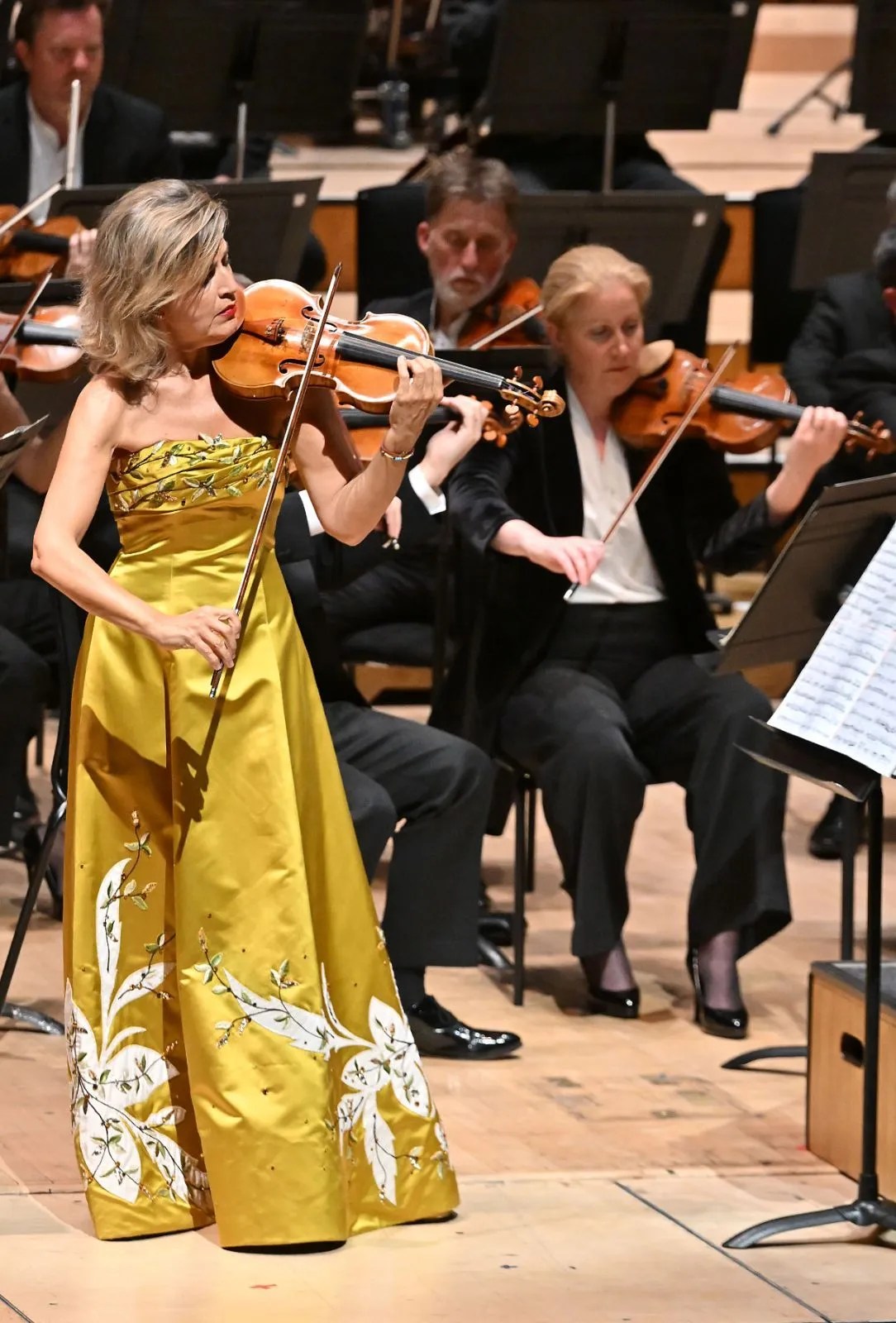
Anne-Sophie Mutter (below) has forged a pioneering path for contemporary music throughout her career, and added another dedication to an illustrious list that includes Lutosławski, Penderecki, Sir André Previn and Unsuk Chin. Air – Homage to Sibelius was written in the light of her admiration for Adès’ Concentric Paths, his Violin Concerto of 2005. It is a very different work indeed, an extended meditation based on a single melody written in the slow days of lockdown in 2021. In the execution Adès brought his music unexpectedly close to that of John Tavener or Arvo Pärt, the latter’s Cantus in memoriam Benjamin Britten recalled by the solemnly descending melody. Beginning on high with the orchestral violins, this was soon joined by Mutter’s silky-smooth tones. Now the piece developed with the soloist in charge, its serene progress tinged with longing. With no brass in the orchestra the textures were light, with tuned gongs suggesting a soft breeze, before the music gained weight on the gradual descent as though nearing the bottom of a mountain. The Sibelius homage could be determined in the line and structure of the piece, and also the rarefied light that it cast adrift.
Before the interval we heard Lutosławski’s Partita, written initially for violin and piano in 1984 but orchestrated for Mutter four years later. The word ‘partita’ is interpreted by Lutosławski in its 18th century form, and this work begins with a stern Allegro giusto that comes adrift when the soloist starts to use portamento, the melody travelling through microtones. Mutter’s control here was masterful, yet the feeling of dislocation was compounded. The central Largo was powerful indeed, the violin singing a darker song, before the closing Presto brought a terrific burst of energy, the colourful orchestration prompting and cajoling. Mutter’s voice, though, spoke the loudest.
The concert had begun with a relatively rare live account of Orpheus, the second of Stravinsky’s three Greek ballets. Thomas Adès directed a compelling performance of a work whose dynamic levels remain quiet for almost the entire half hour – yet contain music of acute description and poignancy. There is dread too, which Adès brought out in the scenes where Orpheus is surrounded by the Furies, then where he met his untimely demise at the hands of the Bacchantes. With the harp of Bryn Lewis treading a solitary, elegant line, Orpheus’ lyre remained as a ghostly presence right through to the end – in spite of the efforts of the Angel of Death, brilliantly voiced by violinist and orchestra leader Benjamin Gilmore.
The concert finished with the remarkable Agon, with which Stravinsky completed his Greek trilogy and indeed entire ballet output when premiered in New York in 1957. Even in his mid-70s the composer was pushing boundaries, this time in the direction of Schoenberg’s serial technique, without compromising his dramatic instincts. With no plot, Agon is essentially a celebration of movement, Stravinsky free to explore old dance forms through the prism of twentieth century harmony and melody, with remarkably imaginative instrumentation. This performance fully revealed its genius, the Renaissance and Baroque dances given a new lease of life with orchestration turned on its head. The colours were enhanced by mandolin (Huw Davies), harp (Bryn Lewis) and percussion (Neil Percy and Tom Edwards), not to mention the superb LSO brass, wind and string sections. Double basses got in on the act, playing high in the register, the weird and wonderful sounds given gruff harmonies and comedic punctuation as the ballet unfolded. Light and shade were exquisitely explored, the advantage of having a composer-conductor such as Thomas Adès at the helm meaning no stone was left unturned. This was a memorable interpretation, capping a wholly stimulating evening of music making.
You can find more information on further 2023/24 concerts at the London Symphony Orchestra website
Published post no.2,195 – Friday 31 May 2024
 Arcana.fm