Last week one of the most esteemed British conductors celebrated his 90th birthday. Sir Roger Norrington has been a prominent force in the classical music recording industry over the last 30 years. His interpretations are largely informed by historical performance practice – which is to see he and his forces look to recreate the music of the day.
Norrington’s interpretations have tended to divide critics as to their effectiveness, and his approach has been more provocative with music from the turn of the 19th century. To some extent the ‘marmite’ reception has come about because he has conducted symphonic music from the likes of Bruckner and Mahler. This ‘marmite’ reception has sometimes overshadowed the sheer commitment and enthusiasm he has demonstrated for the British musical cause, whether with the London Classical Players or latterly with the Stuttgart Radio Symphony Orchestra.
His recording achievements with the former include a notable Beethoven symphony cycle for EMI, energetic and brilliantly played, and some standout recordings of symphonies by Mozart and Schubert, together with a thrilling collection of Rossini overtures. In Stuttgart, Norrington reprised some of this work as well as going deeper into the symphonic tradition. Meanwhile with the London Philharmonic Orchestra he recorded an intriguing set of Vaughan Williams symphonies. Some of the highlights of these discs can be heard below:
Kieran Hebden has reached album number 12 under his Four Tet alias – released via his Bandcamp site on Friday 15 March.
It promises much, for Hebden has the freedom on his own Text Records to do what he wants. Will it show how he is continuing to develop as an artist? Come back to Arcana in the coming week or so to find out…
Published post no.2,102 – Wednesday 28 February 2024
One of jazz music’s strongest qualities is improvisation, and the way musicians are encouraged to speak with freedom and walk a tightrope, to see what they are capable of.
Such a statement can certainly be applied to these three musicians, who improvised this recording on the afternoon of their very first meeting. Dave Harrington contributes guitar and electronics, Max Jaffe looks after the drums and percussion while Patrick Shiroishi is the saxophonist, as well as contributing bells and tambourine.
What’s the music like?
Consistently engaging – and inventive with it. There are four longer form pieces here, and the shorter Ship Rock. Each finds the players fully engaged while the extra-long pieces are well structured, with imaginative changes of colour to aid the ebb and flow.
Staring Into The Imagination (Of Your Face) is immediately notable for Jaffe’s sensitive brush work and Shiroishi’s well-judged vibrato, the saxophone given a nicely poised solo. How To Draw Buildings is something of an epic that bursts with sonic invention, with smoky and psychedelic moods that feature some powerful, long notes on the sax.
Dance Of The White Shadow And Golden Kite has a great urgency, breaking out into manic episodes, while Harrington’s guitar shapes the start of Return In 100 Years, The Colors Will Be At Their Peak. This track is full of incident, becoming fractious as each instrument strives to be heard.
Does it all work?
Largely. With such an instinctive approach – and such little preparation time – it is a risk to open out the broad canvas in this way, but the musical chemistry is such that these three musicians succeed in their endeavours.
Is it recommended?
It is. There is fiercely passionate music to be heard here, and imaginative use of the colours available. Hopefully the trio will continue their musical quest, as it would be interesting to chart their ensemble work over a period of years, to see where it takes them.
For fans of…Jeff Parker ETA Quartet, Ben Monder’s Amorphae, Body / Head, 75 Dollar Bill
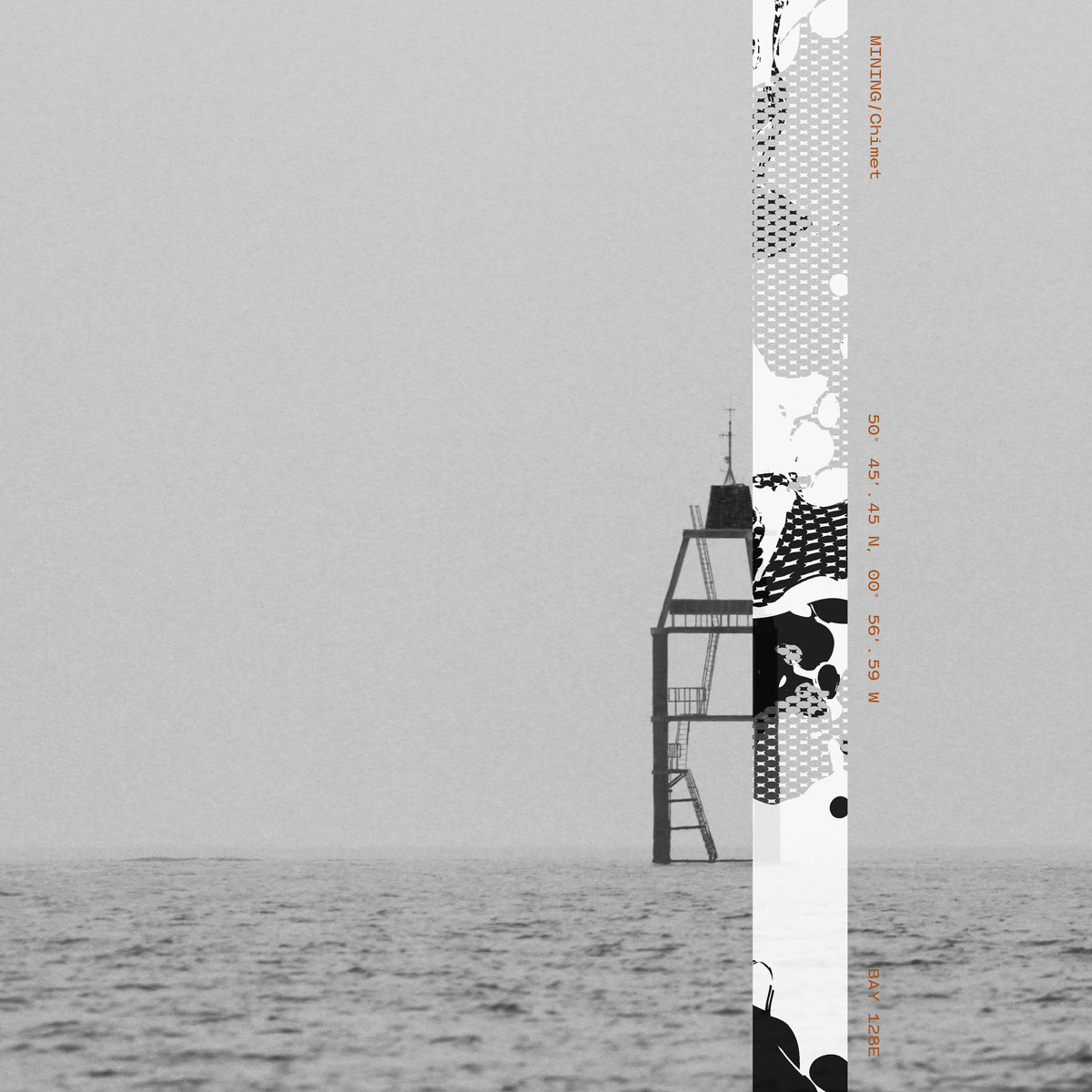
The story behind this remarkable album is best read through quotes from the MINING Bandcamp site and press release, as it bears repeating.
“Chichester West Pole Beacon, also known as Chimet, is a comprehensive weather information system recording conditions in Hayling Bay, West Sussex, both in real-time and historically. Located at 50° 45′.45 N, 00° 56′.59 W, approximately one mile from the entrance to Chichester Harbour, the instrumentation on Chimet records data including air and water temperature; barometric pressure; wind speed and direction; water depth; wave height, period and frequency; and time of day.
Over a period of seven days in October 2017, the devastating Atlantic Hurricane Ophelia fed straight into another weather event, known as Storm Brian in the UK. MINING mapped the data from this storm onto various musical values and parameters, including harmonic range, pitch, density and volume – resulting in a continuous piece of electronic sound design that directly traces the contours of the two storm systems. After several iterations, improvised instrumental performances were added on piano, cello and synthesiser.
The album was created using 2,016 sampled data streams, collected every five minutes between 0030 on October 16th 2017 and 0025 on the 23rd, translating seven days of information into 67 minutes and 12 seconds of detailed and evolving music. With mother nature orchestrating the piece, she is joined by intuitive and powerful improvisations on piano, cello and synthesiser. The recording captures the sense of building expectation and tension, the dropping air pressure, the rising winds, the interlocking storm systems and the serene aftermath. The shifts are seamless, monumental and open to the elements.”
MINING was conceived by Craig Kirkpatrick-Whitby, with sound design and programming from PJ Davy. The improvised contributions on piano, cello and Lintronics are all made by Matthew Bourne.
What’s the music like?
Intense, yet ambient at the same time. The circumstances of composition mean that Chimet is certainly best heard as an uninterrupted stream (pun intended), describing the weather activity in remarkable detail.
Yet the crowning achievement of this project is that in their work together, Craig, PJ and Matthew have made something that has deep emotional content. The sound ‘beds’ are effectively drones, slowly shifting in deep colours, over which Bourne is able to work some carefully thought improvisation.
Ophelia develops very slowly, over a quarter of an hour, but there is something immediately ominous about its approach. The synthesizers pile up, with the occasional intervention from the piano – with layers of notes in swirling harmony, before they gradually retreat. Petrichor poses more of an initial threat, the foreboding low synth sounds presenting a dark outlook, before the relative calm of Latent – a slow piano meditation – dispels the worry.
The central section starts with a piece depicting Chimet itself, the remoteness of the open water apparent in Bourne’s distant musings on the piano. Then, with Arise, a series of long cello notes provide a swell in the texture, moving seamlessly into the elongated Force 10 Pts. 1 & 2. Here the held notes feel bleaker, until the inexorable build that piles them up towards the sky, a regular ticking holding everything in place. There is a strong sense of the ravaged seas, of craft blown this way and that, but also Chimet standing tall throughout.
The epilogue, Debris, has a synthesizer motif depicting the aftermath, with matter falling back to earth and settling, the long note underneath held until it passes from audible range.
Does it all work?
It does. For such incredibly slow music to maintain this level of intensity is remarkable indeed, something few artists can achieve. The melodies may be minimal, but getting caught up in the sweep of the extended piece is inevitable.
Is it recommended?
It is – a proper musical experience that should be played from start to finish, so the listener can get the whole awe-inspiring weather events recreated in their own environment.
This handsomely packaged volume, published late last year, comes billed as ‘the first full-length history of a British period instrument orchestra’. That orchestra, the Academy of Ancient Music, was born just over half a century ago in a London pub not at all far from the Crown and Anchor on the Strand, where the original Academy of Ancient Music was formed in the 1720s.
What’s the book like?
Enlightening and thoroughly engaging – as are the musical performances and recordings that are discussed in its pages. Richard Bratby, one of the Academy’s ‘Hogwood Fellows’, is a compelling storyteller, fully qualified to put the events of the group’s formation in perspective with those around them.
First we have the ensemble’s formation, a helpful base illustrating the radical steps Christopher Hogwood, Decca record producer Peter Wadland and their associates were taking – all borne of enthusiasm for the music and a wish for scholarly respect and exploration.
As venues, record companies and sponsors switched on to the benefits of the ensemble’s existence a whole new movement was formed in front of their eyes. This, the ‘period instrument’ movement, gathered pace at a striking rate in the 1970s and 1980s, where concertgoers and record / CD buyers were compelled to consider accounts of Handel, Mozart, Bach, Vivaldi and their contemporaries as they would have been experienced by audiences of the day.
Bratby tells of the Academy’s trailblazing cause, soon followed and challenged by rival ensembles, almost all to the good of Western musical life – and occasionally Eastern, thanks to the orchestra’s ambitious touring schedule – and the classical recording industry. Not everyone shared the enthusiasm of Hogwood and his charges, and there is a convincing inspection of the critical fallout and opposition, from Richard Taruskin in particular.
At every turn, Christopher Hogwood emerges as the character whose genial but passionate demeanour is the fulcrum on which the Academy turns, the spur behind the scholarly work with a public face. Even a BRIT award heads the Academy’s way! Wadland, too, is suitably credited for his part in the ensemble’s success, with a string of now legendary recordings detailed from the first – Overtures by Thomas Arne in 1974, to the more recent, imaginative offerings of Handel’s Brockes Passion and Dussek’s Messe Solemnelle on the ensemble’s own label. How the industry has changed in that time!
Does it all work?
At every turn. The wealth of authoritative sources gives the book real substance, and their input is judiciously managed. The ‘back office’ staff get the platform and credit they deserve, too, their valuable insight a reminder of the difficulties orchestras face from day to day. The impact of the Coronavirus pandemic is keenly felt, in what must be the first book of its kind to detail the impact of lockdown on every aspect of musical life.
The players, too, get their due credits – and there are frank and often amusing tales of life on tour and in the studio. What comes through more than anything is the love of the great music the group are performing and recording, and the desire to make these new interpretations available.
The only slight pang is the lack of a full discography, which would have helped illustrate just how hard these musicians and their colleagues worked to bring us symphonic cycles by Mozart, Beethoven and – almost – Haydn. To get that idea, however, the ensemble’s Discogs page has the vast majority of their recordings listed.
Is it recommended?
Heartily. Refiner’s Fire does what the best books on music should do – and has you scuttling for the stereo to bring the music off the page. When you do, you will realise just what an important part the Academy of Ancient Music have played – and continue to play – in how we now hear the music of the past.
Listen and Buy
To stress the points above, here is a playlist of just some of the recordings mentioned in the book:
Finally, a disclaimer – as the author of this review I can confirm I am (unfortunately!) not related to Christopher Hogwood. It is a question I am often asked, being also from the East of England!





 Arcana.fm