Unknown's avatar

About Arcana

My name is Ben Hogwood, editor of the Arcana music site (arcana.fm)

In concert – Orchestra of the Age of Enlightenment: Bach Brandenburg Concertos @ Queen Elizabeth Hall

Orchestra of the Age of Enlightenment

J.S. Bach
Brandenburg Concertos:
no.1 in F major BWV1046 (dir. Huw Daniel)
no.3 in G major BWV1048 (dir. Margaret Faultless)
no.5 in D major BWV1050 (dir. Margaret Faultless)
no.4 in G major BWV1049 (dir. Huw Daniel)
no.6 in B flat major BWV1051 (dir. Oliver Wilson)
no.2 in F major BWV1047 (dir. Rodolfo Richter)

Queen Elizabeth Hall, London
Wednesday 13 November 2024

Reviewed by Ben Hogwood Pictures (c) Mark Allan

The music of Bach proves a great source of consolation for many in uncertain times, and the underlining feeling from this packed concert was that the Orchestra of the Age of Enlightenment had offered just that, deep into their tour of the great master’s complete Brandenburg Concertos.

The six concertos, written for a variety of instrumental ensembles, were published just over 300 years ago in 1721 and sent to Christian Ludwig, Margrave of Brandenburg. In a crowded field, they have become one of Bach’s best-loved groups of works, and although they were not designed to be played together they respond extremely well to a concert such as this.

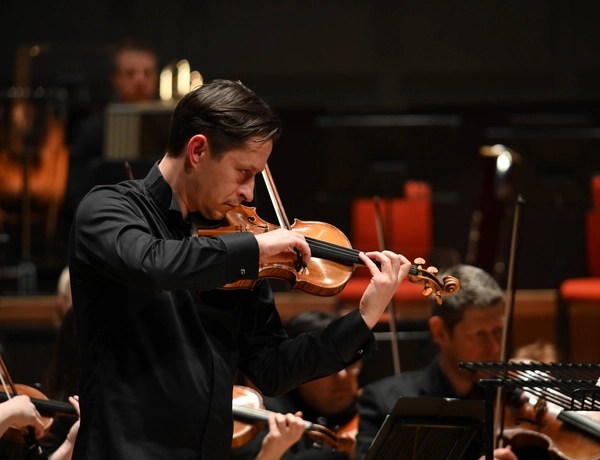
It is difficult to imagine a better set of performances than those given by the OAE, playing without a conductor in the spirit of the compositions, assigning the direction of each concerto to the uppermost string player. The program was introduced with a spark by violinist Margaret Faultless, whose enthusiastic demeanour set the tone for the evening. As the notes of the Brandenburg Concerto no.1 in F major lifted off the page Bach’s inspiration was immediately apparent, like walking into a room of animated conversation. The horns of Ursula Paludan Monberg and Martin Lawrence were front and centre, pointed aloft in a necessary but striking pose. The balance between the 13 players was ideal, not just in the busy first movement but in the emotive Adagio, led by the beautiful tones of oboe trio Clara Espinosa Encinas, Sarah Humphrys and Grace Scott Deuchar. Yet the horns took centre stage, powering the bright Allegro, before a perky series of Menuetto dances were bisected by a bracing second trio.

One of the many joys of the concert was the different sonorities of each piece, which changed to nine string instruments for the Brandenburg Concerto no.3 in G major. This had the requisite spring in its step for the quicker outer movements, especially the jovial dialogue of the third. Meanwhile the ensemble elaborated on Bach’s two written chords that make up the slow movement, where the focus was on violin (Faultless) and harpsichord (Steven Devine) Their tasteful improvisations were an ideal foil.

Completing the first half was the Brandenburg Concerto no.5 in D major, in effect an early keyboard concerto. The seven players were positioned closer to the audience, allowing greater intimacy and the chance to appreciate some of the wondrous sequences in the first movement. Taking the lead here were flautist Lisa Beznosiuk, who recorded the concertos with the orchestra back in 1987, alongside Faultless and Devine. They delivered a sublime Affettuoso second movement, a moment of reflection from the fast movements where Devine was a revelation, his virtuosic brilliance never too showy even in the trickiest of cadenzas.

To begin the second half of the concert the mellow sonorities of the recorders took the lead in the Brandenburg Concerto no.4 in G major, with beautiful clarity achieved by Rachel Beckett and Catherine Latham. Violinist Huw Daniel mastered the busy figuration of his part with considerable flair, while the poise of the accompanying ensemble was consistently satisfying. This concerto is deceptively forward looking, with pointers towards Beethoven in the slow movement, which here benefited from the weighty support of viola da gamba (Richard Tunnicliffe) and double bass (Cecilia Bruggemeyer), both ever presents through the evening. The pugnacious finale, with one of Bach’s many earworms, was great fun in the hands of these nine players.

The colours darkened appreciably for the Brandenburg Concerto no.6 in B flat major, whose highest instrument is the viola. Bach’s scoring here is remarkably inventive, and was brought to life as Oliver Wilson led a fluent account of the first movement. The violas showed their versatility as melody instruments in the reduced scoring of the Adagio, reduced from seven to four players and enjoying its elegant dance-like figurations, before the syncopations of the Allegro were winningly delivered.

Finally the Brandenburg Concerto no.2 in F major was a suitably upbeat piece on which to finish, with soloist David Blackadder – having waited an hour and a half to play – enjoying his moment on stage. He made the trumpet line look – and sound – straightforward, when with this instrument it is anything but! Again the balance was carefully wrought, so that the intricate violin contributions of director Rodolfo Richter could be clearly heard. A lightness of touch from the 11 players brought the phrasing of the Andante to life, with some typically spicy harmonies stressed, before the brilliant colours of the closing Allegro assai, and a celebratory closing statement.

It was a treat to hear the six Brandenburg Concertos presented in this way, a reminder that – in the words of Huw Daniel – these concertos deserve to be the centre of attention. The humming of the audience afterwards was testament to their lasting appeal, 300 years on.

You can listen to the Orchestra of the Age of Enlightenment’s recordings of the Brandenburg Concertos from 1987-88 for Virgin Classics below:

Published post no.2,362 – Thursday 14 November 2024

Switched On – GLOK / Timothy Clerkin: Alliance (Bytes)

by Ben Hogwood

What’s the story?

Andy Bell’s GLOK alias has given him a burst of creativity within electronic music – and after his successful Dissident album of 2019 and Pattern Recognition follow up of 2021, he turns to a collaborative approach.

Timothy Clerkin, who runs the Insult To Injury label, met Ride guitarist Bell through the Bytes label, when they suggested Tim be part of the Dissident Remixed album, which was put together in 2019. The two met at the funeral of Andrew Weatherall, and their collaboration was fuelled by Tim finding and playing an old Les Paul guitar. Ideas were traded online between Amsterdam (Tim) and London (Andy), with the instruments equally shared.

What’s the music like?

Empowering. That’s the first feeling that comes through on Empyrean, where subtle adjustments in tuning give the weighty guitar sound an appealing weirdness, and the loping beats add reassuring depth. The same pitch variations work really well on the gritty AmigA, with the bass sound burrowing through the floor, before wordless vocals that instantly transport the listener back to the heady mood of early ‘90s Manchester.

Bell and Clerkin also make groovy music, using slower rhythms that really set themselves firmly on the floor, with rich colours above. Scattered is one of the more obvious pieces of Weatherall homage here – in a good way, while The Witching Hour goes acidic with all sorts of electronic squiggles taking over. Closing out is the brilliant E-Theme, a kind of Hacienda-Detroit meeting place where airy synths complement blissful vocals.

Nothing Ever is the home banker, with vocals from Du Blonde – aka Beth Jeans Houghton, adding a rich tone to the electro-disco footwork underneath.

Does it all work?

It does – and repeat listens reveal several earworms. Once made known, they refuse to leave!

Is it recommended?

It is indeed. This is a fruitful partnership, blessed with freedom and enjoyment – and proves to be a slow burner that increases in temperature with each listen!

For fans of… Death In Vegas, Andrew Weatherall, 808 State, Stereo MCs, Primal Scream

Listen & Buy

You can explore buying options on the Bandcamp link below – and also read Arcana’s extensive interview with Andy from 2019, when he was not long starting out under the GLOK alias.

Published post no.2,361 – Wednesday 13 November 2024

Switched On – Mirror System: Route 77 (A-Wave)

by Ben Hogwood

What’s the story?

Mirror System is the ambient sibling of System 7, the beat-driven electronic music project headed by husband-and-wife team Steve Hillage and Miquette Giraudy. The duo, who have previous as part of the famed progressive group Gong, have been working together on the project since the early 1990s, and the release of this album fits a pattern of a new Mirror System album every nine years.

As with a number of the duo’s previous albums, Route 77 is inspired by travel – and includes on its journey a couple of intriguing cover versions, Ry Cooder’s Paris, Texas and Manuel Göttsching’s Sunrain.

Don Donovan adds keyboards and effects to Bocca du Lupo, while The Orb’s Alex Paterson adds extra production to Shapes Of Things and Camel Hot. Meanwhile Sonora Desert Edge (The Abyss) includes a poem by Allen Ginsberg.

What’s the music like?

Rich in incident and colourful – but ambient at the same time. Route 77 does indeed fulfil its promise to take the listener on a journey, though while it implies a coastal odyssey in America, there is a strong Eastern flavour to a good deal of the writing here.

Avenue of Lights as good as anything the duo of Hillage and Giraudy have done under this moniker, coming as it does after the intriguing Ry Cooder cover. Often there are heat-soaked promises of far-off lands, such as in Sunrain, which shimmers with a good deal of minimalist chatter. Shapes Of Things gets a great beat up and running, no doubt under the direction of Alex Paterson – but has a frisson of danger about it. These sleights of mood make the album ever more compelling, though still ambient.

Does it all work?

It does. Repeated listening brings more melodic elements to the surface, while the heady atmospherics cast a spell that will be familiar to System 7 fans.

Is it recommended?

Wholeheartedly. Hillage and Giraudy have lost none of their melodic charm in the 30 years they have been making electronic music together, and Route 77 reveals that they have just as much appetite for making new music. It’s as good as anything they’ve done.

For fans of… The Orb, Fluke, Leftfield, Eat Static, The Art of Noise

Listen & Buy

Published post no.2,360 – Tuesday 12 November 2024

In concert – CBSO Strings / Eugene Tzikindelean: Bach: Goldberg Variations

City of Birmingham Symphony Orchestra Strings / Eugene Tzikindelean (above)

J.S. Bach arr. D. Sitkovetsky Goldberg Variations BWV988 (c1740)

Town Hall, Birmingham
Sunday 10 November 2024, 3pm

Reviewed by Richard Whitehouse Picture (c) Beki Smith

Having already made his mark other than as leader of the City of Birmingham Symphony Orchestra with his performances in recent seasons of concertos by Nielsen and Walton, Eugene Tzikindelean this afternoon directed the orchestra’s strings in a performance of Bach’s Goldberg Variations.

First published 323 years ago, the ‘Goldbergs’ launched the series of works from Bach’s final decade in which formal and technical procedures take on an almost arcane dimension, though this music is always realizable in practical terms whatever its abstraction. Taken up by leading virtuosos in the wake of Liszt, notably Busoni who fashioned his ‘concerto without orchestra’ in 1914, it became synonymous with Glenn Gould whose 1955 recording launched his career internationally as surely as it established Bach’s work in the minds of listeners the world over.

More recently the variations have been arranged for a variety of media, among which that by the violinist Dmitry Sitkovetsky has become among the most familiar – firstly as realized for string trio in 1984, then for string ensemble eight years later. The question as to how large a body of strings is left to the musicians: the present account amounted to 38 players including harpsichord, ideal for the acoustic of Birmingham Town Hall and what was a commendably sizable house. Not the least attraction of this arrangement is the skill with which Sitkovetsky has translated the timbral and textural possibilities of the harpsichord original, such that they sound entirely idiomatic in this context as well as capable of a variety of interpretive nuance; with this aspect proving crucial to the overall persuasiveness of the performance heard here.

The duration of the ‘Goldbergs’ can vary widely, according to just how many of the first-half or second-half repeats of its 30 variations are taken. Those anticipating an account around 78 minutes (given in the programme) might have been disconcerted with the hour-long rendition that resulted, but Tzikindelean’s approach in this respect was wholly consistent in placing the emphasis on those variations which mark strategic formal and expressive junctures. Thus the 15th with its starkly fatalistic aura; the 25th, described by harpsichordist Wanda Landowska as the ‘‘black pearl’’ and an adagio of simmering emotional charge; then the 30th, unfolding as a ‘quodlibet’ of popular melodies which seems intent on countering any previous austerity as it builds to a culmination where the Aria da Capo can bring the whole concept full circle.

Such was certainly true of this superbly realized reading, directed by Tzikindelean with that combination of focus and spontaneity as characterizes his work as leader. It would be wrong, moreover, not to single out those other section-leaders whose contributions were hardly less vital to its success – hence second violinist Lowri Porter, violist Chris Yates, cellist Bozidar Vukotic and double bassist Anthony Alcock; Martin Perkins was a lively continuo presence who enhanced successive variations without ever interposing himself on the overall sound.

A fine demonstration of the collective prowess of the CBSO strings, and there will be similar opportunities to hear the orchestra’s woodwind then brass and percussion at Sunday afternoon concerts in January and March next year, which will hopefully prove to be just as memorable.

For details on the 2024-25 season A Season of Joy, head to the City of Birmingham Symphony Orchestra website. Click on the names to read more about violinist Eugene Tzikindelean and arranger / violinist / conductor Dmitry Sitkovetsky

Published post no.2,359 – Monday 11 November 2024

Switched On – Soela: Dark Portrait (Scissor & Thread)

by Ben Hogwood

What’s the story?

Russian-born and Berlin-based, DJ and producer Soela (Elina Shorokhova) moves to Scissor & Thread for Dark Portrait, an album that represents her response to the impact of the war in Ukraine.

With previous releases for Kompakt, Dial and Shall Not Fade, Soela is well established as a producer on the darker side of electronica, utilising her background as a classical pianist. Over its nine tracks Dark Portrait brings in an impressive guestlist, a combination of instrumental and vocal.

What’s the music like?

Soela’s tracks are carefully thought out and subtly coloured, but carry profound meaning. The tone is set by Unsuitable, a quiet and thoughtful piece of music with inward looking vocals. Through The Windows is also quiet but Francis Harris and Philipp Priebe bring presence, the subtle night-time rhythms making themselves known. Module One’s guest slot, Drowning, adds atmospheric beats and smudges of sound, while Dark Portrait itself has a semi-trancey approach.

The music hovers between deep house, dub and trip hop – but February Is Not Going To Be Forever, featuring Lawrence, has more explicit movement. The most meaningful track is left until last. The Darkest Hour Before Sunrise goes deep, with an especially evocative portrait of that special time of the day, bringing a balance to the end of the album that offers a peaceful outcome.

Does it all work?

It does – though turning up the volume on headphones will help appreciate the more subtle moments Soela finds on the album.

Is it recommended?

It is. Carefully considered and deep, this is a serious but successful foray into the darker side of electronica.

For fans of… Henrik Schwarz, Efdemin, Dani Siciliano, Matthew Herbert

Listen & Buy

Published post no.2,358 – Sunday 10 November 2024