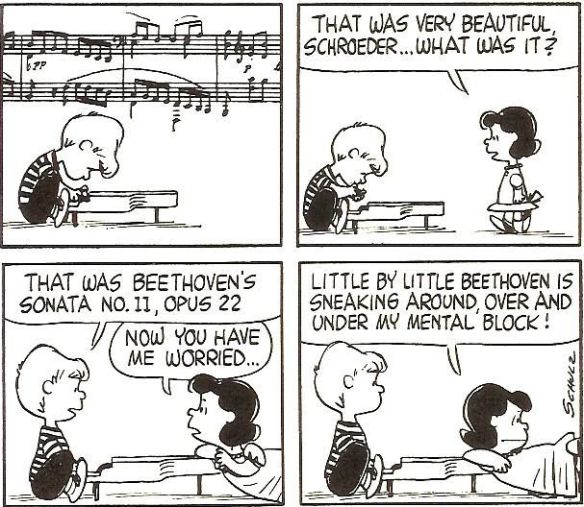
Peanuts comic strip, drawn by Charles M. Schulz (c)PNTS
Man strebt, die Flamme zu verhehlen WoO 120 for voice and piano (1802, Beethoven aged 30)
Dedication Johanna von Weissenthurn
Text Johanna von Weissenthurn
Duration 2′
Listen
Background and Critical Reception
Beethoven dedicated his song Man Strebt, die Flamme zu Verhehlen (One strives to conceal the flame) to Johanna Franul von Weissenthurn, an actress, poet, and playwright active in Vienna beginning in 1789.
Charles Petzold, in his Beethoven 250 series, sets the song in a good deal of context here, revealing a little more about the elusive Frau Weissenthurn in the process.
Thoughts
Given that this song only lasts just over two minutes, it has an unusually elaborate introduction from the piano – maybe part of Beethoven’s portrait-setting?
When the voice enters it sounds preoccupied, and the piano responds again. Translated, the text talks of how ‘a glance says more than a thousand words…a glance will often unbolt the door of passion long concealed. The voice seems to be portraying the glance, the piano more intent on opening the door with its florid right hand.
12 Contredanses, WoO 14 for orchestra (1791-1802, Beethoven aged 30)
no.1 in C major no.2 in A major no.3 in D major (with Trio) no.4 in B flat major no.5 in E flat major (with Trio) no.6 in C major (with Trio) no.7 in E flat major no.8 in C major no.9 in A major no.10 in C major (with Trio) no.11 in D major no.12 in E flat major (with Trio)
Dedication not known Duration 9′
Listen
Background and Critical Reception
Very little is written about this set of 12 country dances, though they appear to have sat on the back burner for some time, Beethoven having begun them 11 years ahead of publication in 1802.
Daniel Heartz notes a crossing-over of material between these dances and the music for The Creatures of Prometheus, with a reference to ‘the composer’s favourite dance tune’ in no.7, which appears in the ballet as the Finale.
All have attractive, ‘one-off’ themes – but given their brevity there is little to no chance for development of the tunes in a minute or 30-second slot.
Thoughts
The music is bright and simple, and full of melody. There are two ideas in the first dance, which sets the scene with a spring in its step. The second hints at a minor key but has warm-hearted chords in the woodwind. The third is quite brisk, before the fourth moves to B flat major – Beethoven becoming a little more adventurous in this genre with his choice of key.
Beethoven makes a lot of simple themes from the notes of the triad, the fifth dance in E flat major providing a good example of how to construct from simple building blocks. This one is longer, allowing for the clarinet to come forward for a simple second theme. The elegant seventh dance has offbeat woodwind, before the most striking dance, the eighth, with castanets helping let the hair down! There is a similar energy to the ninth, with both gone in a flash – before offbeat emphasis in the eleventh. The final dance is the longest, giving more room for the horns and full orchestra, while lingering on the main theme.
Recordings used
Philharmonia Hungarica / Hans Ludwig Hirsch (Warner Classics) Berliner Philharmoniker / Lorin Maazel (Deutsche Grammophon) Academy of St. Martin-in-the-Fields / Sir Neville Marriner (Philips) Orchestra of St. Luke’s / Michael Tilson Thomas (Sony Classical)
There is quite a coarse sound to the Philharmonia Hungarica violins in the Warner recording, which shows its age a little – but not the full Lorin Maazel version. Sir Neville Marriner conducts a typically light hearted version, as does Michael Tilson Thomas, fusing the short dances together effectively.
You can chart the Arcana Beethoven playlist as it grows, with one recommended version of each piece we listen to. Catch up here!
Also written in 1802 Cambini– Wind Quintets nos. 1-3
Next up Man strebt, die Flamme zu verhehlen WoO 120
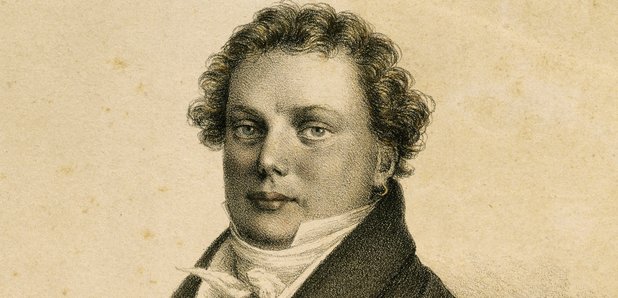
Violinist Ignaz Schuppanzigh, the subject of this song
Lob auf den Dicken(Schuppanzigh ist ein Lump), WoO 100 for tenor, two basses and choir (1801, Beethoven aged 30)
Dedication Ignaz Schuppanzigh
Text Beethoven
Duration 40″
Listen
Background and Critical Reception
This is the first appearance of a musical joke in Beethoven’s output – and one of the first pieces for unaccompanied choir we have encountered. Many of the jokes are from the composer himself – with Lob auf dem dicken Schuppanzigh (Praise to the fat Schuppanzigh) no exception.
It does exactly what it says on the score, taking the mickey out of one of Beethoven’s few lifelong friends, violinist Ignaz Schuppanzigh. ‘We all agree that you are the biggest donkey’, runs the text, affectionately taunting the man who was to take part in the premieres of all three string quartets dedicated to Count Razumovsky, Schubert’s Rosamunde string quartet and Beethoven’s Ninth Symphony, where he led the orchestra.
It seems Beethoven’s friend was thick skinned in more ways than one.
Thoughts
This is definitely one of those songs where the humour is ‘of its time’ – and it certainly helps to have the text to hand when following it. It would be good to know how Schuppanzigh received Beethoven’s humour, as otherwise it feels rather awkward.
It is a tiny musical postcard, showing off the composer’s humour, while giving a hint that composing was something he did in his sleep and that his confidence was high enough to write like this in public. There will be more jokes and send-ups as time goes on…
Recordings used and Spotify links
Cantus Novus Wien / Thomas Holmes (Naxos)
Kammerchor der Berliner Singakademie / Dietrich Knothe (Brilliant)
A full-throated Berlin version – and a light-hearted new recording on Naxos. Both work well.
Spotify links
A playlist of four different versions of the Op.48 Lieder can be found here:
Also written in 1801 Zelter 12 Lieder am Clavier zu singen Z122
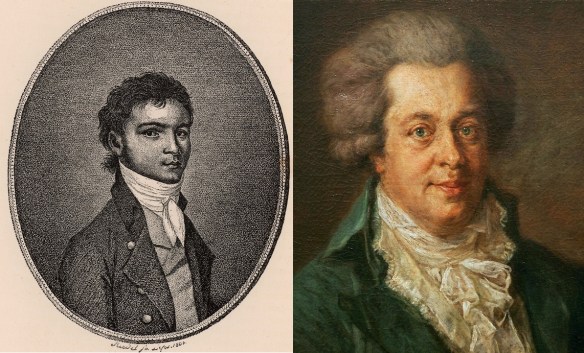
Ludwig van Beethoven and Wolfgang Amadeus Mozart (right, in a portrait by Johann Georg Edlinger)
12 Variations on ‘Ein Mädchen oder Weibchen’ from Mozart’s Die Zauberflöte Op.66 for piano and cello (1796, Beethoven aged 26)
Dedication Count Johann von Brown-Camus
Duration 9′
Listen
What’s the theme like?
The theme is a duet from Act 1 of Mozart‘s opera Die Zauberflöte (The Magic Flute), between the characters Pamino and Papageno, as below. It is an attractive tune in triple time, shared between the piano and cello in its higher register.
Background and Critical Reception
This set of variations is the third and last from Beethoven for piano and cello – and the second to use a theme from Mozart’s Die Zauberflöte. The inspiration is thought to have been two new productions of the opera appearing in Vienna in 1801. Steven Isserlis notes that despite its equal writing for both instruments, the first edition of Beethoven’s new work ‘fails to even mention the cello on its title page: pianistic chauvinism’.
This is all the stranger given the cello’s elevated role in Beethoven’s writing. As Misha Donat observes, writing for Philips’ recording by Heinrich Schiff and Till Fellner, ‘for the first time the two players are treated very much as equals. Their equality is inherent in the theme itself, which is laid out in such a way that the piano takes the part of Pamina, and the cello the answering voice of Papageno.
Isserlis takes the variations ‘depict various aspects of romance – from excited gossip to lofty ardour’. Marc D. Moskovitz and R. Larry Todd, in their wonderful book Beethoven’s Cello, observe how the fourth variation travels through the ‘parallel, though remote and rare, key of E-flat minor’, and Beethoven ‘reaches for the extremes’, the piano in its high register and the cello down low. Then, the three final variations ‘further deconstruct Mozart’s theme’, the last with a coda.
Thoughts
As the authors observe, Beethoven is bringing his ‘duo’ works to an ever more even keel. The theme here is a case in point, piano and cello united in their sharing of melodic material, and some effortless dialogue. Soon Beethoven is working through a busy second variation, before spicing up the melody with some chromatic additions. The questions and answers between the instruments continue, before the striking fourth variation in the minor key – tricky tuning for the cello here!
The two instruments have a lot of fun, finishing each other’s sentences in the fifth variation. Variation 6 is a florid affair, first for piano then cello, before the substantial finale, with the exuberant interplay of its coda – which also goes on a forceful excursion into the minor key. On the music’s return ‘home’ there is a bit more sparkling interplay before the two instruments sign off convincingly.
Recordings used and Spotify links
Adrian Brendel (cello), Alfred Brendel (piano) (Decca) Mischa Maisky (cello), Martha Argerich (piano) (Deutsche Grammophon) Miklós Perényi (cello), András Schiff (piano) (ECM) Steven Isserlis (cello), Robert Levin (fortepiano) (Hyperion) Nicolas Altstaedt (cello), Alexandre Lonquich (piano) (Alpha)
The Spotify playlist below includes all but one of the versions listed above – with the opportunity to hear a clip from Steven Isserlis and Robert Levin’s version on the Hyperion website
All versions are excellent, with operatic flair in evidence from Perenyi and Maisky. Once again though it is Robert Levin and Steven Isserlis who get to the heart of the piece and the enjoyment it can provide.
Also written in 1801 WoelflDuo for cello and piano Op.31
Peanuts comic strip, drawn by Charles M. Schulz (c)PNTS
6 Lieder von Gellert Op.48 for voice and piano (1801, Beethoven aged 30)
1 Bitten
2 Die Liebe des Nächsten
3 Vom Tode
4 Die Ehre Gottes aus der Natur
5 Gottes Macht und Vorsehung
6 Busslied
Dedication not known
Text Christian Fürchtegott Gellert
Duration 14′
Listen
Background and Critical Reception
Although Beethoven was enjoying a fierce period of creativity in his compositions, his health was suffering – and in particular his hearing. This cycle of six Gellert settings captured his state of mind at the realisation that his loss of hearing may well be temporary.
Jan Swafford feels the anguish in songs whose roots go back several years. ‘That Beethoven turned to the artless North German piety of these poems, and set them in a style more interested in declaiming the words than in waxing lyrical, is another indication of his state of mind’, he writes. ‘If doctors could not help him, maybe God could, at least in giving him consolation. These song come from the heart of his anguish and incipient depression.
The texts are revealing, perhaps nowhere more so than the third song Vom Tode, with its line ‘Meine Lebenszeit verstreicht, Stündlich eil ich zu dem Grabe (My life is ending and with each hour I move swiftly to the grave)’.
This is followed by two hymns of praise, before an expansive final song Busslied which explores both sides of the ‘argument’.
Thoughts
The deeper emotion Beethoven has been investing in his instrumental pieces can also be keenly felt in these six settings.
The music of Bitten, in a pure C major, offers a kind of cold and rather downcast consolation, the poet (and composer) contemplating their fate. The tone of Die Liebe des Nächsten, however, is upward looking, and more than a little operatic, the piano answering the voice as a Handel orchestra might have done.
Vom Tode itself has a very hollow ring, and is a sombre affair indeed, one of Beethoven’s most moving songs – and we can surely allow him the exploration of his fate. In the wake of such an empty song, deep in the minor key, Die Here Gott also sounds a little hollow in spite of its status as a genuine hymn of praise. The musical language remains stern, but when Beethoven switches to the major key it becomes genuinely exultant, with massive peals from the piano at the close. Gottes Macht is very much in the same vein, all about strength and power – and here the stance is a Handelian one too.
Busslied is an epic in comparison to these shorter settings, as long as the previous three songs put together. It starts in very withdrawn fashion but moves to a more positive outlook, with a hymnlike melody in the voice. The piano scampers to keep up, turning in some particularly athletic counterpoint.
This is a side of Beethoven we have not yet seen in the vocal music, a deeper and more personal expression which seems more suited to the world of the Lied than the stage. It is a private and rather moving 15 minutes spent with a composer whose physical ailments were destined to challenge him greatly, but ultimately not to overcome his fierce will to compose.
Recordings used
Dietrich Fischer-Dieskau (baritone), Hartmut Höll (piano) (Warner Classics) Hermann Prey (baritone), Leonard Hokanson (piano) (Capriccio) Roderick Williams (baritone), Iain Burnside (piano) (Signum Classics) Matthias Goerne (baritone), Jan Lisiecki (piano) (Deutsche Grammophon)
These are four really excellent versions, from the ‘old-school’ and imperious approach from Hermann Prey and Dietrich Fischer-Dieskau to the newer versions from Roderick Williams and Matthias Goerne. Goerne is especially fine here in his new recording with Jan Lisiecki, finding a moving and reverent stillness in the slower songs and tempering the exuberance of the hymns of praise. Roderick Williams phrases Vom Tode beautifully, with a deliberately flatter tone (not pitch) to the voice.
Spotify links
A playlist of four different versions of the Op.48 Lieder can be found here:
Also written in 1801 HaydnThe Spirit’s Song Hob.XXVIa:41
Next up7 Variations on ‘Bei Männern, welche Liebe fühlen’