Entwurf Beethoven-Gedenkmünze 1970 (5 Deutsche Mark)
Draft for a Beethoven commemorative coin for 5 Deutsche Mark, 1969 – Photograph of an unmarked model (picture courtesy of the Beethovenhaus, Bonn)
Allemande in A major WoO 81 for piano (1793-1822)
Dedication not known Duration 1’30”
Listen
written by Ben Hogwood
Background and Critical Reception
Some of Beethoven’s smaller pieces for piano have a very broad date margin. This Allemande is a case in point, given a composition date of 1793-1822 – the final date indicating a possible revision in his attempt to place it in the set of 11 Bagatelles Op.119. It is placed here to complement the Bagatelle we explored yesterday.
Writing the booklet notes for Ronald Brautigam’s recording, Roeland Hazeldonk talks of the ‘vast number of sketches he (Beethoven) had accumulated since before his arrival in Vienna’. There are many more of those for us to enjoy over the coming instalments.
Thoughts
The Allemande is a flowing piece with an easy temperament. Its florid right hand and relatively static left suggests a kind of etude, though the mood changes with Beethoven slips seamlessly into the minor key, and a more obvious dancing rhythm. After this brief shadow, the flowing music returns and all is well again.
Recordings used and Spotify playlist
Ronald Brautigam (BIS) Gianluca Cascioli (Deutsche Grammophon) Martino Tirimo (Hänssler)
Ronald Brautigam enjoys the expanse of the major key section, while Gianluca Cascioli is very brisk indeed with his tempo choice, wrapping everything up in just over a minute. Martino Tirimo is very easy going, and in his hands the minor-key central section becomes an elegant dance.
You can chart the Arcana Beethoven playlist as it grows, with one recommended version of each piece we listen to. Catch up here!
Next upPiano Sonata no.21 in C major Op.53 ‘Waldstein’
Commemorative medal for Ludwig van Beethoven – Gold-plated bronze medal from the BH Mayer foundry based on a design by Rudolf Mayer, Pforzheim, 1903 (picture courtesy of the Beethovenhaus, Bonn)
Bagatelle in C major WoO 56 for piano (c1803-4, Beethoven aged 33)
Dedication not known Duration 2’45”
Listen
written by Ben Hogwood
Background and Critical Reception
Although Beethoven published a 24 bagatelles in collections through his life, beginning with the seven published as Op.33 in 1802, there were a number of short pieces that did not get as far as publication. They reveal something of the composer’s sketchpad, and some of the directions in which he was experimenting.
Bryce Morrison remarks briefly in his Chandos booklet note that the piece is ‘less interesting’, but Keith Anderson, writing for Naxos, observes that ‘the undated Bagatelle is a curiously capricious little piece, with its imitative entries and sudden whimsical shifts of key’.
Thoughts
Beethoven’s Bagatelles are never without incident, and though to the untrained observer a Bagatelle in C major would seem to be something of a routine encounter, this is far from the case.
The music starts with Beethoven lost in thought, and the implication is that a fugal exercise is about to begin, albeit one with a chromatic melody. This breaks off in mid-phrase, and the music restlessly moves around in search of a key, the left hand wandering off and having to be brought back into line. The ending resolves happily enough in C major, but there is a distracted feeling to this particular Bagatelle.
Recordings used and Spotify playlist
Jenő Jandó (Naxos) Mikhail Pletnev (DG) Ronald Brautigam (BIS) John Lill (Chandos)
Beethoven bagatelles encourage experimentation among pianists, and comparing the versions from Mikhail Pletnev, Ronald Brautigam and John Lill is very instructive. The first two are quick, while Lill gives a thoughtful account. Brautigam has plenty of air to fill in his reverberant recording, while the Jenő Jandó version shares a track with the Presto in C minor – the Bagatelle itself beginning at 4’13”.
You can chart the Arcana Beethoven playlist as it grows, with one recommended version of each piece we listen to. Catch up here!
“Tremate, empi tremate”, Op.116 for soprano, tenor, baritone and orchestra (1803-4, published 1814. Beethoven aged 33 at time of composition)
Dedication Not known Text Niccolo Bentini Duration 9′
Listen
by Ben Hogwood
Background and Critical Reception
A dramatic trio for three vocal soloists and orchestra, Tremate, empi, tremate has its origins in Beethoven’s lessons with Salieri. It is thought Beethoven drafted the work early on in 1802, but it did not receive a first performance for quite some time. It was scheduled for April 1803, but that concert became full of new works such as the first two symphonies, the Piano Concerto no.3 and Christ on the Mount of Olives. The première of the trio finally occurred several years later during a similarly large concert on 27 February 1814, alongside the Seventh and Eighth Symphonies and Wellington’s Victory. Nicholas Marston’s note for Hyperion tells us that the vocal parts were sung by the star soprano Anna Milder-Hauptmann (Beethoven’s first Leonore), Giuseppe Siboni and Carl Weinmüller, who created the role of Rocco in Fidelio.
Salieri is likely to have suggested the text – Tremate, empi, tremate translating as Tremble, guilty ones, tremble – and which tells a turbulent love story. Soprano Chen Reiss, interviewed for Arcana, talked about the piece. “It reminded me a little of the trio in Fidelio with the Father and the two lovers. Marzelline is thinking that Fidelio is a man, and she’s in love with him, and the father basically gives his blessing. It is of course a different story altogether, but the ending is very dramatic. I think it’s a very good piece to perform as an encore in a concert, don’t you agree?”
Given the way the voices combine, and the dramatic third part, she has a strong point. “Yes. I think it is very well conducted, with the middle part which has these beautiful long lines. I think it is an early piece, and of course Beethoven has these dramatic parts, which come later, but he also has a very good sense of lyricism and melodic beauty, a pureness which reminds me very much of Mozart and Haydn. You see it in these early works that he was more classical, and then he became much more dramatic.”
Thoughts
Tremate certainly is a dramatic piece of music, and Beethoven wastes no time in making a bid for his audience with a call to arms from the bass. The soprano and tenor – now a couple – respond but the baritone declares “I want them both restrained”. He is the poisoned onlooker, the other two declaring their innocence.
As the dramatic scene unfolds so too does Beethoven’s vocal writing, with the voices dominating and very little chance for breath between their thoughts, certainly in the breathless opening. The second section gives the soprano and tenor more room to declare their love, finishing each others musical sentences to ‘classical’ accompaniment from the small orchestra. The bass is never far from their side, however, still lamenting his lot.
After a tender clinch we return to the stormy music of the opening, with rolling timpani and braying horns as the three soloists face off. Translated, the text reads, “Cruel stars, I have tolerated for long enough this violent cruelty” – which would still seem to mean a dreadful outcome for the bass and togetherness for the other two.
It is another example of Beethoven’s dramatic vocal writing, though does give the impression to start with that it is trying all the tricks to impress his teacher. There is never a dull moment, that’s for sure!
Spotify playlist and Recordings used
Diana Tomsche (soprano), Joshua Whitener (tenor), Kai Preußker (baritone), Heidelberg Symphony Orchestra / Timo Jouko Herrmann (Hänssler)
Reetta Haavisto (soprano), Dan Karlström (tenor), Kevin Greenlaw (baritone), Turku Philharmonic Orchestra / Leif Segerstam (Naxos)
Janice Watson (soprano), John Mark Ainsley (tenor), Gwynne Howell (bass), Corydon Orchestra / Matthew Best (Hyperion)
Chen Reiss (soprano), Jan Petryka (tenor), Paul Armin Edelmann (baritone), Beethoven Philharmonie / Thomas Rosner (Odradek)
Four fine recordings – but by a whisker the finest is the newest, headed by Chen Reiss. The playlist below collects five versions together, while a clip from the sixth – with Janice Watson and company – can be heard on the Hyperion website
The below playlist collects all three recordings referred to above:
You can chart the Arcana Beethoven playlist as it grows, with one recommended version of each piece we listen to. Catch up here!
Notturno in D major Op.42 arranged for viola and piano by Franz Xaver Kleinheinz under Beethoven’s guidance) (1804, Beethoven aged 33)
Dedication unknown
Duration 28′
1. Marcia: Allegro
2. Adagio
3. Menuetto: Allegretto
4. Adagio – Scherzo: Allegro molto – Adagio – Allegro molto – Adagio
5. Allegretto alla Polacca
6. Andante quasi allegretto – Variations 1-4 – Allegro – Tempo I
7. Marcia: Allegro
Listen
by Ben Hogwood
Background and Critical Reception
Nicholas Marston, writing booklet notes for a Hyperion recording of the Notturno, notes, “The growing amateur market for music in the late eighteenth and early nineteenth centuries encouraged publishers to increase their profits by issuing suitable works in all manner of instrumental arrangements.”
In this spirit, the Notturno in D major is essentially a recasting of the Serenade in D major Op.8, a versatile piece where Beethoven had already authorised an arrangement for flute and piano. This one, completed with the composer’s compliance, was for Beethoven’s own instrument (the viola) and piano.
Beethoven, says Marston, “had little respect for the practice and attempted to exercise some control over it”. Yet the Nocturne was released by the Leipzig publisher Hoffmeister and Kühnel in 1804 in an arrangement by Franz Xaver Kleinheinz (c1770-1832), who was also responsible for the arrangement of Beethoven’s Serenade Op.25 for flute and piano. The score was approved by Beethoven, though not without corrections – made in a fit of pique.
The piece retains its substantial dimensions, being in the originally cast seven movements.
Thoughts
Kleinheinz has, to these ears at least, done a thoroughly good job with Beethoven’s original, giving the viola one of its most substantial pieces from the early 19th century. The brisk, upbeat first movement falls nicely into the instrument’s confines, while the tender side of the viola is revealed in soft, soulful double stopping in the second movement Adagio, together with lyrical passages and a central episode in the minor key with more serious thinking.
The Menuetto is brisk and breezy, while the drama heightens in the central fourth movement Adagio, with several abrupt changes of speed and mood. The relative turmoil of this is complemented by the nimble Allegretto alla Polacca. The substantial penultimate movement Andante quasi Allegretto finds a great deal of expression in the viola’s hands, while the final Marcia has an appreciable heft.
Recordings used and Spotify links
Paul Coletti (viola), Leslie Howard (piano) (Hyperion)
Gérard Caussé, François-René Duchâble (Erato)
Nobuko Imai, Roger Vignoles (Chandos)
Nils Mönkemeyer, Nicholas Rimmer (Genuin)
Simon Rowland-Jones, Niel Immelman (Meridian)
Some fine versions here, especially those of Nobuko Imai, Gerard Caussé and Paul Coletti. Coletti and Howard provide excellent companion pieces int the fiery early Mendelssohn sonata and Schumann’s Märchenbilder to put the piece in context.
You can listen to clips from the Coletti-Howard account on the Hyperion website, while the rest you can hear in full on this Spotify playlist:
You can chart the Arcana Beethoven playlist as it grows, with one recommended version of each piece we listen to. Catch up here!
Also written in 1804 Eberl Symphony in D minor, Op. 34
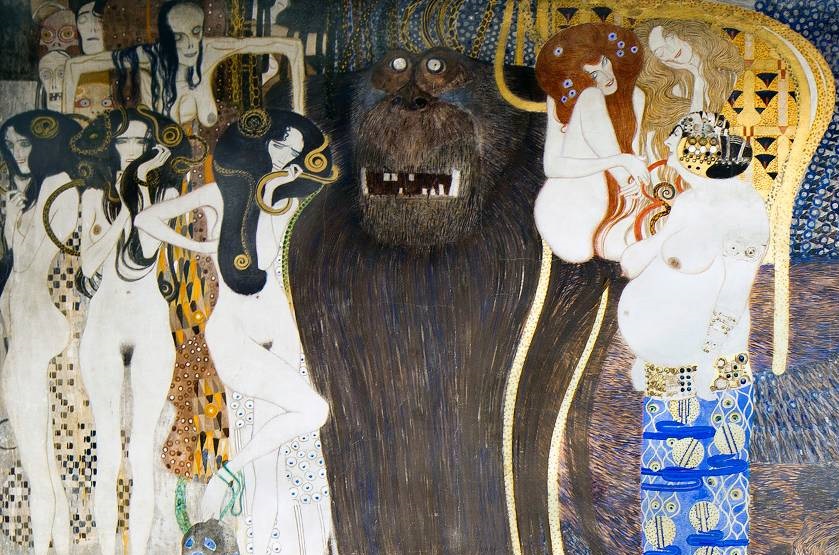
The Hostile Powers. Far wall, detail from the Beethoven-Frieze (1902) by Gustav Klimt
Symphony no.3 in E flat major Op.55 ‘Eroica’ for orchestra (1800-1802, Beethoven aged 31)
Dedication Prince Joseph Franz Maximilian Lobkowitz Duration 48′
1. Allegro con brio 2. Marcia funebre: Adagio assai 3. Scherzo: Allegro vivace 4. Finale: Allegro molto
Listen
Background and Critical Reception
In October 1803, when Beethoven had completed his third symphony, his world was about to change. His friend, the composer Ferdinand Ries, declared, “In his own opinion, it is the greatest work he has yet written. Beethoven played it to me recently, and I believe that heaven and earth will tremble when it is performed.”
Jan Swafford dedicates a compelling chapter to this work, which was to be one of the very first ‘program’ symphonies. Its dedicatee was to be Napoleon Bonaparte, but in a daring step his heroic character and achievements were to be the subject of Beethoven’s symphonic thoughts, built as they were on thematic cells from music previously written to celebrate Prometheus. Rather than be called Bonaparte, however, the Third took the term Eroica, for Beethoven was horrified by Napoleon’s proclamation as Emperor in May 1804. This was the nickname applied when the symphony was published in October 1806, with the dedication changed to Prince Lobkowitz.
Swafford presents a thoroughly absorbing dissection of the piece in his book, showing how Beethoven’s seemingly innocent sketches and musical cells take wing, blossoming into seamless 20-minute sections of music. The fourth movement, a theme and variations, takes its lead from a melody already used in Die Geschöpfe des Prometheus, completed in 1801, and also from the Eroica Variations for piano.
As Swafford writes, Beethoven “is more interested in flow than in eighteenth-century formal clarity”. At the end of the Eroica’s first movement, “the hero has come into his own, but his task is unfinished”. The symphony is now telling its story about an explicit subject, not just looking to impress on musical terms.
This first movement has a scale and ambition not seen before, as does the second movement funeral march. Berlioz, writing of the whole work, surely had this movement in mind when he declared, “I know few examples in music of a style in which grief has been so consistently able to retain such pure form and such nobility of expression.” The third movement continues Beethoven’s move away from the classical minuet towards the full-blown symphonic scherzo of the 19th century, but it is the finale where all Beethoven’s thoughts are clearly headed.
Swafford explains how Beethoven’s thoughts always had this movement at the head of proceedings, with finale-weighted works still relatively rare at the time. He applauds Beethoven’s innovations for the orchestra, with writing for horns and cellos of a standing not previously experienced. Barry Cooper declares this movement “an extraordinary fusion of musical arts, including variation, fugue, march and slow procession, in a symphonic finale of unprecedented formal complexity despite the apparent simplicity and regularity of its main theme. No wonder Beethoven’s admirers were so thrilled by the work, and the general public so perplexed.”
They were indeed, as Alexander Thayer recounts the puzzlement of an early appraisal. “The reviewer belongs to Herr van Beethoven’s sincerest admirers, but in this composition he must confess that he finds too much that is glaring and bizarre, which hinders greatly one’s grasp of the whole, and a sense of unity is almost completely lost.” Swafford has its measure, however. “The final pages are what the unfulfilled end of the first movement was waiting for, the true victory, the completion of the Hero’s task.”
Thoughts
It is rare indeed to be able to pinpoint an exact moment where art moves from one chapter to the next. Beethoven’s Eroica symphony gives us one such moment, a pivot where the whole notion of the symphony changes for ever and the composer strides forward to a new plain.
So many things about this work are new, exciting, and – for the time – dangerous. The first change is length, for this work often clocks in at near to 50 minutes if the repeats are used, twice the length of a Haydn or Mozart symphony. The first two movements alone are half an hour, making Beethoven’s first two symphonies feel like mere warm-ups in comparison. We also have an increasingly large orchestra to go with the bigger structures, and instruments such as the horn, oboe and cello take on an unprecedented status for their time.
Something is up right from the two brisk chords at the start, a call to attention before the main theme itself. The cellos get their moment, setting the heroic nature of the music in E flat major – which is, as we have seen, one of Beethoven’s key centres for power and positivity. As the massive first movement progresses, the composer goes through intricate yet wholly logical forms of developing his material. There is a new level of emotion here too, for this is a symphony from the heart. Its resolve gives the listener a mental picture of Beethoven beating his chest, giving himself a motivational call to arms as part of an emergence from the terrible days and morale of the Heiligenstadt testament.
The second movement, a funeral march, is one of the most profound utterances we have yet heard from Beethoven. This is the first time he has used the orchestra for such sombre means, other than a few isolated passages in the early cantatas, and the depth of feeling is well beyond previous symphonic thought, bringing closely guarded emotions from the intimacy of the piano to the wide open canvas of the orchestra. This is also a long movement, but the tension is sustained throughout. We feel Beethoven’s grief, his wounds, and also, in the C major ending, a semblance of hope.
The Scherzo picks up on this, easing the tension with its initial subject. It packs a punch recalling the heroism of the first movement, especially with the no-nonsense syncopations. No notes are here for the sake of it, all are fulfilling what feels like an inevitable destiny.
The finale, as Jan Swafford observes, brings everything to a head in a climactic fourth movement not experienced since Mozart’s Jupiter symphony. Few symphonic finales are as thrilling, as Beethoven assembles his melodic material and the music grows in stature at every turn, coming to a peak with a triumphant horn theme. The theme ends with a cadence that shows how Beethoven’s harmonic thinking is advancing with every piece – and indeed caps the sharp dissonance experienced near the start of the first movement. With this and many other elements, you can only imagine what the first audience would have thought, having grappled with the sheer scope of the first three movements. Where was this composer going with his music? Can we take the plunge with him? We will soon find out!
Spotify playlist and Recordings used
NBC Symphony Orchestra / Arturo Toscanini (RCA) Cleveland Orchestra / George Szell (Sony Classical) Orchestra of the Eighteenth Century / Frans Brüggen (Philips) Berliner Philharmoniker / Herbert von Karajan (Deutsche Grammophon) Vienna Philharmonic Orchestra / Claudio Abbado (Deutsche Grammophon) Danish Chamber Orchestra / Ádám Fischer (Naxos) Minnesota Orchestra / Osmo Vänskä (BIS) Berliner Philharmoniker / Rafael Kubelik (Deutsche Grammophon) Anime Eterna Brugge / Jos Van Immerseel(ZigZag Territories)
The recorded history of the Eroica deserves a much longer article, but safe to say the versions included here represent part of the vast array of available recordings. The smaller scale takes, such as Dausgaard, have plenty to say, as do the lavish accounts from Karajan and dfgd, where the score’s latent power is always in evidence. Accounts from Vänska and dfgd forge a middle ground, while the ‘period instrument’ versions from Brüggen and Jos van Immerseel give us a sense of what the first audience might have experienced, with thrillingly rough edges to the sound and the melodies.
To listen to clips from the recording from the Scottish Chamber Orchestra conducted by Sir Charles Mackerras on Hyperion, head to their website
You can chart the Arcana Beethoven playlist as it grows, with one recommended version of each piece we listen to. Catch up here!
Also written in 1803 HaydnString Quartet in D minor Op.103 (unfinished)
Next upNotturno for viola and piano in D major, Op.42



 Arcana.fm