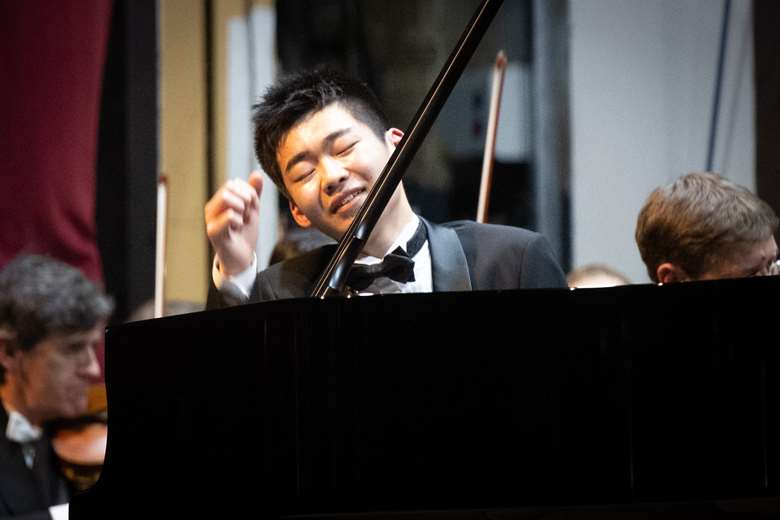
In concert – CBSO / Gergely Madaras: Mahler Symphony no.1

Mahler Blumine (1884)
Larcher Symphony no.3 ‘A Line above the Sky’ (2018-19) [CBSO Centenary Commission: UK Premiere]
Mahler Symphony no.1 in D major (1887-88. rev. 1898)

City of Birmingham Symphony Orchestra / Gergely Madaras

Symphony Hall, Birmingham
Thursday 12 January 2023

Reviewed by Richard Whitehouse Pictures below (c) Hannah Fathers

Following on its customary Viennese New Year concert, the City of Birmingham Symphony Orchestra continued 2023 with this coupling of Austrian symphonies – Mahler’s first such effort being juxtaposed with one of the most substantial among the orchestra’s Centenary Commissions.

Chamber and vocal pieces having established his name, Thomas Larcher has since tackled the symphonic genre with a vengeance – his Third Symphony, inspired by the ultimately tragic exploits of mountaineer Tom Ballard, considering notions of the elevated and sublime across two (more or less) continuous movements as articulated by an orchestra awash with untuned percussion plus an arresting ‘keyboard’ section of piano, celesta, cimbalom and accordion. The timbral and textural range was accordingly wide, though the tendency to veer between passages of amorphous pitch and those where an insipid modality too often failed to afford resolution or fulfilment – whether in those abrupt contrasts of the initial movement or more cumulative unfolding of its successor – meant the whole felt less than the sum of its parts.

Not in doubt was the excellence of the performance, the CBSO audibly attuned to the many expressive nuances of Larcher’s writing with Gergely Madaras (above) securing a traversal which endowed the piece with a logic and cohesion as might otherwise have been more apparent than real. Already performed in Brno, Bregenz, Amsterdam and Valladolid, this marks a further intriguing stage in its composer’s symphonic odyssey and certainly asks the right questions even if the answers seem, at least on a first hearing, to be less than convincing.

Much the same was doubtless levelled at Mahler’s ‘Symphonic Poem in Two Parts’ on its Budapest premiere in 1889 and while what had become his First Symphony almost a decade later does away with even a vestigial programme, it remains a difficult piece to make cohere. Madaras succeeded admirably for the most part – adroitly negotiating the first movement’s quirky unfolding from shimmering miasma, via folk-like geniality, to ecstatic arrival; then imbuing the scherzo with an appealing rusticity, though not even such subtle inflections of phrasing could make the trio sound less mundane than it is. As so often, the highlight was a ‘funeral march’ whose gaunt double-bass melody (eloquently rendered by Anthony Alcock) launched a movement whose intermingled irony and pathos was judiciously characterized.

Madaras duly had the measure of an infernal finale whose martial opening stage brought a visceral response from the CBSO (above), its strings heard to enticing effect in the languorous (but not too cloying) melody that follows. The central climax was finely prepared, and if more might have been made of that otherworldly passage where the main motifs are recalled as though through the ether, the approach to the peroration was vividly sustained – standing horns and trombones adding to the impact of the closing pages in their unabashed overkill.

It was astute programming to open with Blumine, salvaged by Mahler from earlier incidental music as second movement in early hearings of this symphony only to be excised thereafter. With trumpeter Jason Lewis heard to enticing effect, it here made for an atmospheric entrée.

You can read all about the 2022/23 season and book tickets at the CBSO website. Click on the artist names for more on conductor Gergely Madaras and composer Thomas Larcher

On Record: Colorado MahlerFest Orchestra / Kenneth Woods – MahlerFest XXXIV: Sawyers & Mahler: Fifth Symphonies (Colorado MahlerFest)

Sawyers Symphony no.5 (2021) [World premiere]
Mahler Symphony no.5 in C# minor (1901-02)

Colorado MahlerFest Orchestra / Kenneth Woods

Colorado MahlerFest 195269164287 [two discs, 111’45”]

Recorded Live performances at Macky Auditorium, Boulder, Colorado, 28 August 2021

reviewed by Richard Whitehouse

What’s the story?

Two five-movement Fifths brought the 34th Colorado MahlerFest to an impressive ending. Mahler’s cycle is often seen as ‘end of the line’ for the symphony, yet its further evolution is not hard to discern, and Kenneth Woods is rightly making this a crucial aspect of his tenure.

What’s the music like?

Philip SawyersFifth Symphony pursues a stylistic path comparable to those two before it. Its predecessor ended with an expansive Adagio, and this work continues from such inward seriousness in a Moderato that overrides clear-cut sonata procedures for a gradual unfolding whose thoughtful initial theme takes on greater emotional intensity as it builds to an ominous climax, before closing in a mood of no mean ambivalence. The writing, for an orchestra with fifth horn and harp though no percussion other than timpani, is never less than resourceful.

From here an Allegro increases the tempo to capering and, in its middle stages, wistful effect. The central Lento pursues a sustained course over cumulative paragraphs, the latter climaxing with the work’s most anguished music, before an affecting coda. The ensuing Presto affords greater expressive contrast between impulsive outer sections and a chorale-like trio of musing poise. The final Allegro is the most orthodox movement in its energetic and reflective themes, taking in an intensive development and subtly modified reprise prior to a decisive apotheosis.

Pacing is crucial in Mahler’s symphonies, his Fifth being no exception. The opening Funeral March is ideally judged – its development not too histrionic, then a coda whose eruptive force subsides into numbed uncertainty. Proceeding without pause, its successor steers securely to a climactic yet ill-fated chorale, and if the final return of its initial music lacks vehemence, the pulsating expectancy of the closing bars is tangibly rendered. Woods’ handling of the central Scherzo contrasts a rustically evocative trio with the ländler-infused coyness and contrapuntal contrivance either side, the coda wrapping up this overlong movement with real decisiveness.

The remaining two movements are finely realized, the Adagietto taken at a flowing if flexible pace that enables its inherent rapture to emerge without any risk of indulgence. The deftest of transitions duly prepares for a finale whose elaborate interplay of rondo and sonata elements is replete with a cumulative impetus here carried through to a fervent peroration, the chorale blazing forth during a close in which affirmation and nonchalance are irresistibly combined.

Does it all work?

Almost always. Sawyers’ Fifth symphony is a cohesive and absorbing piece – less arresting in overall content than either of its predecessors, though with an unfailing formal logic and expressive eloquence that are not to be gainsaid. Interesting, moreover, that this Fifth marks something of a rapprochement with ‘classical’ tonality, whereas Mahler’s Fifth sets in motion a fractious discourse which informs almost all this composer’s subsequent symphonic works.

Is it recommended?

Certainly. The playing of the Colorado MahlerFest Orchestra is of a high standard, testifying to the excellence of these musicians in their collective responsiveness to Woods’ technical acumen and interpretive insight. To hear this work so authoritatively realized and within the context of a major new symphonic statement says much for the significance of MahlerFest.

Listen & Buy

Online concert – English String Orchestra / Kenneth Woods: Elgar Festival 2022

Elgar arr. Fraser Nursery Suite (1931 arr. 2022) World premiere of this arrangement
David Matthews Shiva Dances Op.161 (2021) World premiere

English String Orchestra (soloists Zoë Beyers, Suzanne Casey (violins), Carl Hill (viola) and Joely Koos (cello) / Kenneth Woods

Filmed at the Guildhall, Worcester, Friday 3 June 2022

by Richard Whitehouse

Welcome listening for the new year provided by the English String Orchestra, as taken from a programme at this year’s Elgar Festival and which featured the premiere of that composer’s last notable work in what is an idiomatic and often perceptive arrangement by Donald Fraser.

His previous Elgar arrangements ranging from miniatures to the Piano Quintet, Fraser duly captured the wistful charm of the initial Aubade then discreet pathos of The Serious Doll. The ESO steered a secure course through the headlong intricacy of Busy-ness, with the deft profundity of The Sad Doll afforded full rein. Solo strings against an implacable rhythmic ostinato offset any lack of visceral impact in The Waggon (sic) Passes, then the high spirits of The Merry Doll were jauntily in evidence. The extended finale, Dreaming is a threnody of tangible emotional import and a resume of earlier themes on its way to a forthright if not a little regretful coda. Kenneth Woods ensured this had gravitas without losing focus, while a bravura showing from Zoë Beyers was but the last in a sequence of solos all admirably taken.

Solos are by no means absent from Shiva Dances by David Matthews. The combination of string quartet and string orchestra has potent Elgarian connotations, of which the composer avails himself in this continuous sequence inspired as much by Aldous Huxley’s description of the Hindu god Shiva as by Indian classical music. Moving from a slow introduction given piquancy by its modal intonations, the work comprises four dances that between them outline the four elements: an impetuous workout representing ‘earth’, a quixotic interplay for soloists and ensemble that of ‘water’, the scherzo-like agility of ‘air’, and an animated waltz for ‘fire’. This latter builds to a forceful restatement of the opening theme, before a coda intensifies the overall expression such that what came before is rendered from a more ethereal perspective.

It says much for the prowess of the ESO that this first hearing betrayed few signs of caution or uncertainty, Woods directing a confident account with which Matthews must have been well pleased. Those listening to this online programme can also hear an encore in the guise of Nimrod from Elgar’s Enigma Variations, taken from a performance during last year’s Elgar Festival and which exudes a searching eloquence as seems to look beyond forthcoming celebrations to that overtly commemorative atmosphere from only a matter of weeks later.

This concert could be accessed free until 1 January 2023 at the English Symphony Orchestra website, but remains available through ESO Digital by way of a subscription. Meanwhile click on the names for more on the English Symphony Orchestra and Kenneth Woods, or on composer David Matthews

On Record: Bamberger Symphoniker / Jakub Hrúša – Hans Rott: Symphony no.1 (Deutsche Grammophon)

Rott Symphony [no.1] in E major (1878-80)
Mahler Andante allegretto in C major ‘Blumine’ (1884)
Bruckner Symphonic Prelude in C minor WAB297 (1876)

Bamberger Symphoniker / Jakub Hrúša

DG 486 2932 [70’11”]

Producers Sebastian Braun (Rott, Bruckner), Johannes Gleim (Mahler)
Engineers Markus Spatz (Rott), Christian Jaeger (Mahler), Thorsten Kuhn (Bruckner)

Recorded September and October 2021 (Rott), December 2021 (Mahler), March 2022 (Bruckner) at Joseph-Keilberth-Saal, Konzerthalle, Bamberg

reviewed by Richard Whitehouse

What’s the story?

Jakub Hrúša makes its debut on Deutsche Grammophon with a new account of the Symphony by Hans Rott (1858-84), whose belated premiere some 33 years ago prompted a reassessment (still ongoing) as to the evolution of this genre during those final decades of the 19th century.

What’s the music like?

Much time and space has been expended on the indebtedness (or otherwise) of Mahler to this work – elements from which can be found in at least five the younger composer’s symphonies – yet equally fascinating is the audible influence it had upon those who came before and after; hence the first movement from Bruckner’s Seventh and the second movement from Schmidt’s First – both of which are similarly grounded in E major). Without seeking to present it as an unalloyed masterpiece, Hrúša makes a persuasive case for a piece that Rott would doubtless have overhauled had his mental state not deteriorated soon after its completion. He finds the right balance between grandeur and introspection in the preludial Alle breve, as between that raptness which briefly though pointedly erupts into anguish in the Sehr langsam that follows.

The Scherzo is the most convincingly realized movement and Hrúša has the measure of its animated main theme with undertones of polka, broadening into the ländler-derived suavity of its trio before regaining its earlier vigour vis an ostinato-like impetus barely held in check – the accelerando not necessary in this instance. Nor does he disappoint in the finale. Much the longest movement, this is easily criticized for diffuseness but, as Hrúša makes plain, the formal ground-plan – prelude-chorale-fantasia-fugue-stretto-postlude – (such as the organist Rott likely extemporized before committing to paper) is readily perceivable and is invested with cumulative momentum sustained to the beatific concluding bars. That the composer so nearly brought off this ambitious conception is surely more significant than any shortcoming.

Couplings have been judiciously chosen to open-out the context of the main work. Included in early hearings of his First Symphony, Blumine is a remnant from Mahler’s early orchestral projects lost to history and Hrúša brings out those expressive ambiguities as offset the lilting trumpet melody. Once attributed to Mahler, Symphonic Prelude is now believed an exercise from Bruckner’s composition class and Hrúša, adhering to the original orchestration rather than that by Albrecht Gürsching, duly makes the most of its ominous and plaintive musings.

Does it all work?

It does. In his accompanying booklet observation, Hrúša reflects on the musical and historical relevance of Rott’s Symphony and there can be little doubt that, among the dozen or so other recordings of this piece, this is the most convincing in terms of all-round cohesion as also the excellence of the playing by the Bamberg Symphony (whose chief conductor Hrúša has been since 2018). A little too forwardly balanced in tuttis, sound otherwise reflects the excellence of the orchestra’s home-venue – Rott’s extensive use of triangle kept within sensible bounds.

Is it recommended?

It is. Those coming to the main work for the first time should certainly makes its latest release their first port-of-call, and it would be worthwhile DG continuing this association with Hrúša and the Bamberg in other mid-European music from the late Romantic and early Modern era.

Listen

Buy

You can listen to clips and get purchase options from the Deutsche Grammophon website

In concert – Eugene Tzikindelean, CBSO / Alpesh Chauhan: Brahms, Nielsen & Shostakovich

Brahms Tragic Overture Op. 81 (1880)
Nielsen Violin Concerto DF61 (1911)
Shostakovich Symphony no.5 in D minor Op.47 (1937)

Eugene Tzikindelean (violin), City of Birmingham Symphony Orchestra / Alpesh Chauhan

Symphony Hall, Birmingham
Wednesday 7 December 2022 [2.15pm]

Reviewed by Richard Whitehouse

A gratifyingly large house greeted this afternoon concert given by the City of Birmingham Symphony Orchestra with its former assistant conductor Alpesh Chauhan, taking in works long established in the repertoire and a concerto which remains on or about its periphery.

Tackling Brahms’s Tragic Overture depends on whether one sees it as an overture pure if not so simple, or as a tone poem with its ‘programme’ subsumed into the music’s inner workings. Chauhan favoured a viable mid-way course, his steady if never flaccid approach keeping its sonata design firmly in view but with enough expressive license to bring out the pathos in its second main theme and, especially, that spellbinding transition to its reprise when a wistful vulnerability steals over the music as if denying the implacable fatalism otherwise dominant.

CBSO leader Eugene Tzikindelean then took the stage as soloist. A bold if unexpected choice for such an appearance, Nielsen’s Violin Concerto has never quite received its due outside of Denmark but that it makes a cogent impression was never in doubt in a reading as insightful as this. Its Praeludium keenly yet sensitively rendered, Tzikindelean despatched the ensuing Allegro with the right chivalrousness and suavity. A broken string in the development caused only minimal delay as he produced its replacement then restrung his instrument with alacrity.

Its self-sufficient halves make sustaining an overall trajectory the crucial factor in this piece and Tzikindelean succeeded admirably, drawing inward rapture from the second movement’s lengthy Poco adagio before steering a never too hasty course through its lightly ironic Rondo. Tzikindelean responded to the enthusiastic response with the opening ‘Country Musicians’ section from Enescu’s Impressions d’Enfance as a delectable encore: maybe we can expect that composer’s Caprice Roumain or Pascal Bentoiu’s Violin Concerto on a future occasion?

Throughout this performance, Chauhan proved steadfast and attentive in support, then came into his own after the interval with an impressive take on Shostakovich’s Fifth Symphony. If the earlier stages of the Moderato seemed a little reined-in, the development accumulated the requisite intensity on the way to a powerfully conceived reprise, then a coda of aching regret. Steadier and less capricious than usual, the ensuing Allegretto yielded a keen impetus and, in its trio, a deftly ‘knowing’ contribution from Tzikindelean having retaken the leader’s chair.

It was the Largo that proved the highlight of this performance. Chauhan sustained its heartfelt interplay of themes with unforced rightness, CBSO woodwind heard to advantage in its rapt central episode before a climax of wrenching eloquence that subsided into expectant stillness. Launched (almost) attacca, the final Allegro unfolded with due emphasis on its ‘non troppo’ marking; its calculated aggression pointedly undercut by musing circumspection, before the heady ascent towards an apotheosis which was more than usually defiant in its equivocation.

A performance that provided ample indication of Chauhan’s emergence as a conductor of the front rank. Hopefully he will be returning to the CBSO soon, the latter’s activities continuing with the customary Christmas and Viennese New Year concerts with which to see out 2022

You can read all about the 2022/23 season and book tickets at the CBSO website. Click on the artist names for more on Alpesh Chauhan and Eugene Tzikindelean