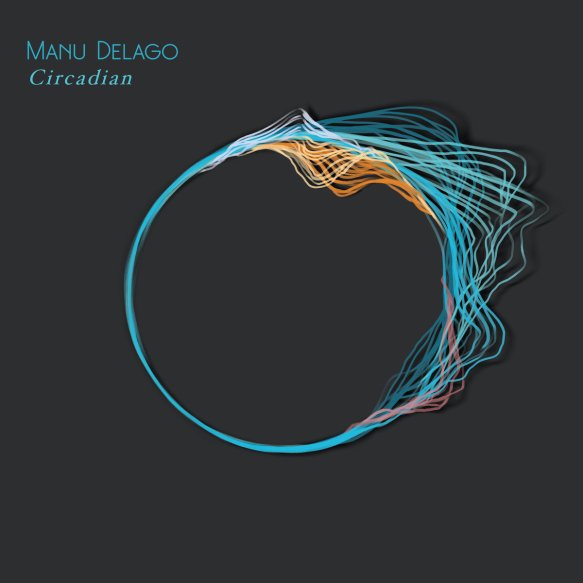
Switched On – Manu Delago: Circadian

reviewed by Ben Hogwood

What’s the story?

While Max Richter made one of the standout contemporary pieces of the last few years in his eight-hour epic Sleep of 2015, encouraging us to fall asleep while it was running, this new album is a response to a lack of quality shuteye. The author, Manu Delago, found he was struggling to get lasting sleep while touring in different climates and time zones, but also looked for inspiration in the brain’s creative thoughts experienced during REM.

Circadian explores this phenomenon, along with light and deep sleep, capped with an abrupt awakening. Delago wrote it while on the road with label-mate Björk, The Cinematic Orchestra, Olafur Arnalds and Anoushka Shankar – and the approach is very different to that of Richter, driven as it is by soft percussion.

What’s the music like?

The list of Delago’s fellow artists is instructive, as his own music draws from his creative experiences with them, but ensures an individual path is also forged.

This is one of the quietest albums I have heard in some time, partly because the principle instrument, the handpan, is so soothing. The title track establishes its bright yet mottled colours, pleasing to the ear as a muffled steelpan might be. Yet as the striking and vividly descriptive track The Silent Flight Of The Owl shows, it combines really well with wind instruments and particularly clarinet, whose soft tones create an eerie impression in the half light, together with what sounds like a didgeridoo in the middle foreground.

The colours of Uranus, again with clarinet, are a sleepy blue, while The Moment I’m Still Awake employs the fuzzy drone of the harmonium, as though there were a fan in the room.

All these recordings are heading for the centrepiece, the 21-minute track Delta Sleep (Live at 4:33am). This depiction of deep sleep was recorded in the middle of the night through to the early hours, the ensemble combining in a hypnotic whole, their sounds fusing into each other with clicks, bright shafts of light and hints of fitful dreaming.

From this emerges Draem and then Zeitgeber, where our subject sits bolt upright, the music building on a syncopated clarinet which has now acquired a rasp to its tone. Adding broken beats, Delago cuts loose for the first time on a track fizzing with the energy of a new day, even though you suspect a slump might be just around the corner!

Does it all work?

From that lengthy description you hopefully get an idea of how effective and descriptive this album is. It does help to know the story behind the music in advance before listening, and to have the right environment for your Circadian experience. Delago’s colours are lovely to the ear and the handpan has a soothing sound, the instrumental craft and blending with ensemble members clear for all to hear.

Is it recommended?

Yes. Circadian could itself work as a sleep aid, providing you bail out before the last track. Delago’s picture painting is exquisite at times, and the relative lack of movement early on is not a problem once the subject has been established. It is a unique approach to an aspect of life that troubles and fascinates us all.

Stream

Buy

On record – Kronos Quartet & Terry Riley: Sun Rings (Nonesuch)

Written by Ben Hogwood

What’s the story?

The Kronos Quartet and Terry Riley have a rewarding history of collaboration covering more than 35 years. Sun Rings is surely one of the most emotive pieces in that history, and is certainly one of the most performed since its premiere in 2002. Here it receives a first full recording.

The work dates back to a commission from NASA, who were looking to mark the 25th anniversary of the launch of the Voyager 1 space probe. They specifically wanted to know if the Kronos could use the ‘space sounds’ collected from the Voyager crafts by physics professor Don Gurnett, who developed plasma wave instruments to receive them. On hearing the results Kronos leader David Harrington immediately contacted Terry Riley to get him on board.

While writing in New York, Riley was interrupted by the World Trade Center attacks of 11 September 2001. They inspired him to turn the focus of his work to peace.
This is the first recording of Sun Rings in its entirety, a chance for those in more than 50 countries who have already experienced it live to hear it in recorded form. Weighing in at nearly 80 minutes, it is a big work, expanding the quartet by adding San Francisco-based vocal ensemble Volti to two of the longest sections, Earth Whistlers and Prayer Central.

What’s the music like?

Fascinating, and timeless in a way that suggests the deep space into which the Voyagers continue to travel. There is a restless edge too, as it seeks the lasting peace Riley had in mind.

After the space sounds set the work in perspective, Hero Danger is a rewarding combination of the otherworldly electronics and the string quartet, with thoughtful lines suggesting a slightly worrisome contemplation. In response Bebopterismo carries urgent anxiety in its angular melody, the music put on edge.

Riley’s musical language is interesting, never purely ‘minimalist’ but repeating his more distinctive melodic ideas. There are rather beautiful dovetails between violin and viola halfway through Planet Elf Sindoori, but just when the ear thinks the sonorities of Sun Rings have been fully established, Earth Whistlers comes as quite a surprise.

It is here the choir are introduced, and this substantial movement makes much of their pure tones. It does perhaps distract from the subject at hand, replicating in a way the interruption of the September 11 attacks on Riley’s thoughts. When we train our gaze fully on Voyager again with The Electron Cyclotron Frequency Parlour there is an intriguing displacement between the close up quartet sound and atmospherics further away, but the focus has shifted.

Prayer Central, the most substantial movement, is soft and contemplative but becomes more animated and off the beat. Venus Upstream is full of anxiety, as though time is limited, its tension spiked by the alarm in the background. The spoken quote from Alice Walker to begin the last section is telling, asking, “Do you really know where you are at this point in time and space and in reality and existence?” It is just the right side of preaching, helped by some lovely cello playing from Sunny Yang.

Does it all work?

Most of the time, though with the caution that for maximum effect the piece is best heard in full and in a quieter place. Then the field recordings really come through to the front. Sun Rings is a substantial piece of work, though there are some natural dips in inspiration once the ideas of each section have been exposed. The use of the choir may split opinion too.

Is it recommended?

Yes. For those following the Kronos Quartet and Terry Riley it is an essential purchase, while providing further evidence of the positive effect astronomy can have as a creative stimulus, not to mention the endless drive for world peace. Between them Riley and the quartet have looked outside of the box to create something unique and, on this evidence, a major work that will last in spite of a few reservations.

Listen

Buy

You can get Sun Rings from the Nonesuch website

Switched On – Deaf Joe – Love Stories (Church Ceilings)

reviewed by Ben Hogwood

What’s the story?

When Deaf Joe released his third album Stuck in 2018 he promised a ‘slew of ambient music’. True to his word, the Edinburgh-based Irishman delivers a sequel just over a year later, its eight tracks spanning just over half an hour of music to calm the soul.

What’s the music like?

Ambient but emotive with it. In his own words, Deaf Joe is ‘chasing memories of special places with lovers and loved ones he’ll never forget’. The scenarios include ‘the sound of the ocean roaring on an Icelandic black sand beach (Reynisfjara)…swimming in Copenhagen harbour at the height of summer (Havnegade)…and the sight of a kaleidoscopic sunset over a volcanic lake in the Philippines (Taal Lake).

There is a gentle but insistent thread of deep emotion that runs through the music because of these associations. Taal Lake opens the musical photo album with the purest chord of all, a rich C major wall of sound. As it gets louder the wall starts to oscillate a little, in keeping with ripples on the surface of the water, effects sweeping across the stereo picture.

It is an indication of just how descriptive Deaf Joe can be. Reynisfjara is similarly watery, depicting the waves on the Icelandic beach spoken of above with rhythmic patterns of subtle power, while Ocean Beach revisits the same key as the lake but applies more movement in the form of a quick four to the floor beat.

Not all of the tracks are purely ambient. Cambodian Sirens has quite a shrill treble that is highly effective, especially when the following Phnom Bakheng / Disintegrating In Lowtown returns us to C major and floats timelessly.

Does it all work?

Yes. Deaf Joe is a talented artist whose pictures with sound are descriptive and richly rewarding, giving listeners a gallery of colourful pictures in which to immerse themselves.

Is it recommended?

It is. This is ambient music looking around the world for its inspiration, but bringing its wide canvas together in one stream of sonic invention.

Stream

Buy

Switched On – YACHT – Chain Tripping (DFA)

reviewed by Ben Hogwood

What’s the story?

This is the seventh album from Portland trio YACHT, their third release for the DFA label. Given that their name is an acronym for Young Americans Challenging High Technology, it feels entirely appropriate that this record should embrace AI and machine learning.

As the press release explains, the trio ‘used neural networks to break their patterns apart into infinite variations, which they re-assembled into new songs that they then learned, performed, and recorded live. Rather than rely on a single tool, they brought together several distinct AI processes: text generation (Char-RNN), latent space interpolation, raw audio generation (SampleRNN), and a ‘neural synthesizer’ called the NSynth. They were inspired by the long history of generative composition, from William S. Burroughs’ cut-up writing method to David Bowie’s custom ‘Verbasizer’ lyrics software from the ‘90s.

What’s the music like?

It is ironic to use the word ‘deadpan’ given the AI involvement, but there is a flatlining aspect to this record, a straight-faced approach that Chain Tripping has to electronic music.

Claire Evans’ vocals are treated carefully to sound like the intervention of a machine, meaning when she sings a lyric like “I was born to lose control”, on the single SCATTERHEAD, the irony is heavy. Hers is a great voice for this sort of album though, dueling with trimmed beats and riffs. Given the nature of the album it is perhaps inevitable that nothing feels left to chance, the rigid instrumentation and content all closely monitored.

There is still time for funk, however. Blue On Blue is a really catchy track, while DEATH has a great bassline to take away from its darkly murderous lyrics. Stick It To The Station is also excellent, with a slow but really loose bassline and a track that gains heft as it develops.

(Downtown) Dancing, the first track, bids us “welcome to your pleasure” but has a bit of a disembodied feel. It works well though, as does the cooing from Evans at the start of Hey Hey. Loud Light adds a heavy slab of irony, with the line “I’m so in love I can feel it in my heart”.

If you didn’t know that the album had its origins in AI you would think it was a very solid piece of work, deriving a little from English electronica such as Human League or Yazoo, but with Evans at the front always packing a strong personality. She saves us from death by automaton, a charismatic presence.

Does it all work?

Not all the time. The technology does to a large extent prevent the personal from getting through, especially when you compare Chain Tripping to previous YACHT songs such as the brilliant Walk The Line. Yet maybe this is the intent, to show that technology might be able to help create a good set of beats, riffs and songs, but what it can’t yet achieve to 100% capability is a full emotional canvas.

As a result these songs would sound great in a club, but only in the context of others that live and breathe more.

Is it recommended?

Yes, for devotees – it is certainly a record of interest, and still good enough to keep YACHT fans happy. Newcomers are better directing themselves to slightly earlier in the band’s canon.

Stream

Buy

Switched On – Defected presents Most Rated Ibiza 2019 (Defected)

Various ArtistsDefected presents Most Rated Ibiza 2019 (Defected)

reviewed by Ben Hogwood

What’s the story?

It has been another memorable summer for Defected. 2019 has seen their head Simon Dunmore and a collective of starry guests return for a third consecutive residency at Ibiza’s Eden club, and the label’s presence grows ever stronger on the island in their 20th year. Most Rated embodies that upward curve, with 30 excellent floor fillers.

What’s the music like?

Very, very good. There are two mixes here that make nearly two and a half hours of paradise for vocal house lovers. The choice moments arrive right from the first track of the first mix, Roberto Surace’s Joys, with its lifting of vocals from the Richard X & Kelis collaboration Finest Dreams. From there we can enjoy another superb Todd Edwards moment, Deeper presented in remix form by Gorgon City. As the momentum builds Riva Starr’s remix of G-Flame and KCC’s Heaven and Melba Moore’s My Heart Belongs To You (the Ferreck Dawn remix) double up effectively, before the piece de resistance of the first mix, Mattei & Omich & Nathan Nicholson’s superb track Doors, with its tagline ‘you close one door and another one opens’.

Finally the swirling strings of Cinthie’s Mesmerizing leave a mark…and if you’ve any sense you’ll head straight on to the second mix. Here Andreya Triana shines on vocal duties with The Vision’s Heaven, while Bless Me Toda from Alan Dixon adds a spiritual high. The music heads deeper with the Heller & Farley Project with Cevin Fisher, the Fire Island remix of We Built This House, and Dave & Sam’s Till The World Blow Up, featuring Mike Dunn. Dunn reappears with the bouncy If I Can’t Get Down, and there’s a similar spring in the step of Alaia & Gallo’s Trippin, featuring Dames Brown. It’s great to see Cassius present, remixing Oliver Dollar’s John’s Church, before the final winning double from Horse Meat Disco (Joey Negro’s remix of Falling Deep In Love) and one of The Shapeshifters’ very best tracks, Kimberly Davis powering the vocals for Life Is A Dancefloor.

Does it all work?

Emphatically so. Hands in the air, smiling faces and dancing feet are all symptoms of the Defected approach, and it transfers effortlessly to these two hot weather winners.

Is it recommended?

Yes, without question. Defected are riding the crest of a wave at the moment and this compilation sums up all the label’s qualities at the moment.

Stream and Buy