Switched On – BUNKR: The Initiation Well (VLSI)

reviewed by Ben Hogwood

What’s the story?

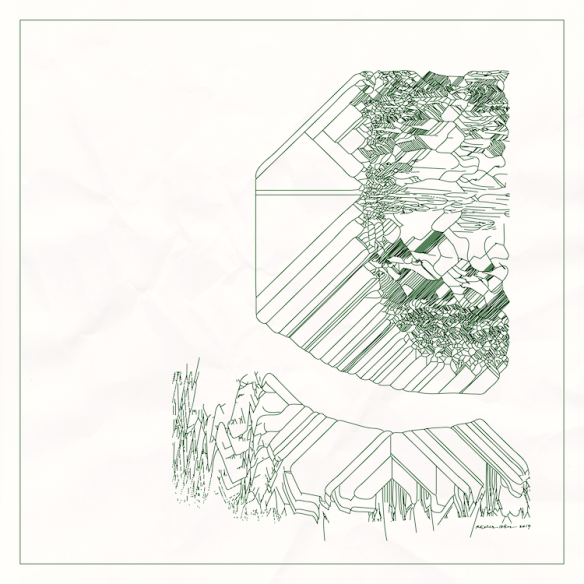
BUNKR is the operating name by which Brighton’s James Dean operates. Before we even hear his music a strong impression is created by the bold cover, which promises discovery, scope and bright light amid dark clouds, not to mention a hint of danger.

The Initiation Well, as Dean puts it, ‘provides the listener with an intrepid exploration of the BUNKR sound world. It’s melodic, pretty atmospheric and a little bit woozy’.

What’s the music like?

As BUNKR describes. Headphones are the best means of discovery here, allowing the listener to take in the widescreen sonic views BUNKR creates on substantial tracks like Docking Procedure, The Initiation Well and Rheasvilian Lakes.

East Of Eden would seem to represent the star at the centre of the album cover. Try listening as the sun comes up and you are in for a magical experience, as it also acts as an upbeat for the kick drum of Docking Procedure, where a lumbering groove and slightly cosmic treble work really well together, and the layers of different textures and loops build up beautifully.

Left For Dust picks up speed and adds a lovely fuzzy bass to go with its busy drum track, and then Rheasvilian Lakes is a lovely floaty number, stretched out as our view disappears into the distance.

Does it all work?

Yes – the tracks work individually but the album works even better as a whole. If anything James Dean’s work here could be compared to that of his label heads, Echaskech – finely crafted pictures where the imagination is left open, though his beats are a little more dub-weighted and a bit slower.

Is it recommended?

Absolutely. This is a versatile album that works on the morning commute and during work but also as a body of work to admire and – in the faster tracks – throw a shape or two. The Initiation Well is an intriguing title that draws you in – and once initiated you’ll want to be submerged again!

Stream

Buy

Switched On – Dominik Eulberg: Mannigfaltig (!K7)

reviewed by Ben Hogwood

What’s the story?

Few musicians can claim to have received an ‘Outstanding Contribution’ award from the UN Decade of Biodiversity.

Yet as you soon find out from the packaging around this release, Dominik Eulberg’s Mannigfaltig is not just any other project.

It is a musical and artistic plea for recognition. Recognition that although we are custodians of some weird and wonderful species here on earth, we might not be for too much longer if things don’t change.

A multi media release, Mannigfaltig (meaning manifold, diverse) combines twelve musical portraits of colourful species with a pack of cards featuring a pair of each of those animals, and an intricate video – another award winner – paying homage to the colourful mayfly on the single Eintagsfliege. The cover art is beautifully realised too, the animal portraits laid out in the shape of a ‘play’ symbol. Eulberg may have been eight years away from the albums game, but he has clearly given his return some thought.

What’s the music like?

Eulberg’s work is of intricate construction but colourful output, rather like the species he portrays.

If you were listening without any knowledge of the album’s subject, you would pick out the opening Eintagsfliege, the Mayfly, as a sublime sunrise moment. Eulberg uses the rich timbre of the lower register of the piano to make a piece of music that stops the listener in their tracks, especially once the clipped beats kick in.

As the album progresses, and Eulberg profiles moths, butterflies, birds and dormice, the little twists and turns make for a really substantial set of tracks. After the beautiful mayfly, Zweibrütiger Scheckenfalter (Meadow Fritillary) has a wavy profile with a glockenspiel at the top end, a tactic Eulberg often employs. Fünffleck-Widderchen (New Forest burnet-moth) plays subtly with the pulse, using some darker shades, while another moth, Sechslinien-Bodeneule, puts its foot down. Siebenschläfer (Dormouse) comes out as a persuasive anthem in waiting, a feel good moment, while Goldene Acht, a pale-clouded yellow butterfly builds its layers to a rich swathe of colour.

As the album moves on the music gets weightier. Neuntöter, a Red-backed shrike, brings out the heavier gear, and then the really substantial Zehnpunkt-Marienkäfer, at 11 minutes, its blissful, warm chords backing another clipped beat glockenspiel, ending in suspension with the delicacy of the chimes.

Does it all work?

Yes, and despite the album’s length it has enough light and shade, fast and slow, to work. The craft behind the music is considerable, but so is the emotion, Eulberg using harmonies that pull gently but insistently at the heartstrings. Throwing in a few genuine anthemic moments at the end with tougher beats completes the deal.

Is it recommended?

Yes – another very fine addition to the Dominik Eulberg discography, Mannigfaltig is his most meaningful album yet, and contains some genuinely memorable music.

Stream

Buy

Switched On – Telefon Tel Aviv: Dreams Are Not Enough (Ghostly International)

reviewed by Ben Hogwood

What’s the story?

In the 2000s, Chicago-based duo Telefon Tel Aviv were highly regarded for their moody electronic music, notable for its wispy vocals and expansive panoramic views. Three high quality albums were released in that time, peaking with Immolate Yourself in 2009. Almost immediately following the album release however tragedy struck, with band member Charles Cooper unexpectedly passing away.

The surviving member Josh Eustis continued in a solo capacity under different aliases, exploring new ground with Puscifer, The Black Queen and striking solo project Second Woman, while briefly appearing as part of Nine Inch Nails’ touring line-up. Then he announced work on new Telefon Tel Aviv material, to the delight of the band’s still devoted fan base – and with Dreams Are Not Enough he releases their fourth album.

Its track titles link to describe a dream Eustis experienced at an early age. I dream of it often…a younger version of myself…standing at the bottom of the ocean…arms aloft…mouth agape…eyes glaring…not seeing…not breathing…still as stone in a watery fane.

What’s the music like?

The nine tracks unfold as a dream sequence might, staying true to the Telefon Aviv sound but if anything branching out towards more experimental territory. I dream of it often makes a really ear-catching start to the album, arriving by stealth as a reverie might, but gradually imposing itself with rhythms that ricochet and echo, the sound waves bouncing off the walls. The sonic panorama is vast, and captivating when heard on headphones, Eustis using drones that are incredibly comfortable on the ear but then blossom into something more substantial.

He continues to shift the sonic perspective, sometimes up close and very personal and then suddenly cutting away to a vast oceanic view. When he does this for standing at the bottom of the ocean, mouth agape or especially eyes glaring the vocals sound like ancient plainchant, the setting a vast underwater cathedral, the beats now resonating around the windows and arches.

There is perhaps inevitably a sense of sadness on the album, remembering Cooper, but there is an incredibly strong resolve too. As it progresses the vision of the recurring dream continues to be remarkably descriptive. Not breathing hammers home its heavy kick drums, as though the heart is struggling to cope, but when final track still as stone in a watery fane arrives there is a lasting peace, Eustis completing his cathartic journey.

Does it all work?

Yes. Electronic music is rarely as moving or as distinctive as this, and although Dreams Are Not Enough is not always an easy listen, it is never less than captivating. Eustis has a wholly original way with beats, the corrugated surfaces on tracks like arms aloft borne of a vivid imagination. It is great to hear his vocals again too, and although they are disembodied at times they frequently strike a chord.

Is it recommended?

Without hesitation. While Immolate Yourself was dreamy and leaned more towards song-based productions, Dreams Are Not Enough feels like an important part of the recovery stage for Eustis, and it continues the story of Telefon Tel Aviv in a reverential way, never wallowing but seeking new sounds, methods and ways of communicating. Anyone who thinks electronic music is devoid of emotion should head right here.

Stream

Buy

Switched On – Manu Delago: Circadian

reviewed by Ben Hogwood

What’s the story?

While Max Richter made one of the standout contemporary pieces of the last few years in his eight-hour epic Sleep of 2015, encouraging us to fall asleep while it was running, this new album is a response to a lack of quality shuteye. The author, Manu Delago, found he was struggling to get lasting sleep while touring in different climates and time zones, but also looked for inspiration in the brain’s creative thoughts experienced during REM.

Circadian explores this phenomenon, along with light and deep sleep, capped with an abrupt awakening. Delago wrote it while on the road with label-mate Björk, The Cinematic Orchestra, Olafur Arnalds and Anoushka Shankar – and the approach is very different to that of Richter, driven as it is by soft percussion.

What’s the music like?

The list of Delago’s fellow artists is instructive, as his own music draws from his creative experiences with them, but ensures an individual path is also forged.

This is one of the quietest albums I have heard in some time, partly because the principle instrument, the handpan, is so soothing. The title track establishes its bright yet mottled colours, pleasing to the ear as a muffled steelpan might be. Yet as the striking and vividly descriptive track The Silent Flight Of The Owl shows, it combines really well with wind instruments and particularly clarinet, whose soft tones create an eerie impression in the half light, together with what sounds like a didgeridoo in the middle foreground.

The colours of Uranus, again with clarinet, are a sleepy blue, while The Moment I’m Still Awake employs the fuzzy drone of the harmonium, as though there were a fan in the room.

All these recordings are heading for the centrepiece, the 21-minute track Delta Sleep (Live at 4:33am). This depiction of deep sleep was recorded in the middle of the night through to the early hours, the ensemble combining in a hypnotic whole, their sounds fusing into each other with clicks, bright shafts of light and hints of fitful dreaming.

From this emerges Draem and then Zeitgeber, where our subject sits bolt upright, the music building on a syncopated clarinet which has now acquired a rasp to its tone. Adding broken beats, Delago cuts loose for the first time on a track fizzing with the energy of a new day, even though you suspect a slump might be just around the corner!

Does it all work?

From that lengthy description you hopefully get an idea of how effective and descriptive this album is. It does help to know the story behind the music in advance before listening, and to have the right environment for your Circadian experience. Delago’s colours are lovely to the ear and the handpan has a soothing sound, the instrumental craft and blending with ensemble members clear for all to hear.

Is it recommended?

Yes. Circadian could itself work as a sleep aid, providing you bail out before the last track. Delago’s picture painting is exquisite at times, and the relative lack of movement early on is not a problem once the subject has been established. It is a unique approach to an aspect of life that troubles and fascinates us all.

Stream

Buy

On record – Kronos Quartet & Terry Riley: Sun Rings (Nonesuch)

Written by Ben Hogwood

What’s the story?

The Kronos Quartet and Terry Riley have a rewarding history of collaboration covering more than 35 years. Sun Rings is surely one of the most emotive pieces in that history, and is certainly one of the most performed since its premiere in 2002. Here it receives a first full recording.

The work dates back to a commission from NASA, who were looking to mark the 25th anniversary of the launch of the Voyager 1 space probe. They specifically wanted to know if the Kronos could use the ‘space sounds’ collected from the Voyager crafts by physics professor Don Gurnett, who developed plasma wave instruments to receive them. On hearing the results Kronos leader David Harrington immediately contacted Terry Riley to get him on board.

While writing in New York, Riley was interrupted by the World Trade Center attacks of 11 September 2001. They inspired him to turn the focus of his work to peace.
This is the first recording of Sun Rings in its entirety, a chance for those in more than 50 countries who have already experienced it live to hear it in recorded form. Weighing in at nearly 80 minutes, it is a big work, expanding the quartet by adding San Francisco-based vocal ensemble Volti to two of the longest sections, Earth Whistlers and Prayer Central.

What’s the music like?

Fascinating, and timeless in a way that suggests the deep space into which the Voyagers continue to travel. There is a restless edge too, as it seeks the lasting peace Riley had in mind.

After the space sounds set the work in perspective, Hero Danger is a rewarding combination of the otherworldly electronics and the string quartet, with thoughtful lines suggesting a slightly worrisome contemplation. In response Bebopterismo carries urgent anxiety in its angular melody, the music put on edge.

Riley’s musical language is interesting, never purely ‘minimalist’ but repeating his more distinctive melodic ideas. There are rather beautiful dovetails between violin and viola halfway through Planet Elf Sindoori, but just when the ear thinks the sonorities of Sun Rings have been fully established, Earth Whistlers comes as quite a surprise.

It is here the choir are introduced, and this substantial movement makes much of their pure tones. It does perhaps distract from the subject at hand, replicating in a way the interruption of the September 11 attacks on Riley’s thoughts. When we train our gaze fully on Voyager again with The Electron Cyclotron Frequency Parlour there is an intriguing displacement between the close up quartet sound and atmospherics further away, but the focus has shifted.

Prayer Central, the most substantial movement, is soft and contemplative but becomes more animated and off the beat. Venus Upstream is full of anxiety, as though time is limited, its tension spiked by the alarm in the background. The spoken quote from Alice Walker to begin the last section is telling, asking, “Do you really know where you are at this point in time and space and in reality and existence?” It is just the right side of preaching, helped by some lovely cello playing from Sunny Yang.

Does it all work?

Most of the time, though with the caution that for maximum effect the piece is best heard in full and in a quieter place. Then the field recordings really come through to the front. Sun Rings is a substantial piece of work, though there are some natural dips in inspiration once the ideas of each section have been exposed. The use of the choir may split opinion too.

Is it recommended?

Yes. For those following the Kronos Quartet and Terry Riley it is an essential purchase, while providing further evidence of the positive effect astronomy can have as a creative stimulus, not to mention the endless drive for world peace. Between them Riley and the quartet have looked outside of the box to create something unique and, on this evidence, a major work that will last in spite of a few reservations.

Listen

Buy

You can get Sun Rings from the Nonesuch website