On Record – George Lloyd: The Works for Violin and Piano (Lyrita)

George Lloyd
Lament, Air and Dance (1975)
Violin Sonata (1978)
Seven Extracts from ‘The Serf’ (1938, arr. 1974)

Tasmin Little (violin), Martin Roscoe (piano); Ruth Rogers (violin), Simon Callaghan (piano) (Extracts from The Serf)

Lyrita SRCD.424 [two discs, 60’33” and 28’16”]
Producers George Lloyd, Adrian Farmer (The Serf) Engineers Tony Faulkner, Adrian Farmer (The Serf)

Recorded 7-8 September 1989 at St Martin’s, East Woodhay; 10 June at Concert Hall, Wyastone Leys, Monmouth (The Serf)

Reviewed by Richard Whitehouse

What’s the story?

Lyrita’s eminently worthwhile Signature Edition devoted to the reissue of Albany recordings of George Lloyd (1913-1998) continues with this volume of his output for violin and piano, here re-released with the addition of music that has been specially recorded for the occasion.

What’s the music like?

Those who have been following this series (or who have those original issues) will know that Lloyd often devoted himself to a specific medium at certain times in his life, and so it proved with this particular duo. Despite having studied the violin with no less than Albert Sammons, he wrote nothing centred on this instrument until his First Violin Concerto of 1970. Between then and its successor (both on SRCD.2421-22) seven years later, he also essayed two major works for violin and piano that reflect the ambition of his symphonies from previous decades.

Although not designated such, Lament, Air and Dance is hardly less of a sonata than the piece which followed. Not least its Lament whose spacious if methodical unfolding on the lines of a chaconne, albeit that in G minor by Vitali rather than the more expected one in D minor by Bach, exhibits formal cohesion to balance its emotional immediacy. The relatively brief Air provides an oasis of lyrical calm, then the Dance makes for a more than viable balance with its bravura writing and a rhythmic verve that fairly dominates those impetuous closing bars.

Seemingly begun the following year but only finished in 1978 (the composer’s website and present booklet note diverge on this), the Violin Sonata is cast on almost the same scale, but its three sections unfold without pause. The notion of a one-movement conception is further reinforced by its initial Largamente’s two main themes – respectively rhythmic and melodic – that evolve through the central Moderato’s brief while delectably whimsical course, to their elaboration and eventual fusion in a Finale which builds to a decisive and impassioned close.

Before either of these works, Lloyd had effectively ‘tried out’ this medium by extracting then arranging seven pieces from his second opera The Serf – which, one senses, he considered his greatest achievement such that the aborted BBC production and recording in 1990 must have been a sore disappointment. Those familiar with the first of his two orchestral suites arranged as late as 1997 (SRCD.2417-18) will recognize some of this music, but the present sequence appeal taken as an overall entity or as individual items which almost all make ideal encores.

Does it all work?

Yes, not least for the fact that Lloyd’s music is idiomatically conceived for whatever medium with which he chose to work. Both main works benefit from the commitment of Tasmin Little and Martin Roscoe in teasing expressive nuances out of music that, not for the first time with this composer, is subtler and more ambivalent than often supposed. Nor are Ruth Rogers and Simon Callaghan found wanting in those extracts from The Serf, recorded just a few months ago and welcome enhancement of what was already a desirable release in the Albany series.

Is it recommended?

Indeed, given the excellence of playing, recording and Paul Conway’s customarily thorough annotations. This series of George Lloyd reissues awaits his operas Iernin and John Socman for completion, though if it could run to a new recording of The Serf then so much the better.

Listen & Buy

For further information visit the dedicated page for the George Lloyd Signature Series. For more on the composer himself, head to the George Lloyd website

Published post no.2,375 – Wednesday 27 November 2024

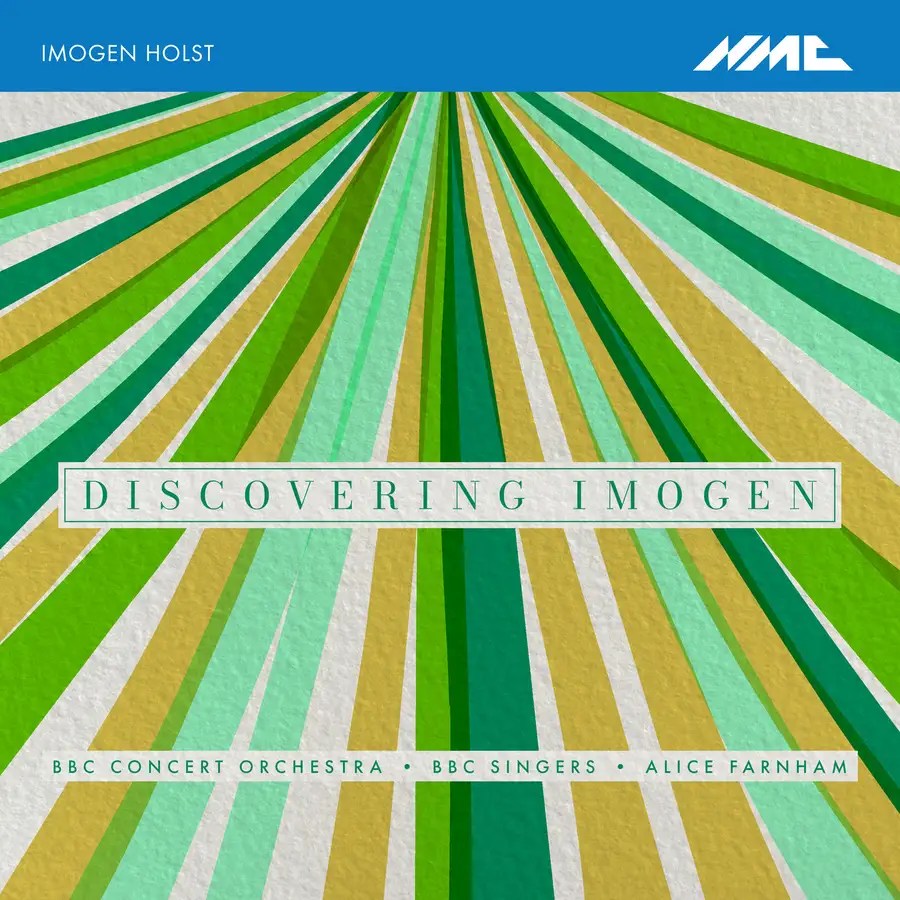
On Record – Imogen Holst: Discovering Imogen (NMC)

BBC Singers (What Man Is He?, Festival Anthem), BBC Concert Orchestra / Alice Farnham

Imogen Holst
Persephone (1929)
Variations on ‘Lorth to Depart’ (1962)
What Man is He? (c1940)
Allegro Assai (1927)
On Westhall Hill (1935)
Suite for String Orchestra (1943)
Festival Anthem (1946)

NMC Recordings NMCD280 [75’01”] English texts included
Producer Colin Matthews Engineers Marvin Ware, Robert Winter, Callum Lawrence
Recorded 27-29 January 2024 at Maida Vale Studio One, London

Reviewed by Richard Whitehouse

What’s the story?

As its executive producer Colin Matthews notes in his introduction, NMC would likely not exist had it not been for Imogen Holst (1907-84) setting up the Holst Foundation prior to her death – so making this release of her larger-scale works the more appropriate, and welcome.

What’s the music like?

The present anthology affords what seems a plausible overview of its composer’s output. The earliest piece here is Allegro Assai, evidently planned as the opening movement of a suite for strings that progressed no further, but which proves characterful and assured on its own terms. Such potential feels well on the way to being realized in Persephone, an overture (albeit more akin to a tone poem) given in rehearsal by Malcolm Sargent, with the influence of Ravel (and indirectly of Vaughan Williams) balanced by the dextrous handling of motifs across a formal evolution such as relates the myth in immediate and individual terms. That this went unheard until the present recording was likely as much a loss to the musical public as to Holst herself.

Underlining its composer’s skill in writing for amateurs, On Westhall Hill is an atmospheric piece the more appealing through its brevity and modesty of scoring. Deriving its text from the Book of Wisdom, What Man Is He? traverses a range of emotions from the sombre, via the introspective, to the affirmative in a setting as searching as it is fervent. Most impressive, however, is the Suite for String Orchestra composed for a ‘portrait’ concert at Wigmore Hall. The four movements unfold from a diaphanous Prelude, via a fluid and astringent Fugue then an Intermezzo whose ruminative warmth hints at qualities rather more fatalistic, to a Jig which convincingly rounds off the whole work with its mounting energy and resolve.

Written in the wake of the Second World War, Festival Anthem went unheard at this time but could be thought a ‘song of thanksgiving’. Adapted from Psalm 104 (‘Praise the Lord, O my soul’), it seamlessly integrates soloistic with choral passages prior to a calmly fulfilled close. The latest work here, Variations on ‘Loth to Depart’ takes a 17th-century tune as harmonized by Giles Farnaby as basis for five variations – the initial four respectively trenchant, eloquent, wistful and incisive; prior to a relatively extended chaconne as distils a pathos the more acute for its understatement. A string quartet is combined resourcefully with double string orchestra in music which can at least hold its own in the context of a distinctive genre in British music.

Does it all work?

It does indeed. It is all too easy to think of Imogen Holst as one who never fully realized her potential in the face of life-long teaching and administrative commitments, but the range of what is heard amply indicates her creative legacy to be one worth exploring in depth. The recordings, moreover, could hardly be bettered in terms of their overall conviction – Alice Farnham securing a laudable response form the BBC Concert Orchestra and, in the choral pieces, BBC Singers. Hopefully other ensembles, professional or amateur, will follow suit.

Is it recommended?

It is indeed. Sound is unexceptionally fine, with informative notes from Christopher Tinker. Alongside the NMC release of her chamber music for strings (D236), and that on Harmonia Mundi of choral music (HMU907576), this is a fine demonstration of Imogen Holst’s legacy.

Listen & Buy

You can listen to samples and explore purchase options on the NMC Recordings website. For more information on the artists, click on the names to visit the websites of the BBC Singers, BBC Concert Orchestra and conductor Alice Farnham, while a dedicated resource can be found for Imogen Holst herself

Published post no.2,374 – Tuesday 26 November 2024

On Record – Merope – Véjula (STROOM)

by Ben Hogwood

What’s the story?

This is the fifth album from Lithuanian duo Merope, who are Indrė Jurgelevičiūtė (singer and kanklès) and Bert Cools (guitar and producer). They have built a lasting reputation for their individual blend of folk and ambient music, honed on the Stroom label since 2012.

Véjula finds them spreading their wings to welcome collaborations with like-minded musicians, including Shahzad Ismaily, Laraaji and Bill Frisell.

What’s the music like?

Merope are simultaneously soothing and stimulating. Their ambient credentials are very strong, and because of that Koumu Lil immediately takes you to a calm, meditative spot, aided by the Lithuanian chordophone known as the kanklès. Once there you can admire the inventive musicianship on offer, as the music shimmers and sparkles in front of your eyes.

Throughout there is an endearing richness of colour, with music that can meander on occasion (enjoyably so) before being punctuated by sudden pinpoints of focus. Laraaji’s zither on Namopi, brings rich swathes of sound, complemented by Shahzad Ismaily’s vocals and prompted by the bass. The thrumming of Vija is similarly hypnotic, while there are more intimate musings on Spindulé. Ismaily returns for O Underhill’s fascinating exercises in perspective, with fragmented bursts of sound.

Frisell plays electric guitar on Lopšinė, a rather wonderful reverie complemented by wordless vocals.

Does it all work?

It does. Merope don’t give the impression of working within rules, but their sense of structure is instinctive and ensures each of their musical explorations is expertly judged.

Is it recommended?

It is. A blissful 40 minutes in the company of a consistently inventive act, one whose colour and warmth is difficult to resist.

For fans of… Laraaji, Harold Budd, Penguin Cafe Orchestra, Bill Frisell

Listen and Buy

Published post no.2,371 – Saturday 23 November 2024

On Record – One True Pairing – Endless Rain (Domino)

by Ben Hogwood

What’s the story?

One True Pairing is the moniker for Tom Fleming, once of Wild Beasts – and is a vehicle that he has used for frank and honest commentary on his life.

In some commendably honest interviews, Fleming has spoken of his mental health difficulties, exacerbated by addiction, but has explained too how music has helped bring him round from them to a much safer space.

Having given notice of his solo potential with his self-titled debut record in 2019, Fleming returns with a host of instrumentalists in tow, but with his guitar kept closest to him.

What’s the music like?

Fleming is a confidential songwriter, letting the listener in to all corners of his world. This is most apparent on songs like Doubt, where he honestly offers up the lyric “I will always do what it takes, but there’s a doubt I can’t shake”. I Don’t Want To Do This Anymore goes further, regretting that “again, we’re lying in a puddle that we made”.

That he makes these brave asides is value enough, but when set against the beautiful instrumentation, chosen with regular collaborator Josh Taylor-Moon and producer John ‘Spud’ Murphy, the results are compelling. Prince Of Darkness is like a coiled spring, Fleming’s urgent vocal offering reassurance from the calm bed of guitars around it, before a sweeping harp takes over. Endless Rain is on firmer ground, and Midlife Crisis finds impressive resolve in the face of its doubts.

Throughout, Fleming’s voice is as personal as could be, its husk burning a path into the listener’s soul. At times this can lead to uncomfortable truths – A Landlord’s Death especially – while elsewhere it feels like a consoling hug. Ruthless Streak is darkly coloured but its string harmonics take it through a fever dream.

Perhaps most affecting of all is Frozen Food Centre, a beautiful epic where swirling guitars back a song about childhood, with the reassurance of home but the threat of spectres lurking in the aisles of the supermarket.

Does it all work?

It does. There is some remarkable music here, written out of necessity – and it makes a powerful impact.

Is it recommended?

Very much so. Those remembering Wild Beasts would be well advised to add One True Pairing to their collection if they haven’t already, as would those whose heads might be turned by songs with a folky edge. On this record Tom Fleming is in the same space as the listener, pouring out heart and soul, and his music resonates deeply with both.

For fans of… Wild Beasts, Nick Drake, Elliott Smith, John Martyn

Listen and Buy

Published post no.2,363 – Friday 15 November 2024

On Record – Bruce Brubaker – Eno Piano 2.0 (InFiné)

by Ben Hogwood

What’s the story?

Building on the success of his first album of Brian Eno reinterpretations, pianist Bruce Brubaker goes deeper into the ambient master’s output.

In his explorations, Brubaker continues to use a Steinway concert grand piano with electromagnetic bows that help him create sustained drone textures.

Here he takes two sections from the 1978 ambient classic Music For Airports album alongside three others, using advanced IRCAM spatialization tools to create an “immersive acoustic experience, turning the piano into a supernatural synthesizer.”

What’s the music like?

The Music For Airports excerpts, not surprisingly, are incredibly calming – and beautifully played. The second version of 1/2 uses the electromagnetic bows to create a sound almost like the clarinet in timbre. Brubaker judges the critical elements like attack and sustain just right, a faithful recreation of the original Eno work but one that gives him plenty of room and space around in the acoustic.

The slow tracks work beautifully, especially Failing Light from Eno’s Ambient 2: The Plateaux Of Mirror, the collaboration with Harold Budd, which is lovingly shaded here. The big surprise, however, is The Big Ship, where he recreates everything by hand, including the shift of rhythmic emphasis that Eno originally performed with an organ drum machine. Here it is commanding and delivered with impressive poise.

Does it all work?

Very much so. Brubaker’s eye for detail and virtuosity work hand in hand.

Is it recommended?

Enthusiastically. Eno Piano 2.0 is an obvious complement to the first instalment but shows Eno’s music in a new and enchanting light. Ambient music has lasted a lot longer than we dared imagine, and reinterpretations like this will only prolong its appeal further.

For fans of… Brian Eno, Harold Budd, Philip Glass, Michael Nyman

You can read an extensive interview with Bruce on Arcana, where he talks about interpreting Eno’s work for piano.

Listen and Buy

Published post no.2,349 – Friday 1 November 2024