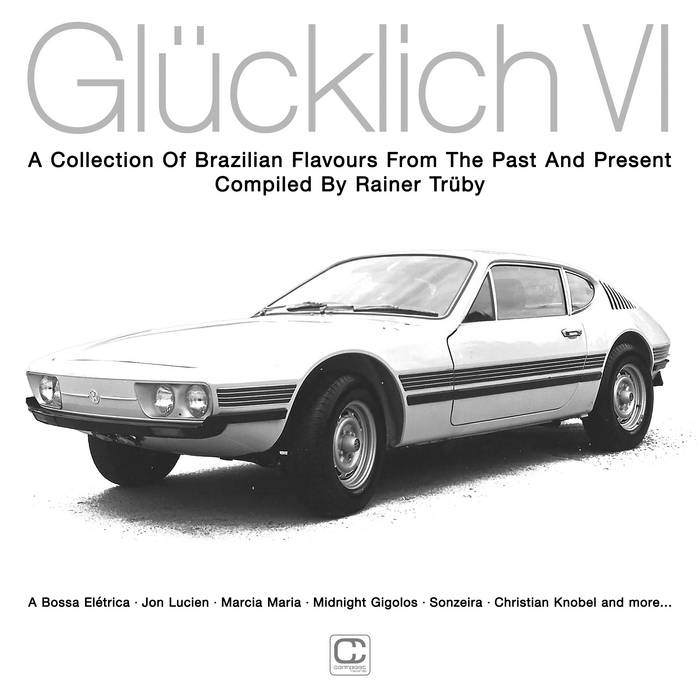
After a long time on hyetas, Rainer Trüby adds a sixth instalment to his Glücklich series, celebrating Brazilian and Brazilian-flavoured music, old and new.
Trüby is a fanatical collector, leaving no stone unturned in the pursuit of happiness, scooping up a number of rarities and vinyl-only gems along the way. It may be two decades since the last Glücklich release, but this one draws on all the elements that made the first five volumes essential for collectors and Brazilian music devotees.
What’sthemusiclike?
Smile-inducing. If you have collected the series to date, you will know what to expect, but for the uninitiated the music here gives an instant, uplifting fix.
If Jon Lucien’sCome With Me To Rio doesn’t get you, with its promise of ‘doing the samba when they want’, then Debbie Cameron & Richard Boone‘s breezy Stop Foolin’ Yourself will. Jean-Marc Jafet‘s Offering goes with a swing, as does Marcia Maria’s piano-fuelled Brasil Nativo.
On the cool side sit MidnightGigolos with BrotherSamba and a winsome Portuguese-language cover of Roy Ayers from Swedes A BossaElétrica, Sob A Luz Do Sol.
Meanwhile Trüby himself gets in on the act with a sultry remix of the Gilles Peterson project, Sonzeira‘s The Mystery Of Man.
Does it all work?
Yes. The loving attention to detail extends throughout the tracklisting and as far as the artwork, which once again links Germany and Brazil – the car being a Volkswagen SP2 manufactured in Brazil between 1972 and 1976.
Is it recommended?
It is great to see Rainer Trüby picking up where he left off with this series, investing a great deal of love and devotion into the music. Because of that we get a winsome collection of music capable of bringing the sunshine to any summer.
A generous 4-CD compilation from Cherry Red, billed as a celebration of the Madchester / baggy scene and the Indie-dance crossover.
If you were anywhere near Radio 1 or even Radio 5 in the early 1990s you will have known about the influence this scene had on the singles charts, but Cherry Red are looking at it from the perspective of the clubs. With that in mind the tracks here are presented unmixed and mostly in 12″ form.
What’sthemusiclike?
This is a buoyant collection to raise many smiles among listeners who were there at the time…but will surely serve as the ideal way in to the curious first-timers.
The big hits take care of themselves – Happy Mondays‘ StepOn, TheCharlatans‘ IndianRope and Stone Roses‘ FoolsGold are pure Manchester gold. That’s before you consider InspiralCarpets, James (via the mixing desk of Andrew Weatherall) and Primal Scream (via Terry Farley)
That the scene crossed over to Ibiza is clear from the inclusion of 808 State‘s PacificState and TheBeloved’sThe Sun Rising. Shoegaze classics abound too, from Chapterhouse and Spacemen3 – or leaner, more direct efforts from the likes of Carter USM and PopWillEatItself.
While it’s great to have the well known classics, the bubbles from beneath the surface are even more valuable. Lesser known names such as Paris Angels, TheWendys, SinisterGroove and NewFastAutomaticDaffodils prove their worth too.
Does it all work?
It does – and the breadth of styles means that this is a collection to dip into over and over again. It also has the added value of putting overplayed radio hits back in their best context. TheMockTurtles‘ CanYouDigIt?is a prime example!
Is it recommended?
Wholeheartedly. As a snapshot of a euphoric time in British music history, ComeTogether works an absolute treat.
After three well-received singles in Wasted, Liberty and Bassdrone, Joyhauser release their debut album. The Belgian duo have spent three years honing their craft, building a strong following underground – but now is the time to put their heads above the parapet and show their true worth.
What’sthemusiclike?
There is some thrilling dancefloor action on In Memoro.
Leben is a powerful opening track, a brooding slower number that catches light halfway through as synth lines flicker like lightning. The coiled spring energy is emphatically released in the quickly paced LXR02, a dark chocolate number with tough beats and a strong workout for the synths.
Elsewhere the combination of minimal but probing synth lines and sharply edged beats yields plenty of rewards. Bassdrone and Liberty are both dancefloor thrillers, and each track brings something to the table.
Does it all work?
Yes. Excitement levels remain high throughout!
Is it recommended?
It is. An excellent debut that bodes well for the future.
Jayda G’s new opus is an intensely personal tale. Since her last album was released, the Canadian singer-songwriter has seen a surge in popularity bringing her high profile remixes and DJ sets, not to mention gigs. It has also seen her marry her childhood sweetheart in the same house where her parents were married.
The story here is much more about them than her – and specifically her father, William Richard Guy, whose voice can be heard in the spoken word interludes surrounding the music. The music itself is all about him, too, tracking his upbringing in Kansas, brushes with local gangs and the authority, splitting with his wife on return from a stint in Vietnam and moving to Washington. From there he moved to Canada, where he remarried and Jayda was born.
Jayda tells the story through pop music, though is more than happy to bring in house, funk and soul to enrich the musical flavour.
What’sthemusiclike?
As above – pop music with extra colour and spice. Jayda writes with clean lines and has a cool vocal delivery, but these are beautifully worked nuggets that work in several contexts. House music fans will love the tempo and energy, lovers of soul will appreciate the deeper moments and the connection to the heart that she finds with her lyrics and vocals.
Pure pop music fans, meanwhile, will delight in the sharply observed lyrics, the hooks on which the music comfortably hangs, the sleek production and the riffs aplenty. What also helps a load here is the way Jayda clearly enjoys her role, and the personal input she gives to tell her story as vividly as possible.
There are many highlights, but a special mention should be made for Heads Or Tails, with its sharply observed pop and house music edge, Jayda G delivering typically cool vocals. Meanwhile Your Thoughts is an excellent power pop song, faultlessly delivered.
Does it all work?
It does. The ebb and flow here is spot on, the movement towards house music only heightens the pop sensibility, and there is a good groove at every turn.
Is it recommended?
It certainly is. This is music that is personal to Jayda G, but it will resonate deeply with any listener making the effort to get involved.
A press release in full, detailing an exciting album coming in October:
This autumn, Erased Tapes are set to release ‘Give It to the Sky: Arthur Russell’s Tower of Meaning Expanded’ by composer and producer Peter Broderick and French 12-piece group Ensemble 0; a complete re-recording of Russell’s epic minimalist orchestral composition originally released in 1983.
Released 6th October, ‘Give It to the Sky’ also includes unreleased tracks by Russell which have been restored and re-recorded, resulting in an 80-minute reanimation that threads several lost songs into a meticulous and gorgeous rendering. The album was recorded live as a group in a small theatre in the Southwest of France with minimal overdubs.
Today, Peter & Ensemble 0 share the lead track ‘Tower of Meaning III’. Peter says of the song; “Tower of Meaning III’ is as good a place to start as any, and being the third track on the album, after a couple of short introductory pieces, I see it as the first piece on the record which dives deeply into the wonderful and mysterious world that is ‘Tower of Meaning’.”
For all its wonder and beauty, the musical output of the American cellist, composer, singer, and musical visionary also embodies irony, tragedy, and paradox. Russell famously recorded more than 1,000 hours of tape and left an otherwise-tremendous archive, now part of the New York Public Library. But before his death in 1992, Russell released just three albums under his own name. One of those was ‘Tower of Meaning’ (1983), a score commissioned for and then abandoned by a Robert Wilson production of Euripides’ Medea. Composer and pianist Philip Glass helped preserve the music, at least, subsequently releasing a somewhat-thin recording on his own label of just 320 LPs.
A few years into his obsession with Russell’s work, Broderick paid $500 for one of those scant copies (it was remastered and reissued in 2006, followed by several subsequent editions). Still, he didn’t connect with that collector’s item the way he did with so much of Russell’s oeuvre. It felt a tad cold and distant, Russell’s usual tangle of intimacy and mystery perhaps lost in his frustrations with the process or maybe in the recording itself. Ensemble 0 founder Stéphane Garin realized he needed to pursue this project immediately after performing just a bit of the piece. In 2019, the group played a 25-minute chunk as a preamble to ‘Femenine’, the pulsing minimalist masterwork of Julius Eastman (a longtime Russell collaborator, Eastman conducted the initial recording of ‘Tower of Meaning’). He was struck by its splendor and subtle difficulty, the way that Russell shirked dissonance in favor of metric complexity. There was little else like it.
Garin was aware of Broderick’s stints interpreting Russell’s songs on stages and albums for the better part of a decade but also his work collaborating with Russell’s estate to restore previously unreleased tracks for the critically acclaimed album ‘Iowa Dream’ (2019). Broderick naturally did not hesitate when Ensemble 0 asked him to enlist, but he did offer a surprise: Rather than lace ‘Tower of Meaning’ with expected Russell standards, why not incorporate some of his cherished songs that had never found a home?
Early in the process, Ensemble 0 made the decision that they would not seek out Russell’s original esoteric scores, which had already been used to stage ‘Tower of Meaning’ elsewhere. They liked the fact that the recording felt unfinished, allowing them to consider what was missing and how the ever-restless Russell might have modified it over time. Ensemble 0 saxophonist Julien Pontvianne toiled over this task, scrutinizing recordings that Russell had slowed with a tape machine in order to find the melodies and undergirding arrangements.
‘Give It to the Sky’ is supple and dioramic. Pontvianne’s transcriptions add both muscle and nuance to the original recording, with a new low-end depth to balance the trebly tremble. Ensemble 0’s layers are as intricate as they are expertly rendered, the obfuscation of that rare Glass release replaced by a clarity that lets you peer inside this mesmeric music. New ideas appear, suggesting ‘Tower of Meaning’ as the scaffolding to something greater.
Ensemble 0 weave in and out of Broderick’s additions. ‘Corky’, a poignant cowboy ballad that Russell never finished, appears, disappears, and reappears three times, the droning exhalations of ‘Tower of Meaning’ making it feel sweeter and sadder. Arriving just after the triumphant halfway mark, the title track is a sublime meditation on mere existence, about staring at some simple rural scene and marcelling at the miracle of being anywhere at all. It is an apt encapsulation of how this entire project feels – a glorious way to hear something that might have seemed familiar as if for the very first time.
Russell was never much for definitive versions, of course. He was constantly rethinking the possibilities of a piece, of wondering what else it could do. ‘Give It to the Sky’ is a powerful affirmation of those principles, using Tower of Meaning’s framework to build outward and upward, to shape something that functions within Russell’s wondrous, paradoxical world. And ‘Give It to the Sky’ is also not intended to be some definitive last word. Broderick and Ensemble 0 speak already of the ways it may shift on stage, of where else it might lead.





 Arcana.fm