Online concert – English String Orchestra / Kenneth Woods: Elgar Festival 2022

Elgar arr. Fraser Nursery Suite (1931 arr. 2022) World premiere of this arrangement
David Matthews Shiva Dances Op.161 (2021) World premiere

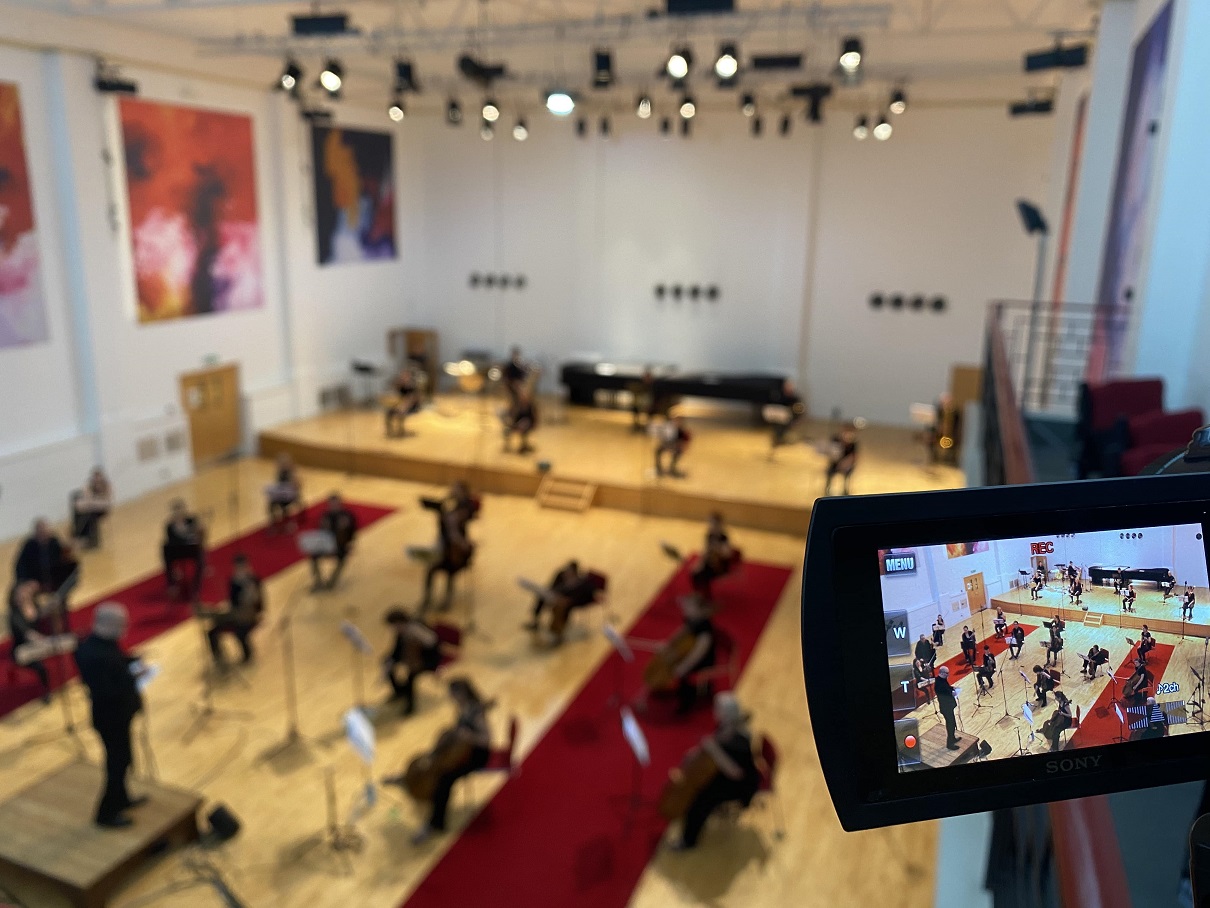
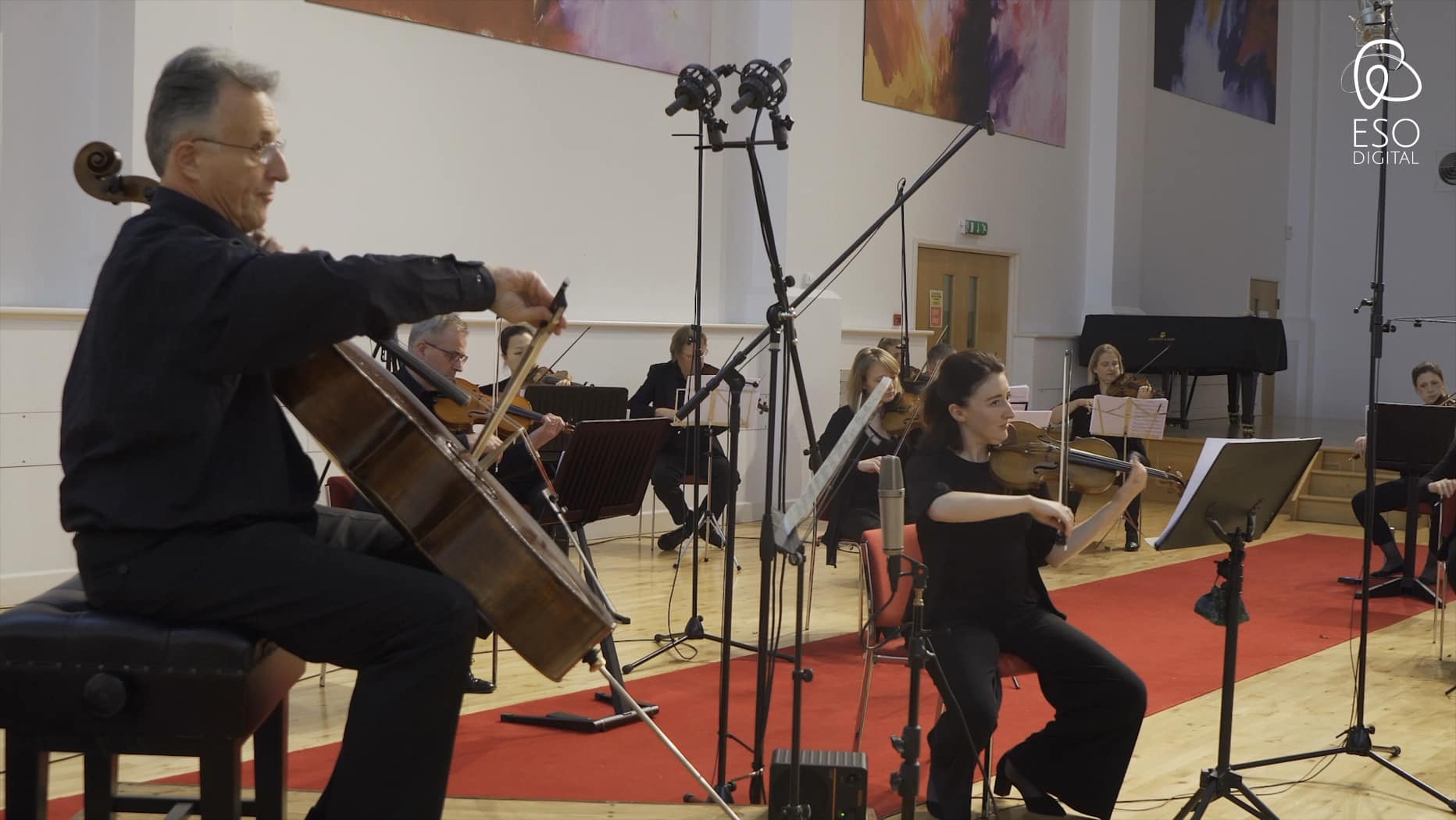
English String Orchestra (soloists Zoë Beyers, Suzanne Casey (violins), Carl Hill (viola) and Joely Koos (cello) / Kenneth Woods

Filmed at the Guildhall, Worcester, Friday 3 June 2022

by Richard Whitehouse

Welcome listening for the new year provided by the English String Orchestra, as taken from a programme at this year’s Elgar Festival and which featured the premiere of that composer’s last notable work in what is an idiomatic and often perceptive arrangement by Donald Fraser.

His previous Elgar arrangements ranging from miniatures to the Piano Quintet, Fraser duly captured the wistful charm of the initial Aubade then discreet pathos of The Serious Doll. The ESO steered a secure course through the headlong intricacy of Busy-ness, with the deft profundity of The Sad Doll afforded full rein. Solo strings against an implacable rhythmic ostinato offset any lack of visceral impact in The Waggon (sic) Passes, then the high spirits of The Merry Doll were jauntily in evidence. The extended finale, Dreaming is a threnody of tangible emotional import and a resume of earlier themes on its way to a forthright if not a little regretful coda. Kenneth Woods ensured this had gravitas without losing focus, while a bravura showing from Zoë Beyers was but the last in a sequence of solos all admirably taken.

Solos are by no means absent from Shiva Dances by David Matthews. The combination of string quartet and string orchestra has potent Elgarian connotations, of which the composer avails himself in this continuous sequence inspired as much by Aldous Huxley’s description of the Hindu god Shiva as by Indian classical music. Moving from a slow introduction given piquancy by its modal intonations, the work comprises four dances that between them outline the four elements: an impetuous workout representing ‘earth’, a quixotic interplay for soloists and ensemble that of ‘water’, the scherzo-like agility of ‘air’, and an animated waltz for ‘fire’. This latter builds to a forceful restatement of the opening theme, before a coda intensifies the overall expression such that what came before is rendered from a more ethereal perspective.

It says much for the prowess of the ESO that this first hearing betrayed few signs of caution or uncertainty, Woods directing a confident account with which Matthews must have been well pleased. Those listening to this online programme can also hear an encore in the guise of Nimrod from Elgar’s Enigma Variations, taken from a performance during last year’s Elgar Festival and which exudes a searching eloquence as seems to look beyond forthcoming celebrations to that overtly commemorative atmosphere from only a matter of weeks later.

This concert could be accessed free until 1 January 2023 at the English Symphony Orchestra website, but remains available through ESO Digital by way of a subscription. Meanwhile click on the names for more on the English Symphony Orchestra and Kenneth Woods, or on composer David Matthews

Online concert – English Symphony Orchestra / Kenneth Woods: Steven R. Gerber – Music In Dark Times

Gerber Music in Dark Times [UK premiere]

English Symphony Orchestra / Kenneth Woods

Recorded at Wyastone Concert Hall, Monmouth, 2 December 2021

by Richard Whitehouse

The English Symphony Orchestra has been assiduous in promoting Steven R. Gerber (below), not least with a release of string-orchestra arrangements of his chamber music from Darron Hagen and Adrian Williams (Nimbus NI6423), and now this online performance of Music in Dark Times.

Written to a commission by Vladimir Ashkenazy and the San Francisco Symphony Orchestra, who gave the first performance in March 2009, this is very much a synthesis of traits from its composer’s maturity and, in contrast to the largely interiorized world of his chamber output at this time, a demonstrably public statement with resonances beyond its immediately American context. Opening with an expanded version of the Fanfare for the Voice of America, written in the aftermath of those events of 9/11, it continues with a Pavane featuring the diaphanous interplay of brass and strings, then by a Dance of Death whose tarantella-like underpinning adds greatly to its malevolence. This, in turn, finds contrast in a Dead March which builds in a steady crescendo towards a climax left ominously unresolved. It remains for an Elegy, scored only for strings, to provide a measure of solace in music that reaches back to pieces by composers such as Piston, Carter and Barber; after which – a full orchestral Fanfare brings this sequence to a close which, while far from affirmative, offers at least a glimmer of hope.

Although scored for sizable forces – including triple woodwind, five horns and four trumpets – Music in Dark Times is resourcefully as well as atmospherically orchestrated so that salient details are always heard to register. The ESO players are audibly at home in this piece, while Kenneth Woods directs with assurance music he clearly – and rightly – believes in. Hopefully it will be issued on a future release of Gerber’s orchestral work (including the still unrecorded Second Symphony), but for now this latest ESO online offering can be well recommended.

This concert can be accessed free from 14-18 October 2022 at the English Symphony Orchestra website, then through ESO Digital by way of a subscription. Meanwhile click on the names for more on the English Symphony Orchestra and Kenneth Woods – while information in the orchestra’s Steven R. Gerber release can be found here

Online concert – English Symphony Orchestra / Kenneth Woods: Music from Wyastone – Sibelius: Symphony no.6 & Tapiola

Sibelius Symphony no.6 in D minor Op.104 (1923); Tapiola Op.112 (1926)

English Symphony Orchestra / Kenneth Woods

Recorded at Wyastone Concert Hall, Monmouth, 1-2 March 2022

by Richard Whitehouse

A cycle of Sibelius symphonies by the English Symphony Orchestra got underway last year with an impressive account of the Seventh, making this second instalment the more pertinent for showing just how the composer had arrived at that work and where he went from there.

Only if the Sixth Symphony is viewed as neo-classical does it feel elusive, rather than a deft reformulation of Classical precepts as here. The first movement duly unfolded as a seamless evolution whose emotional contrasts are incidental – Kenneth Woods ensuring its purposeful course complemented the circling repetition of the following intermezzo, with its speculative variations upon that almost casual opening gesture. Ideally paced, the scherzo yielded a more incisive tone which the finale then pursued in a refracted sonata design as gained intensity up to its climactic mid-point. Tension dropped momentarily here, quickly restored in a disarming reprise of its opening and a coda whose evanescence was well conveyed; a reminder Sibelius Six is as much about eschewal of beginnings and endings in its seeking after a new cohesion.

A suitably expanded ESO then tackled Tapiola – Sibelius’s last completed major work, whose prefatory quatrain implies an elemental aspect duly rendered through the near/total absence of transition in music of incessant evolution. A quality to the fore in this perceptive reading with Woods finding the right balance between formal unity and expressive diversity throughout its underlying course. Just occasionally there was a lack of that ‘otherness’ as endows this music with its uniquely disquieting aura, yet a steadily accumulating momentum was rarely in doubt towards the seething climax, then a string threnody whose anguish can bestow only the most tenuous of benedictions. A reminder, too, that not the least reason Sibelius might have failed to complete his Eighth Symphony was because he had already realized it in the present work.

The ESO being heard to advantage in the spacious clarity of Wyastone Hall, these accounts will be worth getting to know on commercial release (with the Seventh Symphony) early next year, when this cycle will itself continue with recordings of the Fourth and Fifth Symphonies

These works are available for viewing on the English Symphony Orchestra website from 29 July – 1 August, then through ESO Digital by way of a subscription. Meanwhile click on the names for more on the English Symphony Orchestra and Kenneth Woods

Online concert – Raphael Wallfisch, English Symphony Orchestra / Kenneth Woods: Elgar Reimagined

Elgar, arr. Fraser Miniatures for cello and strings: Chanson de Matin; Chanson de Nuit; The Wild Bears (Wand of Youth Suite No.2); Nimrod (Enigma Variations); Romance Op.62; Sospiri Op.70; Mazurka; Pleading; In Moonlight; Salut d’Amour; Adieu

Raphael Wallfisch (cello), English Symphony Orchestra / Kenneth Woods

Live performance at Guildhall, Worcester, 29 October 2021

by Richard Whitehouse

An afternoon concert at last year’s Elgar Festival, these Miniatures for cello and strings had been arranged by Donald Fraser for Raphael Wallfisch. Extending to an 11-movement suite, its viability in terms of smaller groupings was certainly demonstrated by this performance.

Chanson de Matin provided a mellifluous entrée, and if the cello’s assumption of the melodic line marginally obscured the strings’ contribution, that could not be said of Chanson de Nuit whose sombre inwardness was unerringly realized. Nor did The Wild Bears lose on impetus, and if the arrangement conjured Saint-Saëns, this only served to underline the importance of ‘Second Empire’ music on Elgar’s own thinking. Interesting, too, how the Romance brought soloist and strings into an even closer accord than the composer’s version with orchestra. The highlight, however, was Sospiri, for presenting one of Elgar’s finest inspirations in a striking new light. Salut d’Amour then conveyed the music’s essence without cloying, but the cello’s dominance in Nimrod detracted from its subtlety of orchestration as an ‘Enigma Variation’.

A wistful take on Adieu provided an affecting encore, but almost all these pieces would make a viable such item after the Cello Concerto or another British concertante work. What was a relaxed occasion does not imply any less commitment from Wallfisch and the English String Orchestra, heard to advantage with Kenneth Woods in the acoustic of Worcester’s Guildhall. The Miniatures sequence can be heard in full on Elgar Reimagined (Lyrita), but this selection offered an attractive contrast to those larger symphonic works heard elsewhere at the festival.

These works are available for viewing on the English Symphony Orchestra website, by way of a subscription or free trial. Further information on the Elgar Reimagined series can be found here. Meanwhile click on the names for more on Raphael Wallfisch, the English Symphony Orchestra and Kenneth Woods

Online concert – English Symphony Orchestra / Kenneth Woods: Composer Portrait – Walter Arlen

Walter Arlen
Songs of Songs (1955)
The Poet in Exile (1991)

Anna Huntley (mezzo-soprano), Gwilym Bowen (tenor), Thomas Mole (baritone), BBC National Chorus of Wales, English Symphony Orchestra / Kenneth Woods

Studio recording at BBC Hoddinott Hall, Cardiff, 17-20 February 2022

by Richard Whitehouse

Although he is likely best known by his trenchant music criticism for the Los Angeles Times, Vienna-born Walter Arlen has made a distinguished contribution to music administration and is increasingly being recognized as a composer. Several releases of his songs and piano music can be heard on the Gramola label, and this latest of the English Symphony Orchestra online concerts provides a welcome introduction to two of his works that feature orchestra – the one drawing on ancient Jewish sources with the other on poems from a leading modern author.

Whether The Song of Songs is indeed harbinger of monogamy in the Judeo-Christian moral code, it contains some of the eloquent expression in either of the Biblical testaments and has long provided a potent inspiration for musical treatment. In just under 30 minutes, Arlen’s ‘dramatic poem’ takes in the main narrative – the lively opening chorus features much sub-divided writing for female chorus underpinned by incisive orchestral textures. As the piece unfolds, it becomes evident that emotional emphasis is placed upon the solo contributions – whether those of King Solomon as sung with burnished warmth by Thomas Mole, those of the Shepherdess rendered with winsome poise and not a little insouciance by Anna Huntley, or those of the Shepherd which Gwilym Bowen here projects with no mean virility but also tenderness. Nor is the BBC National Chorus of Wales found wanting in passages with textural intricacy and intonational accuracy at a premium. If the final resolution does not bring the expected closure, the direct and unaffected appeal of this setting certainly warrants revival.

Yet the real discovery is The Poet in Exile, a song-cycle to texts by the Polish-American author and cultural eminence Czesław Miłosz. For all its undoubted depth and profundity, these texts are not easily rendered in musical terms, and it is to Arlen’s credit that he goes a considerable way towards elucidating them thus. As the latter states, these poems ‘‘dealt with situations echoing my own remembrance of things past’’; a quality which holds good from the trenchant rhetoric of ‘Incantation’, via the sombre rumination of ‘Island’ then the whimsical elegance of ‘In Music’ and controlled fervour of ‘For J.L.’ (with its distinctive obligato for harpsichord), to the confiding intimacy of ‘Recovery’. Inquiring listeners may already have heard these songs with piano on one of the Gramola releases with Christian Immler accompanied by Danny Driver (GRAM98946), but this version – as orchestrated by Kenneth Woods after an arrangement by Eskender Bekmembatov – makes for a richer and wider-ranging context for a vocal line projected with real assurance by Thomas Mole.

Throughout these works, the musicians of the ESO are heard to advantage in the spacious acoustic of Hoddinott Hall and are directed by Woods with sure sense of where to place the emotional emphasis – especially important in conveying the meaning of the songs. If not a major voice, Arlen’s output is always approachable and often thought-provoking. Anyone who has encountered it will enjoy getting to know his music on a larger scale and hearing it played so persuasively: a worthy present for the composer in advance of his 102nd birthday.

These works are available for free public viewing from 13-17 May on the English Symphony Orchestra website

For further information on Walter Arlen, click here – and for the appropriate Gramola Records link click here. Meanwhile click on the names for more on Czesław Miłosz, the English Symphony Orchestra and Kenneth Woods