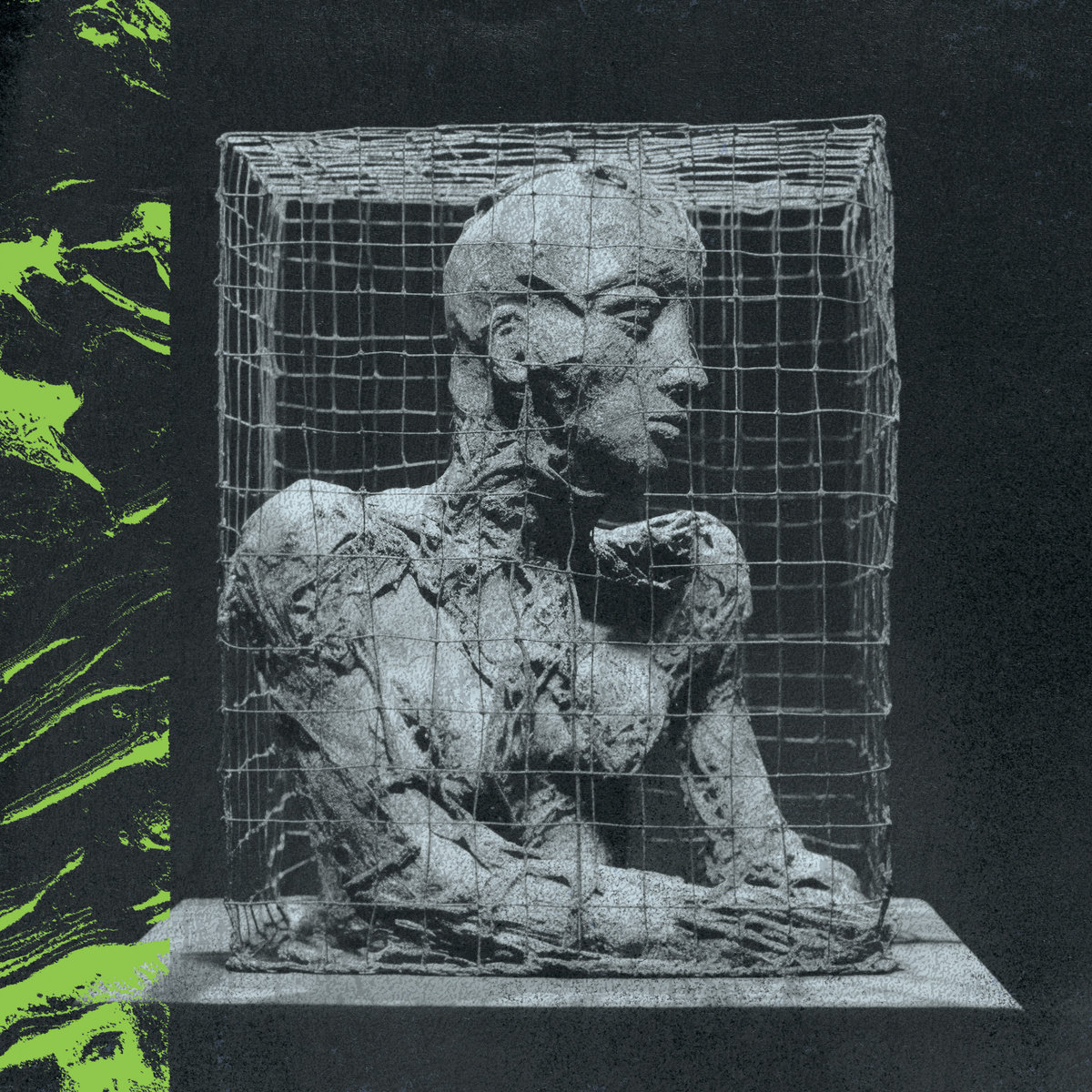
On his Bandcamp page, Brazilian artist Carlos Ferreira is described as an ‘experimental guitarist and composer whose work explores the relationship between sound, space, time and memory.
Isolationism is meant as a study in frequency, resonance and vibration – achieved through the use of electronic and acoustic instrumentation, drones and field recordings.
What’sthemusiclike?
Impressively varied for slow music of this type, and unusually absorbing, too. Isolationism works when listening close up, but it also gives the listener an intriguing set of perspectives as they work through the album, each track placing them in a different soundscape. Around them Ferreira blends a wide variety of slow-moving studies, each individually coloured to descriptive effect.
An Extension Of Breath, featuring sound artist Echo Ho, sets an airy mood, together with field recordings of birds that will confuse the listener walking along on headphones.
The two Quietitude tracks are rather special. Quietitude I features sustained chimes that resonate deeply over a drone that slowly makes itself known and increases in volume only slightly – but enough to sustain a good deal of tension. Quietitude II is much more distorted and ominous, providing a heavy backdrop even when the treble opens out to more opulent textures.
Clarinettist Lucas Protti is a sensitive guest on Living A Metaphor, where his opening ruminations feel borne from a street corner. Percussionist Manami Kakudo brings an unexpected bout of kinetic energy to Naturaleza Muerta, with more playful riffs and bold textures.
Meanwhile Artificial Lungs is a study in perspective, with a single probing piano line tracing tendrils that are gradually washed away by a wave of more distorted but consonant harmony. Take Shelter is more restrained before agitation returns in the form of Organic Matter, where pitches align in bright harmony against slow moving percussion given maximum reverb.
Does it all work?
It does. Some of the louder music can be quite abrasive and confrontational, but this is an observation rather than a criticism. It shows that Ferreira can evoke very different moods in the course of his work.
Is it recommended?
It is – providing more evidence that AKP Recordings are a springboard for fascinating and absorbing musical explorations. Carlos Ferreira definitely fits the bill for that.
The incredibly prolific John Tejada returns with his 15th album – this time pruning his music down to the bare essentials.
With seven tracks clocking in at 36 minutes, this is a record that looks for economy, Tejada having undergone a rigorous quality control process to get it released. As with much of his music the outlook is instrumental, though there is a vocal guest – March Adstrum – on the central track Fight Or Flight.
What’sthemusiclike?
Tejada consistently impresses with his ability to write huge amounts of fully satisfying techno music that – while largely machine generated – has a profoundly beating heart.
As with much of his work, four to the floor is the base on which he operates – but there are always percussive nuances and melodic lines that keep the listener’s interest high and the dancer’s feet ready to go. Starting with woozy atmospherics, the single Simulacrum soon sets down a strong 4×4 beat, bolstered with extra percussion.
Someday has a golden glint to its production, shining through the hazy white noise. The Disease has that lovely steadying quality that Tejada can bring to his music, while Fight Or Flight – with an excellent contribution from March Adstrum – has lovely warm colours and shimmering textures. Centered is a funky piece of work – and a fine one at that – but Trace Remnant is even better, bolstered by Different Mirrors as a coda.
Does it all work?
It does. Tejada has an established style with intricate workings that repays repeated listening – and the golden haze he secures here is rather beautiful.
Is it recommended?
It is. John Tejada remains on top form!
Listen
Buy
Published post no.2,006 – Saturday 11 November 2023
Six years on from Compassion, his debut release for Ninja Tune, Matthew Barnes returns under his Forest Swords moniker for a powerful follow-up. The intervening period has seen him working on commissions writing music for film, ballet and video games – but as listeners will discover from his second album, Barnes continues to take a bold approach to his work.
Bolted was recorded in Barnes’ home city of Liverpool, in a warehouse space – and it includes singles The Low and Butterfly Effect.
What’sthemusiclike?
Expansive. The Forest Swords sound world is one with wide, panoramic views that are especially effective on headphones. Big, reverberant beats and synths are complemented by vocals that are deliberately treated, sometimes warped to blend in with their surroundings as they are on End or brought to the front for maximum effect, as they are on the powerful Line Gone Cold, an epic and emotive piece of work that closes the album.
Often it feels like Barnes’s music is telling the story of an industrial process, with the clanging of percussion in Rubble a working example. Butterfly Effect has rolling beats like a pinball machine but with widescreen synths out front, while Tar sounds like an old, distorted squeezebox pressed into action at short notice. Night Sculpture, an impressive construction, is dominated by a bold melodic chime and is typical of an ability to paint vivid and meaningful pictures in sound.
Does it all work?
It does. Forest Swords stands for distinctive, evocative music that draws from the past – 1980s acts such as Cabaret Voltaire could be mentioned – but also feels part of the future.
Is it recommended?
Yes. This is a bold, striking album that repays repeated exploration.
Listen
Buy
Published post no.2,004 – Thursday 9 November 2023
This is the debut album from Scottish artist Joshua Mannie, better known in musical circles as Barry Can’t Swim.
His singles Sunsleeper and Woman have fared particularly well during 2023, fulfilling Mannie’s wish to deliver the energy of electronic music but with real time performance, so that the music doesn’t sound too manufactured.
The diversities of this album include the sampling of Brazilian group Trio Ternura on Dance Of The Crab, and a rich choral palette on Always Get Through To You. There are vocal guests, too – somedeadbeat, Falle Nioke & Blackboxx and just lil.
What’sthemusiclike?
There is a great deal of positive energy in the music here, helped by Barry Can’t Swim’s refusal to limit himself to a single area of music. Instead he shows himself to be a prodigious shape shifter, capable of bringing uplifting vocals to a mix that includes Afrobeat, deeper house, a bit of jazz, and what sounds like a freely improvised piano.
All of Mannie’s music is freshly minted, as though it were recorded yesterday. It ranges from Sonder, a lovely bit of airy, down tempo music with a soaring sax solo and bumpy rhythm, to Sunsleeper, which is a beauty with its rippling piano line. How It Feels is a good vocal, and could easily be a lot longer, but that promise is fulfilled by I Won’t Let You Down, which is a beauty thanks to the voices of Falle Nioke and Blackboxx. Often the music of Barry Can’t Swim reaches a semi-spiritual high, thanks to songs like Always Get Through To You.
Does it all work?
It does – and because of the instinctive approach to recording, this is electronically based music with a living, breathing heart.
Is it recommended?
Yes. When Will We Land? is an uplifting piece of work made by a producer of great promise and potential. Barry Can’t Swim has definitely provided some sunshine for the winter months, serving notice of another new talent on the Ninja roster.
Brian Eno (vocals, instruments), Melanie Pappenheim (vocals), Leo Abrahams (guitar), Peter Chilvers (instruments, software), Peter Serafinowicz (vocals), Baltic Sea Philharmonic Orchestra / Kristjan Järvi
Brian Eno The Ship [The Ship, Fickle Sun (I), Fickle Sun (II) The Hour Is Thin, Fickle Sun (III) I’m Set Free] By This River, Who Gives A Thought, And Then So Clear, Bone Bomb, Making Gardens Out Of Silence, There Were Bells
Royal Festival Hall Monday 30 October (9 pm concert)
by Ben Hogwood photos (c) Ben Hogwood, not to be reproduced without permission
The estimable Setlist website, documenting the concert history of artists and bands, has a notable seven-year gap between Brian Eno’s last live appearances and this new tour, in which he has been bringing an orchestral perspective to his 2016 album The Ship.
Many artists in Eno’s ambient sphere have looked at the orchestra as a vehicle for original composition, but more recently the tendency has been for artists to use it to regenerate past material, and – perish the thought – boost awareness and bank balance by association through touring. This tactic is clearly not for Eno, who invested a great deal of time in finding the right ensemble before even looking at the layout of this tour. Seeking fresh talent and players with flexibility, he alighted on the Baltic Sea Philharmonic Orchestra, a ten-year-old ensemble conducted by the dynamic Kristjan Järvi. It is fascinating to think that Kristjan, part of a remarkable Estonian conducting trio after father Neeme and elder brother Paavo, is creating new directions for his family, stepping out on ever more adventurous voyages into contemporary music.
This one – on the banks of the Thames – takes its lead from the most famous voyage of the 20th century, the Titanic. Yet Eno chooses not to tell the story in graphic detail, portraying the ship instead through shades of orchestration, atmospheric noise and folk-like utterances. These are made through his own sonorous tones, which worked in this concert to vivid effect. The sonic picture was surely aided by the inclement weather in the UK, the audience becoming part of the vessel as the sea spray splashed against the side. Meanwhile the creaks of the orchestra’s wooden instruments portrayed the boat’s natural bowing and bending.
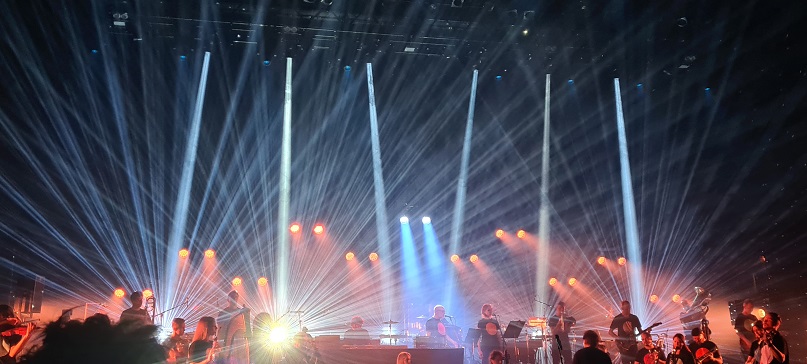
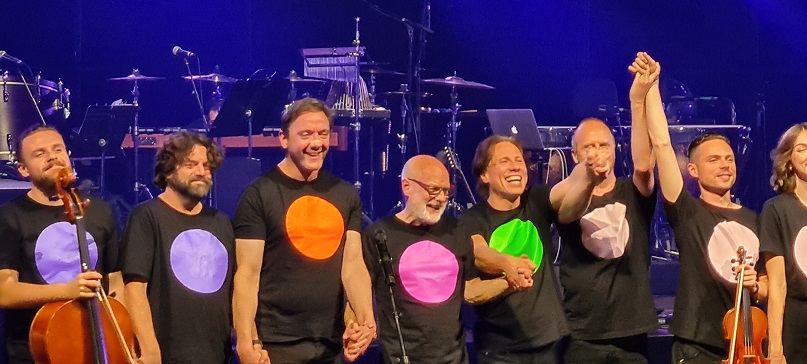
Eno’s music for The Ship reflects his ambient work, in which the music makes incremental changes in its own sweet time, but it shows how ambient music can also be loud. As time progressed this performance assumed a dramatic intensity way above that of the home listening experience. The orchestra’s control was a key aspect, with Järvi ensuring the musicians had as much freedom as they wanted. He walked around the stage to cajole individual players or sections, then faced the audience as though looking out to sea himself. Dressed in colour-co-ordinated t-shirts, the players could see each other and their conductor in the dark – not to mention the cerise shirt of Eno, a point of vivid colour in the middle.
Eno’s vocal was complemented by the understated yet versatile voice of Melanie Pappenheim, and the thoughtful input of guitarist Leo Abrahams and keyboard player / software designer Peter Chilvers. Also present was the actor and comedian Peter Serafinowicz, reading a monologue on war through rich bass tones.
The Ship, a three-movement suite, had at its heart Fickle Sun, itself in three parts. Here the onward motion of the orchestra was irresistible, still moving slowly like the Titanic but flattening everything in its path. Then, the struggle over, Eno reached for the Velvet Underground cover I’m Set Free, its heart-shifting chord progression nudging at the emotions with every repetition, providing an tidal swell for the audience.
This performance was a triumph of spirit and resolve, a warming combination in these troubled times. The encores continued in the same vein, though the deeply uncomfortable Bone Bomb, from 2005 album Another Day On Earth, provided painful relevance with its response to an article on a suicide bomber in Palestine. Eno paused the music after this to give his own unstinting views on the conflict with Israel, declaring proceeds from the Ships gigs would go to help those suffering from the war in Gaza.
Of the other encore items Making Gardens Out Of Silence, from last year’s ForeverAndEverNoMore, reached a more obvious inner peace, before There Were Bells, found Eno’s music once again reaching beyond the ambient to find notes of sustainable emotional power. Equal strength was found in By This River, the earliest music of the night (from 1977), and the track that stayed with the audience long after the concert had finished.
At the end Eno and Järvi generously credited the band and orchestral musicians, looking beyond to single out those responsible for monitoring and lighting, two crucial overlooked b but crucial elements of any performance. The lighting was wholly suitable, the relative darkness allowing the audience to use their mind’s eye in response to Eno’s resolute constructions. Thus was a memorable evening, and one in which the main man himself was also deeply moved.





 Arcana.fm