After yesterday’s languid summer overtones made by Debussy, I have opted for a very different portrayal of heat in today’s selection. The Danish composer Poul Ruders wrote his celebrated Solar Trilogy between 1992 and 1995, describing in it the life and behaviour of the Sun.
This time we get an immediate sense of the overwhelming heat generated by our nearest star from the off. It is fascinating to compare Ruders’ writing with that of Holst in The Planets. Here Ruders portrays the sheer solar energy at work, using all corners of the orchestra to create some truly vast sounds. This is modern music that responds really well to repeated listening, and could easily be used as part of a film or game soundtrack.
The trilogy begins with a stunning stroke in the form of Gong, a piece that seethes with activity and rhythmic drive, before moving onto the central Zenith, whose atmosphere grows very gradually but with considerable tension.
Finally Corona describes an eclipse of the sun, with a ‘sizzling’ start, to quote the composer, before running off at a terrific pace. With an insistent drive it radiates outwards, the orchestra effectively a supergiant star.
Danish composer Ruders continues to write a great deal of music with orchestra, and his work is incredibly descriptive and rewarding. To find out more and to hear more of his music, visit his website here – while at the bottom of this page you will find a dedicated Spotify playlist including the Solar Trilogy and the most recent recording of Ruders’ music, with Mahan Esfahani in the recent Harpsichord Concerto. In contrast, the orchestral piece Nightshade of 1986 completes the selection:
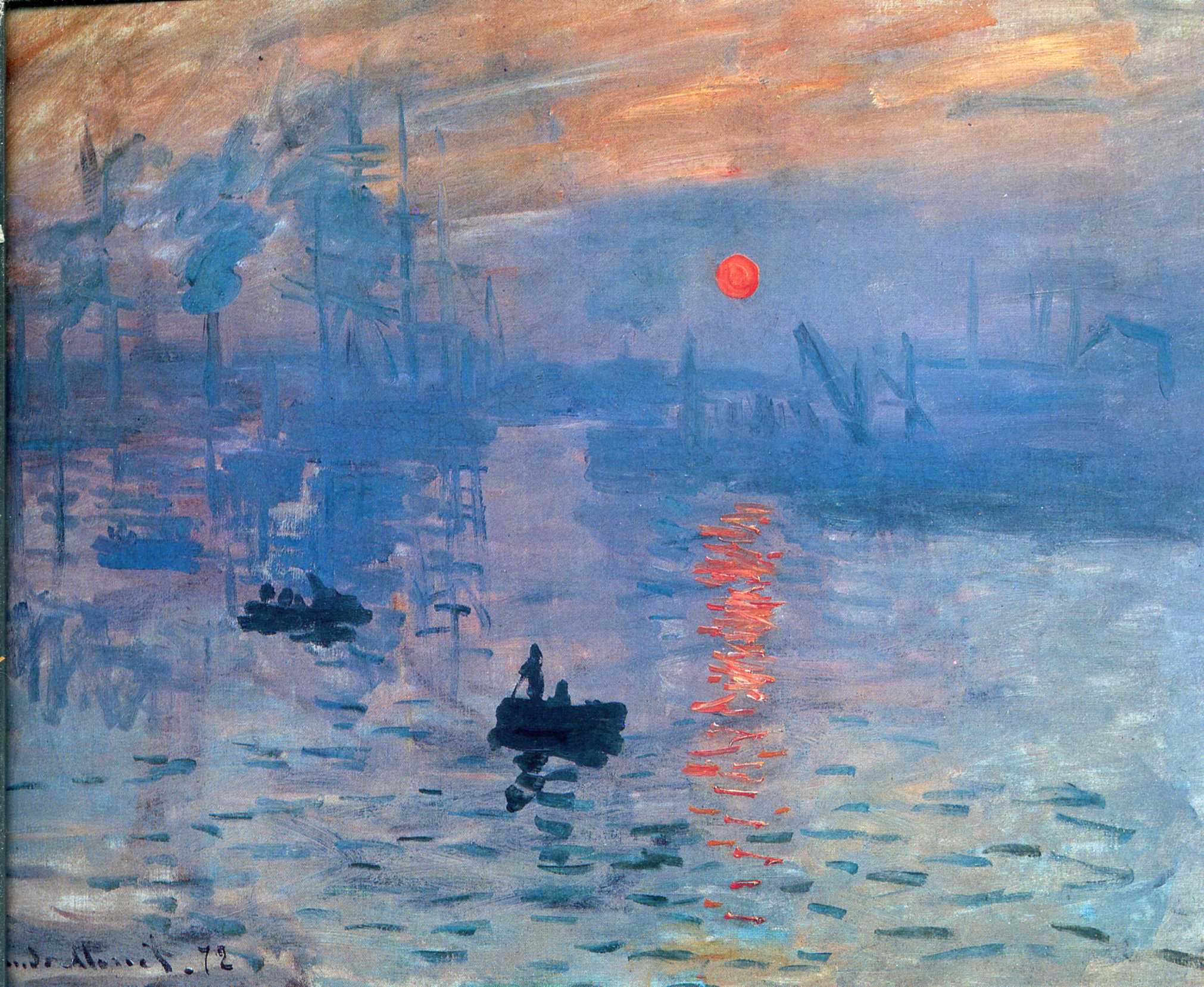
by Ben Hogwood Picture – Impression: Sunrise by Claude Monet
As our UK-based readers will know, England is bracing itself for what could be the hottest week on record. With that in mind, I began thinking of musical evocation of hot weather, and each time I kept on coming back to Debussy‘s influential masterpiece of 1894, the Preludeà l’après-midi d’un faune.
Few orchestral works create such an immediate heat haze, but with one deceptively languid flute solo Debussy set the scene, against a cushion of sunbathed strings and soporific, enchanting woodwind.
I remember playing this piece as an orchestral cellist and falling under the spell of the music, with its rich harmonies and persuasive melodies. Debussy’s mature style was established here – revealing an uncommon ability to tug at the senses and lull the brain at his command. Bask in the sunshine and enjoy!
Here’s a nod in the direction of a particularly interesting new release from Wordcolour, aka Nicholas Worrall.
His new album, The trees were buzzing, and the grass, was released on Houndstooth yesterday – and it looks set to be one of the most intriguing debuts of the year.
A collaborative work, it features guest slots from friends and acquaintances including percussionist Michael Anklin, voice artist Natasha Lohan and performance artist Es Morgan.
Morgan and Worrall worked together on a script for the album, which they chopped and dispersed through the music, interspersed with narration from friends. The music itself flits between scenes, ambient environments and acoustic backdrops in the manner of a film shoot, creating a compelling story.
The wide range of colours are typified by Blossom, which you can watch below:
There are a number of reasons to love Twitter, even now!
There are a number of reasons to love Twitter, even now!
I won’t go into the reasons not to love Twitter, which are all pretty obvious and usually involve politics, trolls and rampant prejudice or discrimination…but for me it remains a place where like minds can hang out and appreciate things they know and love, as well as discovering whole new worlds of culture. The latter is one of the main reasons for me continuing to use the platform. It is continually inspiring to discover and share other people’s love of music, as well as keeping up with news and developments in all musical forms.
There are a good number of polls or questionnaires to be found on Twitter, in which you can engage, spectate or ignore as you see fit. I did want to mention one in particular, from the reliable source that is Michael Irons, which got me thinking. It went like this:
Which are the ten composers that you listen to most of all?
And which ten composers' music would you like to explore further and/ or hear more in concert ?
I saw it late, but since reading it my mind has been occupied for several days. Having given it some thought, the ten composers I listen to most of all are probably as follows:
Now, which ten composers’ music would I like to explore further and / or hear more in concert?
This one is trickier, but going on first instinct I would like to take five of each. There are some composers I still think are massively underappreciated, and I would like to hear more of them in concert. Off the top of my head those five are:
Hindemith, Grieg, Franck, Holst (beyond The Planets) and Joan Tower. Oh, and Liszt as a bonus.
Then five composers I would really like to explore further are:
Rameau, John Foulds, Ruth Crawford Seeger, Caroline Shaw and Andrea Tarrodi, whose music I first heard at the Proms back in 2017.
I’m going to throw the question to electronic and pop music, too – with the ten outfits I listen to most being these:
James, Super Furry Animals, Ed Sheeran (not by choice, but through the radio!), Tears For Fears, New Order, Blur, Stereolab, Depeche Mode, Björk and Erland Cooper
Five outfits I would love to hear in concert are Lady Gaga,Depeche Mode (sadly looking less likely with recent events), Def Leppard (I know!), Stevie Wonder and Joni Mitchell (also unlikely). The five acts I want to hear more of, on recent recommendation, are Robert Palmer, The Hollies, Joni Mitchell and Stevie Wonder (reappearances) and Can.
These names, of course, are just the tip of the iceberg. What I wanted to ask, is which composer(s) or pop acts would you like to read more (or less) of on Arcana? I know there is a big Beethoven project ongoing, but generally we try to adopt a complete lack of any policy on the music we cover! Please let me know, on social media (on Twitter we arehere or through e-mail (editor@arcana.fm)
Arne Deforce (cello), Musicians of BCMG: NEXT / Melvin Tay
CBSO Centre @ 5pm:
Xenakis Ittidra (1996) Fernando Breathing Forest (2022) [Sound and Music commission: World Premiere] Xenakis Akanthos (1977) Howard Compass (2022) [BCMG Sound Investment commission: World Premiere] Xenakis Jalons (1986)
Anna Dennis (soprano), Julian Warburton (percussion), Birmingham Contemporary Music Group / Gabriella Teychenné
The Exchange @ 7pm:
Luque It Is happening Again (2019-21) [UK Premiere] Xenakis La Légende d’Eer (1978)
Birmingham Electro Acoustic Sound Theatre, Sunday 29 May 2022
by Richard Whitehouse
There could been no better way for Birmingham Contemporary Music Group to round off its current season than with this extended tribute to Iannis Xenakis on his 100th birthday. Over three events, a representative selection of the Greek composer’s work was heard within the context of new commissions and realizations of graphic scores.
The latter featured in the Synesthesia concert, after an earlier session where this ‘free, internet-browser-based music application’ (continuing from the UPIC programme that Xenakis pioneered in the 1980s) was made available – two previous graphic scores forming the basis of those pieces heard this afternoon. Philosophy should stop at midnight found Frédéric Pattar following quite literally the contours of the score, a deft humour pointed up though the verse by Richard Brautigan (perhaps a latter-day ‘consolation of philosophy’?), whereas Croquis strideurs found Nicolas Tzortis aligning his score with poetry by Arthur Rimbaud in what was a more capricious or ‘off the wall’ approach.
The three pieces by Xenakis (above) were well chosen to demonstrate the expressive range of his music. Plektó (Braids) is typical of the music from his last years with its teasingly subversive take on a mixed ensemble, while Anaktoria (a lover of Sappho) puts an ensemble as modelled on Schubert’s Octet through its paces in music by turns ingratiating and obstreperous. Most impressive was Phlegra (being (different) regions of modern and ancient Greece), written at the advent of that period when ‘arborescence’ principles brought a new evolutionary dynamism to the composer’s thinking evident in this assured reading by musicians of BCMG: NEXT under the attentive direction of Melvin Tay.
Cellist Arne Deforce earlier took the stage for a performance of Nomos Alpha, typical in its utilizing mathematical abstraction to create viscerally emotional music. Visuals by Marcus de Sautoy and Simon Russell, as derived from the symmetrical properties of a cube, were arresting but it was the musical realization which commanded attention.
Three more pieces by Xenakis were included in the late-afternoon concert. Among his last works, Ittidra (unusual for this composer with its being the reverse spelling of the dedicatee’s name) is a brooding and ultimately fatalistic reassessment of the string sextet, and Akanthos (a city in ancient Greece) extends its instrumental remit to include woodwind and brass as well as soprano whose vocalise adds an often ethereal but at other times keening timbre to the ensemble – vividly conveyed here by Anna Dennis. Again, it was the closing item which made the most lasting impression. Xenakis’s relations with the modernism as represented by Pierre Boulez might at times been strained, but there was evident accord by the time he wrote Jalons for the latter’s Ensemble Intercontemporain. Here those ‘signposts’ or ‘landmarks implied by the title emerge as gestural peaks in music whose headlong motion generates irresistible excitement, and not least with BCMG sounding so responsive to the guidance of Gabriella Teychenné.
Alternating with these works in either half were new commissions by very different composers. With its libretto by Zoe Palmer, Breathing Forest is described by its composer Samantha Fernando as ”A meditation on the inner struggles of a woman and her transformation through the Japanese art of … forest bathing”. What resulted was an exploration of its atmospheric text, realized with audible precision and elegance by Anna Dennis, whose musical substance – while not unappealing in itself – remained too inert to convey the emotional catharsis likely intended. More absorbing was a BCMG commission from Emily Howard, whose Compass takes those spatial and nautical connotations of its title as basis for music that unfolded as a cohesive dialogue between string septet with Julian Warburton‘s array of percussion. Few latter-day composers have shown Howard’s zeal for the interplay of music with mathematics, BCMG’s committed realization vindicating her latest piece musically as well as conceptually.
The final event, an acousmatic concert by Birmingham Electro Acoustic Sound Theatre (BEAST), relocated from CBSO Centre to The Exchange – an impressive Grade Two-listed building on Centenary Square under the auspices of University of Birmingham. Its third-floor conference room certainly suited these two pieces – starting with It Is Happening Again by the Mexican-born, now Madrid-based composer Sergio Luque. Drawing on his development of Xenakis’s stochastic synthesis process, this proved to be a short while evocative study in density of sonic waves whose inherent abstraction was far from being without a tangible atmosphere through its succession of sonic ideas.
Although hampered by microphone malfunction, Christopher Haworth‘s introduction to the next piece was full of relevant detail concerning the purpose and reception of electroacoustic music. Not least when the piece in question was La Légende d’Eer, most expansive and all-encompassing of those Xenakis realized and which caused no mean controversy when initially heard as a musical facet of Diatope at the inauguration of the Pompidou Centre, with its apparently high level of amplification. The present multi-channel version was more easily accommodated, if not at the expense of its dazzling variety – Xenakis evoking the Platonic legend of a soldier returning from the dead via a symmetrical form which takes in an array of instrumental and synthesized sounds as they build to a sustained peak of organized frenzy before the almost regretful evanescence. Had nothing else survived, Xenakis would still have been thought a key creative figure from the post-war era and its impact has not lessened with time or expectation.
It certainly set the seal on a finely conceived and impressively realized sequence of events that reaffirmed Xenakis as a composer whose legacy is undeniable and his influence enduring. The 2020s will bring a whole succession of notable centenaries (that of Ligeti being just a few months away) and BCMG has set the bar high for those to come.




 Arcana.fm