
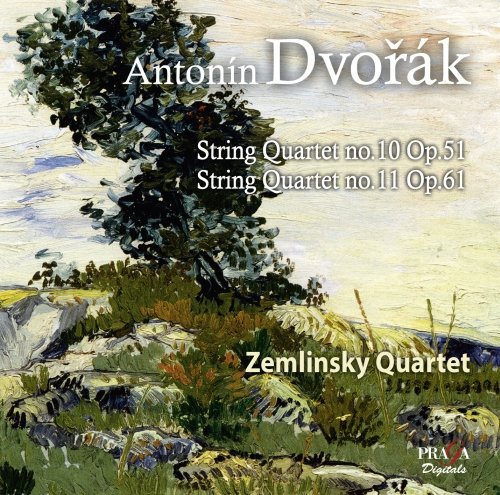
Under the surface – Dvořák middle period String Quartets

dvorak-zemlinsky-qt

Composer: Antonín Dvořák (1841-1904)

Nationality: Czech

What did he write? Dvořák is very well known as a writer of nine symphonies – of which no.9, From The New World, is extremely popular – and the Eighth is often performed too. He wrote in most disciplines, with a lot more orchestral music, string quartets, piano trios, songs and some seldom-explored music for the stage.

Why aren’t these works more popular? Concert programmers are lazy when it comes to Dvořák String Quartets, and often choose just the one work, which is admittedly a cracker – the American quartet of 1893, with its bountiful use of Negro and American spiritual melodies. Yet there are at least 15 other quartets in Dvořák’s armoury. Some of the latter ones do quite well in concert but this pair of works is often overlooked.

What are the works on this new recording? Two mid-period quartets – in E flat major (published as Op.51 and composed in 1879) – and in C major, published as Op.61 and finished in 1881. They are released on the Praga label, played by fellow-countrymen the Zemlinsky Quartet.

What is the music like? Very attractive. There always seems to be a tune about!

The E flat major quartet is especially likeable for its sheer positivity and abundance of good moments. Probably the two best tunes are given to the outer movements, those being the good humoured tune of the first and the outright happiness (with a bit of cheek!) in the fourth movement.

The C major quartet is a bit more serious in tone but is once again full of good tunes and extremely listenable musical dialogue. The first movement sounds a little like mid-period Beethoven with spicier harmonies and has a really nice main theme, while the slow movement is warm and comforting. Before everything comes together in the energetic fourth movement the third is probably the pick, one of Dvořák’s Czech based dance forms.

What’s the verdict? There is some lovely, spring-like music here, and both works receive very committed performances from the Zemlinsky Quartet. The authenticity of Czech players playing Dvořák – which we have here – should never be overlooked, because of their instinctive way with the rhythms and national dances, so this gives them the edge.

Give this a try if you like… any of Dvořák’s better known works listed above, or the composers Brahms and Schumann.

Spotify Playlist

The Zemlinsky Quartet recording is not available but this Playlist includes previous recordings from the Takács and Emerson Quartets, to give you an idea of the works. I’ve also added the composer’s Five Bagatelles for two violins, cello and harmonium as a bonus.

Under the surface – Ustvolskaya Chamber Works on ECM

ustvolskaya-ecm

Composer: Galina Ustvolskaya (1919-2006)

Nationality: Russian

What did she write? Ustvolskaya wrote little published music, but her output still extends to five symphonies and a number of highly regarded chamber works.

Why isn’t she more popular? In general women classical composers have had an extremely raw deal over the centuries, but there are at least now a few contemporaries who are coming through to more prominent positions – among them Dame Judith Weir, now Master (Mistress!) of the Queen’s Music, Thea Musgrave and Sofia Gubaidulina. Ustvolskaya’s music is not perhaps as immediately as theirs, but she is arguably the most inventive and original.

What are the works on this new recording? Two works for violin and piano – the Sonata (1952) and Duet (1964) given characteristically sparse titles. They sandwich an earlier Trio for clarinet, violin and piano (1949), recorded for the second time by ECM.

What is the music like? Challenging. Not in a bad way, you understand!

The Duet is a fascinating piece, because there are some moments where it feels like the violin and piano are in open combat. The piercing high notes from the violin are haunting initially, but at about two and a half minutes in this cuts to some music that I can only describe as bloodthirsty, with violin and piano locked in battle.

There is a greater sense of togetherness between the instruments in the Sonata, where once again Kopatchinskaja and pianist Markus Hinterhäuser play with fearsome intensity. This work is where the influence of teacher Shostakovich is at its keenest, with a five-note motif on the violin that becomes obsessive and disconcerting. There are however some lovely slower moments of deep thought, where the violin makes bird-like calls over the soft piano.

The Trio is another dramatic work, its sonorities reminiscent of Messiaen’s Quartet for the End of Time, written for the same combination with cello. The music is especially effective when Ustvolskaya works the violin and clarinet together, effectively taking the bottom out of the music, while there is often a stronger sense of forward movement. Reto Bieri’s beautiful tone is notable in this performance.

What’s the verdict? If you’re willing to put the work in with Ustvolskaya’s music there are rewards to be had. She is a composer who seems never to waste a note, and although sometimes her writing is austere, it is packed with a deep-seated emotion.

Give this a try if you like… Shostakovich, Messiaen or Bartók

Spotify Playlist

An Ustvolskaya playlist is available on Spotify below, including the Trio and Violin Sonata detailed above, the highly regarded Octet and the Symphony no.5.

Under the surface – Stenhammar String Quartets

stenhammar-quartets

Composer: Wilhelm Stenhammar (1871-1927)

Nationality: Swedish

What did he write? Stenhammar was a pianist primarily, but enjoyed a real affinity with the string quartet, publishing six works in all. His two symphonies, piano concertos and a Serenade are also occasionally heard.

What are the works on this new recording? The String Quartet no.1 and String Quartet no.2. Both are in four movements and last about half an hour each. They are the last of the six to have been recorded by the Stenhammar Quartet for the Swedish record company BIS.

What is the music like? On reflection Stenhammar’s early string quartets have a relatively basic musical language but they feature attractive writing for strings, and are really well played in these affectionate performances.

In the String Quartet no.1 there is a nice falling motif that stands out in the second movement, while the fourth sets out with a strong sense of purpose, as if Stenhammar has been listening to Beethoven.

The String Quartet no.2 is a darker piece, with a shadow passing over the music at the end of the first movement in particular. Here too there is some tuneful music though, and the increasingly vigorous last movement has shades of Dvořák, especially in the pentatonic* ending.

What’s the verdict? These two works are by no means demanding but they make for very pleasant listening at either end of the day, even if the attention occasionally wanders. Very pleasant spring time music.

Give this a try if you like… Dvořák, Grieg or Mendelssohn

Spotify Playlist

A Stenhammar playlist is available on Spotify below, including a mature String Quartet no.4, the lovely Serenade, the Piano Concerto no.2 and the choral piece Midwinter.

Glossary

*pentatonic – a form of scale that only has five notes, as opposed to the most commonly used octave in Western music that has eight.