In concert – BCMG: T R E E Concert

Neue Vocalsolisten [Johanna Vargas (soprano), Truike van der Poel (mezzo-soprano), Martin Nagy (tenor), Guillermo Anzorema (baritone), Andreas Fischer (bass)]; Finchley Children’s Music Group, Birmingham Contemporary Music Group / Michael Wendeberg

Mason The Singing Tree (2020-3) [BCMG Sound Investment commission: World premiere]
Lachenmann Concertini (2005)

Town Hall, Birmingham
Friday 12 May 2023

Reviewed by Richard Whitehouse

Birmingham Contemporary Music Group’s final concert this season also saw the conclusion of Tree City, a 16-year project that has seen Birmingham’s tree coverage increased by some 10% and an occasion marked by this Sound Investment commission from Christian Mason.

Among the leading UK composers, Mason (b1984) has written ambitious works before but none more so than The Singing Tree, a cantata whose seven movements unfold to a suitably arboreal text by Paul Griffiths. Despite its inclusion as an enlarged format in the programme, this was not easily readable under concert conditions (as its author wryly remarked), but of greater concern was its inaudibility during the actual performance; the intricacy of Mason’s writing for solo voices, children’s choir and large ensemble rather offsetting any such clarity.

A pity when Griffiths’ text, growing from the word ‘Tree’ such that each part multiplies by four (thus 1-4-16-64-256-1024), pertinently evokes the growth process alongside temporal and experiential evolution. Not that balance between the five solo voices, positioned centre-right of the platform, a 13-strong choir arrayed in the organ gallery, and an ensemble rich in timbral or textural possibilities seemed at fault, yet any sense of the music gaining gradually in emotional intensity to complement that of its musical complexity felt intermittent at best.

Most absorbing were those movements when Machaut’s rondeau Puis qu’en oubli threaded through the texture with tangible expressive intent, bringing to mind passages of comparable immediacy in seminal choral works by Berio, Kagel or Pousseur. Mason is demonstrably in that European lineage, making it more regrettable when despite its laudable intent – plus the commitment of Neue Vocalsolisten, Finchley Children’s Music Group and BCMG under the assured direction of Michael Wendeberg – his new piece made only an equivocal impression.

What it lacked in overall impact was given context in the second half, with a performance of Concertini by Helmut Lachenmann. Once notorious for (supposedly) predicating the gestural quality of sound, the composer’s more recent larger works exude a determination to align this with a tangible organic development – as heard in those climactic passages when the disparate sources coalesce for music sustained and visceral in its intent. Comparisons with the ataraxic progress of the lengthy final movement from Mason’s work were not to the latter’s advantage.

Once again, BCMG responded with conviction and no little finesse to Wendeberg’s direction – not least in the last third of this piece which had previously seemed to lose focus, but here readily conveyed the ensemble coming together in an audible while, this being Lachenmann, decidedly oblique resolution. Whatever else, the present work confronts and then overcomes those formal and expressive challenges it encounters to a degree that intrigues, frequently provokes but always engages the listener: something that should never be taken for granted. BCMG: NEXT earlier took the stage – pianist Rob Hao evincing due sensitivity in extracts from Lachenmann’s Ein Kinderspiel and in the eddying resonances of Wiegenmusik, before joining with flautist Emily Hicks for the plaintiveness of Mason’s Heaven’s Chimes are Slow.

You can read all about future events at the BCMG website. For more on the composers, visit sites dedicated to Christian Mason and Helmut Lachenmann – and for more on the performers, click on the names to read about Neue Vocalsolisten, Finchley Children’s Music Group and Michael Wendeberg

In concert – Jörg Widmann, CBSO – Weber, Widmann & Beethoven 7th symphony

City of Birmingham Symphony Orchestra / Jörg Widmann (clarinet)

Weber (arr. Widmann) Clarinet Quintet in E flat major J182 (1815, arr. 2018)
Widmann Con Brio (2008); Drei Schattentänze (2013)
Beethoven Symphony no.7 in A major Op. 92 (1812)

Symphony Hall, Birmingham
Wednesday 10 May 2023

Reviewed by Richard Whitehouse

Jörg Widmann has enjoyed a productive association with the City of Birmingham Symphony Orchestra, having been Artist in Residence during the 2018/19 season, and tonight’s concert was typical with its playing to his strengths as composer, clarinettist and (by no means least) conductor.

Arranger, too, given this programme commenced with his take on Weber’s Clarinet Quintet. Most ambitious of its composer’s works for Heinrich Baermann, it demonstrably gains from receiving a concertante treatment. The interplay between clarinet and strings pointed up the acute contrasts of mood and motion in the initial Allegro, then transformed the Fantasia into an operatic ‘scena’ of sustained plangency. With its ‘capriccio presto’ marking and teasingly playful manner, no movement could be less like a Menuetto than the scherzo which follows; here and in the final Rondo, Widmann summoned a tensile virtuosity paying dividends in the latter’s impetuous course to a thrilling denouement. Having given us Weber’s ‘Third Clarinet Concerto’, maybe Widmann could add a Fourth by transforming the Grand Duo Concertant?

The stage was reset for Con Brio, most often played of Widmann’s orchestral works and (in other contexts) a curtain-raiser bar none. Commissioned to accompany Beethoven’s Seventh and Eighth Symphonies in a cycle by Mariss Jansons with the Bavarian Radio Symphony Orchestra, it alludes to both pieces while casting an ear – sometimes facetious, always provocative – over two centuries of European art-music. Whether Widmann hears this as running on borrowed time, the closing bars do not so much resolve as atrophy via a break-down of graphic intent.

A darkened stage greeted listeners after the interval, across which was placed the music for each of Widmann’s Three Shadow Dances. These combine extended clarinet techniques with engaging, often playful virtuosity – moving (right to left) from the deadpan jazz gestures of ‘Echo-Tanz’, through the submerged remoteness (with no electronic treatment) of ‘(Under) Water Dance’, to the uproarious routines of ‘Danse africaine’ where the instrument becomes its own percussion outfit as it bounds towards the ‘elephant calls’ that signify its conclusion.

It made sense to round off the evening with Beethoven’s Seventh Symphony, having already been anticipated in the first half. In his opening remarks, Widmann spoke of the life-changing effect this work had at first hearing, and he duly threw caution to the wind with a reading that brimmed over with the excitement of new discovery. Surprisingly, he chose not to divide the violins right and left, as this would have emphasized their dizzying antiphonal exchanges in the outer movements. Having set a challengingly fast tempo for the scherzo, which the CBSO met with assurance, he might profitably have held back marginally for the greater part of the finale – enabling the coda to ‘take off’ with a frisson as could only be inferred here. This was otherwise a performance that conveyed the music’s visceral essence with thrilling immediacy.

It set the seal on an impressive showing for Widmann and this orchestra, who will hopefully be working together again in a future season. Next week sees the CBSO reunited with Mirga Gražinytė-Tyla for a performance of Mahler’s decidedly non-valedictory Tenth Symphony.

You can read all about the 2022/23 season and book tickets at the CBSO website – and for specific information on Mirga conducting Mahler, click here. There are several sites to visit for more info on Jörg Widmann – click here for his official site, here for his profile at publisher Schott Music, and here for information from his management at HarrisonParrott

In concert – Binker Golding @ The Forge

Binker Golding (saxophone)

The Forge, Camden, London
Thursday11 May 2023

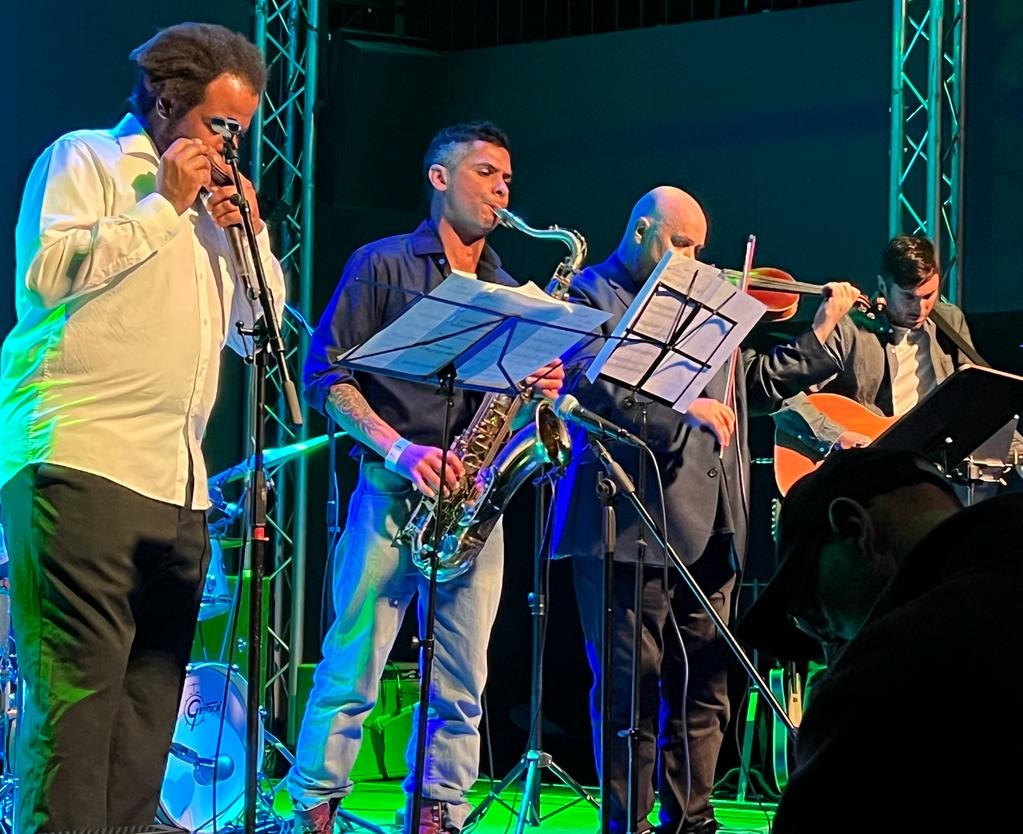
Reviewed by John Earls. Picture (c) John Earls

I once spoke to jazz saxophonist Binker Golding last year just after he had performed a blistering set at London’s Rough Trade East, promoting his excellent Feeding the Machine album with drummer Moses Boyd (very different but exciting musical fare). I told him I’d seen him at Ronnie Scott’s (with a quintet doing some new tunes for a forthcoming album) just as we were coming out of the Covid-19 pandemic. “Oh?” he said, “It was all right, yeah?” I assured him it was. But was quite surprised he felt he had to ask.

This gig at The Forge in Camden with a superb seven piece band was testimony to what a great foundation that Ronnie’s gig was. Right from the off this outfit grabbed the evening and ripped up a storm.

The set mostly comprised of material from last year’s wonderful (and superbly titled) album Dream Like a Dogwood Wild Boy. It’s a great collection of tunes traversing across jazz, Americana, country and blues.

Opening with (Take Me To The) Wide Open Lows we get the mix of melody and solo virtuosity that is a feature throughout the evening whereby the band including Benet McLean (violin), Billy Adamson (guitars) and Daniel Casimir (bass) get to show what they can do collectively and individually. Philip Achille (harmonica) was a particular stand out for taking his instrument to places you didn’t know it could go. 

I have to confess I was more than a little disappointed when I found out that Sarah Tandy and Sam Jones were not going to be performing (as originally advertised). Tandy’s thrilling piano and Jones’ relaxed but sharp drumming – both of which are not only a feature of the album but were a considerable part of a performance at Southbank Centre’s Purcell Room in November 2022 for the London Jazz Festival – were something I was particularly looking forward to.

However, Deschanel Gordon – on organ rather than piano – and Zoe Pascal on drums offered a different but equally compelling dimension to the proceedings.

All Out Of Fairy Tales was a brilliant closer (as it is on the album). A beautifully wistful number.

I love the musicians that Binker Golding puts around him, what he does with them and what he lets them do. They seem to love it too.

Whether he thinks it or not (we didn’t get the chance to speak afterwards this time) this concert was a stunning display of what an assured composer, performer and band leader Binker Golding is. And if he’s reading this, it was more than all right.

John Earls is Director of Research at Unite the Union and tweets at @john_earls

You can listen to the Binker Golding album on Spotify below:

Happy Eurovision Day! Start with an anthem…

There is only one tune to start the day with today…and it’s the Eurovision anthem – or, as it is known in classical circles, the Prélude to Marc-André Charpentier’s Te Deum. Written in the final decade of the 17th century, this bright opener has shown itself to be an incredibly versatile piece of music, capable of beginning a larger-scale sacred piece but equally well-suited as a fanfare for trumpet and organ, or organ alone.

You can hear it in its original context – followed by the whole of the Te Deum…

If you’d prefer, here is the Prélude on its own:

Now, though, it is treasured as the music we hear before a certain singing contest gets underway – so without further ado, let’s celebrate!

Switched On – Loscil: ALTA (self-released)

by Ben Hogwood

What’s the story?

On his Bandcamp page, Loscil describes this self-released single track as ‘a generative music piece originally part of an audiovisual installation at the Libby Leshgold Gallery on the Emily Carr University campus in Vancouver BC, in March 2023. The installation was designed as a 4-channel piece of endless music. Presented here in stereo, it can be thought of as a long exposure capture of the otherwise continuous music from the installation.’

Moving on, he says, ‘ALTA is an addition to the ADRIFT series of generative music pieces named after abandoned sea vessels. Originally released in 2015 as a mobile application, and redesigned as a Max patch for the installation, ALTA/ADRIFT uses structured random selection, mixing and panning to weave together the sonic phrases and layers.

The MV Alta was abandoned at sea and set adrift in 2018 near Bermuda, eventually reaching the shores of Ireland in 2020 where she remains shipwrecked.’

What’s the music like?

Few artists have the ability to capture a listener’s mind as Scott Morgan does. Only a second or two into ALTA and his music as Loscil has cast its own inimitable spell, setting out its considerable structure and declaring – in that instant – that it’s time to slow down.

ALTA certainly takes its time, the single track running for just over 42 minutes, but in that period it calms the mind, slows the thoughts, and pans out to take a broad overview of its watery panorama.

There is an otherworldly presence in the treble tones that cross the sound picture from one side to the other, and also in the held middle ground sounds that give such a detailed and focussed perspective. Once again the listener can zoom in to forensically examine the properties of each sound, or they can draw back to take in the vast panorama, which the music does frequently.

As the single movement progresses, so the music starts to follow the pattern of breathing – with long inhalations, full of consonant harmony, followed by silence – and then a similar, sonorous exhalation. This supports a meditative process for the listener, shutting out the noise outside. By the end the timbres are like the softest panpipes, given the longest possible sustain.

Does it all work?

Yes – as one track that ebbs and flows over a vast span, switching between detailed close-ups and big, spray-painted panoramas.

Is it recommended?

It certainly is – an addition to the Loscil discography showing once again his ability to hold the attention for longer spans. ALTA might be the length of a romantic symphony, but it has a similar impact in its subtle but intense means of expression, simultaneously inward and outward looking. An essential encounter for fans, and those new to Scott Morgan’s music.

If that hasn’t convinced you, head over to Bandcamp, where the music is available at whatever price you wish to pay!

Listen & Buy