
On record: Steve Elcock: Orchestral Music, Volume Three (Toccata)

elcock-3

Steve Elcock
Symphony No. 6 Op.30 ‘Tyrants Destroyed’ (2017)
Symphony No. 7 Op.33 (2020)
Manic Dancing Op. 25 (2015)

Marina Kosterina (piano, Manic Dancing), Siberian Symphony Orchestra / Dmitry Vasiliev

Producer/Engineer Sergei Zhiganov
Recorded 21-25 June 2021, Philharmonic Hall, Omsk

Toccata Classics TOCC0616 [75’54”]

Reviewed by Richard Whitehouse

What’s the story?

Toccata Classics continues its survey of Steve Elcock’s orchestral music with a third volume that features two of his most recent symphonies alongside his piano concerto malgré-lui, each demonstrating a visceral immediacy and a quixotic individuality as previously encountered.

What’s the music like?

After the Beethovenian dialectic of his Fifth Symphony, Elcock concentrated on smaller scale projects prior to its successor. Cast in two movements (the first slightly longer), this might be felt to emulate another totemic Fifth, that by Nielsen, but Elcock’s Sixth is a wholly different proposition. The opening Molto moderato unfolds incrementally and even hesitantly from its subdued beginnings on lower strings, so making the baleful climactic processional the more unnerving when it suddenly arrives. Nor does the ensuing Allegro bring any real catharsis – its gradual and methodical build-up (via that cumulative harmonic and rhythmic intensifying found in Pettersson but which Elcock has made his own) at length culminating in a vehement peroration which would seem to fulfil the remit of this work’s subtitle in unequivocal terms.

Three years on and the Seventh Symphony sees a very different approach. Here every aspect speaks of intended equivocation, the single movement redolent of Elcock’s Fourth in variety of incident yet eschewing its tonal and textural complexity for an overt transparency abetted by relatively modest instrumentation and modally informed clarity of content. Vestiges of an expanded sonata design can be sensed in the stealthy alternation of slower and faster tempos, leading to a central developmental crux as brings in its wake less a reprise than the statement of a melody evidently heard in a dream but whose eloquence and poise seem nothing if not tangible. From here the music heads back towards its modal origins, then it evanesces away for what is the deftest and most affecting conclusion in any of Elcock’s symphonies thus far.

Placed between these symphonies as (necessary) shock-absorber, Manic Dancing is another of Elock’s concertante pieces. The integration of piano and orchestra recalls the Sinfoniettas Giocosa and La Jolla by Martinů, even if the febrile velocity of its outer Allegros could hardly be mistaken for urbanity. The central Largo in the emotional heart in every sense – its limpid opening offset by a restiveness to the fore in twin climaxes, with cadenza-like facets emerging out of the texture before the animated music resumes its designedly manic course.

Does it all work?

Indeed, not least in underlining the overt distinctiveness of Elcock’s symphonies as taken on their own terms. As before, the playing of the Siberian Symphony Orchestra leaves nothing to chance in bringing out the sheer imagination and richness of the orchestral writing, with Dmitry Vasiliev ensuring that formal cohesion remain paramount. Marina Kosterina contributes animated and resourceful pianism, and those who have responded positively to earlier volumes in this series (TOCC0400/0445) will be gripped or maybe even a little disconcerted by this latest addition.

Is it recommended?

Yes, not least with sound of clarity and impact comparable to earlier instalments, and detailed notes from Francis Pott. Toccata will hopefully continue its series of Elcock’s chamber music, while the English Symphony Orchestra has recorded his Eighth Symphony for future release.

Listen

Buy

For further information, audio clips and purchase information visit the Toccata Classics website. For more on Steve Elcock you can visit the composer’s website

In concert – Do we need a new compass? / Anna Dennis & BCMG NEXT @ CBSO Centre, Birmingham

compass

Schoenberg Pierrot Lunaire, Op. 21 (1912)

Anna Dennis (soprano), BCMG NEXT (Rebecca Speller (flute), Heather Ryall (clarinet), Claudia Dehnke (violin), Cameron Howe (viola) Carwyn Jones (cello), Joe Howson (piano) / Leo Geyer (conductor)

Querfurth cold pastoral (2021) [UK Premiere]
Ghisi
 Black Rain (2021) [UK Premiere]

Anna Dennis (soprano), Birmingham Contemporary Music Group (Robert Looman (flute), Nicholas Cox (clarinet), Kate Suthers (violin), Ulrich Heinen (cello), Goerge Barton (percussion), John Reid (piano) / Gabriella Teychenné

CBSO Centre, Birmingham
Thursday 17 March 2022

Written by Richard Whitehouse

Birmingham Contemporary Music Group has been involved in various cross-national projects over its 35 years, with Do we need a new compass? one of the most ambitious: three concerts in three countries by three ensembles, with BCMG joining Bologna’s FontanaMix Ensemble and Hannover’s Das Neue Ensemble in commissioning two composers to write for one of the other ensembles. This last of three concerts featured two UK premieres next to a piece whose influence, conceptually and musically, has been far-reaching in the 120 years of its existence.

Whether through its eliding between cabaret and art-song, or its scoring for mixed ensemble, Schoenberg’s Pierrot Lunaire still blazes a trail. This performance duly played to the virtues of these ‘three times seven poems’ – Anna Dennis teasing a deft elegance from ‘Moondrunk’ and forlorn yearning from ‘A Pallid Washerwoman’, her rapt intertwining with flute in ‘The Sick Moon’ a highlight. The second part was less consistent – the ominous menace of ‘Night’ a little tepid, then the graphic imagery of ‘Red Mass’ falling short of its climactic violence.

Not so the stark evocation of ‘The Crosses’ as set the tone for the gradual pacification of the third part – from the suffused melancholy of ‘Homesickness’, through the visceral irony of ‘The Moon Fleck’ (its canonic interplay a stern test of coordination as was amply fulfilled), to the distanced nostalgia of ‘O Ancient Scent’ with its numbed sense of re-arrival. Dennis was never less than persuasive in these settings, and Leo Geyer ensured that BCMG NEXT brought character as well as discipline to Schoenberg’s always resourceful instrumentation.

A tough challenge, moreover, for the new pieces which came after the interval. Interesting that that by Kaspar Querfurth should have sounded the more ‘Italian’ – the restrained, even austere ambience of cold pastoral bringing to mind the deadpan ambivalence found in the later music of Donatoni and Aldo Clementi, for all that the vestigial evolving of its motifs went some way to conjuring a musical evocation of Keats’s Ode on a Grecian Urn – or at least those final two lines when the object being contemplated utters its indelible response.

His extensive involvement in electroacoustics was evident in Daniele Ghisi’s Black Rain, though the earlier stages in his setting of lyrics by Andrea Agostini were for the most part understated in their interaction between voice, ensemble and electronics; the latter coming   to the fore gradually while remorselessly so as to envelop the soundstage in a coruscating resonance – above which, Dennis’s voice emerged as an expressive focal point. ‘Immersive’ is a rather overused term these days, but the present piece more than justified this epithet.

It helped in these latter works that the BCMG musicians was so responsive to the direction of Gabriella Teychenné, whose activity with London-based Sinfonia Humanitas has rightly been attracting plaudits. She was wholly justified, too, in having begun the second half with the First Postlude (1981) by Valentin Silvestrov – the Ukrainian composer’s homage to his Russian forebear Shostakovich, whose ‘strength through calmness’ is a potent reminder of music’s ability to reach across boundaries to a degree exemplified by this evening’s concert.

Further information on BCMG events in the 2021/22 season can be found at their website. Click on the names to read more detail on composers Kaspar Querfurth and Daniele Ghisi, or for more on Anna Dennis, Leo Geyer and Gabriella Teychenné

In concert – Do we need a new compass? / BCMG NEXT @ Jennifer Blackwell Performance Space, Symphony Hall, Birmingham

compass

Meredith Four to the Floor (2005)
Heather Ryall, Emily Wilson, Beth Nicholl, George Blakesley (bass clarinets)

Mason Heaven’s Chimes Are Slow (2010)
Rebecca Speller (flute), Joe Howson (piano)

Howard Cloud Chamber (2006)
Emily Wilson (clarinet), Mikaella Livadiotis (piano)

Anderson Scherzo with Trains (1993)
Heather Ryall, George Blakesley (clarinets), Beth Nichol (basset horn), Emily Wilson (b-clarinet)

Jennifer Blackwell Performance Space @ Symphony Hall, Birmingham
Thursday 17 March 2022 (1pm)

Written by Richard Whitehouse

BCMG NEXT may have had a major role in tonight’s concert at CBSO Centre, itself marking the culmination of a major project that has already featured events in Bologna and Hannover, but it was a worthwhile move to include more of these young musicians in a lunchtime recital.

Anna Meredith has written numerous chamber pieces, among which Four to the Floor has an immediate appeal – not least through the uniform line-up of its clarinet quartet in music whose methodical exploration of timbre almost inevitably results in the descent intimated by its title. It may have been a transcription of the final item from his song-cycle after Christina Rosetti, but Christian Mason’s Heaven’s Chimes Are Slow felt no less evocative in this incarnation for flute and piano – not least as rendered with such poise by Rebecca Speller and Joe Howson.

Emily Howard’s composing career has unfolded parallel to her scientific research, such that Cloud Chamber bridges any likely divide through its iridescent timbral interplay for clarinet and piano – realized here with precision and verve by Emily Wilson and Mikaella Livadiotis. The recital ended with Scherzo (with trains), one of Julian Anderson’s most engaging shorter works whose inspiration in Thoreau as well as rhythms of high-speed trains puts its diverse clarinet quartet through an unpredictable discourse here ensuring a characterful performance.

This diverse and enjoyable recital was also the second BCMG-related event to be held at the Jennifer Blackwell Performance Space, adjacent to the Circle level at Symphony Hall – itself much improved as a setting with the overhead promotional screen turned off for the duration.

Further information on BCMG events in the 2021/22 season can be found at their website. Click on the names to read more detail on composers Julian Anderson, Emily Howard, or for more on Christian Mason and Anna Meredith

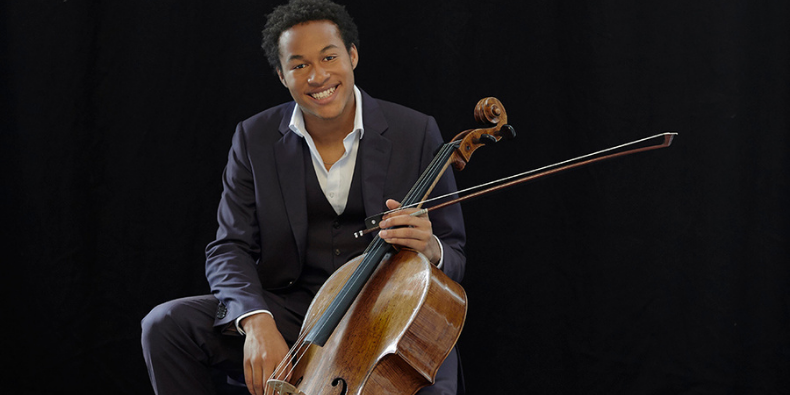
In concert – Sheku Kanneh-Mason, CBSO / Charlotte Politi: Tchaikovsky, Shostakovich & Weinberg

16-March-Sheku-KM

Tchaikovsky Swan Lake, Act 2 – Scène, Op. 20 No. 10 (1875-6)
Shostakovich
Cello Concerto No. 2 in G, Op. 126 (1966)
Weinberg
Symphony No. 3 in B minor, Op. 45 (1949-50, rev. 1959)

Sheku Kanneh-Mason (cello, above), City of Birmingham Symphony Orchestra / Charlotte Politi (below)

Symphony Hall, Birmingham
Wednesday 16 March 2022

Written by Richard Whitehouse

This evening’s concert by the City of Birmingham Symphony Orchestra should have been a Weinberg double-bill but the last-minute indisposition of Mirga Gražinytė-Tyla (having tested positive for Covid) brought to the podium one of the orchestra’s assistant conductors, Charlotte Politi.

Something in the programme had to give and that was only the second hearing in the UK for Weinberg’s Fourth Symphony, an incisively neo-classical piece long familiar to enthusiasts through the Melodiya recording issued in the 1970s and which, while it lacks the gravitas of later symphonies, is never less than engaging in its own right. Instead, the programme began with the ‘Scène’ from Act Two of Tchaikovsky’s Swan Lake (itself the opening number of the suite) – its fraught pathos enticingly realized, if making for an all-too brief curtain-raiser.

Sheku Kanneh-Mason was still present for Shostakovich’s Second Cello Concerto, among the first products of his final creative period and one of his most equivocal works in any medium. Most accounts over-stress its introspection, but Kanneh-Mason gauged the varied expressive shades of its Adagio with unforced rightness; its wrenching climax finding acute contrast with the sombre rumination from which it emerges and to which it returns. The ensuing Allegrettos could not be more dissimilar – a tensile and sardonic scherzo culminating in raucous fanfares as set into motion the finale. If coordination of soloist and orchestra in the former was a little tentative, Kanneh-Mason adroitly negotiated the latter’s gnomic dialogue – afforded focus by an easeful refrain and with a culmination of defiant exasperation, then a coda of furtive repose.

With its unshowy virtuosity and its concertante-like solo writing, this is a hard piece to bring off, but Kanneh-Mason rendered it with some conviction. He returned for an eloquent encore of what sounded to be a (Ukrainian?) folksong with the front four desks of the CBSO cellos.

After the interval, another chance to hear the Third Symphony by Weinberg this orchestra has rather made its own in recent seasons. Ostensibly a response to the anti-formalist campaign as spearheaded by Andrei Zhdanov, with the intention of making Soviet art more accountable to the public, its citing Belorussian and Polish folksongs is offset by the opening Allegro’s often ambivalent progress to a coda shot through with foreboding. Politi was often persuasive here, then not at all fazed by the Allegretto’s interplay of whimsical with a more sardonic humour.

Even better was to come in the Adagio’s finely sustained progress towards a climax of stark tragedy, only slightly mediated by the pensive close. An energetic final Allegro duly set out to secure an affirmative end, only to culminate in marked desperation, and it was a measure of Politi’s insight that the coda maintained its uncertainty even as those decisive closing bars echoed to silence. The CBSO responded impressively throughout a piece it must know better than any other orchestra, and it was to Politi’s credit that her own input was so often evident.

Hopefully MG-T will recover in time for the CBSO’s forthcoming European tour, such that Weinberg’s Fourth Symphony will gain the hearings it deserves. And if next season she can schedule the Fifth, arguably his finest purely orchestral symphony, then so much the better.

For more information on the CBSO’s spring tour, visit their website. Meanwhile for more information on the artists, click on the names to access the websites of Charlotte Politi and Sheku Kanneh-Mason. Meanwhile for more on composer Mieczysław Weinberg, click here

In concert – Soloists, CBSO Chorus, Czech Philharmonic Orchestra / Semyon Bychkov: Dvořák 8th symphony & Janáček Glagolitic Mass

220316_London_Barbican 2_WebRes_007_(c)_Petr Kadlec

Dvořák Symphony no.8 in G major Op.88 (1891)
Janáček Glagolitic Mass (1928 version)

Evelina Dobračeva (soprano), Lucie Hislcherová (alto), Aleš Briscein (tenor), Boris Prýgl (bass), Daniela Valtová Kosinová (organ), CBSO Chorus, Czech Philharmonic Orchestra / Semyon Bychkov

Barbican Hall, London
Wednesday 16 March 2022

Written by Ben Hogwood Photo credits Petr Kadlec

To hear the Czech Philharmonic Orchestra play Dvořák is surely one of classical music’s great pleasures. It was Dvořák who conducted them in their first ever concert, and for the second instalment of their Barbican visit Semyon Bychkov chose to programme his Symphony no.8, a work surely written with the spring season in mind.

The Eighth gets a slightly raw deal, sandwiched in Dvořák’s published output between the critically acclaimed Seventh and the ubiquitous Ninth, the New World. This is a shame because the joyous melodies and persuasive dance rhythms are a celebration of life itself, the composer glorying in the outdoor spaces of the Bohemian countryside. Melodic invention abounds throughout the four movements, and this performance gave room to the delightful swagger of the outdoor tunes, while retaining an elegant, almost Schubertian profile. Perhaps unexpectedly there were also pointers towards early Sibelius, the vivid natural scenes laden with intensity and fulsome orchestration.

The Czech Philharmonic wind section were the stars of this performance, with a sunny flute in the opening pages and some outstanding clarinet playing in the Adagio. Not to be outdone, the strings offered a cushion of sound as springy as the forest floor itself, while bright trumpets energised the fanfare at the start of the finale. The elegance of the cellos’ theme at the start of the first movement and the violins’ graceful way with the Intermezzo were two of many memorable moments from the strings. Bychkov judged the work’s profile to perfection, and there were many smiles among orchestra and audience alike as each new melody made itself known.

A very different mood prevailed for the second half, where celebration came at a cost. Janáček‘s Glagolitic Mass remains a work of extraordinary intensity, stretching its performers to the limits of their range and veering wildly between adulation and strife.

The CBSO Chorus were on heroic form throughout. Superbly marshalled and prepared by chorus director Simon Halsey, organist Julian Wilkins and conductor / pianist Lada Valesova, they sang as one, nailing the tricky ‘Old Church Slavonic’ pronunciations with apparent ease – in particular the distinctive ‘Amin, amin’ refrain of the Gloria. The Credo, the beating heart of this piece, had a white-hot intensity while leaving room for interpretation on the composer’s own religious feelings. By contrast the miraculous chord on which the Agnus Dei often hangs was truly celestial, ideally voiced and weighted. Its introduction was chilling indeed, strings and brass icy to the touch.

The Glagolitic Mass is a tough gig for its four vocal soloists, who have little room in which to make an impact, but the quartet here largely caught its operatic dimensions. If soprano Evelina Dobračeva seemed a little withdrawn initially she soon found her footing. Tenor Aleš Briscein, the highest of high priests, was commendably secure in his intonation but appropriately edgy as Janáček’s writing pushed the limits of the vocal range. Boris Prýgl offered fulsome support as bass soloist, as did alto Lucie Hislcherová in her brief appearance. Organist Daniela Valtová Kosinová, on the other hand, made the most of her instrument’s crucial role, launching into a Postludium of fearsome strength and wildly irregular rhythm. The instrument was well balanced through the Barbican speaker system, Kosinová’s feet a whirl as they kept up with Janáček’s demanding bass part, before those two damning final chords of the crucifixion. Bychkov encouraged the feverish violins through an Intrada that, while ultimately triumphant, only heightened the searing intensity of what had gone before.

Both these national statements felt so appropriate for the times, celebrating freedom of movement but also the power – and cost – of faith. As with the first night performances Bychkov eloquently dedicated the music to the people of Ukraine, before a performance of the country’s national anthem. It is hard to think of two more appropriate or contrasting accounts, and the Czech Philharmonic and their principal conductor deserve the utmost credit for two nights of unrivalled artistic brilliance.

You can listen to the repertoire in this concert by using the Spotify playlist below, which includes the Czech Philharmonic Orchestra‘s recent recordings of both works for Decca, made under their previous and sadly missed principal conductor Jiří Bělohlávek: