Listening to Beethoven #203 – Prelude in F minor WoO 55

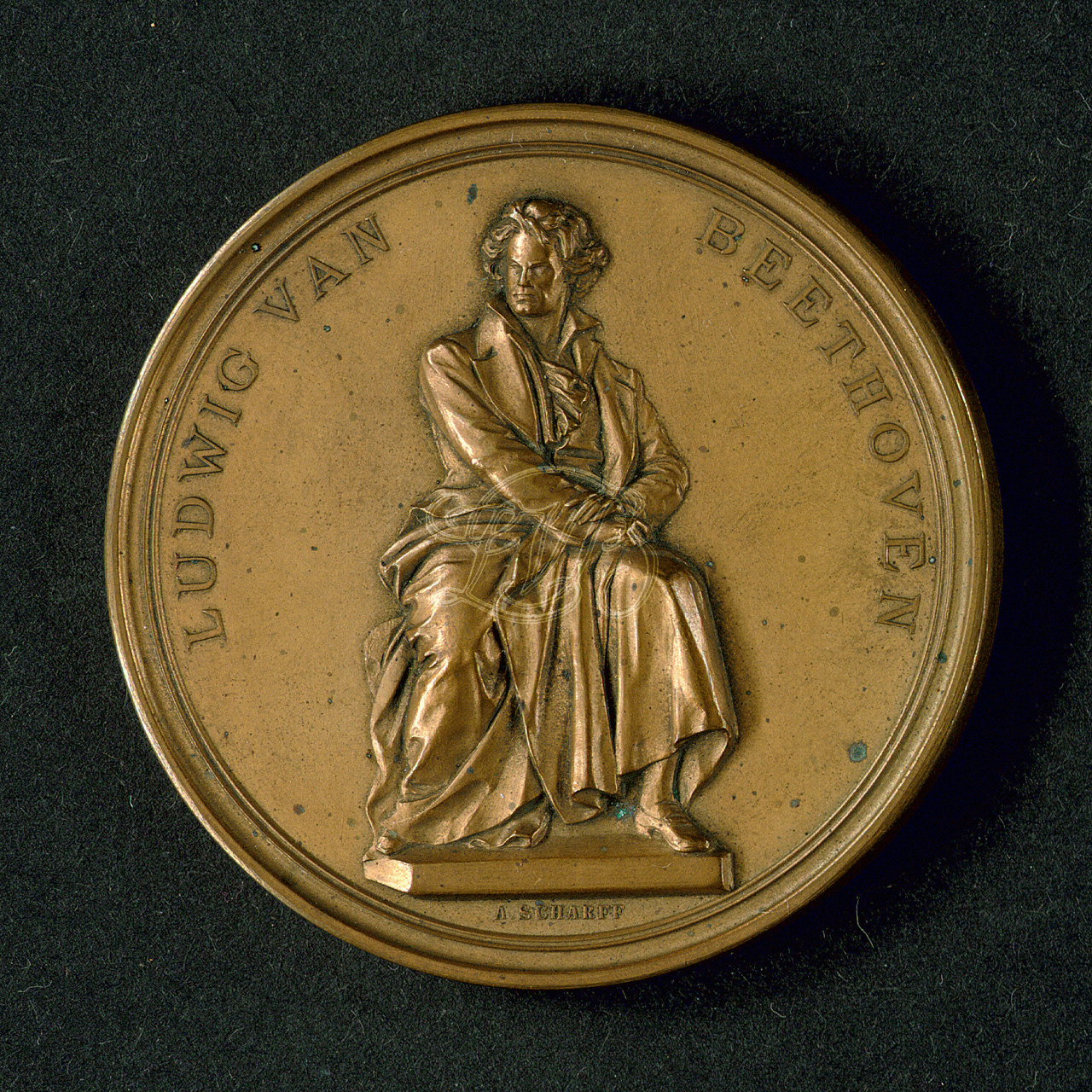
Commemorative medal for the unveiling of the Beethoven monument in Vienna – bronze medal based on a design by Anton Scharff depicting the Beethoven sculpture by Caspar von Zumbusch

Prelude in F minor WoO 55 for piano (1803, Beethoven aged 32)

Dedication not known
Duration 3′

Listen

written by Ben Hogwood

Background and Critical Reception

Roeland Hazendonk, writing booklet notes for the recording made by Ronald Brautigam for BIS, describes this piece as ‘an almost perfect pastiche of a prelude by Bach’, drawing attention to its similarity with the Prelude in the same key from the first book of Bach’s Well-Tempered Clavier.

Thoughts

If you heard this piece without knowing, your first guess at a composer would surely not be Beethoven, for this is a piece of incredibly accurate pastiche. It is remarkably similar in both mood and profile to the F minor prelude of Bach referred to above, yet it is clearly not a copy as you will hear by comparing the two:

Beethoven starts the Prelude confidently, and it evolves naturally in a series of arpeggios that pass instinctively between the hands. For much of the piece he keeps the tonality close to F minor, though the central section starts wandering towards further flung keys. It all comes back together for a poised conclusion.

Perhaps this was a study for one of Beethoven’s teachers at the time, but it expresses his knowledge and love of Bach better than words could possibly manage!

Recordings used and Spotify playlist

Jenő Jandó (Naxos)
Olli Mustonen (Sony BMG)
Ronald Brautigam (BIS)

Gianluca Cascioli adopts a slow and steady tempo, but gives great feeling to his performance. Ronald Brautigam is much quicker but still allows the notes to breathe, pausing at strategic points in the music to give the phrasing a natural structure.

You can chart the Arcana Beethoven playlist as it grows, with one recommended version of each piece we listen to. Catch up here!

Also written in 1802 Reichardt Das Zauberschloss

Next up 6 Ländler WoO15

Listening to Beethoven #202 – Serenade in D major Op.41

Öèôðîâàÿ ðåïðîäóêöèÿ íàõîäèòñÿ â èíòåðíåò-ìóçåå Gallerix.ru

View of Freyung Plaza in Vienna from South-East by Bernardo Bellotto

Serenade in D major Op.41 for flute and piano, arranged by Franz Xaver Kleinheinz (1803, Beethoven aged 32)

Dedication not known
Duration 22′

1. Entrata, Allegro
2. Tempo ordinario d’un Menuetto
3. Allegro molto
4. Andante con Variazioni
5. Allegro scherzando e vivace
6. Adagio – Allegro vivace e disinvolto

Listen

Background and Critical Reception

The original version of this serenade, for flute, violin and viola, was completed in 1801. It was sufficiently popular for Beethoven to be approached for an arrangement by Franz Xaver Karlheinz, who was keen to use it for flute and piano. Beethoven approved, further adding his assent by checking the finished version, which was published in 1803.

As Arcana noted with the original version, there are six movements in a piece which appears not to have been written with any particular person in mind, more for the Viennese domestic market.

Thoughts

As noted in the original version of the Serenade, ‘Beethoven looks back to Mozart and Haydn with this piece, using the form of a Serenade to its full potential. Like Mozart he brings the most out of seemingly small forces’.

The arrangement for flute and piano works well, though the piano is in danger of dominating if there is not the required sensitivity from the player. The music remains bright and breezy, its good tunes exchanged frequently between flute and piano. The third movement, while lively, is noticeably heavier with the piano employed, while the first movement can also be punchier with the greater attack a piano offers. The dance movements, however, are enjoyably rustic and retain their charm, the fifth movement breezing along and the sixth, with its slow introduction, full of good humour too.

Recordings used and Spotify links

Jean-Pierre Rampal (flute), Robert Veyron-Lacroix (piano) (Vox Box)
Emmanuel Pahud (flute), Eric Le Sage (piano) (Auvidis Valois)
Kazunori Seo (flute), Makoto Ueno (piano) (Naxos)

Each of these three versions features a flautist who appears to be thoroughly enjoying themselves. Emmanuel Pahud is arguably the most stylish, and has an attentive partner in Eric Le Sage, but the other versions are also very enjoyable.

You can listen to these versions on the playlist below:

You can chart the Arcana Beethoven playlist as it grows, with one recommended version of each piece we listen to. Catch up here!

Also written in 1803 Paganini Le streghe Op.8

Next up Prelude in F minor WoO55

On Record – Gilmore Trail: Impermanence (Chasmata Records)

gilmore-trail

reviewed by Ben Hogwood

What’s the story?

Sheffield quartet Gilmore Trail return after five years away, with a deeply felt new album. It is their third long player, and since the second they have amicably replaced drummer Sam Ainger with Bob Brown

The band is named after a route in Alaska from which you can reliably see the Northern Lights, and their music has always reflected something of the mystery and awe generated from encounters with natural phenomena.

Impermanence is a collection of seven instrumentals looking to recapture that wonder, from a framework of change and uncertainty – completed as it was before the pandemic. Its intimate moments mark the passing of close family members, but further afield the music continues to look to nature for inspiration.

What’s the music like?

Virtuosic, deeply felt and atmospheric. These lovingly crafted instrumentals often begin with a deceptively simple melodic or harmonic cell. From this they spread their tendrils outwards, increasing in volume and intensity all, so that by the climactic point the listener has the effect of diving head first into waves of euphoric, distorted sound. The single Ruins, reflecting on a legacy in near collapse, has that effect, serious in tone but powerful in execution, Brown’s drumming ideally paced.

The more ambitious tracks fall just shy of ten minutes but feel shorter, having grown organically without repeating themselves. Their intensity builds in a compelling and inevitable way, and the moments of release – often two-thirds of the way through – are genuinely thrilling. Yet the shorter tracks should not be overlooked, especially the higher guitars of Convalescence.

The natural portraits are engrossing. Distant Reflection is initially sombre but takes on a wonder at its surroundings. This is helped by the singing bowls of Sally Blyth, a sound practitioner who finds just the right tone at the start, Brown’s drums sensitively picking up the pace afterwards. Even when the music peaks, with drum rolls and a wall of guitar sound, the tolling of the bowls can still be heard. Echoes Of Solitude considers the plight of the lonely whale through the saxophone of Martin Archer, whose phrases are thoughtfully managed – definitely a case of less is more.

Does it all work?

It does. The seven tracks have a similar profile in terms of the build of their intensity, but they paint very different portraits. Repeated listening is recommended, since it reveals more of the detail the band work into their music, all the while keeping it unified and pressing forward.

Is it recommended?

It is. If you – like me – had not encountered the music of Gilmore Trail before, rich rewards await. Fans of Explosions In The Sky or Mogwai should not hesitate – making a new acquaintance like this is a no-brainer.

Stream & Buy


Let’s Dance – Various Artists: Africa Gets Physical Vol. 4 – Thandi Draai (Get Physical)

Thandi Draai

reviewed by Ben Hogwood

What’s the story?

The Africa Gets Physical series has been a ray of light in house circles since it started. For its fourth volume Berlin label Get Physical hand the reins to Thandi Draai, who has been making waves in South African tech house over the last couple of years. Draai’s guide looks across the continent for inspiration, highlighting a range of talent in house circles.

What’s the music like?

Excellent. House may be the main musical discipline but there is a lot of variety here, and it is well chosen and ideally sequenced by Draai.

Of the 17 numbers there are some powerful stand-out tracks. Afro BrothersAmathuba, featuring Pixie and Lucky Keys, is a slightly trancey number with a really strong vocal. BlaQRhythm’s In The Jungle goes heavy on the percussion, while the next one strong offbeat presence. Dawgpound uses a clever, refracted vocal on Egypt to give the impression of a distorted monastery set to house beats. Eltonnick & G-Wash10’s Osiros, featuring T_Phoenix, is just superb, its driving beat and penetrating vocal complementing each other perfectly. Meanwhile Khensy & Cuebur’s Hulelewani is powerfully wrought, with a richly harmonised vocal. On the deeper side sits Sikkelela, with rich harmonies from Un_nown & Zikhona.

Throughout the collection modern tech beats sit comfortably with original percussion – which gives the music plenty of drive – and some really excellent, authentic vocals.

Does it all work?

It does – Thandi Draai’s selection is full of top quality house, and the impression is that there is still plenty more where this came from.

Is it recommended?

Definitely – the most inspiring volume of Africa Gets Physical to date, for which the label should be applauded. We need more exposure to house music from the Southern Hemisphere, especially if it’s as good as this!

Stream

Buy


In concert – CBSO Centre Stage: CBSO strings play Kodály & Korngold

CBSO-Strings

Kodály Serenade, Op. 12 (1919-20)
Korngold
String Sextet in D major, Op. 10 (1914-16)

CBSO Strings: Kate Suthers & Charlotte Skinner (violins), Adam Römer & Jessica Tickle (violas), Miguel Fernandes & Helen Edgar (cellos)

CBSO Centre, Birmingham
Thursday 27 January 2022 2pm

Written by Richard Whitehouse

Two unfamiliar while appealing works were featured in this afternoon’s Centre Stage recital given by string players from the City of Birmingham Symphony Orchestra, written during the early stages and in the aftermath of the First World War at a pivotal time in European culture.

The focus on choral and pedagogic music of Kodály’s later years makes his earlier chamber works the more valuable, and while the Serenade for two violins and viola is by no means the most imposing, its deftness and finesse of writing for this unusual line-up cannot be gainsaid. The lively outer movements abound in those allusions to and inflections of folk melodies that Kodály explored extensively in his maturity, with the central Lento touching upon a vein of ‘night music’ less inwardly intense than if equally evocative to that found in the music of his contemporary Bartók. Its relatively extended formal trajectory can make the final Vivo seem unduly prolix, yet in so buoyant and finely integrated a performance, there was no likelihood of this movement forgoing any sense of direction on its way to a decidedly nonchalant close.

Kodály was around 30 when writing this piece, whereas Korngold was barely out of his teens when he finished the Sextet as draws equally on very different (if by no means incompatible) stylistic traits evident in works for this medium by Tchaikovsky and Schoenberg. If the latter composer is to the fore in the lengthy initial Moderato with its intricate thematic interplay and frequent density of texture, the Adagio exudes a melodic eloquence denoting those operas or film-scores to come. The ensuing Intermezzo is arguably the most characteristic movement in its suavity and teasingly coy charm, while the Finale looks back to Brahms and even Dvořák (whose Sextet would be a welcome inclusion in these recitals) for its underlying vitality and easy-going humour as makes the coda’s rush to the finish the more unexpected and engaging.

Such was the impression left by a finely prepared reading by no means lacking in spontaneity or those flights of fancy such as denote the ‘confidence of youth’. Quintets are the order of the day for the next Centre Stage recital, which features contrasting works by Mozart and Brahms.

You can read more about that next Centre Stage recital, and book tickets, on the CBSO website