
In concert – Alexander Roslavets, Gidon Kremer, LPO / Andrey Boreyko @ Royal Festival Hall: A Dark Century

Alexander Roslavets (narrator / bass), Gidon Kremer (violin), London Philharmonic Choir (men’s voices), London Philharmonic Orchestra / Andrey Boreyko

Schoenberg A Survivor from Warsaw Op.46 (1947)
Weinberg Violin Concerto in G minor Op.67 (1959)
Shostakovich Symphony no.13 in B flat minor Op.113 ‘Babi Yar’ (1962)

Royal Festival Hall, London
Wednesday 27 November 2024

Reviewed by Richard Whitehouse Pictures (c) Richard de Stoutz (Andrey Boreyko), Angie Kremer (Gidon Kremer)

Anyone who heard one or other of these works for the first time at this concert by the London Philharmonic Orchestra could be forgiven for thinking that the twentieth century, if not a ‘dark century’ per se, was at the very least a troubled one for all that the quality of its music was undeniable.

With its elements of melodrama and cantata, Schoenberg’s A Survivor from Warsaw is one of his most original conceptions and necessarily so, given the unnerving immediacy of its text in which a speaker has to take on the roles of survivor and officer in just six minutes. Alexander Roslavets rose to this challenge, bringing out emotional contrasts as surely as he instilled his words with that ominous dread whose culmination in the prayer Shema Yisrael was intoned by the London Philharmonic Choir with the right balance between desperation and defiance.

One composer who witnessed something of such atrocities was Mieczysław Weinberg, and if his Violin Concerto demonstrably continues the ‘Romantic’ tradition, this is still an inherently personal statement. Gidon Kremer has championed the composer extensively in recent years and, while technical issues seemingly inhibited the respectively incisive and impetuous outer movements, the restless searching of its intermezzo-like Allegretto then confiding eloquence of its Adagio were abundantly in evidence. For all its outward virtuosity, the music’s essential inwardness is what prevails as the soloist remains musing when the orchestra fell silent at the close of the finale. Kremer was in his element here, as in a touching rendition of Silvestrov’s Serenade which made for an apposite encore and was dedicated to all the people of Ukraine.

Best known for giving the posthumous premiere of Gorecki’s Fourth Symphony with the LPO 10 years back, Andrey Boreyko is well established as an exponent of Shostakovich so that his take on the Thirteenth Symphony did not disappoint. At a distance of over six decades, it can be hard to recapture the provocation of that most eminent Soviet composer using verse by the most populist younger poet, as Yevgeny Yevtushenko then was, but this setting of Babi Yar retains all its expressive force through the immediacy and resourcefulness in which it relates official indifference to the Jewish massacre as that ravine outside Kyiv was transformed into landfill. Broodingly restrained, Roslavets emerged into his own with Humour – its scabrous send-up of bone-headed officialdom inspiring one of Shostakovich’s most scurrilous scherzos.

Fashioning the last three movements into a cohesive if cumulative unity, Boreyko underlined the potency of Shostakovich’s creative vision as he takes the Soviet establishment to task for various failings economic as In the Store, political as in Fears and cultural as in A Career. Implacable then volatile, these first two are rounded off by Yevtushenko’s considering of the relationship between society and the individual; framed by an undulating melody, for flutes then strings, which is one of its composer’s most evocative as well as affecting inspirations.

It duly brought this work, and this performance, to its subdued yet spellbinding close. As the relationship between East and West becomes ever more confrontational, Shostakovich’s 13th remains a testament to rationality and compassion whose denigration is to everybody’s cost.

For details on the 2024-25 season, head to the London Philharmonic Orchestra website. Click on the names to read more about soloists Alexander Roslavets and Gidon Kremer

Published post no.2,373 – Monday 25 November 2024
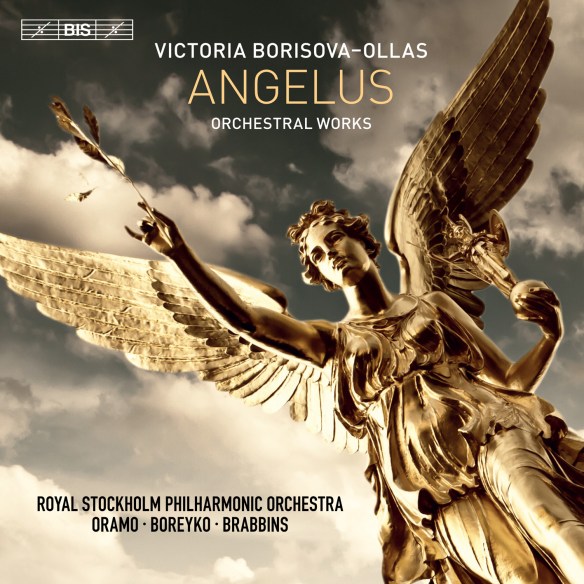
On record – Victoria Borisova-Ollas: Angelus (BIS)

Victoria Borisova-Ollas
Angelus (2008)
The Kingdom of Silence (2003)
Before the Mountains Were Born (2005)
Creation of the Hymn (2013)
Open Ground (2006)

Royal Stockholm Philharmonic Orchestra / Andrey Boreyko (Angelus), Martyn Brabbins (The Kingdom of Silence, Before the Mountains Were Born), Sakari Oramo (Open Ground)

BIS BIS2288 SACD [82’08”]

Producers Thore Brinkmann, Ingo Petry
Engineers Marion Schwebel, Matthias Spitzbarth

Recorded August 2016 (Open Ground), November 2017 (Angelus), August 2019 (The Kingdom of Silence, Before the Mountains Were Born) in Stockholm Concert Hall

Written by Richard Whitehouse

What’s the story?

BIS issues what is only the second release dedicated to the music of Victoria Borisova-Ollas (b1969), Vladivostok-born and resident in Sweden for almost three decades, superbly played by the Royal Stockholm Philharmonic Orchestra and sumptuously recorded in Stockholm Concert Hall.

What’s the music like?

UK audiences have had few opportunities to hear Borisova-Ollas, but her piece Wings of the Wind was second at the Masterprize International Music Competition in 1998, and her multi-media drama The Ground Beneath Her Feet was premiered at the Manchester International Festival in 2007. Her orchestral writing is confident and assured – drawing on a lineage that takes in such as Rimsky, Glière and Respighi in music which is never less than evocative or atmospheric, but lacks greater expressive focus so as to convey a more arresting personality.

An in memoriam to her teacher Nikolai Korndorf, The Kingdom of Silence duly proceeds as the ‘journey of a life’ from beatific stasis, through episodes of angst and decisiveness, and on to a serene if underwhelming catharsis. More distinctive is Before the Mountains Were Born, the third of this composer’s works to draw inspiration from the Psalms (here No. 94 – ‘Lord, you have been our dwelling place’) and whose supplicatory yearning informs a cadenza-like passage for the four principal woodwind prior to a decidedly unexpected close.

The nearest thing here to a showpiece, Open Ground picks up on American minimalist traits in its swift and unrelenting while highly eventful progress to a tellingly evanescent conclusion: a tale of reality and stability which could yet find favour with orchestras on both sides of the Atlantic.

Most expansive is Angelus, inspired by a visit to Munich and the sheer range of bell-sounds to be heard there – the result being a ‘morning to evening’ evolution where elements of chant and tintinnabulation are prominent within a texture of lingering and iridescent sonority such as enfolds the senses without engaging the intellect. Moreover, the accumulation of incident toward its centre lacks underlying emotional intensification, or the organ-capped climax any semblance of tension and release. More substantial is Creation of the Hymn – a sequence of variations, on an original theme of some trenchancy, originally written for string quartet and reworked for 15 strings. A range of stylistic associations is evoked, but the astute dovetailing of expressive contrasts and purposeful follow-through to a fervent ending holds the attention.

Does it all work?

Whatever else, this music is certainly good as regards first impressions. Dig deeper, however, and lack of substance in the actual ideas and way by which these generate the larger content is hard to deny – for all that the aural enticement of the orchestration cannot be gainsaid. Nor is there any lack of commitment from the Royal Stockholm Philharmonic, guided by Messrs Boreyko, Brabbins and Oramo to performances of real virtuosity. Those who already have the earlier disc of Borisova-Ollas’s orchestral music on Phono Suecia will certainly want this too.

Is it recommended?

Yes, with reservations. Wide-ranging sound is on a par with BIS’s customary high standards, while the composer’s annotations are quirky but informative. Hopefully releases of Borisova-Ollas’s chamber and instrumental work will emerge to open-out the perspective on her music.

Listen & Buy

You can listen to clips from the recording and purchase, either in physical or digital form, at the BIS website

Spotify