
In concert – Matthew McKinney & Roelof Temmingh @ Bechstein Hall, London

Matthew McKinney (tenor), Roelof Temmingh (piano)

Program including songs by Robert and Clara Schumann, Richard Strauss. Full repertoire list at the bottom of this review

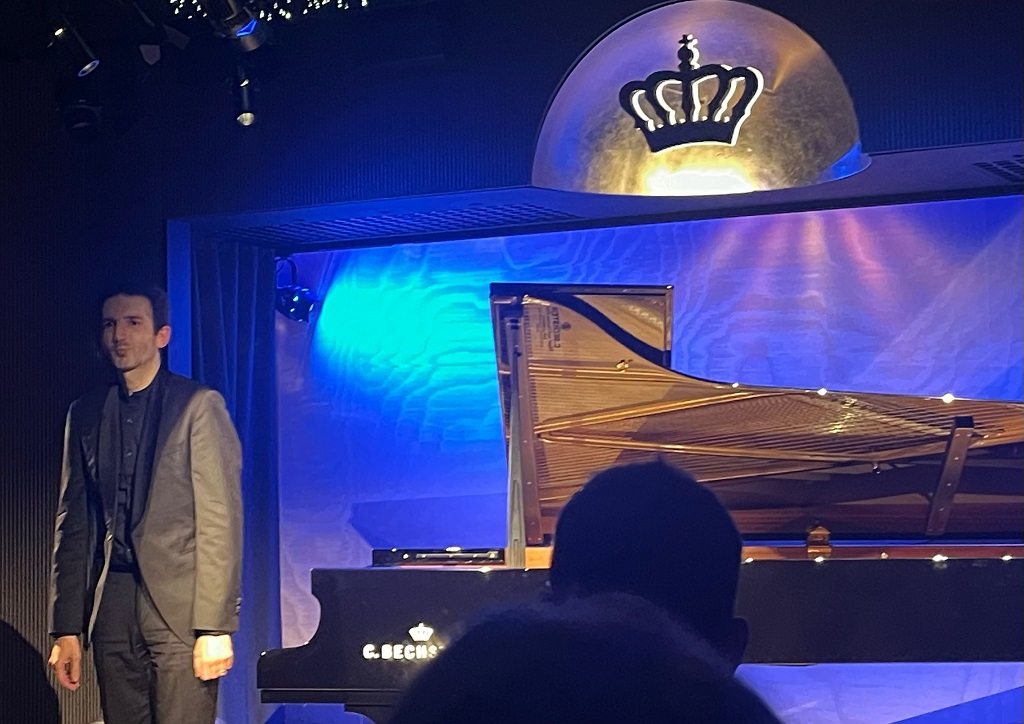
Bechstein Hall, London, 28 March 2025

by John Earls. Photo credit below (c) John Earls

Scottish tenor Matthew McKinney is the winner of the 2024 Kathleen Ferrier Awards and there was quite a sense of anticipation for this recital with pianist Roelof Temmingh at the suitably intimate Bechstein Hall.

Performance is of course the key element in voice and piano recitals such as this. But it is also exciting to be presented with a programme that has clearly been put together with such thought and care. Under the theme of Finding Freedom this programme consisted of two parts. The first was an alternating Clara and Robert Schumann affair, the second a more eclectic but no less engaging mix.

The Schumanns’ set consisted of rotating Clara and Robert Schumann songs neatly threaded together in a lovers’ exchange. It demonstrated not only the consideration and skill of the programming but the quality of Clara’s as well as Robert’s songwriting. McKinney’s singing was beautiful throughout.

The set also included two pieces of recited poetry, Afrikaans poet Breyten Breytenbach’s Red-breasted Dove and Rabindranath Tagore’s Unending Love, both of which deftly complimented the sentiment.

For the first half the audience was requested to save applause until the end of the set, entirely appropriate for the mood and respectfully observed. For the second half however McKinney advised “please do clap any time you want to”. And just as well as this was a much more varied affair including a couple of Robert Schumann solo piano pieces for Temmingh to shine.

Opening with Frank Bridge’s Love Went A-Riding it also included two Benjamin Britten songs, a forceful Batter My Heart (from The Holy Sonnets of John Donne) immediately followed by a tender Sonnetto XXX (from Seven Sonnets of Michelangelo), and a rendition of Tosti’s Marechiare that was full of brio and panache.

There then followed a lovely and affecting sequence. Rebecca Clarke’s I’ll Bid My Heart Be Still (originally composed for viola but ‘reimagined’ here for voice), Robbie BurnsAe Fond Kiss (McKinney unaccompanied) and Temmingh’s own Verjaarsdagbrief (Birthday Letter) based on a letter written by his grandfather to his grandmother and sang in Afrikaans by McKinney who then looped back to Ae Fond Kiss. The audience silence afterwards was marked and sincere.

The set concluded with a couple of well delivered Richard Strauss songs which led to the inevitable and deserved calls for an encore which McKinney admitted they didn’t have so we got a repeat of the magnificent Marechiare which was gratefully received.

Matthew McKinney and Roelof Temmingh performed the following repertoire:

Breytenbach Red-breasted dove
Clara Schumann and Robert Schumann songs interspersed:
Clara Ich stand in dunkeln Träumen Op.13/1, Liebeszauber Op.13/3, Volkslied, Lorelei,
Robert Der Nussbaum Op.25/3, Volksliedchen Op.51/2, Zwielicht Op.39/10, Kreisleriana Op.16/8 (solo piano), Mondnacht Op.39/5
Tagore Unending love
Clara Der Mond kommt still gegangen Op.13/4, Die stille Lotosblume Op.13/6
Robert Die Lotosblume Op.25/7, Widmung Op.25/1

Bridge Love went a-riding H.114
Weir Sweet Little Red Feet (from The Voice of Desire)
Robert Schumann Ritter vom Steckenpferd Op.15/9
Auden What’s in your mind, my dove, my coney?
Britten Batter my heart Op.35/2, Sonnetto XXX Op.22/3
Robert Schumann Vogel als Prophet Op.82/7
Tosti Marechiare
Clarke I’ll bid my heart be still (reimagined); Trad Scots Ae fond kiss
Temmingh Verjaarsdagbrief
Richard Strauss Befreit Op.39/4, Zueignung Op.10/1

John Earls is Director of Research at Unite the Union. He posts on Bluesky and tweets / updates his ‘X’ content at @john_earls

Published post no.2,489 – Sunday 30 March 2025
In concert – Emmanuel Despax @ Bechstein Hall, London

Emmanuel Despax (piano)

Ravel Miroirs (1905)
Despax Sounds of Music – Concert Paraphrase on The Sound of Music by Richard Rodgers and Oscar Hammerstein (unknown)
Fauré arr. Despax Après un rêve Op.7/1 (1877)
Debussy Clair de lune (1905)
Ravel Gaspard de la nuit (1908)

Bechstein Hall, London, 7 March 2025

by John Earls. Photo credit (c) John Earls

The most recognised piece of music by French composer Maurice Ravel is his 1928 large orchestral work Boléro, famously used in the film 10 and by Torvill and Dean when ice dancing their way to a 1984 Winter Olympics gold medal.

But there is also a magnificent repertoire of piano music including for solo piano and this provided the main feature of this recital by Emmanuel Despax, marking the 150th anniversary of Ravel’s birth.

The first set opened with Miroirs (Mirrors), a suite of five short movements Ravel dedicated to his fellow members of the French avant-garde artist group Les Apaches.

Noctuelles (Night Moths) had twinkling moments of calm surfacing through its dark undertones, contemplative birdsong is evoked in Oiseaux tristes (Sad Birds), Une barque sur l’océan (A Boat on the Ocean) captured both the flow and ripple of the waves, Alborada del gracioso (The Jester’s Aubade) had a jittery, Spanish aspect, and the bells of La vallée des cloches (The Valley of Bells) are not peals so much as melancholic, dark flashes.

The set ended with Despax’s Sounds of Music, a ‘Concert Paraphrase’ on Rodgers and Hammerstein’s The Sound of Music. I enjoyed its dark humour and nods to other classical piano composers – “If you hear something you recognise it’s not plagiarism, it’s on purpose” Despax forewarned us.

The second set opened with Despax’s arrangement of Faure’s Après un rêve (After a Dream) which was serious and majestic followed by Debussy’s Clair de lune (Moonlight) which whilst thoughtful and considered was also beautifully delicate and expressive.

But the evening was Ravel’s and it concluded with his epic three part masterpiece Gaspard de la nuit (Gaspard of the Night) derived from the prose poems by Aloysius Bertrand. Described by Despax as a “symphonic work for solo piano” it is notoriously difficult to play.

Ondine’s hypnotic trills are shaken by a short powerful blast towards the end and Despax displayed his virtuosity throughout. Le Gibet presents bells of a different kind to those featured in the earlier set, more disturbing and ominous as the repeating tolls maintained throughout evoke the lone hanged man of its inspiration. The way Despax leaned into his keyboard in rapt concentration reminded me of jazz pianist Brad Mehldau at his most intense. The final piece, Scarbo, depicts a mischievous goblin and was spritely before its dramatic long pause towards the end and a forceful energetic finish. It was as captivating to watch as it was to listen to.

What was clear from this performance is the attachment and affinity that Emmanuel Despax has for the music of Maurice Ravel. This was confirmed by an encore of Pavane pour une infante défunte (Pavane for a Dead Princess) which provided a moving and tender conclusion to the evening.

John Earls is Director of Research at Unite the Union. He posts on Bluesky and tweets / updates his ‘X’ content at @john_earls

Published post no.2,468 – Sunday 9 March 2025

In concert – Susan Bullock & Richard Sisson @ Bechstein Hall, London

Susan Bullock (soprano), Richard Sisson (piano)

Bechstein Hall, London, 21 February 2025

by John Earls. Photo credit (c) John Earls

There can’t be that many connections between Richard Wagner and the Great American Songbook, but Susan Bullock is one of them.

The revered British soprano has appeared as Wagner’s Brünnhilde in opera houses around the world, and has also performed the role of Isolde.

Last year she and pianist Richard Sisson released Songs My Father Taught Me, an album of songs from and inspired by some of the classics from the Great American Songbook, and that formed the basis of this wonderful recital at the shiny new Bechstein Hall in London’s Wigmore Street (a stone’s throw from Wigmore Hall).

It was clear from the start the genuine affection and affinity both musicians have for these songs. Bullock’s father was, she tells us, “a policeman by day and a wannabe Bing Crosby by night”. Sisson’s grandmother was a fan of the classic musicals.

I’ve Got the World on a String (Harold Arlen and Ted Koehler) and Hello Young Lovers (Rodgers and Hammerstein) were a fine opening to the show, before Sisson drew the audience’s attention to the full programme listing displayed on the digital notice boards in the hall – “the writing’s on the wall. It’s like Belshazzar’s feast!”

And what a programme! In the first set alone we had greats from Rodgers and Hart (My Funny Valentine), George and Ira Gershwin (‘S Wonderful) and Jerome Kern and Oscar Hammerstein (Bill and Can’t Help Lovin’ That Man), as well as a zingy What About Today (David Shire).

There was also a gorgeous Bewitched, Bothered and Bewildered (Rodgers and Hart) and a charged If I Loved You (Rogers and Hammerstein) with Bullock ranging from whisper to exhortation and Sissons eulogising afterwards about the amazing “symmetrical chords”.

The first half finished with a fabulous One for My Baby with Bullock playing the part perfectly, sat at the piano looking weary before finally walking down the aisle still singing to exit out the back door.

Alas, Bullock was not to be seen nursing ‘one for the road’ in the bar during the interval but thankfully returned for an excellent second set. This started by acknowledging some great heirs to the American Songbook. Firstly, Stephen Sondheim (Oscar Hammerstein II was a mentor to Sondheim and something of a surrogate father) with a moving Send in the Clowns, a very humorous The Boy From… and a dramatic Losing My Mind. This was followed by a beautiful arrangement and performance of Bert Bacharach and Hal David’s A House Is Not a Home.

A warm The Folks Who Live on the Hill (Kern and Hammerstein) was then followed by a magical medley from songwriters featured earlier – Stormy Weather, The Man I Love, All the Things You Are, What’s the Use of Wond’rin’ plus Tommy Wolf and Fran Landesman’s The Ballad of the Sad Young Men.

Of course these songs have wonderful tunes and beautiful melodies, which is why they have been, and continue to be, frequently covered as instrumentals, particularly by some of the jazz greats. But they also have stunning lyrics that can be touching, witty and poetic. One could grab lines from any of the songs in this programme but Sisson made a particular reference to the lyrics of The Ballad of the Sad Young Men. Take these closing lines:

While a grimy moon, watches from above
All the sad young men, who play at making love

Misbegotten moon shine for sad young men
Let your gentle light guide them home again
All the sad, sad, sad, young men.

The show ended with a delightful take on the Gershwins’ Let’s Call the Whole Thing Off and a moving encore of You’ll Never Walk Alone from Rodgers and Hammerstein’s Carousel.

This was a superb celebration of magnificent songs. Bullock’s singing was expressive and crystal clear, Sisson’s piano accompaniment was wonderfully balanced with some lovely flourishes. These great songs have endured for a reason. And with advocates and performances such as this they will be around for a good while yet.

John Earls is Director of Research at Unite the Union. He posts on Bluesky and tweets / updates his ‘X’ content at @john_earls

Published post no.2,454 – Sunday 23 February 2025