Listening to Beethoven #220 – Symphony no.2 in D major Op.36 (arranged for piano trio)


The Longing for Happiness. Left wall, detail from the Beethoven-Frieze (1902) by Gustav Klimt

Symphony no.2 in D major Op.36 for orchestra (1800-1802), arranged for piano trio 1805 (Beethoven aged 34)

Dedication unknown
Duration 30′

1. Adagio molto – Allegro con brio
2. Larghetto
3. Scherzo: Allegro
4. Allegro molto

Listen

Background and Critical Reception

Beethoven’s friend and pupil Ferdinand Ries took charge of this arrangement of the Symphony no.2 for piano trio – but the very limited writings about the arrangement strongly imply that the final decisions on its construction and execution were made by Beethoven himself.

The reason for this arrangement is not abundantly clear, other than it making the symphony available for domestic, small-scale music making. Yet the nature of the scoring would mean only very accomplished players could see it through from one end to the other!

Thoughts

This is a remarkable and surprisingly effective transcription, one that fully retains the vitality of Beethoven’s invention while compressing it for the intimacy of a chamber music environment.

Inevitably the textures are very different, but having less instruments does on occasion give the listener opportunity to appreciate the bare bones of Beethoven’s melodic invention.

Spotify playlist and Recordings used

Robert Levin (piano), Peter Hanson (violin), David Watkin (cello) (Archiv Produktion)

Emanuel Ax (piano), Leonidas Kavakos (violin), Yo-Yo Ma (cello)

This is a very fine performance from pianist Robert Levin and soloists drawn from the Orchestre Révolutionnaire et Romantique. The fast music is punchy and incisive, while the slower music has more intimate moments, beautifully captured.

You can chart the Arcana Beethoven playlist as it grows, with one recommended version of each piece we listen to. Catch up here!

Also written in 1805 Spohr String Quartet no.1 in C major Op.4/1

Next up An die Hoffnung Op.32

Listening to Beethoven #219 – Variations on Ich bin der Schneider Kakadu Op.121a

Beethoven and the Austrian composer Wenzel Müller, who wrote the initial theme on which the ‘Kakadu’ variations are based

Variations on Ich bin der Schneider Kakadu Op.121a for piano trio (1803, revised 1819-20. Beethoven aged 33 at time of composition)

Dedication Prince Nikolas Borissovich Galitzin


Duration 19′

Listen

by Ben Hogwood

Background and Critical Reception

The reference material I have been using for the Beethoven project has the Kakadu variations with a completion date of 1803 – though there are another tranche of dates to take into account. The first autograph score appeared in 1816 after what appears to have been a number of revisions, giving an indication of how Beethoven regarded the material. The opus number 121 confirms a much later publication date of 1824, closely followed by the Choral symphony.

Lewis Lockwood suspects that a number of revisions may even have been made as late as this, particularly the striking introduction with which the work begins. The theme, however, is taken from an opera by the Austrian composer Wenzel Müller. Completed in 1794, the comedy Die Schwestern von Prag (‘The sisters from Prague’)  contains the aria I am Kakadu the tailor, whose main theme is lifted by Beethoven for this piece. Following a large introduction are 11 variations on the theme.

Thoughts

This is a substantial piece of work, especially with a full bodied introduction added to the front. In truth this introduction gives the Kakadu variations something of a Baroque profile, giving it a stern, slow minor key introduction, very much a ‘Grave’. It builds in tension, too, with some pretty sparse material that lasts over a third of the piece, and is drawn out for maximum dramatic impact.

Once the theme finally arrives it is something of a light relief, with quite a jaunty profile as the piano and staccato strings set out the simple tune. A feeling of contentment prevails, and this spreads to a flowing first variation and a second variation with light hearted triplets on the violin.

The cello takes over melodic duties for a warm third variation, and the interplay becomes more dense – a sparkling fourth and more intimate fifth attest. The sixth opens the hatches with octaves on the piano, before a thoughtful seventh brings violin and cello alone, the former sweetly sung. The piano’s return is initially quite restrained, the ninth variation a hark back to the solemn introduction and a pause for thought. For the tenth it is as though the trio have saddled a horse and ridden off at speed. The last variation and finale is a wholly suitable summing up, bringing the work to a bracing conclusion.

Spotify playlist and Recordings used

Beaux Arts Trio (Philips Classics)
Daniel Barenboim (piano), Pinchas Zukerman (violin), Jacqueline du Pré (cello) (EMI)
Rudolf Serkin (piano), Yuzuko Horigome (violin), Peter Wiley (cello) (Sony Classical)
Florestan Piano Trio (Hyperion)
Stuttgart Piano Trio (SWR)

There are some heavyweight trio combinations who have taken on the Kakadu variations. Among them are the superstar trio of Daniel Barenboim, Pinchas Zukerman and Jacqueline du Pre, whose high voltage version is a memorable encounter. As enjoyable are the versions from the Beaux Arts Trio, the Stuttgart Trio, and Rudolf Serkin leading the Marlboro Music Society.

The below playlist contains those these recordings, while you can click here for clips from the Florestan Trio account

You can chart the Arcana Beethoven playlist as it grows, with one recommended version of each piece we listen to. Catch up here!

Also written in 1803 Danzi Sextet in E major Op.15

Next up tbc

Listening to Beethoven #218 – Gedenke mein! WoO130

Gedenke mein! WoO130 for voice and piano (1804-5, revised 1819-20. Beethoven aged 33 at time of composition)

Dedication Prince Nikolas Borissovich Galitzin


Text Anonymous
Duration 1’30”

Listen

by Ben Hogwood

Background and Critical Reception

Thoughts

This song has quite a gentle, hymn-like profile – especially when the harmonies. The voice and piano move together, step by step, with a nostalgic tone, until what can only be a regretful closing statement.

Spotify playlist and Recordings used

A seldom-recorded song – but when you have versions from the great baritone Dietrich Fischer-Dieskau and tenor Peter Schreier the song is still amply covered.

The below playlist contains those two recordings:

You can chart the Arcana Beethoven playlist as it grows, with one recommended version of each piece we listen to. Catch up here!

Also written in 1805 Wölfl Piano Sonata in C minor Op.25

Next up Variations for piano trio on ‘Ich bin der Schneider Kakadu’ Op.121a

Listening to Beethoven #217 – Bagatelle in C minor, WoO 52

Commemorative medal for Ludwig van Beethoven – Bronze medal from the Hungarian Ministry of Culture based on a design by József Reményi (picture courtesy of the Beethovenhaus, Bonn)

Bagatelle in C minor WoO 52 for piano (c1795-7, Beethoven aged 24-6)

Dedication not known
Duration 3’45”

Listen

written by Ben Hogwood

Background and Critical Reception

A bagatelle that slipped through the net on Arcana’s Beethoven voyage! This one, which appears to have been finished between 1795 and 1797, is one of a series of such works completed in C minor. It was seemingly on the shortlist to be picked for the set of bagatelles Beethoven published as Op.119 in 1823.

Misha Donat, writing in his notes for the recording by Steven Osborne on Hyperion, suggests the movement was intended for inclusion as part of the Piano Sonata no.5 in C minor Op.10/1, but ‘discarded the scherzo-like piece because its tempo was too similar to that of the finale’. The piece was first published in 1888.

Thoughts

It is easy to see how this piece could be an out-take from the C minor sonata. It has the profile of a scherzo, with a repeated note motif that isn’t too dissimilar to that used in the forthcoming Symphony no.5. Although this ‘riff’ starts in the left hand it transfers to the right as well, and Beethoven enjoys playing with the syncopations it generates.

As a ‘trio’ section Beethoven moves into the major key, with a lighter touch and a warmer outlook to the music. It doesn’t last long, however – and we return to the dogged C minor material for a convincing finish.

Not exactly an easy Bagatelle to play, and much more a sonata fragment – but typically well constructed and memorable in its material.

Recordings used and Spotify playlist

Jenő Jandó (Naxos)
Mikhail Pletnev (DG)
Ronald Brautigam (BIS)
John Lill (Chandos)

Ronald Brautigam provides plenty of energy on his account, and there are tasteful versions from the other three pianists on the list – as well as Steven Osborne on Hyperion.

You can chart the Arcana Beethoven playlist as it grows, with one recommended version of each piece we listen to. Catch up here!

Also written in 1797 Eberl 2 Sonatas for Keyboard four hands, Op.7

Next up Gedenke mein!, WoO 130

Listening to Beethoven #216 – Piano Sonata no.23 in F minor Op.57 ‘Appassionata’

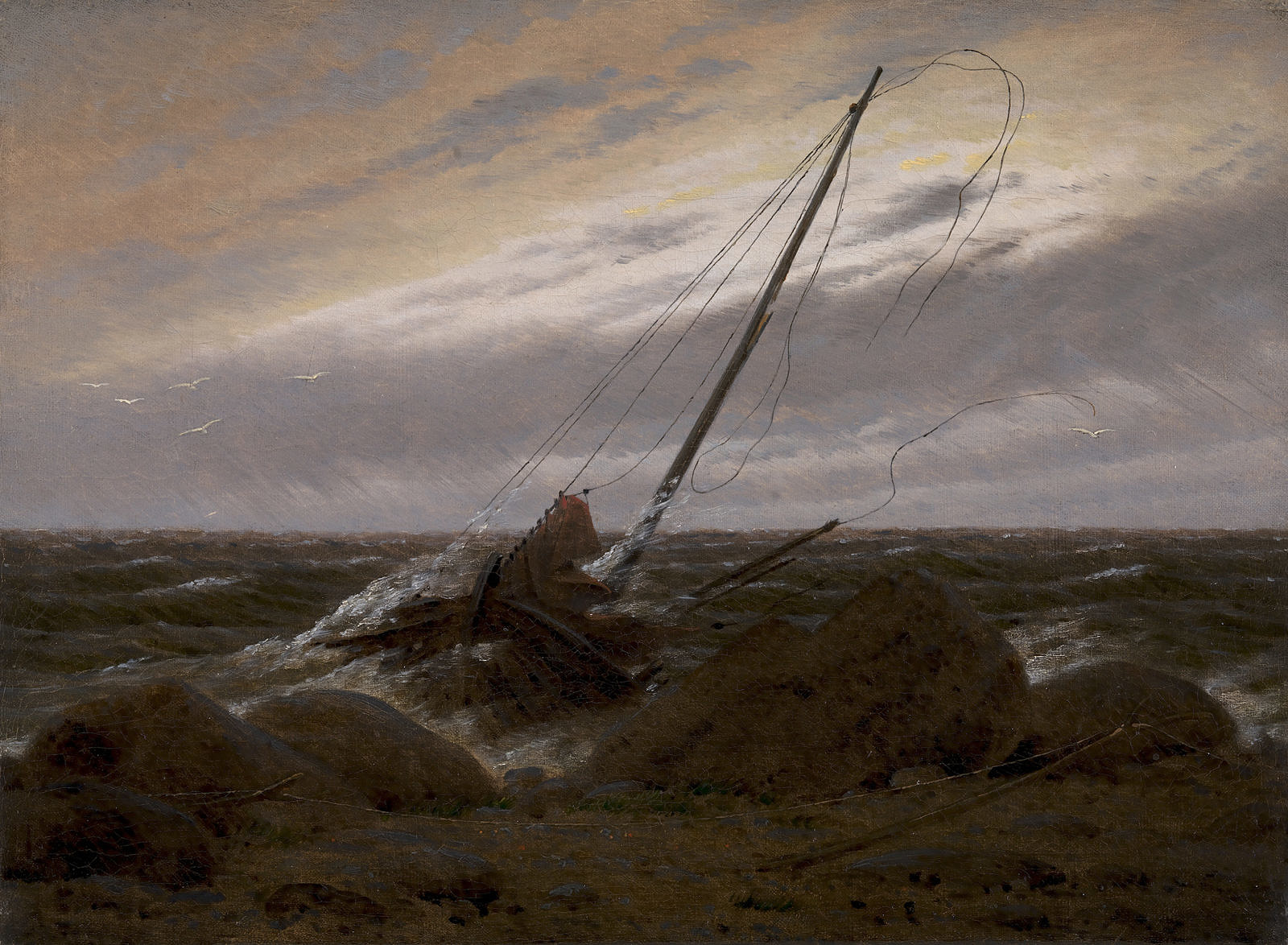
After the Storm by Caspar David Friedrich (1817)

Piano Sonata no.23 in F minor Op.57 ‘Appassionata’ for piano (1804-5, Beethoven aged 34)

1. Allegro assai
2. Andante con moto
3. Allegro ma non troppo – Presto

Dedication Count Franz von Brunswick

Duration 23″

Listen

written by Ben Hogwood

Background and Critical Reception

Even within Beethoven’s output, the Appassionata sonata is seen as a landmark. As Angela Hewitt writes in the booklet note for her recording of the work on Hyperion, it is a central part of Beethoven’s ‘heroic’ period, sat in publication order between the Eroica symphony and the Piano Concerto no.4, and at a time where Beethoven was taking risks.

Beethoven’s fellow composer and friend Ferdinand Ries recorded how he watched Beethoven at work in Baden. The two composers went for a walk, where Ries described a striking melody on the shawm – which Beethoven could not hear because of his rapidly advancing deafness. It turned out that he was preoccupied in any case, for on their return he immediately went to the keyboard, and played through the newly composed finale of the new sonata, Ries recounting a performance of ‘irresistible fire and mighty force’.

Writing in The Beethoven Companion, Harold Truscott asserts that ‘technically, apart from one or two passages, the work is not difficult to play…yet can still sound very brilliant. Its real difficulty, however, is control of its varied elements and of the great expressive power which is their sum.’

Angela Hewitt notes Beethoven’s holding back of this power until the finale – an increasingly notable feature of his writing. As Jan Swafford writes, ‘Beethoven had an incomparable skill for raising a movement to what seems an unsurpassable peak of excitement or tension, then to surpass it.’

Thoughts

In the Appassionata the risk taking can be seen everywhere you turn. It can be found in the work’s opening phrase, going down to the low ‘F’ exploiting the bigger range of Beethoven’s new Erard piano. It can be found in the stormy middle section of the first movement and the whirlwind figurations of the last, where the right hand is playing so fast it threatens to go off the end! It can also be found in the structural design, Beethoven writing a slow movement that acts initially as an equivalent to the hymnal slow movement in the Pathetique sonata, but ends up as a bridge to the finale. The consolation it was beginning to provide is wholly lost.

Its opening three notes give an immediate idea of the gravitas of the piece. They may be the notes of the F minor triad but they carry great weight – as Beethoven’s works in this key were wont to do. The first movement is compelling, the main theme littered with interruptions as though a battle is being waged between war and peace. The latter breaks out in the second movement, the hymnal motive both simple and moving, but soon gathering momentum as Beethoven finds he cannot stand still.

All is headed for a last movement of formidable power, unlike anything we have heard on the piano so far. The torrent of notes fly in the face of Truscott’s assertion that the piece is not difficult to play – but the language for the listener is unremitting and straightforward. At the end the Appassionata sets its listener down in a heap, all emotion spent.

Recordings used and Spotify links

Alfred Brendel (Philips)
András Schiff (ECM)
Angela Hewitt (Hyperion)
Paul Badura-Skoda (Arcana)
Stephen Kovacevich (EMI)
Igor Levit (Sony Classical)
Claudio Arrau (Philips)
Daniel Barenboim (Deutsche Grammophon)

There are some towering interpretations of Beethoven’s masterpiece in this playlist, not least those by Emil Gilels, Claudio Arrau and Alfred Brendel. Andras Schiff and Angela Hewitt are also very fine. Paul Badura-Skoda secures authentic drama from his Broadwood piano, dating from a mere decade after the piece was written.

You can hear clips of Angela Hewitt’s recording at the Hyperion website

You can chart the Arcana Beethoven playlist as it grows, with one recommended version of each piece we listen to. Catch up here!

Also written in 1805 Cherubini Faniska

Next up tbc!