Listening to Beethoven #215 – Triple Concerto in C major Op.56

View of the Augarten Palace and Park, Vienna by Johann Ziegler

Triple Concerto in C major Op.56 for piano, violin, cello and orchestra (1803-4, Beethoven aged 33)

1 Allegro
2 Largo (attacca)
3 Rondo alla polacca

Dedication Joseph Franz von Lobkowitz
Duration 38′

Listen

written by Ben Hogwood

Background and Critical Reception

It is fashionable in recent times to look down on Beethoven’s Triple Concerto, but despite its perceived critical failings it was an innovative work for its time. Lewis Lockwood notes how, “We can readily connect the Triple Concerto with the symphonie concertante that had prospered in France and in French-influenced centres such as Bonn and Mannheim in the later eighteenth century, and which stayed alive until about 1810.”

Beethoven had performers in mind when writing the piece, too – the violinist Georg August Seidler, cellist Anton Kraft (the senior figure in the cello-playing family) and almost certainly Beethoven himself, at the piano. Jan Swafford traces the origins of Beethoven’s thinking to the baroque concerto grosso, describing the work as ‘gorgeous but peculiar, expensive and impractical to perform’. Commentators are united in drawing a link to Beethoven’s intentions at the time of composition, where he was looking to move to Paris and impress the musical hierarchy there. The concerto would have been in his arsenal for sure, but while staying put it quickly lost its allure – with no public performance until 1808, at the summer concerts in Augarten (above)

The Triple Concerto has a substantial structure, with a first movement almost 20 minutes in length – then a relatively brief Largo in A flat major which leads directly to a Rondo alla Polacca finale. The key choice is instructive, A flat having been used for the slow movements of the Pathetique sonata and the Piano Concerto no.1. Commentators have noted how prominent the cello in this piece – and in their excellent book Beethoven’s Cello, Marc D. Moskovitz and R. Larry Todd spend time examining its role.

Along with Lewis Lockwood, they see the Triple Concerto as a forebear to techniques used by Beethoven soon after in his third Cello Sonata, Op.69, with Lockwood going further to bring in the two piano trios Op.70.

Thoughts

Listening to the Triple Concerto is a pleasant if undemanding experience – and if the listener is in the right mood an enjoyable concert experience is in store. It certainly is a long first movement, its 20 minutes an extraordinary length of time for a concerto even when there are three soloists involved. Although it can seem very drawn out at times there is a very appealing warmth, especially when the cello is to the fore. Its themes are invested with a great deal of warmth, complemented by the violin and then trumped by the piano.

The second movement feels like a flash in the pan, for it is only 5 minutes in length (roughly 15% of the work) but it has an appealing tenderness and lyricism. The Rondo alla Polacca is a ‘safe’ C major, though there is some dancing as the soloists have fun together.

The musical language of the Triple Concerto feels relatively basic – back in C major as we were in the Piano Concerto no.1 – but the interplay between the soloists is where the chief interest lies. The language feels quite basic – we are in C major as we were for the first piano Concerto – and the length of the piece is considerable. Yet, in the right combination of soloists and orchestra, the Triple Concerto can still be an appealing proposition.

Recordings used and Spotify links

David Oistrakh (violin), Mstislav Rostropovich (cello), Sviatoslav Richter (piano), Berliner Philharmoniker / Herbert von Karajan (EMI)
Christian Tetzlaff, Tanja Tetzlaff, Royal Northern Sinfonia / Lars Vogt (Ondine)
Wolfgang Schneiderhan, Pierre Fournier, Géza Anda, Deutsches Symphonie-Orchester Berlin / Ferenc Fricsay (Deutsche Grammophon)
Beaux Arts Trio, London Philharmonic Orchestra / Bernard Haitink (Philips)
Urban Svensson, Mats Rondin, Boris Berezovsky, Swedish Chamber Orchestra / Thomas Dausgaard (Simax)

The Triple Concerto discography is dripping with illustrious soloists, sometimes starry individuals in search of a winning trio showcase, or artists who have formed a genuine musical chemistry together. Of the versions listed above, there are some high voltage collisions that prove an intoxicating experience – none more so than the irresistible combination of Oistrakh, Rostropovich, Richter and Karajan.

You can chart the Arcana Beethoven playlist as it grows, with one recommended version of each piece we listen to. Catch up here!

Also written in 1804 Spohr Violin Concerto no.2 in D minor Op.2

Next up Piano Sonata no.23 in F minor Op.57 ‘Appassionata’

Listening to Beethoven #214 – Piano Sonata no.22 in F major Op.54

Sea beach with fisherman (The fisherman) by Caspar David Friedrich (1807)

Piano Sonata no.22 in F major Op.54 for piano (1804, Beethoven aged 33)

1 In tempo d’un menuetto
2 Allegretto – Più allegro

Dedication Count Ferdinand Waldstein
Duration 12′

Listen

written by Ben Hogwood

Background and Critical Reception

Beethoven biographer Lewis Lockwood has an important observation, that ‘in other middle-period pairings, a long, powerful and brilliant work (in this case the Waldstein sonata) is succeeded by a short and quiet one, with Beethoven creating a double image and a deliberate contrast, a reminder of the balance between great and small, between seemingly opposed and adjacent modes of being that can compliment one another, as a rare flower grows by a large tree’.

Little needs to be said after that rather neat summing up – though it is as always worth hearing the thoughts of pianist Angela Hewitt. Writing booklet notes for her Hyperion recording, she notes the elegance of the opening before ‘all hell breaks loose’. For the second movement, she stresses the importance of observing the composer’s ‘dolce’ marking to avoid it sounding like a study.

Thoughts

As Angela Hewitt notes, it is a graceful and genial start to this piece, Beethoven enjoying a few sleights of hand with some chromatic inflections to the melody, before the cavalry rights roughshod over the tranquil mood. There is a perceptible glint in the composer’s eye while this happens, and you can sense the frowns the first audience may well have had! This means when the mood returns to tranquil the listener is no longer as trusting as to what might happen – and they are right to be wary, for Beethoven enjoys a few more outbursts and melodic quirks.

The second movement is fast and flowing, though there is a more romantic element to the twinkling right hand, and a good deal of expressive weight when the left hand goes towards the bottom end of the piano. Once again Beethoven enjoys journeying to far-flung keys, and the momentum never lets up right to the emphatic finish.

This is a curious piece, one that is indicative of Beethoven’s quest for the new, challenging existing notions of how a sonata should behave. It has elements of the Waldstein’s virtuosity and energy in the final movement, and has all the characteristics of a ‘prelude and fugue’ from the Baroque period. There is much to enjoy here!

Recordings used and Spotify links

Alfred Brendel (Philips)
András Schiff (ECM)
Angela Hewitt (Hyperion)
Paul Badura-Skoda (Arcana)
Stephen Kovacevich (EMI)
Igor Levit (Sony Classical)
Claudio Arrau (Philips)
Daniel Barenboim (Deutsche Grammophon)

Once again a crowded field of some very fine versions, though those from András Schiff, Alfred Brendel and Stephen Kovacevich prove particularly enjoyable.

You can hear clips of Angela Hewitt’s recording at the Hyperion website

You can chart the Arcana Beethoven playlist as it grows, with one recommended version of each piece we listen to. Catch up here!

Also written in 1804 Hummel Rondo in E flat major Op.11

Next up Triple Concerto in C major Op.56

Listening to Beethoven #213 – Piano Sonata no.21 in C major Op.53 ‘Waldstein’

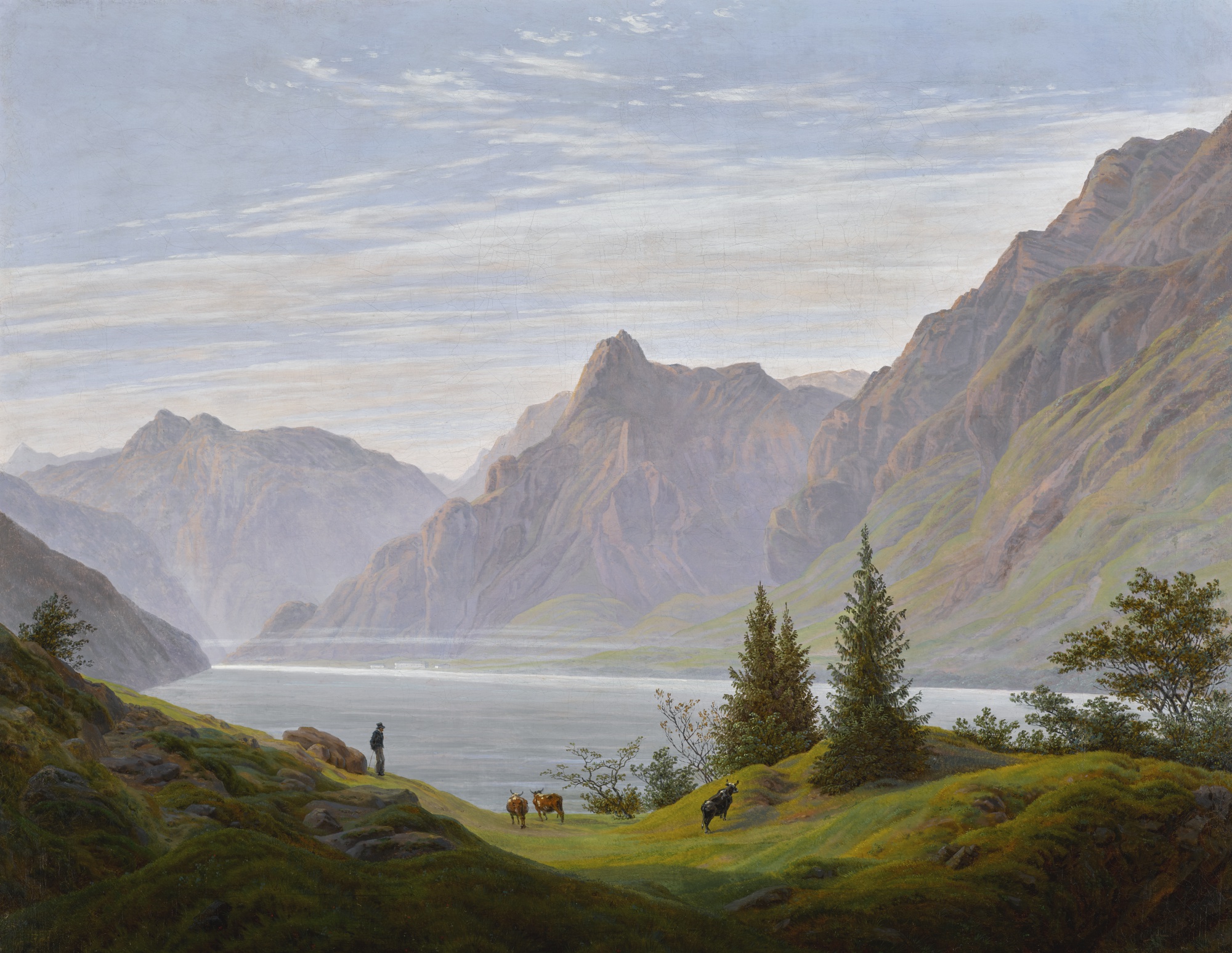
Landscape With Mountain Lake, Morning by Caspar David Friedrich (1823-35)

Piano Sonata no.21 in C major Op.53 ‘Waldstein’ for piano (1804, Beethoven aged 33)

1 Allegro molto
2 Introduzione – Adagio molto –
3 Rondo: Allegretto moderato

Dedication Count Ferdinand Waldstein
Duration 25′

Listen

written by Ben Hogwood

Background and Critical Reception

Beethoven’s next piano sonata was dedicated to the man who could claim to have had the greatest impact on his success as a composer – Count Ferdinand Waldstein of Bonn. What the Count made of this dedication we do not know, for he was fighting abroad at the time, but Beethoven had dedicated a remarkable new work in his favour.

It was written for a new piano – an Érard of French origin, with four pedals and an extended range. Jan Swafford gives a compelling account of how Beethoven wrote for this new instrument, ‘its action heavier and its sound bigger than the Viennese pianos he was used to.’ There were new colours to explore, and pedal effects with which to experiment, and Beethoven wasted no time, using the piano as ‘the vehicle of a heroic journey that ends in overflowing exaltation’. In this sense, the Waldstein Sonata was similar in thought to the recently premiered Eroica symphony.

The sonata, however, is a very different animal. Charles Rosen talks of ‘a characteristic sound, not only unlike the music of other composers, but unlike any other work of Beethoven, an energetic hardness, dissonant and yet curiously plain, expressive without richness.’ For Lewis Lockwood, ‘this sonata could never have been played by merely competent amateurs in Beethoven’s time. With its arrival the technical level of the piano sonata was elevated to that of the concerto.’ He equates it to Beethoven’s accomplishment for the violin in the Kreutzer sonata.

In an interview with Arcana, Angela Hewitt recognised its difficulties. “I don’t think it’s his greatest sonata but it is a wonderful performance piece when you can bring it off. If you look at every detail in it then it and want to play it well it is very difficult.”

The first movement draws attention for what Swafford terms its ‘surging and singularly pianistic dynamism’. The second movement was initially going to be a substantial Andante, but failed its initial audition with friends, who declared it too long. After a fit of pique, Beethoven reluctantly agreed and removed it, publishing it separately as the standalone Andante favori. Replacing it was a short transitional movement in the same key, a ‘short stretch of reverie and anticipation’.

The anticipation is lets loose by the finale, ‘one of the most ecstatic of all movement for piano’ in Swafford’s eyes, ‘like a gust of wind that shocks the listener into a sense of the joyous effervescence of life’. For him, the Waldstein is ‘a feat of disciplined craftsmanship that would have been practically unimaginable if he had not done it’. Here is a defining demonstration of what musical composition is about.’

Thoughts

I’m going to disagree with Angela Hewitt and declare the Waldstein as the finest sonata in Beethoven’s output thus far, in a crowded field. Even listening to it now, some 218 years after composition, its first movement has the power to make the listener sit up and take notice of its unusual writing.

For few works for piano are as immediately propulsive, and to be writing that now gives an idea of just how forward-looking this piece must have sounded to its first audience in 1804. The first movement bubbles with energy, establishing C major as the home key but with a restless gait and an unstoppable drive. Contrast that with the still second theme, a glimpse of pure light before the quickfire figures return.

The second movement Adagio is indeed a magical transition, but the finale into which it leads is brilliantly judged, ghosting in with a graceful, singing melody, the piano now sounding more orchestral in its wide range of colours and figures. Soon the energy levels of the first movement are met and surpassed, the deceptively simple melody keeping the ship on course while the torrent of water surrounds it from the other hands.

Everything here is done with a firm assurance, the composer fully confident in his processes and results. As a result the Waldstein is Beethoven’s most assured and confident pieces yet – impeccably structured, brilliantly written for the developing piano and full of challenges, not to mention thrills and spills for the audience.

Recordings used and Spotify links

Emil Gilels (Deutsche Grammophon)
Alfred Brendel (Philips)
András Schiff (ECM)
Angela Hewitt (Hyperion)
Paul Badura-Skoda (Arcana)
Stephen Kovacevich (EMI)
Igor Levit (Sony Classical)
Claudio Arrau (Philips)
Daniel Barenboim (Deutsche Grammophon)

Emil Gilels gives a peerless account for DG, one of his very finest piano recordings. In a crowded field his is arguably the leading version, though the others listed above are hardly slouches!

You can hear clips of Angela Hewitt’s recording at the Hyperion website

You can chart the Arcana Beethoven playlist as it grows, with one recommended version of each piece we listen to. Catch up here!

Also written in 1804 Ries Piano Sonata in A minor Op.1/2

Next up Piano Sonata no.22 in F major Op.54

Listening to Beethoven #212 – Allemande in A major, WoO 81

Entwurf Beethoven-Gedenkmünze 1970 (5 Deutsche Mark)

Draft for a Beethoven commemorative coin for 5 Deutsche Mark, 1969 – Photograph of an unmarked model (picture courtesy of the Beethovenhaus, Bonn)

Allemande in A major WoO 81 for piano (1793-1822)

Dedication not known
Duration 1’30”

Listen

written by Ben Hogwood

Background and Critical Reception

Some of Beethoven’s smaller pieces for piano have a very broad date margin. This Allemande is a case in point, given a composition date of 1793-1822 – the final date indicating a possible revision in his attempt to place it in the set of 11 Bagatelles Op.119. It is placed here to complement the Bagatelle we explored yesterday.

Writing the booklet notes for Ronald Brautigam’s recording, Roeland Hazeldonk talks of the ‘vast number of sketches he (Beethoven) had accumulated since before his arrival in Vienna’. There are many more of those for us to enjoy over the coming instalments.

Thoughts

The Allemande is a flowing piece with an easy temperament. Its florid right hand and relatively static left suggests a kind of etude, though the mood changes with Beethoven slips seamlessly into the minor key, and a more obvious dancing rhythm. After this brief shadow, the flowing music returns and all is well again.

Recordings used and Spotify playlist

Ronald Brautigam (BIS)
Gianluca Cascioli (Deutsche Grammophon)
Martino Tirimo (Hänssler)

Ronald Brautigam enjoys the expanse of the major key section, while Gianluca Cascioli is very brisk indeed with his tempo choice, wrapping everything up in just over a minute. Martino Tirimo is very easy going, and in his hands the minor-key central section becomes an elegant dance.

You can chart the Arcana Beethoven playlist as it grows, with one recommended version of each piece we listen to. Catch up here!

Next up Piano Sonata no.21 in C major Op.53 ‘Waldstein’

Listening to Beethoven #211 – Bagatelle in C major, WoO 56

Commemorative medal for Ludwig van Beethoven – Gold-plated bronze medal from the BH Mayer foundry based on a design by Rudolf Mayer, Pforzheim, 1903 (picture courtesy of the Beethovenhaus, Bonn)

Bagatelle in C major WoO 56 for piano (c1803-4, Beethoven aged 33)

Dedication not known
Duration 2’45”

Listen

written by Ben Hogwood

Background and Critical Reception

Although Beethoven published a 24 bagatelles in collections through his life, beginning with the seven published as Op.33 in 1802, there were a number of short pieces that did not get as far as publication. They reveal something of the composer’s sketchpad, and some of the directions in which he was experimenting.

Bryce Morrison remarks briefly in his Chandos booklet note that the piece is ‘less interesting’, but Keith Anderson, writing for Naxos, observes that ‘the undated Bagatelle is a curiously capricious little piece, with its imitative entries and sudden whimsical shifts of key’.

Thoughts

Beethoven’s Bagatelles are never without incident, and though to the untrained observer a Bagatelle in C major would seem to be something of a routine encounter, this is far from the case.

The music starts with Beethoven lost in thought, and the implication is that a fugal exercise is about to begin, albeit one with a chromatic melody. This breaks off in mid-phrase, and the music restlessly moves around in search of a key, the left hand wandering off and having to be brought back into line. The ending resolves happily enough in C major, but there is a distracted feeling to this particular Bagatelle.

Recordings used and Spotify playlist

Jenő Jandó (Naxos)
Mikhail Pletnev (DG)
Ronald Brautigam (BIS)
John Lill (Chandos)

Beethoven bagatelles encourage experimentation among pianists, and comparing the versions from Mikhail Pletnev, Ronald Brautigam and John Lill is very instructive. The first two are quick, while Lill gives a thoughtful account. Brautigam has plenty of air to fill in his reverberant recording, while the Jenő Jandó version shares a track with the Presto in C minor – the Bagatelle itself beginning at 4’13”.

You can chart the Arcana Beethoven playlist as it grows, with one recommended version of each piece we listen to. Catch up here!

Also written in 1803 Danzi Preiss Gottes

Next up Allemande in A major, WoO 81