View of Freyung Plaza in Vienna from South-East by Bernardo Bellotto
Serenade in D major Op.41 for flute and piano, arranged by Franz Xaver Kleinheinz (1803, Beethoven aged 32)
Dedication not known
Duration 22′
1. Entrata, Allegro
2. Tempo ordinario d’un Menuetto
3. Allegro molto
4. Andante con Variazioni
5. Allegro scherzando e vivace
6. Adagio – Allegro vivace e disinvolto
Listen
Background and Critical Reception
The original version of this serenade, for flute, violin and viola, was completed in 1801. It was sufficiently popular for Beethoven to be approached for an arrangement by Franz Xaver Karlheinz, who was keen to use it for flute and piano. Beethoven approved, further adding his assent by checking the finished version, which was published in 1803.
As Arcana noted with the original version, there are six movements in a piece which appears not to have been written with any particular person in mind, more for the Viennese domestic market.
Thoughts
As noted in the original version of the Serenade, ‘Beethoven looks back to Mozart and Haydn with this piece, using the form of a Serenade to its full potential. Like Mozart he brings the most out of seemingly small forces’.
The arrangement for flute and piano works well, though the piano is in danger of dominating if there is not the required sensitivity from the player. The music remains bright and breezy, its good tunes exchanged frequently between flute and piano. The third movement, while lively, is noticeably heavier with the piano employed, while the first movement can also be punchier with the greater attack a piano offers. The dance movements, however, are enjoyably rustic and retain their charm, the fifth movement breezing along and the sixth, with its slow introduction, full of good humour too.
Recordings used and Spotify links
Jean-Pierre Rampal (flute), Robert Veyron-Lacroix (piano) (Vox Box) Emmanuel Pahud (flute), Eric Le Sage (piano) (Auvidis Valois) Kazunori Seo (flute), Makoto Ueno (piano) (Naxos)
Each of these three versions features a flautist who appears to be thoroughly enjoying themselves. Emmanuel Pahud is arguably the most stylish, and has an attentive partner in Eric Le Sage, but the other versions are also very enjoyable.
You can listen to these versions on the playlist below:
You can chart the Arcana Beethoven playlist as it grows, with one recommended version of each piece we listen to. Catch up here!
Beethoven and Thomas Arne (a lithography caricature after Francesco Bartolozzi)
7 Variations on ‘God save the King’ WoO78 for two pianos (1799-1803, Beethoven aged 32)
Dedication George Thomson
Duration 5’30”
Listen
What’s the theme like?
The theme is one of the best-known tunes in the British Isles today. Rule, Britannia! was written by James Thomson in 1740, and set to music by Thomas Arne the same year. It first appeared in Arne’s opera Alfred, but went on to gain its standing as one of Britain’s most patriotic songs through frequent performance at the Last Night of the Proms:
Background and Critical Reception
This is the second of two British national tunes taken up by Beethoven after an approach from George Thomson in 1803. Towards the end of the year Beethoven sent him the variations on God Save The King and this smaller set of five, taking its lead from Thomas Arne’s famous tune.
Angela Hewitt writes how the variations, ‘besides being a humorous offering from the composer, are also a great piece on which to work, and demand careful preparation’. After presenting such a rousing theme, Beethoven surprisingly gives us some rumbling in the bass (maybe a nod to the navy—it sort of sounds like being underwater), though we come out of it eventually. Variation 2 has a lovely lyrical, syncopated line, while variation 3 has typical Beethoven fingerwork. The fourth variation goes into an angry B minor and gives us the theme in recognizable form, again with those bass rumblings. Things lighten up for the last variation, onto which he tacks a very amusing coda. I hope your first reaction at the end will be to laugh!’
Thoughts
Once again Beethoven’s sense of humour comes to the fore in this variations set. It takes a little longer, however, for as the Rule, Britannia theme is presented the mood is chaste and respectful. The first variation does indeed sound mysterious, and the lilting second continues the watery association, a kind of barcarolle.
For the third variation the mood is busy and energetic, then the fourth puts on a stern countenance and heads for the lower reaches of the piano again. The slip back to D major from the darker B minor is effortlessly done – at which point the music races away to a sparkling fifth variation and impudent coda. Once again, beautifully and amusingly done!
Recordings used and Spotify playlist
Cécile Ousset (Eloquence) Rudolf Buchbinder (Teldec) Ronald Brautigam (BIS) John Ogdon (EMI) Olli Mustonen (Decca) Angela Hewitt (Hyperion)
The variations give a rousing finish to Angela Hewitt’s superb new disc of Beethoven variations on Hyperion, with the first variation appropriately strange as it plumbs the murky depths of the piano. Ousset is typically classy with her account, while Ronald Brautigam is very much outdoors in the full spray of the waves. His third variation in particular is a treat.
You can listen to an excerpt from the recording by Angela Hewitt, released in 2021, on the Hyperion website
Also written in 1803 KrommerOboe Concerto in F major Op.37
Next up Serenade for piano and flute in D major Op.41
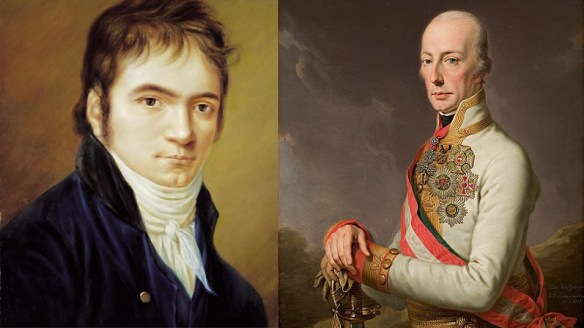
Beethoven and Joseph Kreutzinger – Kaiser Franz I, ruler of Austria in 1803. Portrait by Joseph Kreutzinger c.1815
7 Variations on ‘God save the King’ WoO78 for two pianos (1799-1803, Beethoven aged 32)
Dedication George Thomson
Duration 9’30”
Listen
Background and Critical Reception
Beethoven continued to use the variation form as something of a compositional playground, while on the other hand completing works of an ever-expanding structure, such as the Kreutzer Sonata we have just appraised.
His source material was imaginatively drawn, and on occasion to him suggested by others. As Angela Hewitt writes for Hyperion. ‘it probably comes as a surprise to many to know that Beethoven wrote variations on the current British national anthem….but indeed he did. In 1803 he was approached by George Thomson, a civil servant living in Edinburgh who was passionate about collecting folk songs from his own country. He wanted Beethoven to compose six sonatas on Scottish melodies—a project which never materialized, but which started a business relationship that lasted until 1820. For Thomson, Beethoven completed some 150 arrangements of Scottish, Welsh and Irish folk songs (including Auld lang syne). Towards the end of 1803, he sent him these two sets of variations for piano, saying they weren’t too difficult and hoping they would have much success.’
Beethoven was keen to ‘show the English what a blessing they have’ with that tune’, which had by 1795 found use in Prussia as a royal anthem.’.
Thoughts
It comes as no surprise to report that Beethoven has a good deal of fun with this tune. It is almost crying out for the slightly irreverent but highly musical treatment it gets at his hands, from the skittish rhythms of the second variation to the rumbling bass of the left hand in the third.
The fourth variation resorts to the minor key but is not as downcast as Beethoven has tended towards in previous variation sets. Soon we recapture the tongue in cheek mood through a march (variation six) and a mischievous coda, which runs from po-faced solemnity to outrageous gymnastics for the pianist.
A thoroughly entertaining ten minutes offering the firmest possible proof of Beethoven’s sense of humour. A good one to pull out at dinner parties, too!
Recordings used and Spotify playlist
Cécile Ousset (Eloquence) Rudolf Buchbinder (Teldec) Ronald Brautigam (BIS) Alfred Brendel (Regis) John Ogdon (EMI) Olli Mustonen (Decca) Angela Hewitt (Hyperion)
There are some very entertaining versions in the list above. If anything Beethoven’s humour sounds most brazen on a fortepiano, giving Ronald Brautigam’s version extra edge. Cécile Ousset is typically classy, Buchbinder too, while Hewitt’s new recording shows how much she clearly loves Beethoven’ send-up of one of the world’s most famous tunes.
You can listen to an excerpt from the recording by Angela Hewitt, released in 2021, on the Hyperion website
Also written in 1803 Pierre RodeViolin Concerto no.7 in A minor Op.9
Beethoven’s biggest violin sonata has a curious back story. Its dedication to Rodolphe Kreutzer, who never played the piece, masks its intention as a performing vehicle for George Bridgetower, a violinist with whom Beethoven had recently become good friends. A charismatic child prodigy of mixed race, the violinist ultimately settled in Britain but left his mark all over the piece, due in part to a West Indian heritage that was exotic to those he encountered. Simon Nicholls, writing booklet notes for the recording by Paul Barritt and James Lisney on Woodhouse Editions, writes how Beethoven’s friend and contemporary Carl Czerny described Bridgetower as a ‘bold, extravagant’ virtuoso.
The change in dedication allegedly came after the two had rehearsed the piece. Bridgetower had shown his prowess in an early concert performance, particularly in the slow movement, but soon after he and Beethoven quarrelled over a female friend, and the dedication was altered.
The musical style, however, reflects the original violinist’s technical ability and ambition, confirmed in its labelling ‘scritta in uno stilo, molto concertante quasi come d’un concerto’ (written in a highly concert-like style, almost in the manner of a concerto’). It is in a sizeable three movements, lasting around 40 minutes – almost double the length of any of the other violin sonatas. Beethoven wrote the Rondo finale before the other two movements, originally intending it as the finale of the sonata Op.30 no.1. In writing the Kreutzer, he ensured the other two movements’ themes were still related to this Rondo.
Lewis Lockwood writes that ‘with Op.47 we reach the summit of Beethoven’s early violin sonata style, now raised to a brilliant pitch of virtuosity in the most difficult violin writing of the period’. He notes Berlioz’s opinion of the Kreutzer as ‘one of the most sublime of all violin sonatas’, and that Leo Tolstoy, who wrote a short story entitled The Kreutzer Sonata, described the work as ‘the supreme example of the power of music’.
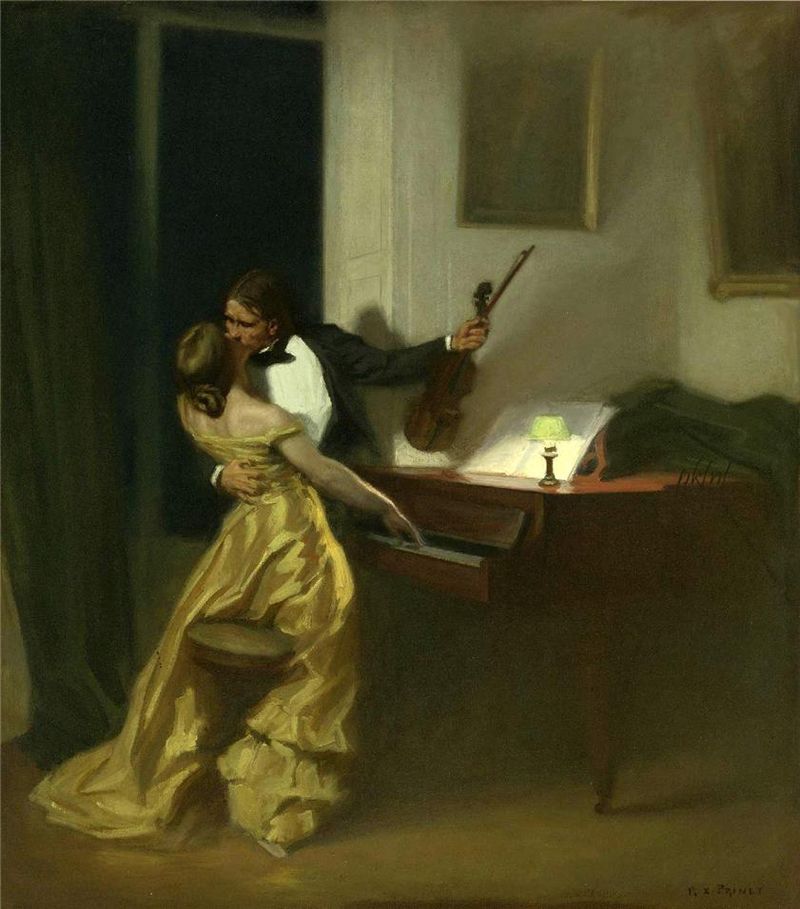
Kreutzer Sonata, painting by René François Xavier Prinet (1901), based on Leo Tolstoy’s 1889 novella, ‘The Kreutzer Sonata’
Thoughts
Right from the start it is clear we are on different ground with the Kreutzer sonata. The dramatic chord from the violin beginning the piece is on a grand scale, a cadenza in all but name. The violin takes much more of the lead in proceedings, much more so than in the previous works, dominating the introduction of the first movement. When the Allegro arrives, however, both instruments share the theme. As the work unfolds so too does a tension between the ‘home’ key of A major and A minor, where a lot of the music sits. This abates a little with the serene second theme, but the first movement nonetheless ends emphatically in the minor key.
The second movement, a theme and variations of consistently high quality, starts sweetly from the violin before the two instruments engage in close conversation. They exchange a wealth of melodic ideas, and both have fun once Beethoven starts flexing his muscles. Variation IV in particular would present a lot of fun for the piano with the trills, once the techniques are mastered! The variations are closely stitched together and flow almost seamlessly, their sentences entwined, leading to a closing paragraph of great serenity.
After the contented finish to the theme and variations, the third movement bursts out of the blocks with vim and vigour. The music is quite rustic, with dotted rhythms from the violin and a bubbly stream of harmony from the piano. The lively exchanges continue, the violin’s bird-like figurations restless and unwilling to settle. This being a rondo, the principal theme becomes engrained in the mind, and the virtuoso profile continues through to the exuberant finish. Major key just about triumphs over minor too, the sparring between the two having been one of the principal dramatic features. Little wonder that some – such as Kreutzer – did not fully understand the piece, for its forward thinking nature is unlike anything written for the two instruments together to this point.
Recordings used and Spotify playlist
Midori Seiler (violin), Jos van Immerseel (fortepiano) (Zig Zag Classics) Yehudi Menuhin (violin), Wilhelm Kempff (Deutsche Grammophon) Josef Suk (violin), Jan Panenka (piano) (Supraphon) Alina Ibragimova (violin), Cédric Tiberghien (Wigmore Hall Live) Tasmin Little (violin), Martin Roscoe (piano) (Chandos) Frank Peter Zimmermann (violin), Martin Helmchen (BIS) Paul Barritt (violin), James Lisney (piano) (Woodhouse Editions) Arthur Grumiaux (violin), Clara Haskil (piano) (Philips) Augustin Dumay (violin), Maria João Pires (piano) (Deutsche Grammophon)
There are several recordings of the Kreutzer sonata to have gained ‘classic’ status, including (but not restricted to) Arthur Grumiaux and Clara Haskil, David Oistrakh and Lev Oborian and Nathan Milstein and Artur Balsam. The three I found myself engaging with most were Yehudi Menuhin with Wilhelm Kempff – with compelling chemistry and total control of Beethoven’s ensemble work – then Mayumi Seiler and Jos van Immerseel, for their brio and verve on period instruments. The newest recording, too, made a strong impact, with Frank Peter Zimmermann and Martin Helmchen delivering a reading of poise and power for BIS.
You can chart the Arcana Beethoven playlist as it grows, with one recommended version of each piece we listen to. Catch up here!
Also written in 1803 Haydn – String Quartet in D minor. Op.103
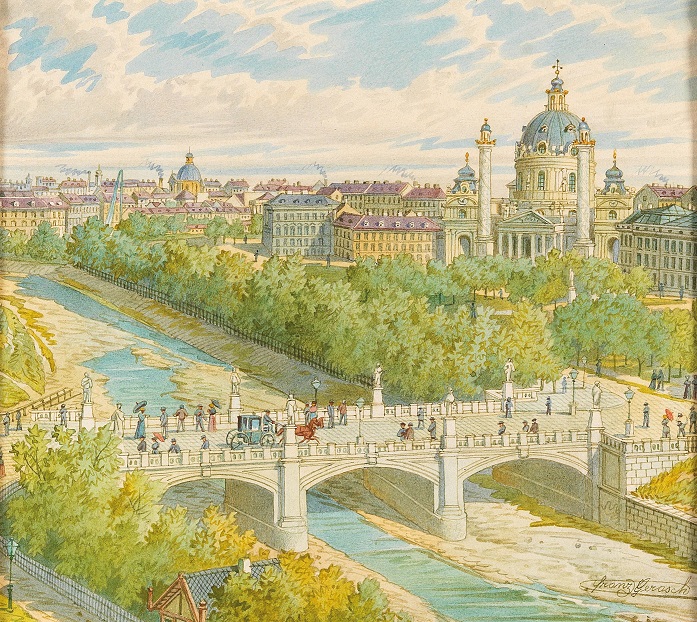
A view over Vienna river and St. Charles’s cathedral by Franz Gerasch (before 1906)
Trio in E flat major Op.38 for clarinet / violin, cello / bassoon and piano (1803, Beethoven aged 32)
Adagio – Allegro con brio
Adagio cantabile
Tempo di menuetto
Tema con variazioni: Andante
Scherzo: Allegro molto e vivace
Andante con moto alla marcia – Presto
written by Ben Hogwood
Background and Critical Reception
Beethoven’s Septet was a considerable success on its appearance in 1799, creating demand for the work to be arranged in a number of other instrumental combinations. Beethoven produced two trio versions, just as he did with the Op.11 Clarinet Trio– one for clarinet, cello and piano, with a substitution for cello with bassoon encouraged, and another for the more conventional piano trio (violin, cello and piano).
Writing for Hyperion Records, bassoonist Laurence Perkins details the specifics of the arrangement. The re-voicing gives (for the most part) the septet’s string parts to the piano, while much of the original clarinet part is preserved. A good deal of the cello line comes from the bassoon part of the septet, with occasional additions from the cello and horn parts. Perkins observes that there were far fewer bassoonists around than cellists in those times, but that offering the different choices of instrumentation would help the selling potential of the music. As he says, there is a strong case for performing this version with bassoon rather than cello, for “it restores that very special link between the clarinet and bassoon which is such a special feature of the original septet.”
He goes on to praise Beethoven’s achievement in the arrangements. “By transcribing the string parts with Beethoven’s characteristic pianistic style, it sounds totally convincing, as if it had been originally conceived in this form. From the spacious elegance of the adagio introduction to the first movement, leading into the energy, expression and momentum of the allegro con brio, we are on a very similar musical journey to the septet itself. The slow movement, adagio cantabile, remains as a wonderfully melodic vehicle for the clarinet’s lyrical qualities, while the minuet and trio is every bit as characterful, the bassoon adding its own brand of wit in the cheeky horn passages of the trio section. The theme and variations is particularly effective with lots of imaginative interplay between the three instruments, and the scherzo retains all the energy and excitement of the original version. The dark introduction to the final movement leads into the vibrant, energetic presto with the famous violin cadenza faithfully reproduced on the piano.”
Thoughts
If I were listening to this work cold, I would think it to be a substantial new piano trio almost in the form of a serenade. However with the knowledge that it is in effect another version of the Septet, it is easy to pine for the colours Beethoven uses in his expert blending of the seven different players. That said, this is an extremely effective arrangement, with or without clarinet and bassoon, and the three parts are ideally balanced. The music never feels too congested, and there is room for the wit and charm of the original to come through at every turn.
The bassoon / cello has an attractive solo to carry the second movement Adagio Cantabile to a higher plane, ably supported by the other two instruments. The cheeky subject of the Tempo di Menuetto isn’t quite as effective without the rhythmic prompting of the double bass, but leaves its witty mark nonetheless.
My personal preference would be for the clarinet / bassoon / piano version, going in line with Perkins’ argument and because the melodic ideas translate really nicely to the wind instruments. The conventional piano trio would not have to wait long for another original piece!
Recordings used and Spotify Links
Martin Roscoe (piano), Sarah Watts (clarinet), Laurence Perkins (bassoon) (Hyperion) Judith Kent Stillman (piano), Richard Stoltzman (clarinet), Michael Reynolds (cello) (KidsClassics) Adrian Brendel (piano), Pascal Moraguès (clarinet), Filipe Pinto-Ribeiro (cello) (Paraty) Beaux Arts Trio [Menahem Pressler (piano), Isidore Cohen (violin), Peter Wiley (cello)] (Philips)
This delightful piece translates well to its smaller medium, and is served by some thoroughly enjoyable performances. Perkins’ own, with clarinettist Sarah Watts and pianist Martin Roscoe, is a treat – while Richard Stoltzmann overseas a bright reading on KidsClassics. The Beaux Arts Trio give a good performance on Philips with the piano trio version, but the clarinet really does help preserve the spirit of Beethoven’s original melodies. You can hear the Roscoe / Watts / Perkins version on the Hyperion website
You can chart the Arcana Beethoven playlist as it grows, with one recommended version of each piece we listen to. Catch up here!
Also written in 1799 Haydn String Quartet in G major Op. 77/1
Next up Sonata for piano and violin no.9 in A major Op.47 ‘Kreutzer’




 Arcana.fm