Listening to Beethoven #127 – Piano Sonata no.6 in F major Op.10/2

friedrich-wreck-in-the-sea-of-ice
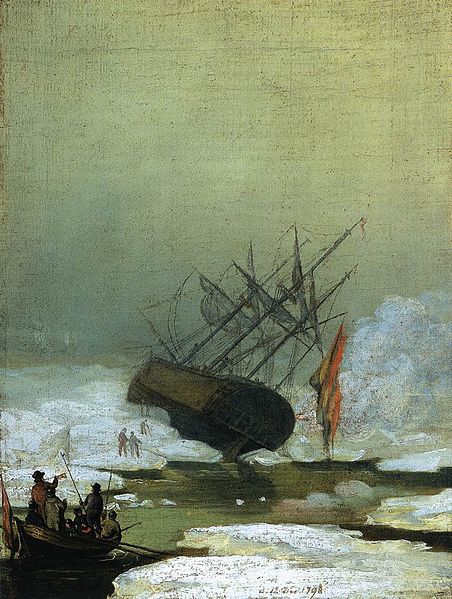
Wreck In The Sea of Ice by Caspar David Friedrich (c1797)

Piano Sonata no.6 in F major Op.10/2 for piano (1798, Beethoven aged 27)

1 Allegro
2 Allegretto
3 Presto

Dedication Countess Anna Margarete von Browne
Duration 19′

Listen

Background and Critical Reception

The three piano sonatas Op.10 were published in 1798, dedicated to Countess Anna Margarete von Browne. As Daniel Heartz notes, ‘women continued to garner most of his dedications of works for keyboard, as was the case with Mozart and Haydn’.

In contrast to the first sonata of the set, in C minor, the F major piece is admired as the joker. Lewis Lockwood says, ‘There is a lot to say about the capacity of the Sonata Opus 10 no.2 in F major to make much from little, a very strong Beethovenian feature. Thus the first two notes of the opening figure suffice to generate much of the later thematic content while always relating back to this germ idea.’

Writing in The Beethoven Companion, Harold Truscott enjoys the composer’s humour in the outer movements and the reflective second, describing the piece as ‘a completely individual masterpiece’. Angela Hewitt, meanwhile, agrees with Daniel Heartz that the second movement ‘minuet’ is…’not very dance-like’, and notes the fusion of Haydn’s wit and Bach’s counterpoint in the finale, ‘but with an exuberance typical of the young Beethoven’.

Thoughts

This is a sonata to put a smile on your face. The playful start introduces the ‘peek-a-boo’ characteristics of the first movement, which is also a great example of Beethoven’s use of silence. It feels like there are several characters playing a game in the first movement. The first comes out in the cheeky and slightly timid opening phrase; the second is more assertive, with many more notes. Beethoven develops his material with freedom, taking it on a tour of several keys, before returning home.

The second movement is deeper in thought, a single stream of consciousness in the minor key that proves a very effective reflection, with some spicy chords. The third movement sounds like it is going to be a fugue, or a Bach invention, but it doesn’t end up that way – and Beethoven returns to playing games, if not quite as mischievously as before.

Recordings used and Spotify links

Emil Gilels (Deutsche Grammophon)
Alfred Brendel (Philips)
András Schiff (ECM)
Angela Hewitt (Hyperion)
Paul Badura-Skoda (Arcana)
Stephen Kovacevich (EMI)
Igor Levit (Sony Classical)

The best accounts of this sonata are (in my opinion) the ones that bring the humour to the front. Angela Hewitt has some lovely characterisation in her first movement, where the timid and detached phrases are countered by rich, flowing episodes. Paul Badura-Skoda’s fortepiano has a crisp attack, particularly in the first movement.

Perhaps the most effective account is that of András Schiff, who successfully combines the humour and Beethoven’s invention from small cells, a reading that keeps the listener hanging.

The playlist below accommodates all the versions described above except that by Angela Hewitt:

You can hear clips of Hewitt’s recording at the Hyperion website

You can chart the Arcana Beethoven playlist as it grows, with one recommended version of each piece we listen to. Catch up here!

Also written in 1798 Haydn Missa in Angustiis (Nelson Mass)

Next up Piano Sonata no.7 in D major Op.10/3

Listening to Beethoven #123 – Piano Sonata no.4 in E flat major Op.7


Emilias Kilde by Caspar David Friedrich (c1797)

Piano Sonata no.4 in E flat major Op.7 for piano (1797, Beethoven aged 26)

1 Allegro molto e con brio
2 Largo con gran espressione
3 Allegro
4 Rondo. Poco allegretto e grazioso

Dedication Countess Babette von Keglevics
Duration 28′

Listen

Background and Critical Reception

‘If any proof was needed to show that early Beethoven is not just imitation Haydn or Mozart’, writes Angela Hewitt, ‘then surely the Piano Sonata in E flat major Op.7 would be the best example.’

This is a work of formidable size, lasting nearly half an hour and second only to the Hammerklavier Sonata in Beethoven’s 32 published piano sonatas. Yet it has a common thread running through it, as Daniel Heartz observes. ‘The whole cycle is remarkable for its unified tone, which is both stylistic and motivic. No sonata of the Op.2 trilogy quite succeeded in achieving this feat.’

Hewitt has a special affection for the piece. ‘The colour change to C major for the Largo…startles us but immediately calls our attention to expect something different and exceptional’, she says of the second movement, finding the third ‘full of humour and charm’. The finale, however, works as ‘one of the last examples of his early style’, and ‘the movement ends in the most unassuming way. Perhaps if it ended loudly, she muses, this piece would be performed more often.’

The sonata is dedicated to Countess Babette von Keglevics, one of Beethoven’s most gifted piano pupils of the time.

Thoughts

Op.7 certainly is a substantial piece, but – as agreed above – a unified one. The flowing interaction between right and left hand of its opening pages set the tone. The piano writing is dense for its time, with lots going on, and in the middle (development) section of the first movement Beethoven travels far harmonically before suddenly deciding to go back to the first theme.

This proves to be a feature of the other movements. The slow movement, beautifully simple in its hymn-like theme, enjoys the sound of C major but suddenly takes a darker turn, where it really feels like Beethoven is using the piano as an orchestra. The left hand (lower strings) has an ominous figure which turns the music colder. Then we return to the safety of C major and all is forgotten.

The third movement is initially graceful, with a little stop-start motion in triple time, but its central section is a complete contrast, a turbulent episode in the minor key. The finale looks to resolve this, beginning in serenity, before it too succumbs to a stormy central section. Finally peace is completely restored, and Beethoven ends in quiet peace.

Recordings used and Spotify links

Emil Gilels (Deutsche Grammophon)
Alfred Brendel (Philips)
András Schiff (ECM)
Angela Hewitt (Hyperion)
Paul Badura-Skoda (Arcana)
Stephen Kovacevich (EMI)
Igor Levit (Sony Classical)

Claudio Arrau captures the full drama and exploration of the first movement development section. It takes a little while for the ear to adjust to Paul Badura-Skoda’s instrument but the sonorous tones suit chords that are close together. His is an intimate account if slightly jumpy on occasion, and he achieves considerable turbulence in the stormy trio of the third movement. It’s lovely to hear the piano itself creaking as he plays it. Emil Gilels is superb in the slow movement but perhaps a bit too grand in the outer two, and so it is Alfred Brendel who finds arguably the best combination of expanse and gracefulness.

The playlist below accommodates all the versions described above except that by Angela Hewitt:

You can hear clips of Hewitt’s recording at the Hyperion website

You can chart the Arcana Beethoven playlist as it grows, with one recommended version of each piece we listen to. Catch up here!

Also written in 1797 James Hewitt Piano Sonata in D major ‘The Battle of Trenton’

Next up Piano Sonata no.19 in G minor Op.49/1

Listening to Beethoven #112 – Piano Sonata no.5 in C minor Op.10/1


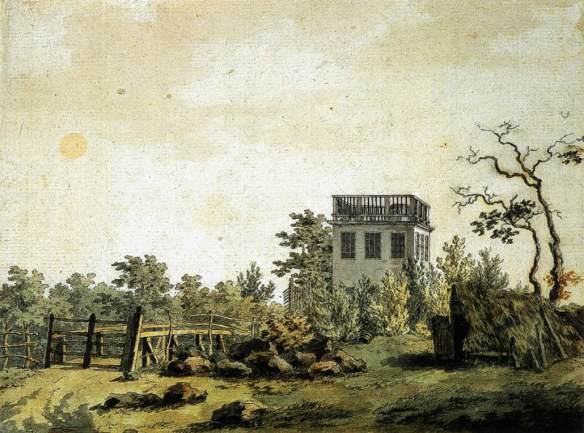
Landscape with Pavilion by Caspar David Friedrich (c1797)

Piano Sonata no.5 in C minor Op.10/1 for piano (1797, Beethoven aged 26)

1 Allegro molto e con brio
2 Adagio molto
3 Finale (Prestissimo)

Dedication Countess Anna Margarete von Browne
Duration 19′

Listen

Background and Critical Reception

Beethoven turns once more to the piano sonata, with the first of a triptych eventually published in September 1798. This work, completed almost a year earlier, sees a swift return to C minor. For the pianist András Schiff, the three works published as Op.10 ‘are more concentrated…they turn outwards, towards connoisseurs and amateurs. Perhaps for that reason they are slightly easier to play.’ From experience, the C minor is still a tough nut to crack if you haven’t reached Grade 8!

Schiff and Daniel Heartz note the pointers towards a sonata yet to be composed. ‘The Adagio molto in 2/4 time that follows is in A flat’, notes Heartz, ‘a key that, when joined with the song-like character and coming right after fretful C minor, will make an unforgettable impression in the Pathétique.

This comes after a first movement where Schiff speaks of ‘drama and turmoil. Its opening theme is a so-called ‘Mannheim rocket’, as in Op.2/1, but it is sharpened by the dotted rhythm’. Other qualities are the thick scoring, an extreme contrast between very quiet (pianissimo) and very loud (fortissimo), and increased gaps between high and low registers.

Although the ending is in C major, ‘we hear it as minor’, says Schiff, the whole movement ‘secretive and urgent’. There is a ghostly conclusion where ‘the work disappears mysteriously and rapidly’.

Thoughts

On one hand, the first movement of this sonata could feel like a ‘regulation’ piece of Beethoven – especially if you are familiar with his other works in C minor (the Fifth Symphony, Pathétique Sonata, or the First Piano Trio to pick just three examples). On the other, with closer inspection, there is still plenty going on. The beefy C minor chords show how much Beethoven’s piano writing is filling out, while the use of silence allows the composer to pop in a few witty asides for his audience, as Haydn or Clementi might have done.

Time slows to a near standstill for the second movement, the anticipation of what Beethoven would do with his Pathétique sonata. Expressive licence is given to the free right hand, which is allowed to wander in the way a C.P.E. Bach Fantasia might have done, but by the end the mood is calm and meditative. Not so the third movement, a flurry of notes with more crunchy chords in the lower end of the piano. Beethoven is off the leash again, contrasting the bold first theme with the slight lilt of the second, reflecting perhaps his work on German Dances around the time of composition. This theme moves to C major for its second statement, after which the piece hurries to the finish line – but, as Schiff notes, ends in a puff of smoke.

Recordings used and Spotify links

Emil Gilels (Deutsche Grammophon)
Alfred Brendel (Philips)
András Schiff (ECM)
Angela Hewitt (Hyperion)
Paul Badura-Skoda (Arcana)
Stephen Kovacevich (EMI)
Igor Levit (Sony Classical)

Paul Badura-Skoda gives an engaging performance on a Johann Schantz piano, dating from Vienna in 1790. The mottled tones of the left hand work nicely in the Adagio, though textures are more ragged in the faster music. Emil Gilels takes a broad view of the slow movement, complementing a commanding account of the outer two. Schiff is typically engaging, as is Hewitt, who shapes the melodic phrases beautifully.

The playlist below accommodates all the versions described above except that by Angela Hewitt:

You can hear clips of Hewitt’s recording at the Hyperion website

You can chart the Arcana Beethoven playlist as it grows, with one recommended version of each piece we listen to. Catch up here!

Also written in 1797 Viotti Violin Concerto no.22 in A minor

Next up Duo for viola and cello in E flat major WoO 32, ‘Eyeglasses Duo’

Listening to Beethoven #87 – 12 Minuets

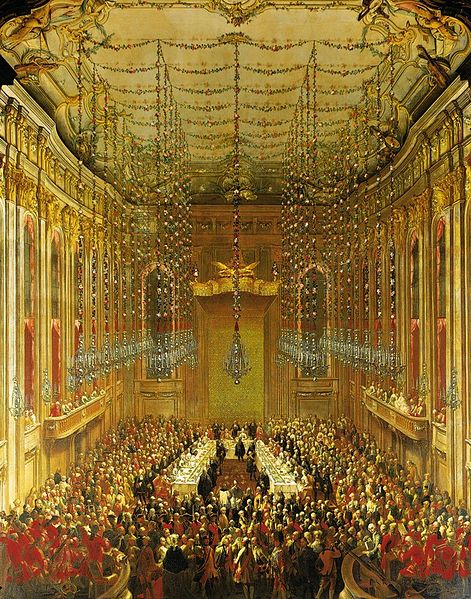
Court banquet in the Redoutensaal on the occasion of the marriage of Joseph II and Isabella of Bourbon-Parma by Martin van Meytens

12 Minuets, WoO 7 for orchestra (1795, Beethoven aged 24

no.1 in D major
no.2 in B flat major
no.3 in G major
no.4 in E flat major
no.5 in C major
no.6 in A major
no.7 in D major
no.8 in B flat major
no.9 in G major
no.10 in E flat major
no.11 in C major
no.12 in F major

Dedication Vienna Artists’ Pension Society
Duration 25′

Listen

Background and Critical Reception

These dances are companions to the 12 German Dances WoO 8, and were written for the masked ball in the Large Redoutensaal, Vienna, on 22 November 1795. It is thought Beethoven had Haydn‘s sponsorship for this event – his teacher had composed for the event three years earlier, a charitable donation. It is also thought Haydn would have attended the 1795 ball.

The minuets last around 2 minutes each, and as with Beethoven’s previous dances they are easy on the ear and light on the feet – despite being composed for a relatively large orchestra, with trumpets and timpani. Daniel Heartz, in a characteristically detailed appraisal of the dances, finds them to be longer than Haydn’s examples, and notes how their choices of key tend to be a third apart.

Thoughts

There is nothing too daring here given the function they were written for, but at the same time there is an embarrassment of good tunes and danceable beats for the guests.

The third minuet, in G major, is especially lively, and has some lovely in its middle section with a pair of horns. The fourth, in E flat major, has a beefy main them which contrasts with the delightful clarinet solo in its middle section. After a while there is a danger that all the different minuets will feel like one long dance, but Beethoven varies the scoring and melodic material enough to avoid that.

Minuet no.9 is brightly scored for the wind, while no.10, returning to E flat major, is like many of these pieces still in thrall to Haydn. The last, as is Beethoven’s wont, features the shrill piccolo in its middle section, the middle of a regal F major sandwich.

Recordings used and Spotify links

The playlist below includes recordings from Philharmonia Hungarica / Hans Ludwig Hirsch (Warner Classics), the Swedish Chamber Orchestra conducted by Thomas Dausgaard on Simax and the Academy of St. Martin-in-the-Fields under Sir Neville Marriner (Philips)

Thomas Dausgaard’s crisp versions are once again a lot of fun, if a touch aggressive at times – the dancers might have a couple of bruised feet afterwards! Sir Neville Marriner and the Academy of St. Martin-in-the-Fields are typically stylish and colourful. Once again the Philharmonia Hungarica and Hans Ludwig Hirsch are more relaxed in their steps.

You can chart the Arcana Beethoven playlist as it grows, with one recommended version of each piece we listen to. Catch up here!


Also written in 1795 Pleyel Keyboard Trio in D major B461

Next up Zärtliche Liebe WoO123

Listening to Beethoven #45 – Oboe Concerto in F major, second movement


The Beethoven-Haus, Bonn Picture by Dr. Avishai Teicher

Oboe Concerto in F major (slow movement) Hess 12 (1792-3, Beethoven aged 22)

Dedication not known
Duration 7′

Listen

Background and Critical Reception

The Oboe Concerto is one of the works sent by Haydn to the Elector of Cologne, showing the progress of his pupil Beethoven since he started with him in Vienna. What he did not realise at the time was that most of the works, including the Octet previously heard, had already been written in Bonn and were all but complete.

Sadly only the slow movement of the concerto, in B flat major, has survived in full, and even then only in sketch form. There is an outline of melody from the beginning to the end, but the piece needed extensive revision for any performance to be possible. This came from a couple of sources, but the one finished by Charles Joseph Lehrer, and orchestrated by Willem, is the only one to be recorded so far.

Daniel Heartz, in his superb book Mozart, Haydn and Early Beethoven 1781-1802, writes that ‘incipits of the three movements survive on a sheet in the Beethoven Archive at Bonn. The two oboists in electoral service were Georg Libsich and Joseph Welsch. From them the young composer could have learned the instrument’s strengths and limitations. His experiences in Bonn, including playing in the court orchestra, endowed him with a fine feeling for the technical and timbral possibilities of all the instruments.’

Thoughts

This fragment is an intriguing listen, even with the knowledge that a good deal of this work is not by Beethoven himself. Initially the tone is serious but relaxes as the strings expand with a soft-voiced introduction, teeing up the oboe nicely.

The main melody is attractive, and soon the oboe is reaching into the upper end of its register, well above the strings. The soloist has plenty of opportunity to show off, especially in a cadenza towards the end, which is nicely cued up by some spicier harmony from the strings. After the cadenza a short statement of the tender theme is all that is required.

Recordings used

Bart Schneemann, Radio Chamber Orchestra / Jan Willem de Vriend (Channel Classics)

Bart Schneemann gives an excellent account, with Jan Willem de Vriend balancing the small Radio Chamber Orchestra nicely. The slow movement of the concerto is tagged on to a second volume of oboe concertos by the German 18th century composer oboist and composer Ludwig August Lebrun, who died three years before Beethoven’s concerto was sent back to Bonn.

Spotify links

Bart Schneemann, Radio Chamber Orchestra / Jan Willem de Vriend

You can chart the Arcana Beethoven playlist as it grows, with one recommended version of each piece we listen to. Catch up here!

Also written in 1793 Haydn 3 String Quartets, Op.71

Next up Que le temps me dure (version 1)