
In concert – Pocket Ellington @ The Vortex

Alex Webb (piano, musical director), Tony Kofi (tenor saxophone), Alan Barnes (saxophones/clarinet), David Lalljee (trombone), Andy Davies (trumpet), Dave Green (double bass) and Winston Clifford (drums)

The Vortex, London, 14 December 2024

by John Earls. Photo credit (c) John Earls

One might think at first that the idea of a ‘Pocket Ellington’ – big band jazz played by a smaller ensemble – is something of a contradiction if not illogical. But then there’s the tunes and then there’s this particular group of musicians (under the musical direction of Alex Webb) and their love of the music.

Duke Ellington’s stature and influence as a pianist, composer and band leader is pretty much unsurpassed. Miles Davis is supposed to have said “At least one day out of the year all musicians should just put their instruments down, and give thanks to Duke Ellington”. So it was fascinating to see and hear this seven piece band interpret some of the best big band charts there are.

Three of the Ellington compositions played – Main Stem, What Am I Here For and Happy Go Lucky Local – feature on his Piano in the Background album which contains the following lines in Irving Townsend’s sleeve notes: “The piano used for this album has three more keys than regular pianos, allowing Duke to play ninety-one keys instead of eighty-eight. He wants you to know that he played them all madly”. I assume Alex Webb’s piano had the standard number of keys but I was reminded of this quote with some of his playing and the enthusiasm and respect for the music that was on display from the rest of the band.

Mood Indigo featured some raspy trumpet from Andy Davies and smoky tenor saxophone from Tony Kofi as well as Alan Barnes“more reeds than you can shake a stick at” according to Webb – playing saxophone and clarinet.

As well as compositions by Ellington there was also a nod to other artists influenced by him. Thelonious Monk’s Ruby, My Dear and Monk’s Dream were combined in a fantastic Ruby, My Dream medley and Charles MingusBoogie Stop Shuffle featured some terrific mute trombone by David Lalljee who also went full throttle on Gil EvansLas Vegas Tango. The rhythm section of Dave Green (double bass) and Winston Clifford (drums) were solid throughout.

It wasn’t just full-on swing either. Come Sunday (from Ellington’s Black, Brown and Beige suite) was smooth and gorgeous with the horns in lovely collective harmony and the ballad Day Dream enchanting.

Day Dream is a Billy Strayhorn composition and not surprisingly, given that Strayhorn was Ellington’s great songwriting collaborator and friend, there were a number of other Strayhorn tunes in the set. These included a moving Blood Count which was the last finished piece that Strayhorn wrote. It features on the terrific album of Strayhorn tunes by Ellington and his Orchestra …And His Mother Called Him Bill recorded in 1967 after Strayhorn’s death. On the album the saxophone is played by Johnny Hodges for whom Strayhorn often wrote – “We have our own Johnny Hodges” said Webb acknowledging Alan Barnes’ affecting rendition. (Apparently, Ellington never played the tune again after the recording session.)

The set finished with – what else? – the Ellington Orchestra’s signature tune Take the “A” Train (another Strayhorn composition). It was a great version of a great tune that has a great story (the title refers to the opening words with which Ellington gave Strayhorn directions to get his house by subway but there’s more to it than that). It was a fitting end to a wonderful night’s live music paying tribute to one of the greats.

John Earls is Director of Research at Unite the Union. He posts on Bluesky and tweets / updates his ‘X’ content at @john_earls

Published post no.2,395 – Monday 16 December 2024
In concert – Jazz On The Box: A Tribute To The BBC’s Jazz 625 @ The Cockpit, London

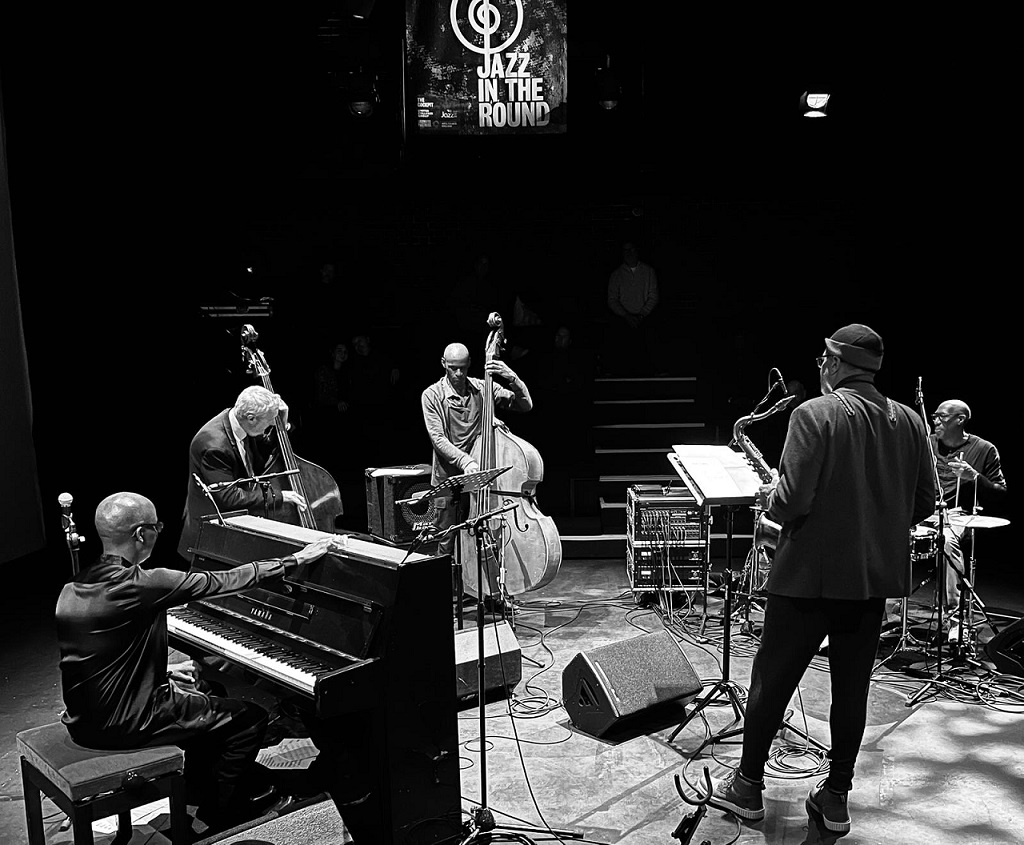
Robert Mitchell (piano), Jean Toussaint (tenor saxophone), Larry Bartley (double bass), Rod Youngs (drums) and Dave Green (double bass)

The Cockpit, London, 20 November 2024

by John Earls. Photo credit (c) John Earls

Jazz 625 was a BBC television jazz programme which ran for two years between 1964 and 1966.The show was first broadcast on BBC2 on 21 April 1964 (on what turned out to be the channel’s opening night). It is revered because in that period it brought into UK living rooms live performances by American jazz legends such as Dizzy Gillespie, Oscar Peterson, Thelonious Monk, Art Blakey, Dave Brubeck and Duke Ellington (who appeared in a gala presentation in the first show). It also showcased UK jazz musicians such as Tubby Hayes, Ronnie Scott and John Dankworth.

In May 2019, Jazz 625 returned to the BBC as a 90-minute live show on BBC Four called Jazz 625 Live: For One Night Only. The house band for that broadcast featured Robert Mitchell (piano), Jean Toussaint (tenor saxophone), Larry Bartley (double bass) and Rod Youngs (drums).

In celebration of Jazz 625’s sixtieth birthday this year, the band were reunited under Robert Mitchell at London’s The Cockpit as part of the London Jazz Festival for a performance also featuring the legendary UK bass player Dave Green. Green is one of only two people still alive who appeared on the show (the other being singer Cleo Laine, one of only eight women to have appeared on the show throughout those two years).

Green opened proceedings with a solo bass piece that highlighted his musicality, understanding, tradition, inventiveness and preparedness to take risks. It was a captivating and spirited performance.

The re-convened For One Night Only band fittingly started their set with a lovely Along Came Betty (written by Benny Golson and most famously recorded by Art Blakey), a tune they performed on the 2019 programme. The programme also saw Thelonious Monk’s Criss Cross, heard here with some excellent solos on sax (Joshua Redman did sax duties for this tune on the broadcast), piano and bass and classy drum intervals from Rod Youngs.

Youngs’ drumming style gives the appearance of him shrugging his shoulders and it was fascinating to watch his smooth brush strokes on the next tune, Ben Webster’s Body and Soul (which featured some soft and expressive piano playing by Mitchell) and some more energetic and hefty drum work on the next tune, an original whose title I didn’t quite catch (Mood Board?).

There then followed a Jean Toussaint-penned tune Calypso (also new?),a nice nod to the influence of oft-neglected Jamaican jazz musician and composer Joe Harriott (the tapes of his Jazz 625 performance were recorded over). It’s a sunny piece on which both saxophone and piano shone. It is also worth noting here Toussaint’s (and indeed Mitchell’s) role in supporting new UK jazz talent. One of the highlights of the For One Night Only programme is seeing Toussaint playing with saxophonist Camilla George (who he taught and mentored) for a performance of Harriott’s Tonal.

Finally, the band were joined by Dave Green for Blue ‘n’ Boogie, a 1944 jazz standard written by Dizzy Gillespie and Frank Paparelli. It’s the first time I’ve seen two double basses play together in a small ensemble and what a treat it was. To say that Green and Larry Bartley engaged in ‘battling basses’ would be to imply too much competition, whereas what was evidently on display was a mutual respect between two fine musicians that span generations. Bartley paid lovely tribute to Green in words and music. Their double bass exchanges were a joy.

John Earls is Director of Research at Unite the Union. He posts on Bluesky and tweets / updates his ‘X’ content at @john_earls

Published post no.2,370 – Friday 22 November 2024