
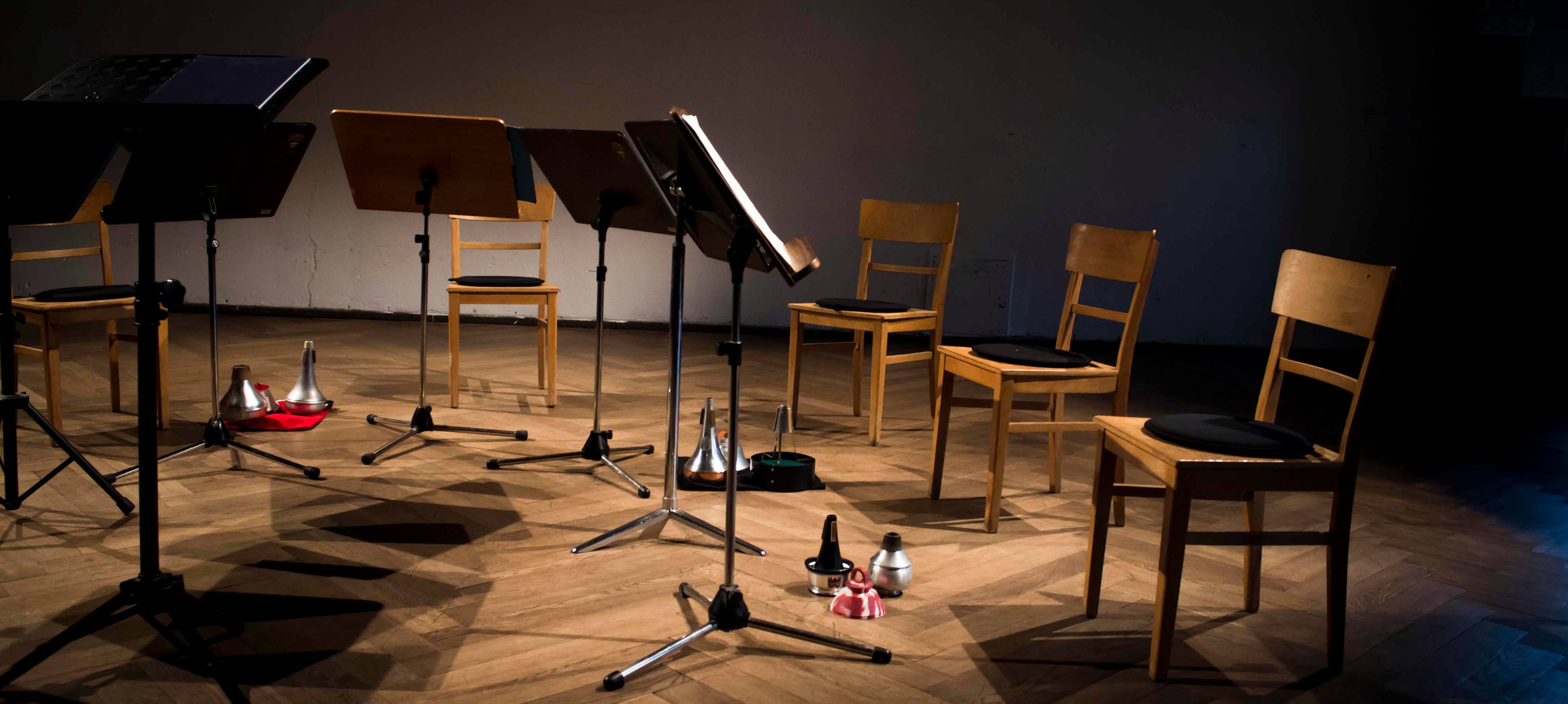
Online Concert – Ensemble Apparat @ Ultraschall 2024

Poppe Zug (2007)
Bailie Night Scenes I & II (2023) [World Premiere]
May Multiplayer Instrument (2023) [World Premiere]
López Brass Quintet (2003-04)

Ensemble Apparat (Mathilde Conley and Rike Huy (trumpets), Samuel Stoll, Morris Kliphuis and Elena Kakaliagou (horns), Weston Olencki and Wojciech Jeliński (trombones), Eliot Duschmann (tuba)] / Max Murray

Radialsystem V, Berlin
Sunday 21 January 2024

by Richard Whitehouse

Heading into its second quarter-century, Berlin’s annual Ultraschall festival put together some typically wide-ranging programmes – not least this Sunday afternoon concert, which featured Ensemble Apparat in a sequence of diverse pieces for various ensembles of brass instruments.

Among the leading German composers of his generation, Enno Poppe (1969-) has now built a sizable catalogue – from which Zug, whether it refers primarily to a train or a procession (or the capital of a Swiss canton), continually diverts and intrigues with its interplay for brass septet. Unfolding as three intensifying waves of activity, the music elides between sometimes playful and at other times ominous moods. While the expressive outcome is left in the balance, there can be no doubting the formal cohesion of a work whose technical dexterity never draws undue attention to itself.

Its comparable number of players aside, there could scarcely have been greater contrast than with Night Scenes by Joanna Bailey (1973-). Much of her recent output features audio-visual or installation elements, the present diptych setting its instrumental component in the context of a soundtrack whose incrementally changing ambience likely reflects those places specified. Hence the luminous if distanced activity of Geneva and atmospheric if never claustrophobic confines of Schwarzwald, with these two complementing each other in an evocative totality.

From here to installation pure if not so simple. Visual artist Ragnhild May (1988-) has made a feature of human and mechanical amalgams, with Multiplayer Instrument her most ambitious such project yet by fusing the ensemble into a ‘meta-brass instrument’ whose sonic and even constructional qualities are in a constant state of change. While its overall impact inevitably depends on being seen as well as heard (see the photographs on the Ultraschall website), the stark and even hieratic nature of this undertaking is undeniable even to those ‘just’ listening.

The combining of sound-sources was heard at its most graphic in the Brass Quintet by Jorge E. López (1955-). Here the instrumental music is interpolated with concrète episodes such as evoke respectively the sonic overlap between an alpine crevice and industrial powerplant, the tortuous process of mountain rescue down a vertical cliff-face, then its effortful continuation over a field of scree. In each case, the contextual emergence and resolution of these episodes has been provided by the music for brass out of which they come then into which they return.

That brass writing has all the visceral immediacy associated with this composer, not least in its emphasis on those lower sonorities of Wagner tuba and contrabass tuba. The preludial first section vividly contrasts its contrasting musical-types, while the second is an incisive toccata and the third a plangent threnody, then the fourth section resembles an introduction and fugue in which a lively jig earlier insinuated by trumpet rapidly comes to the fore – dominating the closing stages as it draws all five instruments into a recessional of jocular yet wanton inanity.

Such was the impression made by this performance, superbly rendered by the musicians of Ensemble Apparat under the astute direction of Max Murray. It set the seal on a programme of engrossing music and music-making – these being characteristic of Ultraschall at its best.

You can watch this concert via the Ultraschall website Click on the names to read more about Ensemble Apparat and Max Murray – and for the composers Enno Poppe, Joanna Bailie, Ragnhild May and Jorge E López, whose 65th birthday tribute can be read on Arcana
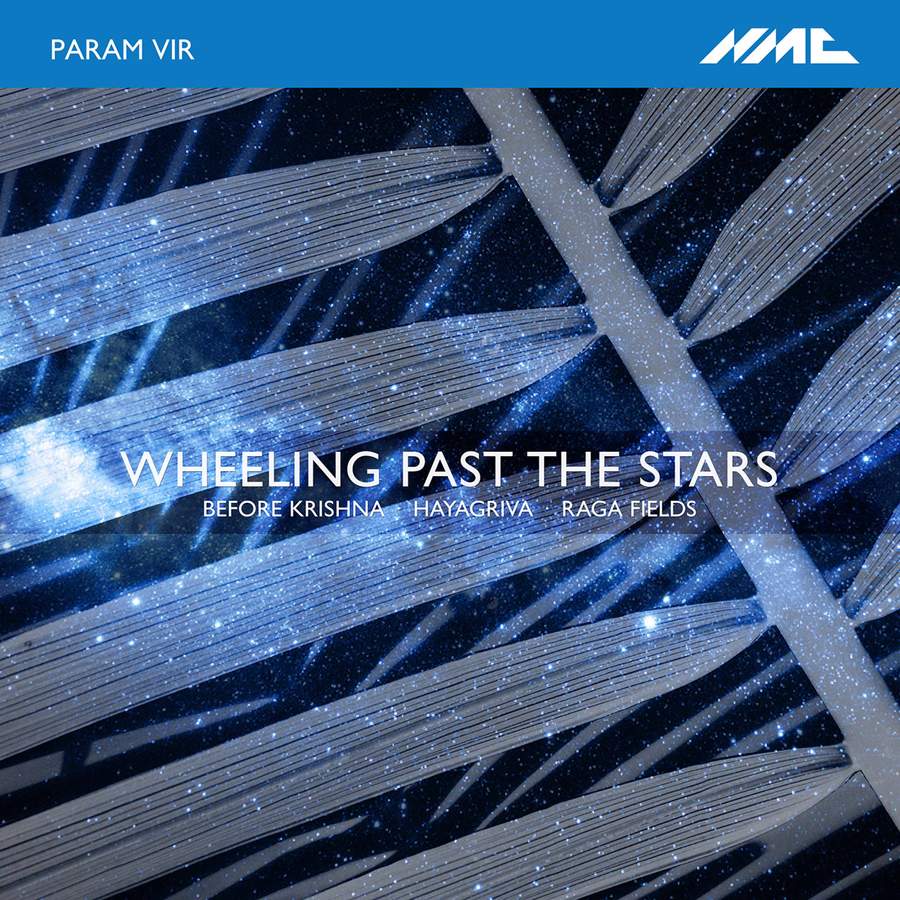
On record – Param Vir: Wheeling Past the Stars (NMC Recordings)

param-vir

cPatricia Auchterlonie (soprano); cUlrich Heinen (cello); aSoumik Datta (sarod), aKlangforum Wien / Enno Poppe; bLondon Chamber Orchestra / Odaline de la Martínez dSchönberg Ensemble / Micha Hamel

Param Vir

Raga Fields (2014)a
Before Krishna (1987)b
Wheeling Past the Stars (2007)c
Hayagriva (2005)d

NMC Recordings NMC D265 [69’07”] 

Producers aFlorian Rosensteiner, bStephen Plaistow, cDavid Lefeber, dAnneke van Dulken, dWim Laman
Engineers aFritz Trondel, dDick Lucas

Recorded b14 December 1988 at BBC Studios, Maida Vale, London; d13 December 2005 at Muziekgebouw, Amsterdam; a23 May at Konzerthaus, Vienna; c10 October 2020 at Henry Wood Hall, London

Written by Richard Whitehouse

What’s the story?

Not a little surprisingly, this release from NMC is the first devoted to Param Vir (b1952), his music a welcome though undervalued presence in the UK over the almost four decades since relocating here from his native India and making for a ‘portrait’ whose appearance is timely.

What’s the music like?

Right from his earliest pieces written in the UK, Vir possessed a distinctive and engaging idiom – as can be heard in Before Krishna, subtitled an ‘Overture for Strings’, in which the narrative leading up to the deity’s birth is evoked through an intensive development of the ‘Krishna row’; heard in the context of string writing as is audibly influenced by (if never beholden to) the sonorist techniques from previous decades. Especially striking are those deftly enveloping chordal harmonics into which the music diffuses during the final bars.

Hayagriva is demonstrably more personal in approach – not least in its evoking the horse-headed being and mythological archetype behind a work whose headlong rhythmic energy gradually moves, via an intricately detailed transition, to a closing section whose subdued manner does not preclude music of fastidious textural variety and expressive nuance from emerging. The colour sequence ‘red/crimson-green/gold-blue’ evolves in parallel, but the aural trajectory pursued by this ‘mixed ensemble of 15 players’ is appreciably more subtle.

The song-cycle Wheeling Past the Stars draws on four poems by Rabindranath Tagore (sung in widely praised translations by William Radice). ‘Unending Love’ opens the sequence with its ecstatic vocal melisma and cello glissandi, while ‘Palm-tree’ portrays night-ride and storm with no mean resourcefulness. The unaffected charm and vivacity of ‘Grandfather’s Holiday’ then provides an admirable foil to ‘New Birth’, its frequently impassioned contemplation of those ‘who come later’ making for an earnest yet always eloquent conclusion to this cycle.

Raga Fields is outwardly a concerto for sarod but one where the orchestral contribution can be perceived as growing out of the soloist – whether in the gradual textural proliferation of ‘Void’; the comparable melodic interplay, notably through a variety of insinuating solos for woodwind, of ‘Tranquil’; then the stealthy rhythmic accumulation of ‘Vibrant’, in which the constant shifting between notated and improvisatory passages is heard at its most intensive. As the coming together of differing concepts, this is a productive and engrossing synthesis.

Does it all work?

Yes, in that Vir’s music exhibits its Indian antecedents distinctly yet always subtly. Allied to unforced harmonic clarity and a keen feeling for textural finesse is a sure sense of where each piece is headed formally, such that the considerable emotional intensity never risks becoming turgid or self-indulgent. It helps that these performances are attuned to the work at hand – not least Patricia Auchterlonie with Ulrich Heinen in the song-cycle, or the three ensembles that are heard in the remaining items. Whatever else, Vir has been well served by his performers.

Is it recommended?

Indeed. The sound has, in some cases, been remastered to mitigate the considerable time-span between performances, while Paul Conway pens his customary reliable notes. Hopefully, a follow-up release, maybe of Vir’s wide-ranging orchestral output, will not be long in coming.

Listen & Buy


You can get more information on the disc at the NMC website, where you can also purchase the album. For more on Param Vir, you can visit the composer’s website