Listening to Beethoven #52 – Piano Trio in C minor Op.1/3


The Cafe Griensteidl, on Michaelerplatz, Vienna by Reinhold Völkel

written by Ben Hogwood

Piano Trio in C minor Op.1 no.3 for piano, violin and cello (1792-94, Beethoven aged 23)

Dedication Prince Charles Lichnowsky
Duration 32′

Listen

Background and Critical Reception

Beethoven was already leading his audiences into new sound worlds and structures with the first two piano trios of his Op.1 set – but with the third installment he cut many of the cords tying him to the past. In his booklet notes accompanying the Florestan Trio’s recordings of the trios on Hyperion, Richard Wigmore takes up the story.

“In the first two trios Beethoven’s subversiveness was still cloaked in the language of the classical comedy of manners. But in the Piano Trio in C minor Op.1 no.3, it erupted in a work of startling explosive vehemence and dark lyric beauty.” Haydn, who had recently returned to Vienna from London, was in the audience with the work’s dedicatee Prince Lichnowsky. He was full of praise for the first two works in the set but had reservations around the third. Those reservations, according to a diary entry from Beethoven’s pupil Ferdinand Ries, led Haydn to advise his pupil not to publish the work. The truth, it seems, was more subtle – Haydn not necessarily critical of the musical content but airing doubts about its difficulty for the musicians of the day and its challenging content for the Viennese audiences. They were not accustomed to hearing music of such assertiveness and drama in the form of the piano trio.

Beethoven was his own man here – with the influences of Mozart less keenly felt. As Wigmore writes, “the music is profoundly Beethovenian in its abrupt, extreme contrasts, with violent rhetoric (the first page alone is peppered with sforzando accents) alternating with intense pathos and yearning lyricism”.

Thoughts

A very different atmosphere inhabits the third of Beethoven’s Op.1 piano trios. From the outset there is a chill down the spine of the music, a shiver as the bare octaves from the three instruments announce the opening theme. The mood is similar to that of Mozart’s Piano Concerto no.24, also in C minor – which gives an idea of the orchestral concepts behind Beethoven’s writing. It sets the tone for further outings in this key, with foreboding tones and a repressed energy suggesting the music could erupt at any minute. In contrast to the first two works in the set, it grabs the initiative and looks forward with every opportunity.

The ‘coiled spring’ is kept largely intact in the first movement, though the music does threaten to run away at times, often countered by the calmer second theme. The next movement is serene but retains a serious demeanour to start with, loosening up as its theme and variations format unfold – shaking off its ‘slow’ tag, too, with variations such as the driving third, with lots of attack on the piano, and the jaunty fifth. The fourth variation, set in E flat minor, is laden with melancholia.

The Scherzo finds Beethoven setting a relatively sombre mood, with the first real smile on the face of the music arriving in the tumbling piano figure that opens the ‘trio’ section. This is where he moves from minor key to major, moving from shade to sunlight.

For many the Finale provides a telling shift in Beethoven’s expression, with the sudden outbursts and syncopated rhythms of its main theme. Here the ensemble sounds so much more than violin, cello and piano, as though a whole orchestra were punching out the statement. This is where the no-holds barred approach has its roots, and the energy levels remain high through towards the end. This makes the closing bars even more striking, a brooding coda only heightening the feeling that this is a beginning, a statement of clear intent. Even at the end there is little resolution, the performers’ emotional energies spent, what little solace, there is clouded by what has gone before.

One can only imagine the atmosphere when the first audiences in Vienna heard it, and Haydn’s relative shock at such a bold, aggressive tone. What a striking piece it is, reaching moods barely hinted at in Beethoven’s output until now. The Piano Trio no.3 sets a precedent for all the other ‘traditional’ forms – symphony, piano concerto, string quartet and instrumental sonatas – combining formal innovation with deeply expressed emotions which liable to change like the wind.

Recordings used

Castle Trio (Lambert Orkis (piano), Marilyn McDonald (violin), Kenneth Slowik (cello) (Warner Classics)
Florestan Trio (Susan Tomes (piano), Anthony Marwood (violin), Richard Lester (cello) (Hyperion)
Beaux Arts Trio (Menahem Pressler (piano), Daniel Guilet (violin), Bernard Greenhouse (cello) (Philips, 1964 recording)
Wilhelm Kempff (piano), Henryk Szeryng (violin), Pierre Fournier (cello) (Deutsche Grammophon)

The Castle Trio are great to listen to here, as they capture the sense of originality that first audience would have experienced. Their account features some very impressive fingerwork from Lambert Orkis and intense expression from the string players. Another recording on ‘period’ instruments to mark up is that by Andreas Staier, Daniel Sepec and Jean-Guihen Queyras. It is superbly played, taken at daring speeds and arguably plumbing even greater emotional depths.

Szeryng, Fournier and Kempff inhabit the drama of the outer movements in particular but there is a great intensity between them throughout. The slow movement variations are more expansive but tastefully so.

Once again the Florestan Trio have the measure of this music but also its inherent drama – where they are well-matched by the superb Beaux Arts Trio.

Spotify links

The playlist below compiles the recordings made by the Castle Trio, Beaux Arts Trio and the ensembles of Kempff-Szeryng-Fournier and Staier-Sepec-Queyras:

You can chart the Arcana Beethoven playlist as it grows, with one recommended version of each piece we listen to. Catch up here!

Also written in 1794 Haydn Symphony no.101 in D major ‘Clock’

Next up Der freie Mann WoO 117

Listening to Beethoven #44 – Octet in E flat major Op.103


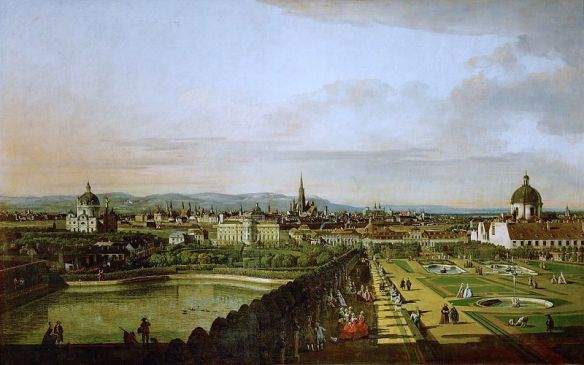
View of Vienna during the Baroque era by Bernardo Bellotto (18th century)

Octet in E flat major Op.103 for wind octet (2 oboes, 2 clarinets, 2 horns and 2 bassoons) (1792-93, Beethoven aged 22)

Dedication Maximilian Franz, Elector of Cologne
Duration 21′

Listen

Background and Critical Reception

The Octet dates mostly from 1792, when Beethoven was still in Bonn – where author Daniel Heartz confirms it was written as Tafelmusick for the Harmonie band of the elector. The Harmonie band had a specific instrumentation mirroring the one written for by Mozart in Vienna – two each of oboes, clarinets, horns and bassoons.

When Beethoven had arrived in Vienna and was studying under Haydn, the elder composer unwittingly submitted the completed work back to the Elector in Bonn. It was covered in the enclosure of ‘a few pieces of music, a quintet, an eight-voiced parthie, an oboe concerto, variations for the piano, and a fugue composed by my dear pupil Beethoven, who was so graciously entrusted to me’. The Octet was finally published as Op.103, three years after Beethoven’s death.

In his appraisal of the piece, Anthony Burton writes that ‘some of the accomplishment of this work may be due to its revision in 1793, after Beethoven had moved to Vienna and begun studying with Haydn. He complements the first movement as ‘particularly well constructed, with intensive treatment of its opening idea’, saying that ‘Beethoven yields nothing to Mozart in his handling of the instruments. If anything, he makes more effective use of the contrast between the full band and groups of two or three players’. He gives the bassoon in the second movement as an example of this, and in the fourth movement applauds the way in which Beethoven ‘spreads the arpeggio figuration of the first theme around the group, including – spectacularly – the horns.’

Thoughts

The Octet is an attractive and entertaining piece, with all the first principles of communal chamber music. Beethoven’s part writing is inclusive, passing his melodies and their development between the groups of oboes, clarinets, horns and bassoons.

The lively first movement explores the lovely sonorities of the wind ensemble, with lively exchanges and imaginative working of the melodies. The second movement is effectively pared down to bring out the solo qualities of oboe and bassoon, who pass Beethoven’s graceful writing between each other, the rest of the ensemble content to accompany from afar.

The Minuet (really a scherzo in all but name) has a nervous energy running through it, generated from the four-note motif the instruments share, with a few unexpected minor-key harmonies and occasional pauses. The trio section of this movement has fragments of melody from the clarinet and bassoon, punctuated by horns.

The last movement is the standout, ending on a high with some virtuosic writing for the horns amongst the bright and characterful writing, while the clarinets bubble to the surface too. Beethoven’s wit comes out smiling here.

Given this is one of his early works for wind ensemble the assurance of Beethoven’s writing is striking, taking the piece close to the world of Mozart’s serenades for wind of around 11 years earlier. The Viennese audiences would surely have been impressed, and it’s no wonder Haydn made a case in favour of the Octet.

Recordings used

Members of the Berlin Philharmonic Orchestra (Deutsche Grammophon)
L’Archibudelli (Sony Vivarte)
Sabine Meyer Bläserensemble (Warner Classics)
The Albion Ensemble (Helios)

Like the Rondino previously heard, there are some fine versions of the Octet. The Members of the Berlin Philharmonic Orchestra, a starry cast, give a strong account from 1969 for Deutsche Grammophon. There is a greater lightness of touch from the Sabine Meyer Bläserensemble, who are especially fluent in the first movement. The rougher contours of the L’Archibudelli horns are appealing, as is their expansive approach to the second movement, taken at a slower tempo. The finale is an eventful quickstep.

Spotify links

L’Archibudelli

Sabine Meyer Bläserensemble

You can chart the Arcana Beethoven playlist as it grows, with one recommended version of each piece we listen to. Catch up here!

Also written in 1793 Cimarosa Concerto for 2 flutes in G major

Next upOboe Concerto in F major (fragment)

Routes to Beethoven – 1770: Music in the year of Beethoven’s birth

by Ben Hogwood

Picture: Beethoven’s parents, Johann van Beethoven and Maria Magdalena Keverich

The last listening exercise before diving into the music of Beethoven is to explore the music being made in the year of his birth, to try and get an idea of the temperature in Western classical music.

For Mozart, opera was key – even at the age of 14. His year began with a trip to Italy, organised by father Leopold with the aim of securing a big stage commission. That was duly achieved in Milan, at the flagship Teatro Regio Ducal (below). In December this prestigious venue became the setting for the premiere of Mozart’s first opera, Mitridate, re di Ponto. An ambitious three-act work, it has some eyecatching arias for the leading cast, virtuoso writing that established Mozart as a composer of real intent and secured a number of standing ovations at the premiere.

With the commission for Mitridate secured in January the Mozarts toured Italy for much of 1770, where Wolfgang found the time to take his symphonic canon into double figures. Don’t forget, he was still barely a teenager!

Haydn, meanwhile, an established composer in his late thirties, was beginning to flex his symphonic muscles. His Sturm und Drang period was just under way, and the innovations he would make in nearly every musical genre were beginning to take shape. 1770 was a relatively quiet year for his output, however. The symphony he completed, no.43 in E flat major, is known as the Mercure for no obvious reason. It is perhaps a more ‘polite’ piece than the minor key examples around it, but that should not be seen as a derogatory observation – it has the typical Haydn poise, guile and wit.

In London, Johann Christian Bach (Bach’s eleventh and youngest son) was impressing with his symphonies and piano concertos, and Hummel published a set of six as Op.6 in 1770. Daniel Heartz writes of how no.5 was a favourite with the public, to judge by the number of reprinting, but that the sixth in the series is impressive, with a ‘fiery middle movement’.

Meanwhile the fifth Bach son, Carl Philipp Emanuel, was adding to his enormous output too. Exact dates are harder to find for his works, though the first version of the Passion According to St Mark can definitely be said to have been completed in 1770.

Meanwhile Gluck, one of the most prominent operatic composers of the day, was occupied with the Viennese premiere of Paride ed Elena. When compared with his stage successes Orfeo ed Euridice or Iphigenie en Tauride, it has not performed well historically. Little is written about its premiere or reception, save for the relative lack of a convincing plot in the opera itself, but listening to it reveals some beautiful writing for soprano and castrato, and a Chaconne that becomes increasingly daring as it proceeds. It has been cited in a number of articles such as this one that Paride ed Elena marks a change in opera from singing to storytelling.

Elsewhere Boccherini was making a name as a prolific composer of works for strings, the most since Vivaldi – and secured for himself a prestigious role as cellist and composer to the royal court in Madrid. He would write more than 15 cello concertos and much chamber music besides.

What of the music of Bonn, where Beethoven was born in 1770? Well not much is known – or at least, not within easy reach in books or on the internet! It would be intriguing to know what was played at his baptism in St. Remigius on 17 December. Listen to the playlist below though and you will get an idea of the music circulating in what appears to have been a transitional year in European music. In many ways it was the calm before the storm.

Listen

The music of 1770 is collected in a Spotify playlist below:


Routes to Beethoven – Joseph Haydn

by Ben Hogwood

November, 1792. The 21-year old Beethoven was planning to leave his home town of Bonn for Vienna, and he left with a ringing endorsement from Count Waldstein, his most important patron. Mozart had died the previous year at the age of thirty-five, and Waldstein sensed the stage was clear. “Dear Beethoven!”, he wrote. “You are going to Vienna in fulfillment of a wish that has long been frustrated. Mozart’s genius is still in mourning and weeps for the death of its pupil. It found a refuge with the inexhaustible Haydn but no occupation; through him it wishes to form a union with another. With the help of unceasing diligence you will receive the spirit of Mozart from the hands of Haydn.”

This was of course rather fanciful. To suggest Haydn as a channel for Mozart’s inspiration did the older composer – now sixty and in the prime of his musical life – little recognition. Haydn was aware of Beethoven, the younger composer having sent him his ambitious choral Cantata on the Death of Emperor Joseph II – and was willing to take him on. Thus Beethoven left Bonn in early November 1792 and travelled for ten days until arriving in Vienna.

All appeared to be going well for him there, but when Haydn sent a letter to Elector Maximilian dated just over a year later he included a clutch of works that Beethoven had already written in Bonn. Most were sadly lost – including an Oboe Concerto – but an Octet-Partita for wind ensemble has survived. The covering letter expressed the conviction that ‘On the basis of these pieces, expert and amateur alike must admit that Beethoven in time will attain the rank of one of the greatest musical artists in Europe, and I shall be proud to call myself his teacher. I only wish that he might remain with me for some time yet.’

The reply was curt, since Maximilian was receiving music he had already seen – and could not see any discernible progress to finance Beethoven further. As Lewis Lockwood points out in his Beethoven biography, Haydn’s priorities as a composer were stacked up. He had made a pioneering and highly successful visit to London in 1792, and a sequel was on the cards, for which he would need new string quartets and symphonies. Beethoven, too, given his ability and individuality, was not to be the perfect match. Lockwood talks of ‘the same stubborn personal resistance’…which ‘seems to have troubled his relationship to Haydn, though here it was mingled with reverence for authentic genius.’

With Haydn’s focus abroad, Beethoven looked elsewhere for his teaching and found counterpoint studies with Johann Schenk. Haydn returned to London and the brief relationship was at an end. Before he left Vienna, however, he was privy to Beethoven’s Op.1 – three trios for piano, violin and cello – and Op.2, a set of three piano sonatas dedicated to Haydn.

The trios contained a problem, in the explosive form of the third piece in C minor. Haydn advised withholding this from publication, calculating the impact on the Viennese audience might damage Beethoven’s reputation. It was, as Michael Steinberg in The Beethoven Quartet Companion points out, ‘a surprising attitude from a composer who was himself so bold. An observer went further, noting ‘a kind of apprehension, because he realised that he had struck out on a path for himself of which Haydn did not approve.

Jan Swafford holds the conviction that Beethoven took far more from Haydn than he himself declared at the time. ‘There is no record of what transpired in their lessons’, he writes. But it can be said that at least by his Op.2 Piano Sonatas, composed in 1794-5, Beethoven was showing the fruits of his studies in a startlingly mature way. After his months with Haydn, Beethoven emerged a far more sophisticated composer. To mention only one issue: Before Haydn, Beethoven had a shaky idea of proportion, might write an introduction to an aria that was a quarter of its length. After he finished the lessons with Haydn, he had one of the most refined senses of proportion of any composer – a sense of it, in other words, at the level of Haydn.’

Haydn’s influence on Beethoven can be gauged at this stage by listening to some of the works he was writing while teaching the younger composer. The three string quartets published as Op.74 are a case in point. The slow movement of no.3 in G minor finds the sort of spaciousness we became accustomed to from Beethoven in his equivalent slow movements. Meanwhile in the slow movement of no.1 in C major Haydn goes on all sorts of unusual tonal routes, seeming to travel far from home but only so he can show his dexterity as a composer, bringing the music ‘home’ with a single, deft switch. Beethoven was to acquire that quality too.

The Piano Sonatas offer some clues, too. The playful opening of the Sonata in C major has a wit Beethoven was only too keen to take forward. So too the grand gestures of the Sonata in E flat major, a key that was to assume great importance for Beethoven over the years. Haydn’s Masses were well known to Beethoven too, and the Nelson Mass – closely associated with Nelson’s victory over Napoleon – cast quite an influence on the younger composer’s Mass in C major.

The later symphonies acquire a dramatic instinct which must have appealed to Beethoven too. Like C.P.E. Bach, who we have already heard from, Haydn had a Sturm und Drang period that marked his music forever, and the last twelve symphonies, written for use in London, are even more vivid in their stories. The introduction to the relatively unsung Symphony no.98 in B flat major has a dark edge, and these works, now laden with timpani, have more emotive and dynamic contrasts, straining at the leash of the conventions of form and harmony. The final, London symphony – no.104 in D major – demonstrates best of all how far Haydn had taken the form. Its dramatic slow introduction reaching towards the 19th century and beyond, while the slightly rustic finale is brilliantly written.

There is much speculation on how Beethoven and Haydn’s relationship developed, if it did at all, beyond that of a prodigious pupil and a seasoned master of his craft in his early sixties. Certainly a healthy mutual respect existed, Haydn spotting the gifts Beethoven had in abundance, while Beethoven himself found his early works bearing clear influence of Haydn even more than Mozart. We will explore those in greater depth, as Beethoven takes on the forms of symphony, string quartet, piano trio and piano sonata and bears them into the 19th century.

You can listen to selections from Haydn’s enormous output, including the works discussed above, on the playlist below:

2020 Beethoven: The Story So Far

As you may well know, Arcana is undertaking a Beethoven listening project this year, in celebration of the 250th year since his birth.

We are approaching Beethoven by way of composers and teachers that had an influence on his output – J.S. Bach, son C.P.E., Handel and teachers Albrechtsberger and Salieri. We have also had a quick look at the Mannheim school of composers who helped the forms of the symphony and sonata to spread their wings.

We will shortly hear from Haydn and Mozart, then a quick look at Clementi – who Beethoven held in very high regard – before a guide to the music of 1770, the year of Beethoven’s birth. Then – finally – we will start on the music of Beethoven himself.

Arcana have several exciting interviews in the bag to help us with our discovery of Beethoven. Pianist Angela Hewitt has given some pearls of wisdom on the Piano Sonatas, while this morning Cyprien Katsaris held court as he talked of his upcoming Beethoven Odyssey. Many discoveries were made! We will also hear from cellist Steven Isserlis, who has offered his thoughts on the Cello Sonatas.

It has been a relatively slow start – but expect the tempo to rise considerably over the coming months! Meanwhile here are clips from one of Hewitt’s discs for Hyperion on the Piano Sonatas, including the wonderful opening pages of the Pastoral: