Erland Cooper always has his eye on future projects…so it is no surprise to see him following up his Orcadian odyssey Carve The Runes… with a new ambient EP. Composed as a sister piece to Do Birds Dream?, it renews his close link to bird life – and the weightless release of flight.
The piece is divided into five sections, and there is a shorter edit, but Asleep On The Wing works best as a one-off experience.
What’s the music like?
Immensely restful. What is noticeable is how at ease Erland Cooper is with longer form compositions – and as a result Asleep On The Wing evolves at a natural pace.
With comforting surrounds of ambience, the music grows around a central, sonorous drones, with piano flicks and harp-like sonorities drifting in and out of consciousness, musical images that gain focus for a while before becoming blurred again.
Around the seven minute-mark in the full version the ambient fuzz descends, as though in a deeper sleep, but still there is a depiction of a longer, restful time on the wing – like the murmuration depicted in the sleep visualiser on YouTube but similarly evoking a big bird of prey, a condor in the Andes for instance.
https://www.youtube.com/watch?v=JLkNWWVXJLY As ever, Cooper’s orchestration is thoughtfully crafted, for while Freya Goldmark is credited as a featured artist her violin is rarely in the foreground – yet there are signs of colouring before the bird calls at the end, which suggest a gradual awakening. Meanwhile human voices occasionally appear in the distance.
Does it all work?
It does indeed…and makes for a very calming 22 minutes.
Is it recommended?
Yes. Once again Erland Cooper has made a lovely score that rewards close inspection while forming a blissful backdrop.
For fans of… Tim Hecker, Biosphere, Stars of the Lid, A Winged Victory for the Sullen
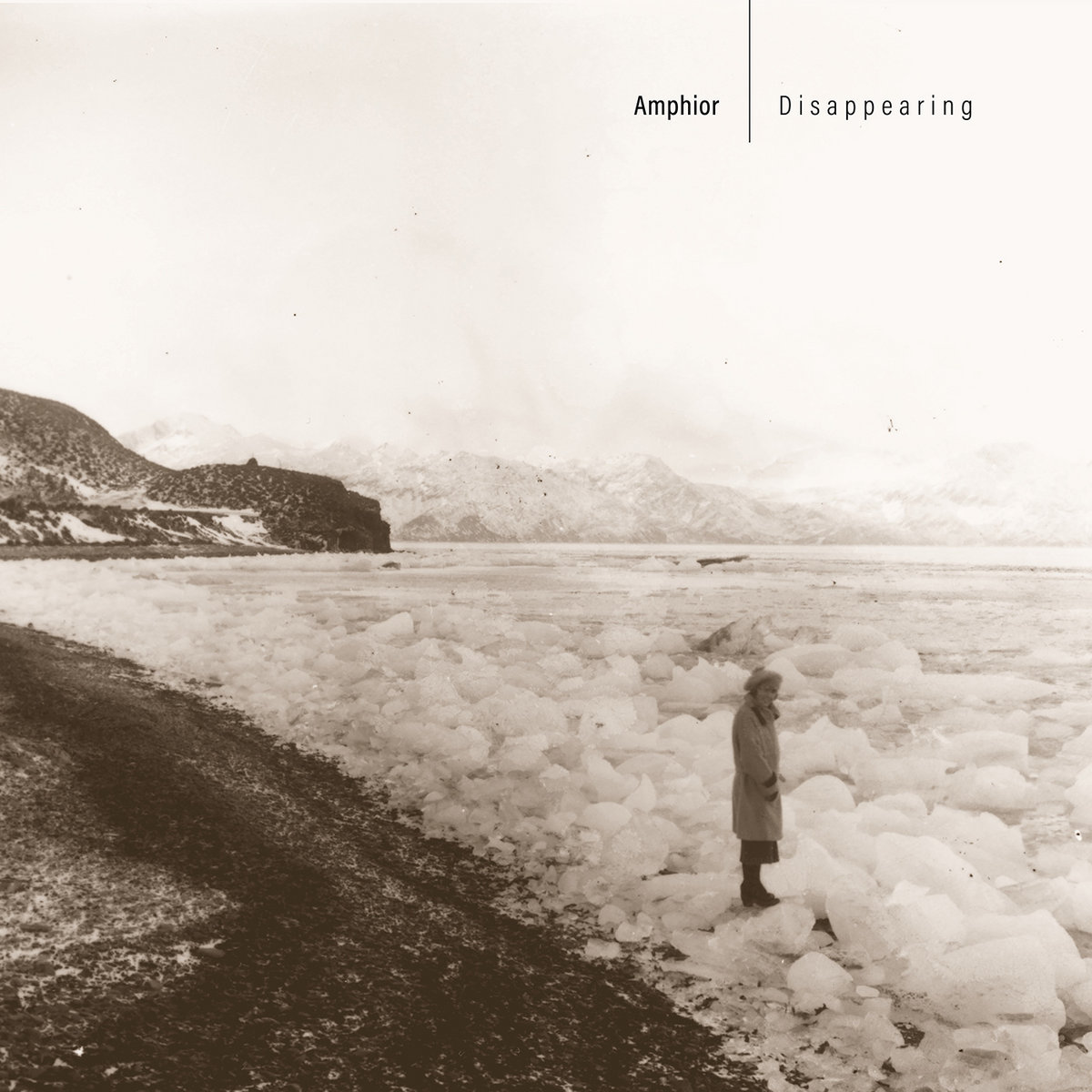
For his second album in Glacial Movements under the Amphior alias, Danish musician Mathias Hammerstrøm explores the point where tangible dissolves into ethereal.
It is a deeply personal exploration, as he explains. “The album is a meditation on anxiety and the longing for a time when it had less sway over me. Reflecting on my childhood, I remember how playing the piano was deeply meaningful to me, and crafting Disappearing felt like reconnecting with my younger self through the music.”
What’s the music like?
The eleven tracks here cast a wide net, their moods very different as though experiencing different hours of the day. Some of them cut off abruptly, as though passing through a door from tangible to intangible.
Under The Stars has a suitably wide panorama in its musical outlook, with low piano and spacious textures, the sky arching overhead. By contrast Time Is A Thief has softer and slightly more ominous musings, its added notes portraying the anxiety Hammerstrøm mentions before growing in power.
Echoes From The Past presents a lighter picture, though is slightly wobbly on its feet, while other tracks are much less certain in outcome. The eerie Costume Party briefly resembles the fuzzy nostalgia at the chilling close to The Shining, while some tracks, notably Bring To Light, collapse into disconcerting fragments.
Disappearing itself has an impressive grandeur, a distinctive loop asserting itself against a texture the listener can dive into, while the clock ticks ominously through the fuzzy Bloom. Everything Is Passing has a good deal of musical wow and flutter, removing the firm ground from the listener’s feet before ending in cold ambience.
Does it all work?
It does, and Mathias Hammerstrøm’s music often plays tricks with the listener’s sense of perspective. This is overall a good thing, though can be quite unnerving at times.
Is it recommended?
It is. Amphior’s latest has some highly descriptive music in its eleven short chapters, and though anxiety is never fully quelled it is certainly confronted with the overall ambience of Mathias Hammerstrøm’s distinctive writing.
Story, visuals and music come together in the work of Italian Lia Bosch, the first woman to record on the Glacial Movements label in its history. Described as ‘a multi-dimensional work that encourages deep reflection on existential and social themes’, Polar Code unfolds with the following plot:
Polar Code unfolds through a story set in an abandoned alien base in Antarctica, a remote and mysterious location where ancient human experiments once took place.
The protagonist, a researcher sent by a secret government agency, is tasked with investigating unusual activity detected in the region. Upon arrival, he encounters a desolate, eerie landscape filled with darkness and secrets, where every corner hides traces of a vanished alien presence that still feels ominously close. As the researcher explores the facility, he comes across the symbol of infinity, a glowing, pulsating portal that seems to be the key to understanding the connection between all life forms in the universe. This symbol becomes the focal point of the narrative, conveying a profound message about interconnection: every human action, every choice, has repercussions that extend beyond time and space.
The researcher is thus plunged into a deep existential reflection on his own existence and humanity’s role in a vast, intricate cosmos. The symbol of infinity, laden with meaning, is not merely a scientific discovery but an ethical and philosophical call. It embodies a profound truth: no matter how separate or superior humans may believe themselves to be, they are an integral part of a universal, interconnected system. The information contained within the symbol offers humanity a chance for redemption and salvation, but it also demands an acknowledgment of human fragility and the oppressive structures that underpin society.
The protagonist faces a crucial decision: to accept the revelation of the symbol and risk disrupting the global order, or to turn away from the opportunity to change humanity’s fate. This choice presents a profound moral dilemma, in which the potential to reform society—currently rooted in exploitation and conflict—collides with the risk of unleashing further destruction. Bosch delves into the tension between the need for renewal and the dangers inherent in transformation. Polar Code stands out as a work that transcends simple storytelling, weaving together sound, images, and words to provoke reflection on power dynamics, human fragility, and cosmic.
What’s the music like?
Compelling – and not a little eerie.
Polar Code opens with thick ambience, the remoteness of the location described by music that is simultaneously comforting and a little oppressive, the audio equivalent of lying under a thick duvet.
Gradually the sonic perspective widens and Bosch reveals her descriptive powers. Secret Frequencies pulses with activity, while the frequencies reach higher in Resonance. Stepping Beyond caries with it the danger of exploring hidden places and dark corners, the thickness of the sound closing in. Unknown System and Alien Circuit provide a little relief from this but presents mysterious vistas, created through subtle harmonic implications.
As the explorations continue so Bosch’s noise spectrum broadens still further, with long notes of New Parameters ushering in the striking scenes of Unveiling, where single notes in shrill timbres paint vivid pictures. Infinity has a sprawling, semi-industrial outlook, still cold but with various machine workings spotlit. Gradually the sound retreats, with Insight offering a reflection then a sonorous blast of ambient noise.
Does it all work?
Yes, but is all the more effective if the listener has the story close by. Then the full range of Lia Bosch’s painting in sound can be fully appreciated.
Is it recommended?
It is indeed. Polar Code presents a cold outlook and is often bleak in its canvas, but there is real storytelling afoot here, and for Bosch to achieve that in a small number of meaningfully deployed notes is most impressive.
For fans of… Loscil, Autechre, Cabaret Voltaire, Tim Hecker, Biosphere
Listen & Buy
Polar Code is released on Friday 5 December – at which point you will be able to listen to it via Bandcamp here:
Ark Zead is an artist shrouded in mystery. Nothing is known about the composer – other than Glacial Movements head Alessandro Tedeschi taking delivery of ‘seven ethereal soundclouds that drastically lowered the temperature by several degrees’.
From Ark Zead themselves: “I am a gong and Tibetan singing bowls player, interested in vibes in a very usual way. But I felt inspired when I faced the very hostile cold in Canada. I looked for stories about exploring these lands and the people who live there. I then modified my vibe sounds with computers and synthesizers to describe the state of isolationism you have to reach to enjoy the beauty of the true North.”
What’s the music like?
In a word, chilly! The right conditions are needed to experience the best of Ark Zead – an environment where you can hear as much of the audio spectrum as possible, taking advantage of some of the low bass drones that characterise this music, and also the subtlety of movement that takes place. The press release says as much: It is highly recommended to listen to Niptaktuk at night, in a quiet environment.
The music is incredibly cold to the touch – the icy wind that blows through Unnuaq chills the bone, and shows this music as equal parts ambient and unnerving. At times there is consonant harmony, but elsewhere there is slight but lasting discord that creates a heavy atmosphere, laden with dread.
The gong and singing bowls are used to great effect on Sikinik, while by contrast Båken Nunatak is laden with thick ambience. A vast wind is summoned on the title track. Ultimately this is music of greatly immersive ambience, a chance for the listener to put all else aside and lose themselves in the slow but inexorable progressions crafted by the composer.
Does it all work?
It does – especially if you are familiar with the Glacial Movements output, as that will help prepare you for the intensity of ambience that Ark Zead achieves.
Is it recommended?
Yes. Ark Zead is able to describe the weather in musical terms, with sounds so cold you can barely feel your fingers. A truly immersive experience, and one that is both cleansing and disarming in equal measure. Just like the cold.
For fans of… Loscil, Machinefabriek, Tim Hecker, Stars of the Lid
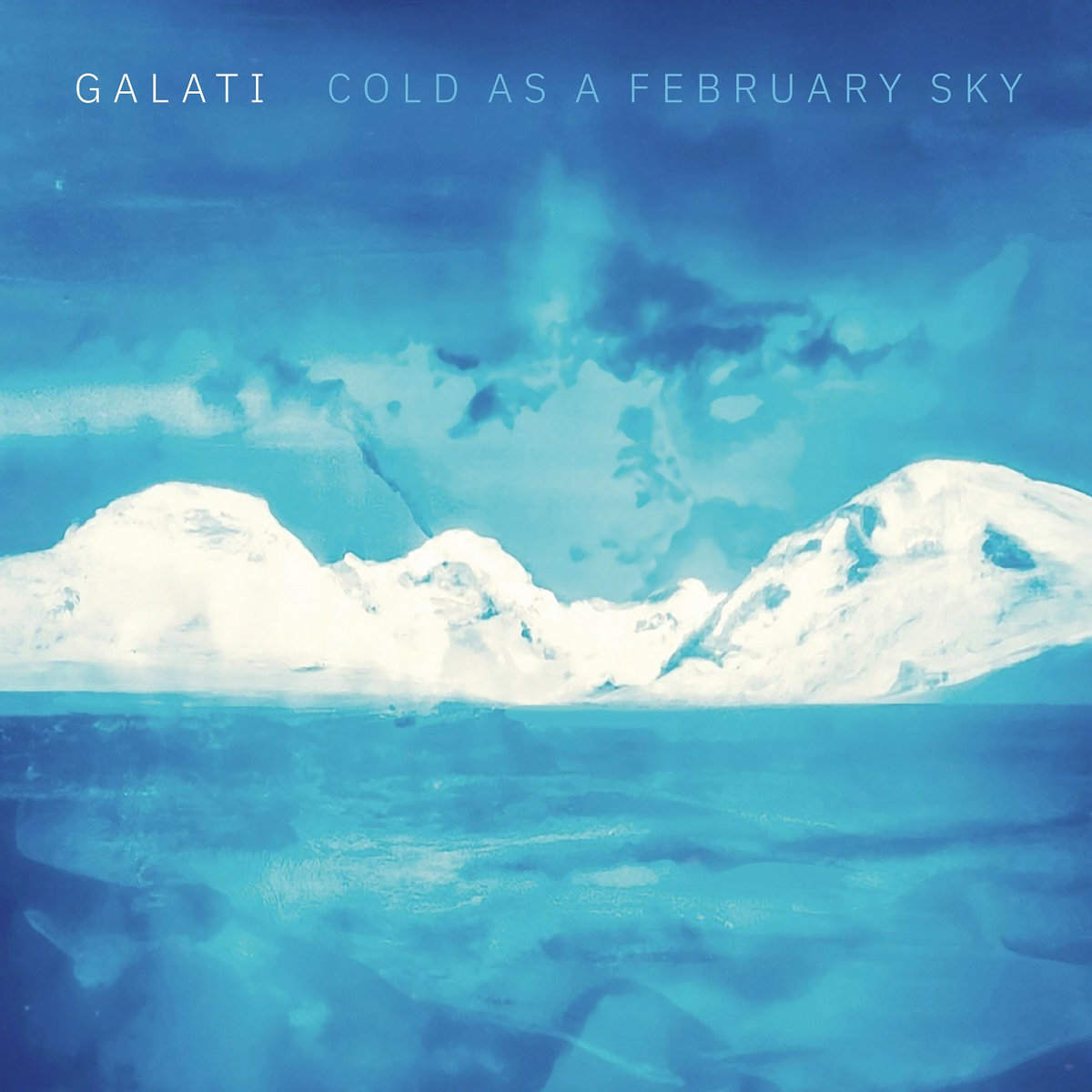
Galati is the moniker by which Roberto Galati is best known. The Italian producer has completed his first long player for the Glacial Movements label, writing in the shadow of the Karst Plateau in a blend of cold ambient music and a warmer post-rock.
What’s the music like?
Evocative – and certainly representing the album title. Many of Galati’s pieces are built on slowly shifting loops, with bright textures and fresh scoring.
Galati makes good use of the guitar early on, especially on As still as these high mountains.
After that, the music clouds over, and uncertainty and jeopardy are in play. That day exploded silentlyall around me is a dramatic about turn, its harmonies uncertain and the textures glowering in the half light. These are partially resolved on the following track, With wide, unbelieving eyes,with subtly wrought drama. After that the intensity subsides a little, though there are still vivid images that remain. Gradually the music comes to rest.
Does it all work?
It does. This is a dramatic album, best heard in one sweep so that the musical statements get to make their most powerful impact.
Is it recommended?
It is. This is a bold and lasting statement from a producer whose grasp of short and long structures is right on the money.



 Arcana.fm