Listening to Beethoven #130 – String Trio in G major Op.9/1

string-trio-op91

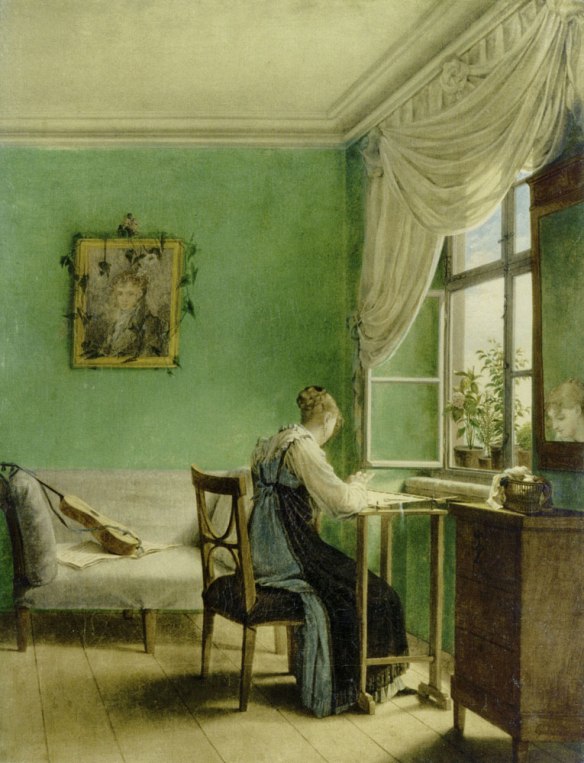
Woman embroidering, by Georg Friedrich Kersting

String Trio in G major Op.9/1 (1798, Beethoven aged 27)

Dedication Count Johann Georg von Browne
Duration 25′

1. Adagio – Allegro con brio
2. Adagio, ma non tanto e cantabile
3. Scherzo: Allegro
4. Presto

Listen

Background and Critical Reception

Seemingly preoccupied with units of three, Beethoven returned to the string trio around the same time that he was working on the three Op.10 piano sonatas – just before writing the three sonatas for violin and piano Op.12. The trios are dedicated to Count von Browne, husband of the dedicatee for Op.10 – and there are several parallels between the two sets. D major and C minor are used for a work in each – while G major, seldom used until now, is used for this first piece.

Robert Simpson, writing in The Beethoven Companion, argues persuasively that the trios are overlooked. ‘His three Op.9 trios are rightly quoted as the locus classicus for astonishing weight and richness of sound in this medium’. He notes how Beethoven’s writing for the three instruments is so inclusive that the ‘missing’ second violin that would make up a string quartet is not evident.

Thoughts

Beethoven has already shown an impressive mastery of the string trio in the Op.3 and Op.8 works, but with the first work of Op.9 he goes up another level. The grand introduction for the first movement is imposing, almost orchestral in its conception given that there are only three instruments in play. It leads to a main theme where Beethoven is really pushing the ranges of the three instruments, the cello down low and the violin up high. It gives a strong sense of pushing boundaries – but there is a lot of fun to be had in the process.

The second movement is a beauty, a tender reflection in E major, a stream of consciousness. The third movement is bright, a quick dance that is much more scherzo than minuet, while the fourth movement rushes forward impatiently, each of the instruments bristling with energy.

Beethoven’s ambition here is clear, taking the string trio to a new level of technical prowess while expanding the form.

Recordings used and Spotify links

L’Archibudelli (Vera Beths (violin), Juergen Kussmaul (viola), Anner Bylsma (cello)
The Grumiaux Trio (Arthur Grumiaux (violin), Georges Janzer (viola), Eva Czako (cello) (Philips)
Anne-Sophie Mutter, Bruno Giuranna and Mstislav Rostropovich (Deutsche Grammophon)
Leopold String Trio Isabelle Van Keulen (violin), Lawrence Power (viola), Kate Gould (cello) (Hyperion)
Trio Zimmermann (Christian Tetzlaff (violin), Antoine Tamestit (viola), Christian Poltéra (cello) (BIS)

You can listen to the versions from L’Archibudelli, the Grumiaux Trio, the Mutter-Giuranna-Rostropovich trio and Trio Zimmermann on this playlist:

Heifetz and co are expansive in the slower music but enjoy tripping along in the third movement, relishing the music’s positive energy. The Grumiaux Trio are satin-smooth, Arthur’s violin taking the lead in an affectionate account. The Leopold String Trio give an elegant first movement but keep the freshness of the new discoveries as the work progresses.

You can chart the Arcana Beethoven playlist as it grows, with one recommended version of each piece we listen to. Catch up here!

Also written in 1798 Kozeluch Sinfonia Concertante in E-flat major

Next up String Trio in G major Op.9/2
Listening to Beethoven #129 – Clarinet Trio in B flat major Op.11

clarinet-trio

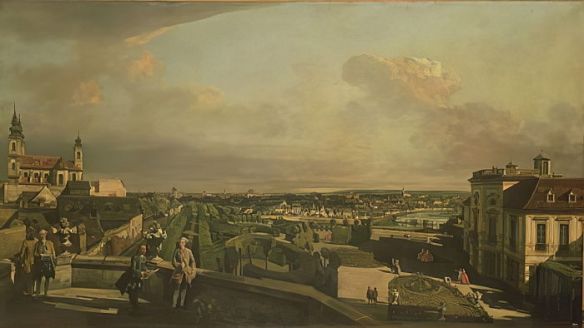
The Kaunitz Palace and Garden, Vienna by Bernardo Bellotto

Trio in B flat major Op.11 for clarinet, cello and piano (1797-8, Beethoven aged 27)

Dedication Countess Maria Wilhelmine von Thun
Duration 22′

1. Allegro con brio
2. Adagio
3. Tema con variazioni ‘Pria ch’io l’impegno’: Allegretto

Listen

Background and Critical Reception

The combination of clarinet, cello and piano was a relatively rare one when Beethoven wrote his trio in 1798. It is thought to have been written for the Viennese clarinettist Joseph Bähr, but was dedicated to Countess Maria Wilhelmine von Thun. Richard Wigmore, writing in his booklet note for Hyperion on the piece, thinks Bähr suggested a theme for the variations Beethoven wrote in the finale – on Josef Weigl’s new comic opera L’amor marinaro which was premiered late in 1797 – and which gives the trio its sometimes-used Gassenhauer nickname.

Daniel Heartz dubs the piece ‘very entertaining’, but Lewis Lockwood is less convinced. ‘Of the lesser works, designed for popularity and little more, the most developed are the Clarinet Trio Op.11 and the Quintet for Piano and Winds Op.16. On its publication in 1798 Beethoven dedicated it to a Countess Thun, presumably the oldest one of several by that title, who a few years earlier had gone on her knees to implore him to play. For her pains she now received a light and flashy reward that moved from a glittering first movement and slow movement to the circus style of its finale, made up of variation on the hit tune Pria ch’io l’impegno from a recent comic opera by Josef Weigl. In once more forcing an inevitable comparison with Mozart, whose E flat major Clarinet Trio, with viola, had been another quiet masterpiece, Beethoven did well to make his piece attractive to audiences and performers, especially cellists, but he was fully aware that instead of attempting a really serious work that could stand up to Mozart’, he was trolling the surface for easy dividends.’

Lockwood’s relative disdain for the piece has not carried over to audiences, nor artists – for as you will read below there are many fine versions of the piece. This in spite of the critic in 1798 who declared that the work was ‘difficult’ and that Beethoven wrote ‘unnaturally’.

Thoughts

What a charming piece this is.

The first theme we hear is an unlikely one. Given that the piece is in B flat major Beethoven seems to want nothing to do with the home key initially, arriving there as though by accident. The second theme is nice, too, given out by the clarinet after a simple and quite dreamy aside in D major. The tone of clarinet, cello and piano is lovely – and while the piano often takes the lead there is plenty for the other two instruments.

The second movement is sublime, a lovely period of reflection with a lyrical theme made for cello. This is also the ideal point to enjoy the colour combination of cello and clarinet in particular which Beethoven clearly relished.

The composer has a great deal of fun with the ‘Gassenhauer’ theme, which has a wide set of variations. The perky theme is taken for a run first by the piano, then through a canon between cello and clarinet, then another upright exchange with brilliant high notes from the clarinet. The fourth variation finds minor key stillness, deep in thought, but is completely swamped by tempestuous scales from the piano, blasted out fortissimo. Variation 7 returns to the minor key, in a mock-stern funeral march, then we hear a glorious high cello and clarinet unison for the eighth. The ninth and final variation goes far and wide, allowing the piano room to roam before a bracing coda.

Recordings used and Spotify links

Sabine Meyer (clarinet), Heinrich Schiff (cello), Rudolf Buchbinder (piano) (EMI)

Gervase de Peyer (clarinet), Jacqueline du Pré (cello), Daniel Barenboim (piano) (EMI)

Karl Leister (clarinet), Pierre Fournier (cello), Wilhelm Kempff (piano) (Deutsche Grammophon)

The Nash Ensemble (Virgin Classics)

Jon Manasse (clarinet), Clive Greensmith (cello), Jon Nakamatsu (piano) (Harmonia Mundi)

Paul Meyer (clarinet), Claudio Bohórquez (cello), Eric Le Sage (piano) (Alpha)

The trio led by Jon Manasse give a sparkling performance, of which you can hear half on Spotify due to time restrictions. Sabine Meyer and her trio are also superb, with Heinrich Schiff excelling in the slow movement. Karl Leister, Pierre Fournier and Wilhelm Kempff had a great rapport, as do Eric Le Sage and his trio – all of them emphasising how much pleasure this work can bring as pure chamber music to be enjoyed together.

You can listen to these versions on the playlist below:

You can chart the Arcana Beethoven playlist as it grows, with one recommended version of each piece we listen to. Catch up here!

Also written in 1798 Eybler Clarinet Concerto in B flat major

Next up String Trio in G major Op.9/1

Listening to Beethoven #119 – Serenade in D major Op.8

Ignaz Schuppanzigh, Austrian violinist, teacher and friend of Beethoven

Serenade in D major Op.8 for string trio (violin, viola and cello) (1796-7, Beethoven aged 26)

Dedication unknown
Duration 30′

1. Marcia: Allegro
2. Adagio
3. Menuetto: Allegretto
4. Adagio – Scherzo: Allegro molto – Adagio – Allegro molto – Adagio
5. Allegretto alla Polacca
6. Andante quasi allegretto – Variations 1-4 – Allegro – Tempo I
7. Marcia: Allegro

Listen

Background and Critical Reception

Beethoven returned to the string trio for a love letter to Vienna – possibly echoing his feelings after returning to the city. He chose the form of a serenade, and followed many of its conventions, including a March which ushers the players in and takes them out after a series of dance movements.

Choosing a string trio to perform the Serenade was quite unusual. In Mozart’s case the string ensemble would have been more substantial, with wind instruments possibly included.

Beethoven biographer Lewis Lockwood is quite dismissive of this work, implying it is lightweight when compared with the ‘higher level’ of the three string trios that follow as Op.9. Daniel Heartz notes this, but makes a strong claim for the Serenade’s endearing humour. ‘For three solo string instruments to produce such a big, pompous sounds as this Marcia in common time is already funny and portends a good show to come’. He notes how each of the three instruments gets a good solo in the theme and variations movement, placed fourth of six.

He also reveals that the work was advertised alongside another E flat major composition, the Piano Sonata no.4 Op.7, in the Wiener Zeitung on 7 October 1797. Stephen Daw, in his notes for the Leopold Trio recording on Hyperion, observes how ‘the Serenade was challenging material to play by the apparent standards of the time, but it looks as though Beethoven was already acquainted with the great violinist Schuppanzigh (above) at this time.

The use of a Polacca for the fifth movement is unusual, for Daw ‘one of the few real polonaises to survive from the period between those of W. F. Bach and Chopin.

Thoughts

The Serenade is a bright and breezy work, but an ambitious one too, far from the lightweight piece of fluff suggested by Lewis Lockwood.

The Marcia theme that forms the outer casing of the sandwich is hefty, and deceptive with it – Beethoven could easily have four or five instruments on stage rather than three. The contrast with the tender Adagio is rather affecting, and this movement takes its time, looking back longingly when it moves into the minor key.

A brisk Menuetto takes us back for a whirlwind stint on the dancefloor, and fades out rather cleverly with pizzicato. The fourth movement is one of extremes, with a slow section that threatens to spoil the mood, but ends up being a po-faced foil for a capricious Scherzo, taken at a breakneck speed.

The Polacca is next, tripping along with an enjoyment of the dance, and with a catchy tune. Then the theme and variations, which Beethoven turns over beautifully, showcasing each of the trio’s instruments in significant solo episodes – with a special place for the viola in the middle and the cello at the end. After this the reappearance of the Marcia theme ensures the Serenade signs off with a flourish – and everyone can go home!

The Serenade is a thoroughly enjoyable piece, not to be taken too seriously – but with plenty of emotion under its often frivolous surface. It is definitely not a Beethoven work to be thrown away.

Recordings used and Spotify links

L’Archibudelli (Vera Beths (violin), Juergen Kussmaul (viola), Anner Bylsma (cello)
The Grumiaux Trio (Arthur Grumiaux (violin), Georges Janzer (viola), Eva Czako (cello) (Philips)
Anne-Sophie Mutter, Bruno Giuranna and Mstislav Rostropovich (Deutsche Grammophon)
Leopold String Trio Isabelle Van Keulen (violin), Lawrence Power (viola), Kate Gould (cello) (Hyperion)
Trio Zimmermann (Christian Tetzlaff (violin), Antoine Tamestit (viola), Christian Poltéra (cello) (BIS)

You can listen to the versions from L’Archibudelli, the Grumiaux Trio and the Mutter-Giuranna-Rostropovich trio on this playlist:

There are some very fine recordings of the Serenade, with three standing out as excellent – the Grumiaux Trio, who are quite luxurious in their thick sound, the Leopold Trio for a strongly characterised account, and Trio Zimmermann for an equally musical recording. All of them capture Beethoven straining at the leash, offering a Serenade but much more besides.

You can chart the Arcana Beethoven playlist as it grows, with one recommended version of each piece we listen to. Catch up here!

Also written in 1797 Wranitzky Symphony in C minor, Op. 31 “La paix”

Next up Sonata for piano (four hands) Op.6