There is a refreshing lack of information to go with the new BEAK>> album. It is, quite simply, the need of a group of people to make music, with no back story in particular – just the love of what they do and can achieve together.
This is probably why >>>> does not have more of a distinctive title, as the music is left alone to have the best possible impact. It was recorded at Invada studios in Bristol, the sessions dotted around to accommodate the band’s touring schedule.
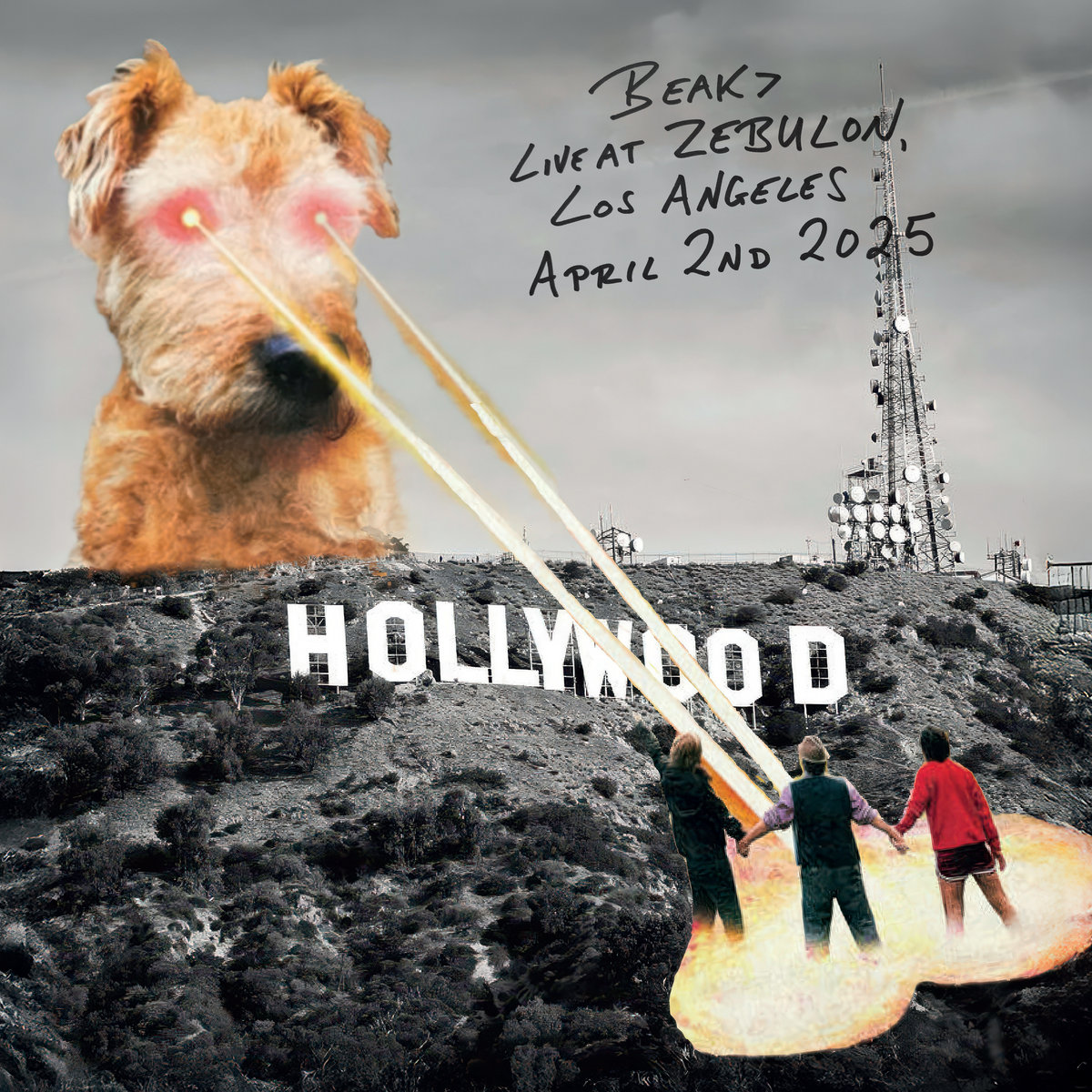
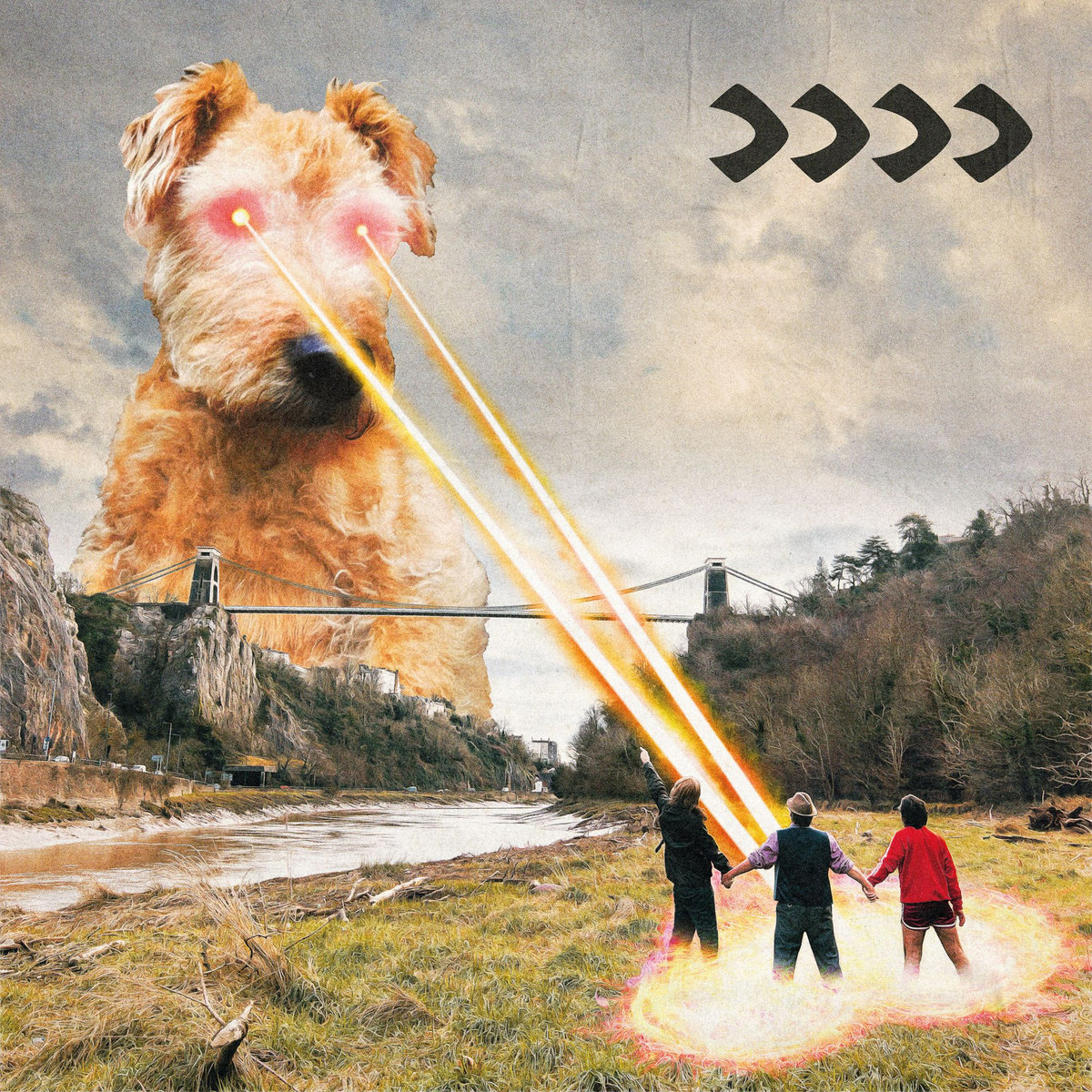
There is, however, a story behind the opening track Strawberry Line, which is a tribute to Geoff Barrow’s much-loved dog Alfie, who appears on the album’s cover.
What’s the music like?
Compelling. As the band say, it works best listened to in one breath from start to finish, where the listener can appreciate how the grooves take hold through the album.
The Alfie tribute, Strawberry Line, starts with a solemn, chorale-like figure, which eventually acquires a groove and grows to impressive heights. The Seal has a clipped rhythm and greater urgency, while Windmill Hill starts the more beat-driven section of the album with an appealing, wonky groove.
From here on the bass heads are in for a treat, thanks to the grooves of Hungry Are We and Ah Yeh, which has been around for a little while, and makes a very strong impact in this LP version. As the album progresses the spirits rise further, with a brilliant bass line on Bloody Miles and some clanging, metallic percussion that propels Secrets towards the 1980s in the company of a buzzing synth code.
The closing Cellophane is an unsettling affair, however, going through a woozy vocal and distracted band passage before suddenly gaining momentum like a dance of death, careering into the buffers at the end.
Does it all work?
It does – and the bigger the system the better for this affair, so that the bass driven tracks make their mark and the woozy, psychedelic dressing gets its full perspective.
Is it recommended?
Very much so. BEAK>> are continuing on their compelling path of sonic innovation with this powerful and multifaceted piece of work.
For fans of… Portishead, Magazine, Cabaret Voltaire, Can
Beak> have delivered a surprise release of their first album in six years today. The aptly titled >>>> is released by Invada and Temporary Residence Ltd
The band – Geoff Barrow (of Portishead), Billy Fuller (Robert Plant’s Sensational Space Shifters) and Will Young (Moon Gangs), explained the reason for their surprise delivery.
“At its core we always wanted it to be head music (music for the ‘heads’, not headphone music), listened to as an album, not as individual songs. This is why we are releasing this album with no singles or promo tracks.”
They have also spoken about the genesis of >>>>. “The recording and writing initially began in a house called Pen Y Bryn in Talsarnau, Wales in the fall out from the weirdness of the Covid days. Remote and with only ourselves and the view of Portmeirion in the distance we got to work. With the opening track, “Strawberry Line” (our tribute to our dear furry friend Alfie Barrow, who appears on the album’s cover) as the metronomic guide for the album, we then resumed recording, as before, at Invada studios in Bristol, whilst still touring around Europe and North/South America.After playing hundreds of gigs and festivals over the years we felt that touring had started to influence our writing to the point we weren’t sure who we were anymore. So we decided to go back to the origins of where we were at on our first album. With zero expectations and just playing together in a room.“
This is the first TV soundtrack by Benjamin Power, aka Blanck Mass – a surprising state of affairs, given Power’s prolific output as a composer. It would seem he has been biding his time, for as part of the duo Fuck Buttons he released three albums, as well as providing a good deal of music for the opening ceremony of the Olympic Games in London 2012.
Since then he has turned to solo work as Blanck Mass, building a reputation for electronic music of unusual and uncompromising power, with a further five albums under his belt. The Rig is heading up Amazon Prime’s selection of January viewing, a six-part season with a stellar cast directed by Line of Duty stalwart John Strickland. In it, the crew of a North Sea oil rig encounter unseen forces that cut them off from the mainland, with far reaching consequences for their environment and the crew on board.
What’s the music like?
As with all the best soundtracks, Power’s response is one that vividly captures the environment. The weighty main theme is ideally pitched, punching through with concrete-heavy beats that capture the industry, the majestic yet brutal outlines of the right.
The early numbers draw the listener in, setting the scene as the main characters are revealed and established, and conveying the mysterious circumstances the crew find themselves in. Inevitably some of these sketches are short, and work best in the context of the full album, but the disorientation of both personnel and environment proves unnerving for the listener too.
At the same time the ongoing industrial processes are reflected in the clattering percussion (Flesh Meets Floor), the dripping pipes, the echoing chambers and the misty outlines of the vast structure. The unseen menace of the sea is there, too. Sometimes we fall back to companionship, often laced with uncertainty (Ghost), while key scenes such as Helideck build momentum. Power responds to the scenes in kind, moving between the claustrophobic corridors and dimly lit offices of the rig to the vast open reaches of the North Sea.
There are some striking moments. No Fore Without Flare captures the drama of that particular sequence, while We’ll Bring Him In is loaded with emotion. Charlie sends out wails of anguish, realised fully in the extended portrayal of The Wave. This is where the bottom drops out of the music, Power using subtle but striking pitch variations to maximise the discomfort. The story ends in relative comfort but the lasting dread remains.
Does it all work?
Yes. Inevitably there are descriptive elements to the score that are short and undeveloped, but when listened to as a whole the music for The Rig contains a great deal of substance. Power paints a vivid picture of the surroundings without ever resorting to cliché, and there are moments of keen emotion as the characters take over.
Is it recommended?
Wholeheartedly. His previous albums as Blanck Mass suggested Benjamin Power would take to the small screen like a duck to water – and The Rig is proof positive that he has.
John Wyndham’s classic 1957 novel The Midwich Cuckoos has inspired a number of big and small screen responses, the most recent being from Sky with their starry interpretation that has been all over digital TV of late. It tells (plot spoiler alert!) of a group of children arriving by stealth in a leafy English town, then growing quickly both physically and mentally as a unit until their power eclipses that of their parents. As the seven-part series takes shape, the tension between the two reaches breaking point, and a number of startling events lead to an extremely fraught battle of the minds.
Reviews for the series, fronted by Keeley Hawes and Samuel West, have been lukewarm, but to this writer at least the story remains a compelling and disturbing one, the tension rarely letting up, with the idea that such dark things could be afoot in ‘normal’ English towns proving to be profoundly unnerving.
The job of portraying these elements in sound has been given to Hannah Peel, who is building up an impressive arsenal of music for the screen, both in analogue and digital form. For her score to The Midwich Cuckoos she uses analogue synthesizers to replicate the ‘hive mind’, shared by the group of children whose initial purpose is to take over the suburbs, but whose greater aims become even more disturbing.
Peel adds drones and tape manipulations to dislocate the perspective of the viewers, but also dips into more obviously English and pastoral references when writing about the setting and the ‘home’ personalities involved.
What’s the music like?
Deeply unnerving but weirdly consoling at the same time – rather like the children who have mysteriously arrived in the town!
Peel’s ability to portray pastoral scenes through her electronics is a massive bonus, for some of the scene setting is exquisite, matching the rich green shades of the production. Yet there is often a dark undercurrent to the writing and a sense of profound unease, especially when describing the hive mind the children have in place. This is done with a single pitch of changing colour and tonal quality, an eerie echo rebounding as though off the walls of a quarry. Lasting comfort is hard to find, though there is brief solace in the mother-child relationships that are formed.
Peel writes descriptively, her melodies portraying the strength of emotion on show from the mothers towards their children, but the deep drones and atmospherics tell a very different story, revealing the layers at work in the youngsters’ minds.
The title music itself is otherworldly, suggesting the intervention of beings from well beyond this planet, and quoting the birdsong of the cuckoo which has at its heart the promise of spring. The Cuckoo music takes the form of the bird as it grows, with the telling lyric “In June, I change my tune”. The Midwich Cuckoos Theme is dark indeed, blotting out the light in a haunting 20 second salvo.
Does it all work?
It does, with the caveat that some of these pieces are short pockets of music written to score specific scenes rather than hang together as part of an album structure. That said, The Midwich Cuckoos makes for compelling if unsettling home listening, which might end with you positioned behind the sofa!
Is it recommended?
Indeed it is – another auspicious addition to Hannah Peel’s discography, revealing a powerfully dark aspect of her writing for the screen.
Listen
Buy
As an aside it is worth purchasing the soundtrack on Bandcamp below, as that gives you four bonus tracks.




 Arcana.fm