
Listening to Beethoven #222 – Leonore

Beethoven’s Leonore as designed for the Wiener Staatsoper, 2020

Leonore, opera in three acts (1804-05, Beethoven aged 34)

Libretto Jean Nicolas Bouilly, trans. Joseph Sonnleithner

Duration 138′

by Ben Hogwood

Background, Synopsis and Critical Reception

“Probably nothing has caused Beethoven so much grief as this work, whose value will be fully appreciated only in the future”.

The words of Stephan von Breuning to Franz Wegeler in Bonn, talking about Beethoven’s first opera Leonore, which did indeed bring a great deal of strife for its composer in the lead-up to the premiere in November 1805.

The libretto was relatively new, written in the late 1790s by Jean Nicolas Bouilly, the administrator of a French department near Tours during the Reign of Terror. Lewis Lockwood gives an excellent back story to Leonore’s construction. He writes that ‘it was widely accepted that during Bouilly’s governance an episode resembling that of the opera plot had actually taken place’…where ‘a woman disguised as a young man had worked her way into her husband’s prison and freed him from his unjust captivity. Thus, if the take were true, Bouilly himself would have been the minister who liberated the prisoner, and so the libretto seemed to commemorate not only actual heroism but the author’s own benevolence amid the frightening atmosphere of France in those years.’

The opera is set in the prison. The first act is conducted at ground level, where the prisoners take in the rarified air on their rare visits above ground, and where Leonore, disguised as Fidelio, has arrived to try and rescue her beloved Florestan. Immediately she becomes the object of Marcellina’s affections, which she eventually repels. In this process we are introduced to Rocco, a peasant voiced by a fulsome baritone who helps Leonore greatly.

The two levels below ground are reserved for the prisoners, The second act brings them to the fore, as Leonore gets closer to freeing her beloved, with memorable moments including the quartet Mir ist so wunderbar and the Prisoners’ Chorus. The third and final act begins in the dungeon where Florestan has been chained to the wall for two years, freezing and starving. He takes centre stage at the start, his pain all too evident for the audience in the aria Gott, welch Dunkel hier. Liberation is at hand, however – Florestan seeing Leonore as an angel sent to rescue him. The finale celebrates her bravery.

Rather confusingly, Beethoven wrote four overtures for Leonore / Fidelio. The first one to be used was Leonore no.2, which was used for this version of Leonore. The subsequent three versions work in different introductions for Florestan’s aria, while the Fidelio overture itself – written for the 1814 staging – is wholly different.

Two composers had already set the libretto to music. The second, Ferdinando Paer, aroused Beethoven’s interest and competitive edge. Because Paer had already named his version Leonore, Beethoven titled his Fidelio, or Conjugal Love. He hooked up with Joseph Sonnleithner, a prominent musical figure in Vienna, who translated the libretto – on which Beethoven began work in January 1804. At that point he only wanted the ‘poetical part’ of the libretto to be translated, and an exchange between the two reveals that his plans were already in place to stage the work in June 1804. leading up to the premiere in November 1805, which took place under the shadow of Napoleon’s anticipated invasion of Vienna – and was indeed attended by a large number of French army officers. Further attempts at staging in Berlin and Prague were unsuccessful, before Beethoven revised the opera for a production in Vienna in 1814, renaming it Fidelio.

As Jan Swafford explains in an absorbing biography chapter about Leonore, writing vocal music could be a struggle for Beethoven. “He always had more trouble writing vocal music than instrumental”, Swafford writes, referring to the sketchbook for Leonore where there are 18 different beginnings to Florestan’s aria In des Lebens Frühlingstagen and a mere ten for the chorus Wer ein holdes Weib. That didn’t mean Beethoven wasn’t any good at it, but the process of getting the right notes on the page was a painful experience.

The results, however, have been revelatory. Lewis Lockwood describes a work that “has resonated through two centuries as a celebration of female heroism”. In a candid booklet note for his recording of Leonore on Deutsche Grammophon, John Eliot Gardiner notes how “for sheer simplicity and directness of utterance, and for the way he imbues his orchestral set-pieces and accompaniments with dramatic life and emotional intensity, Beethoven has no peer. His single opera has a unique appeal, and a magic very much of its own – especially in its first version, the Leonore of 1804-05, where his ideas, while sometimes crude, are at their most radical.” Later, he declares that “while as a musician I can easily succumb to the sheer beauty of the new music written for Fidelio, nothing, I find, can compare with Beethoven’s original response to his material in 1805.”

Thoughts

In spite of Beethoven’s difficulties, and a compositional practice where he had to grind out many of the results, Leonore is a thoroughly absorbing drama from start to finish. Right from the call to arms of the overture the listener is gripped, the stark outlines immediately setting a tense atmosphere which only occasionally lets up when more tender love is expressed.

The use of a narrator between scenes does not check the flow of the drama – if anything it provides helpful points of context. Without the information provided by Beethoven scholars, would we have known of the difficulties he experienced in composing? As John Eliot Gardiner says, the ‘dramatic life and emotional intensity’ are always there, with relatively little padding in the plot.

What helps, too, is how easily Beethoven moves between solo arias, duets, trios and quartets – and even in the latter the use of many voices does not stop him from getting clarity. The first quartet in Act 1, Mir ist so wunderbar, is beautifully woven in together – while on the solo front, Ha! Welch is a brisk aria, led from the front by Pizarro who is in jubilant mood. Beethoven is certainly not afraid of putting his foot on the accelerator when needed.

Interestingly the operatic influences – to this ear at least – are less from his vocal training with Salieri but more from study of Handel. This is the case especially where recitatives and arias are paired, as in the finale to Act 2.

There are some genuinely thrilling moments in Leonore. The flurry of activity through the Act 2 duet between Pizarro and Rocco (Jetzt, Alter, hat es Eile!) shows the urgency of which Beethoven is capable. Auf Euch nur will ich bauen, led by Pizarro is an exhilarating trio, punchy and red blooded with a shiny brass coating. Countering this is the bleak, vivid word painting at the start of Gott! Welch dunkel, the extended scene where Florestan is down in the dungeon. It is a stark piece of writing and incredibly affecting with orchestra and emotion stripped bare, Florestan’s pain revealed for all to hear in F minor, one of Beethoven’s ‘tragic’ keys. Consolation, however, is found in the love for Leonora, expressed in a tender theme whose radiance is all the more revealing in this setting. High drama follows in the quartet, the exclamations brilliantly managed, and the top ‘C’ soprano near end of Ich Kann mich noch nicht fassen carries maximum impact.

The opera flows very naturally from one section to the next. Although this is an opera with a female hero there are a lot of steely lines for men at the start of Act 2 – none more so than the explosive arrival of Pizarro with his declamation that Ha! Welch ein Augenblück (Ha, the moment has come when I can wreak my vengeance!) Marcellina and Leonora arrive to redress the balance in a brightly cast C major. Ach brich noch is a standout aria, with sonorous horns for company, written in a higher register that looks forward to Weber and beyond. While Act 1 is described as more ‘domestic’ is it nonetheless a satisfying experience, with the arias for Marcellina and Rocco hardly throwaway. The latter’s first aria, where “if you haven’t gold as well, happiness is hard to find” is memorable.

Yet while these moments are high points, nothing quite carries the impact of The Prisoners’ Chorus. This is the dramatic apex of the work, wide-eyed wonder spreading from the jailed forces as their strength comes to the fore. Then, as Leonore learns of the likelihood of marriage, there is a breathless joy. The other many high points are the prisoners, ‘filled with loyalty and courage’ at the rousing end to Act 2, and the reveal of Leonore to Florestan, with the oboe’s involvement especially poignant. The finale is full of incident, the music eventually shifting to a pumped-up C major for a triumphant finish.

Beethoven experienced a great deal of bad fortune in the realisation of Leonore, and the opera has since proceeded under a cloud. In fact, it is only in the last 30 years or so that it has regained anything of its stature, thanks to notable recordings from John Eliot Gardiner and René Jacobs. Both these esteemed conductors have seen the qualities in the music, and how Beethoven – contrary to the opinion of some – has proved to be a great opera composer.

Recordings used

Hillevi Martinpelto (Leonore), Kim Begley (Florestan), Franz Hawlata (Rocco), Matthew Best (Don Pizarro), Christian Oelze (Marzelline), The Monteverdi Choir, Orchestre Révolutionnaire et Romantique / John Eliot Gardiner (DG Archiv)

Marlis Petersen (Leonore), Maximilian Schmitt (Florestan), Dimitry Ivashchenko (Rocco), Johannes Weisser (Pizarro), Robin Johannsen (Marzelline), Freiburg Baroque Orchestra / René Jacobs (Harmonia Mundi)

Those two recordings I mentioned are both cut and thrust experiences. René Jacobs provides a leaner orchestra and much faster tempo choices, which plays to the speed of Beethoven’s creativity. For John Eliot Gardiner Matthew Best is a superbly malevolent Pizarro. Both have superb soloists – and rather than choose a favourite I would merely opt for both! You can listen on the links below:

Also written in 1805 Cherubini Faniska

Next up Leonore Overture no.2 Op.72a
Listening to Beethoven #208 – Symphony no.3 in E flat major Op.55 ‘Eroica’


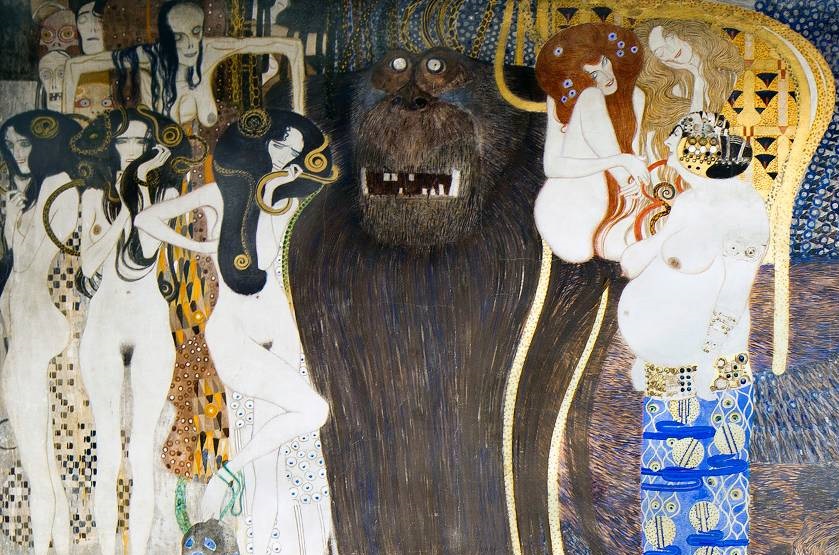
The Hostile Powers. Far wall, detail from the Beethoven-Frieze (1902) by Gustav Klimt

Symphony no.3 in E flat major Op.55 ‘Eroica’ for orchestra (1800-1802, Beethoven aged 31)

Dedication Prince Joseph Franz Maximilian Lobkowitz
Duration 48′

1. Allegro con brio
2. Marcia funebre: Adagio assai
3. Scherzo: Allegro vivace
4. Finale: Allegro molto

Listen

Background and Critical Reception

In October 1803, when Beethoven had completed his third symphony, his world was about to change. His friend, the composer Ferdinand Ries, declared, “In his own opinion, it is the greatest work he has yet written. Beethoven played it to me recently, and I believe that heaven and earth will tremble when it is performed.”

Jan Swafford dedicates a compelling chapter to this work, which was to be one of the very first ‘program’ symphonies. Its dedicatee was to be Napoleon Bonaparte, but in a daring step his heroic character and achievements were to be the subject of Beethoven’s symphonic thoughts, built as they were on thematic cells from music previously written to celebrate Prometheus. Rather than be called Bonaparte, however, the Third took the term Eroica, for Beethoven was horrified by Napoleon’s proclamation as Emperor in May 1804. This was the nickname applied when the symphony was published in October 1806, with the dedication changed to Prince Lobkowitz.

Swafford presents a thoroughly absorbing dissection of the piece in his book, showing how Beethoven’s seemingly innocent sketches and musical cells take wing, blossoming into seamless 20-minute sections of music. The fourth movement, a theme and variations, takes its lead from a melody already used in Die Geschöpfe des Prometheus, completed in 1801, and also from the Eroica Variations for piano.

As Swafford writes, Beethoven “is more interested in flow than in eighteenth-century formal clarity”. At the end of the Eroica’s first movement, “the hero has come into his own, but his task is unfinished”. The symphony is now telling its story about an explicit subject, not just looking to impress on musical terms.

This first movement has a scale and ambition not seen before, as does the second movement funeral march. Berlioz, writing of the whole work, surely had this movement in mind when he declared, “I know few examples in music of a style in which grief has been so consistently able to retain such pure form and such nobility of expression.” The third movement continues Beethoven’s move away from the classical minuet towards the full-blown symphonic scherzo of the 19th century, but it is the finale where all Beethoven’s thoughts are clearly headed.

Swafford explains how Beethoven’s thoughts always had this movement at the head of proceedings, with finale-weighted works still relatively rare at the time. He applauds Beethoven’s innovations for the orchestra, with writing for horns and cellos of a standing not previously experienced. Barry Cooper declares this movement “an extraordinary fusion of musical arts, including variation, fugue, march and slow procession, in a symphonic finale of unprecedented formal complexity despite the apparent simplicity and regularity of its main theme. No wonder Beethoven’s admirers were so thrilled by the work, and the general public so perplexed.”

They were indeed, as Alexander Thayer recounts the puzzlement of an early appraisal. “The reviewer belongs to Herr van Beethoven’s sincerest admirers, but in this composition he must confess that he finds too much that is glaring and bizarre, which hinders greatly one’s grasp of the whole, and a sense of unity is almost completely lost.” Swafford has its measure, however. “The final pages are what the unfulfilled end of the first movement was waiting for, the true victory, the completion of the Hero’s task.”

Thoughts

It is rare indeed to be able to pinpoint an exact moment where art moves from one chapter to the next. Beethoven’s Eroica symphony gives us one such moment, a pivot where the whole notion of the symphony changes for ever and the composer strides forward to a new plain.

So many things about this work are new, exciting, and – for the time – dangerous. The first change is length, for this work often clocks in at near to 50 minutes if the repeats are used, twice the length of a Haydn or Mozart symphony. The first two movements alone are half an hour, making Beethoven’s first two symphonies feel like mere warm-ups in comparison. We also have an increasingly large orchestra to go with the bigger structures, and instruments such as the horn, oboe and cello take on an unprecedented status for their time.

Something is up right from the two brisk chords at the start, a call to attention before the main theme itself. The cellos get their moment, setting the heroic nature of the music in E flat major – which is, as we have seen, one of Beethoven’s key centres for power and positivity. As the massive first movement progresses, the composer goes through intricate yet wholly logical forms of developing his material. There is a new level of emotion here too, for this is a symphony from the heart. Its resolve gives the listener a mental picture of Beethoven beating his chest, giving himself a motivational call to arms as part of an emergence from the terrible days and morale of the Heiligenstadt testament.

The second movement, a funeral march, is one of the most profound utterances we have yet heard from Beethoven. This is the first time he has used the orchestra for such sombre means, other than a few isolated passages in the early cantatas, and the depth of feeling is well beyond previous symphonic thought, bringing closely guarded emotions from the intimacy of the piano to the wide open canvas of the orchestra. This is also a long movement, but the tension is sustained throughout. We feel Beethoven’s grief, his wounds, and also, in the C major ending, a semblance of hope.

The Scherzo picks up on this, easing the tension with its initial subject. It packs a punch recalling the heroism of the first movement, especially with the no-nonsense syncopations. No notes are here for the sake of it, all are fulfilling what feels like an inevitable destiny.

The finale, as Jan Swafford observes, brings everything to a head in a climactic fourth movement not experienced since Mozart’s Jupiter symphony. Few symphonic finales are as thrilling, as Beethoven assembles his melodic material and the music grows in stature at every turn, coming to a peak with a triumphant horn theme. The theme ends with a cadence that shows how Beethoven’s harmonic thinking is advancing with every piece – and indeed caps the sharp dissonance experienced near the start of the first movement. With this and many other elements, you can only imagine what the first audience would have thought, having grappled with the sheer scope of the first three movements. Where was this composer going with his music? Can we take the plunge with him? We will soon find out!

Spotify playlist and Recordings used

NBC Symphony Orchestra / Arturo Toscanini (RCA)
Cleveland Orchestra / George Szell (Sony Classical)
Orchestra of the Eighteenth Century / Frans Brüggen (Philips)
Berliner Philharmoniker / Herbert von Karajan (Deutsche Grammophon)
Vienna Philharmonic Orchestra / Claudio Abbado (Deutsche Grammophon)
Danish Chamber Orchestra / Ádám Fischer (Naxos)
Minnesota Orchestra / Osmo Vänskä (BIS)
Berliner Philharmoniker / Rafael Kubelik (Deutsche Grammophon)
Anime Eterna Brugge / Jos Van Immerseel (ZigZag Territories)

The recorded history of the Eroica deserves a much longer article, but safe to say the versions included here represent part of the vast array of available recordings. The smaller scale takes, such as Dausgaard, have plenty to say, as do the lavish accounts from Karajan and dfgd, where the score’s latent power is always in evidence. Accounts from Vänska and dfgd forge a middle ground, while the ‘period instrument’ versions from Brüggen and Jos van Immerseel give us a sense of what the first audience might have experienced, with thrillingly rough edges to the sound and the melodies.

To listen to clips from the recording from the Scottish Chamber Orchestra conducted by Sir Charles Mackerras on Hyperion, head to their website

You can chart the Arcana Beethoven playlist as it grows, with one recommended version of each piece we listen to. Catch up here!

Also written in 1803 Haydn String Quartet in D minor Op.103 (unfinished)

Next up Notturno for viola and piano in D major, Op.42

Listening to Beethoven #188 – Symphony no.2 in D major Op.36


The Longing for Happiness. Left wall, detail from the Beethoven-Frieze (1902) by Gustav Klimt

Symphony no.2 in D major Op.36 for orchestra (1800-1802, Beethoven aged 31)

Dedication Karl Alois, Prince Lichnowsky
Duration 30′

1. Adagio molto – Allegro con brio
2. Larghetto
3. Scherzo: Allegro
4. Allegro molto

Listen

Background and Critical Reception

Beethoven’s time in Heiligenstadt may have been difficult, but it yielded music of remarkable positivity in such testing situations. George Hall, writing booklet notes for Simax, sums up the situation neatly: ”What has proved remarkable to Beethoven’s biographers is that the (second) symphony, whose sketches date back to 1800 and whose finishing touches were probably added in 1803, was composed largely in the year that he wrote the famous Heiligenstadt testament. The fact that this document – in which Beethoven in his post-suicidal mood railed against his deafness and isolation in a letter – was conceived in the year of this predominantly happy and straightforward piece is considered paradoxical.’

‘Symphony no.2 is the main fruit of Beethoven’s labors in 1801-2 and is considered to be the culminating success of his early period’, writes Daniel Heartz. He gives an account of the premiere on 5 April 1803, which took place at the new Theater an der Wien, and included the hastily composed short oratorio Christus am Ölberge and also a new piano concerto, the third.

In a fascinating and detailed analysis, Heartz goes on to draw close links with Mozart‘s Symphony no.38, the Prague, which Beethoven greatly admired. Written in the same key, the two works share a broad Adagio introduction to the first movement, and a nearly identical instrumentation. The crucial difference here is that Beethoven adds clarinets in A, a distinctive part of the woodwind sound which makes such a difference to this symphony.

The second symphony would probably have been, to date, the longest symphony yet published – a quality acknowledged by Allegmeine Musikalische Zeitung of Leipzig, in their 1804 appraisal. ‘It is’, their critic wrote, ‘a noteworthy, colossal work (the biggest so far), whose profundity, strength and artistic understanding are very rare, and presents difficulties from the point of view of execution…that certainly no previous symphony has offered.’

Heartz identifies it as ‘a watershed for its composer, the last of his big works in which he looked to Haydn and Mozart for inspiration.’ Later, he notes that when ‘the London Philharmonic Society invited Beethoven to compose a symphony in the style of the first and second symphonies’, it was ‘an offer that deeply offended the composer, who indignantly refused. There can scarcely be more striking confirmation than this that a corner was turned after 1802.’

Thoughts

If you approached this piece cold, there is no way you would know it was written by a man whose grip on life itself was tenuous. In the midst of all the strife he was experiencing, Beethoven pulled out this sunny piece of beautifully joined-up thinking, giving the best possible response to his illnesses and impending deafness. If he was to be hindered, the music would see him through.

There is much to love about the Second Symphony. Its dimensions look front-loaded, with a substantial first and second movement and a shorter Scherzo and Finale placed third and fourth. These two, however, act as a combined pair – and so the feeling is of a trio of movements, as perfected by Mozart in the Prague symphony discussd above. The spirit of Mozart is present for sure, but so is the drive and energy of the younger composer, along with his ability to develop incredibly small melodic cells into material for whole movements.

His expertise in this is evident in those third and fourth movements. The scherzo’s seemingly throwaway phrase at the start is the block on which the whole movement rests, played by the orchestra but with the strings keeping busy in between. The finale follows on naturally, moving closer to ‘home’ with another clipped phrase from the full orchestra.

Before these two symphonic gems we have had the pleasure of an energy-filled first movement and a balletic second, a ‘slow’ movement with a good deal of poise. Here the clarinets make themselves known the most, and Beethoven’s writing for wind is a joy in which to indulge. The movement flows with a happy stream of invention, anticipating perhaps the outdoor vistas of the later Pastoral symphony.

Working backwards, the first movement has a good deal of drama in its introduction and a tautly argued Allegro section which frequently breaks into an unfiltered smile. Perhaps Mozart and a little of Haydn are most obvious in the music here, but again the material could not be from anyone else.

Many commentators declare the Second Symphony as the culmination of Beethoven’s first period. With music of such rich invention, such clever but instinctive development and such bright textures, it is to be savoured – and bodes extremely well for what is to come.

Spotify playlist and Recordings used

NBC Symphony Orchestra / Arturo Toscanini (RCA)
Cleveland Orchestra / George Szell (Sony Classical)
Orchestra of the Eighteenth Century / Frans Brüggen (Philips)
Berliner Philharmoniker / Herbert von Karajan (Deutsche Grammophon)
Vienna Philharmonic Orchestra / Claudio Abbado (Deutsche Grammophon)
Danish Chamber Orchestra / Ádám Fischer (Naxos)
Minnesota Orchestra / Osmo Vänskä (BIS)
Royal Concertgebouw Orchestra / Rafael Kubelik (Deutsche Grammophon)
Anime Eterna Brugge / Jos Van Immerseel (ZigZag Territories)

Performances on ‘period’ instruments or modern interpretations are both to be lauded in this piece. The former camp contains really fine versions from Anime Eterna Brugge and Jos van Immerseel, or the Orchestra of the Eighteenth Century and Frans Brüggen, to name just two thoroughly enjoyable accounts. The latter gives great enjoyment thanks to the batons of Harnoncourt, Kubelik and Szell, not to mention many, many others!

To listen to clips from the recording from the Scottih Chamber Orchestra conducted by Sir Charles Mackerras on Hyperion, head to their website

You can chart the Arcana Beethoven playlist as it grows, with one recommended version of each piece we listen to. Catch up here!

Also written in 1802 Haydn Mass in B flat major Hob. XXII:14 ‘Harmoniemesse’

Next up No, non turbarti, WoO 92a

Listening to Beethoven #171 – String Quintet in C major Op.29

Carl_Schütz_Wien_Michaelerplatz

Der Michaelerplatz, die Kirche, die KK Reitschule und das KK National Theater, Wien, by Carl Schütz (late 18th century)

String Quintet in C major Op.29 (1801, Beethoven aged 30)

Dedication Count Moritz Fries
Duration 33′

1. Allegro moderato
2. Adagio molto espressivo
3. Scherzo: Allegro – Trio
4. Presto – Andante con moto e scherzoso – Tempo I

Listen

written by Ben Hogwood

Background and Critical Reception

Beethoven’s only original String Quintet was commissioned by Count Moritz Fries, and was completed towards the end of 1801. It gained immediate respect, with brother Carl describing it as ‘one of Beethoven’s most excellent’, placing it above the other works he was promoting, the Second Symphony and Third Piano Concerto.

Richard Wigmore is similarly convinced, declaring the quintet to be ‘the final phase of his so-called ‘first period’. This strangely neglected masterpiece is Janus-headed, at once retrospective and prophetic’. Special praise is reserved for the second movement, where Beethoven ‘never wrote a more voluptuously Mozartian slow movement than the Adagio molto espressivo. On the other hand, the tranquil expansiveness and harmonic breadth of the quintet’s first movement prefigure later masterpieces like the first Razumovsky string quartet and the Archduke trio.’

Jan Swafford also holds the quintet in high regard, describing it as ‘a warmly songful work that for all its lightness of spirit has a singular voice and some startling experiments – it amounts to a covertly radical outing’.

The finale has been nicknamed ‘The Storm’ in German speaking countries, due to its ‘tremolo shiver plus falling swoops in the violins’. ‘Twice in the course of the finale’, says Swafford, ‘a new piece of music turns up like an unknown guest at a wedding: a jaunty minuettish tune marked ‘Andante con moto e scherzoso’, the last word indicating ‘jokingly’.’

Thoughts

The String Quintet is indeed a very impressive and mature piece, and as commentators have noted it bears very little resemblance to the works of Mozart for the same instrumental combination. There is a lot going on in the course of its 33 minutes, and the listener is continually engaged and often impressed by the speed of Beethoven’s thoughts.

The first movement unfolds very naturally, with a flowing melody that expands into a substantial structure. The second theme is shared around all the parts and works its way into a lot of the musical arguments.

The beautiful slow movement has a passionate heart, glimpsed especially towards the end with a fiery episode in the minor key. Indeed during his development of the main material Beethoven moves to some very distant tonal areas, the piece losing sight of its centre ground for a while as though having taken a wrong turn. The return to the main theme features pizzicato – increasingly a part of Beethoven’s writing – and some rich, quasi-orchestral textures.

After two lengthy, quite dense movements a quick Scherzo is just the ticket, and this one knows where it wants to go – but has time to show off some witty musical dialogue. The last movement does indeed have a stormy façade, showing how Beethoven is increasingly bringing drama into his chamber music. The tremolos assigned to the strings as part of the ‘storm sequence’ create a few chills, while Beethoven’s part writing is impeccably worked out – and the big surprise, where the minuet-like music appears, is brilliantly stage-managed.

Recordings used and Spotify links

Nash Ensemble [Marianne Thorsen, Malin Broman (violins), Lawrence Power, Philip Dukes (violas), Paul Watkins (cello)] (Hyperion)
Endellion String Quartet, David Adams (viola) (Warner Classics)
Fine Arts Quartet, Gil Sharon (viola) (Naxos)
Academy of St. Martin-in-the-Fields Chamber Ensemble [Kenneth Sillito, Malcolm Latchem (violins), Robert Smissen, Stephen Tees (violas), Stephen Orton (cello)] (Chandos, 1998)
Academy of St. Martin-in-the-Fields Chamber Ensemble [Kenneth Sillito, Malcolm Latchem (violins), Robert Smissen, Stephen Tees (violas), Stephen Orton (cello)] (Philips, 1991)
WDR Symphony Orchestra Cologne Chamber Players (Alpha)
Amadeus String Quartet, Cecil Aronowitz (Deutsche Grammophon)

There is a very impressive set of recordings of Beethoven’s String Quintet – and the listener cannot really go wrong with any of the above, from a classic and slightly luxurious Amadeus Quartet recording on Deutsche Grammophon to the most recent version, from the WDR Symphony Orchestra Cologne Chamber Players on Alpha, released in 2020.

Arguably the pick of the recordings comes from the Nash Ensemble, coupled with the Op.4 quintet.

The Nash Ensemble version on Hyperion can be heard here

You can chart the Arcana Beethoven playlist as it grows, with one recommended version of each piece we listen to. Catch up here!

Also written in 1801 Wranitzky 3 String Quintets Op.8

Next up tbc

Listening to Beethoven #168 – Piano Sonata no.13 in E flat major Op.27/1 ‘Sonata Quasi una fantasia’

Frau vor untergehender Sonne (Woman before the Rising Sun) by Caspar David Friedrich (1818)

Piano Sonata no.13 in E flat major Op.27/1 ‘Quasi una fantasia’ for piano (1801, Beethoven aged 30)

1. Andante – Allegro – Andante
2. Allegro molto e vivace
3. Adagio con espressione
4. Allegro vivace

Dedication Princess Josephine von Liechtenstein
Duration 16′

Listen

written by Ben Hogwood

Background and Critical Reception

The year 1801 was all about the piano sonata for Beethoven, who expanded the form with each of the four pieces completed in that year. Having stretched formal and expressive boundaries with Op.26, he moved on to a pair of sonatas published as Op.27. Both bore the inscription ‘Sonata quasi una fantasia’, recognising their experimental approach and formal ambiguity. The form was becoming less conventional and more emotional in his hands, and the first of the Op.27 pieces made several new advances.

Unfortunately for the E flat major piece, its neighbour – the rather well-known Moonlight sonata – has stolen all the thunder. Yet as Jan Swafford writes, it is deserving of much higher exposure and regard. ‘Like all his sonatas it has a singular personality, from stately to haunted to ebullient’, he declares. ‘Its opening Andante is something of a blank sheet, offering little in the way of melody or passion but a great deal of pregnant material’. The four movements last around 17 minutes, and are played without a break.

Sir András Schiff, in the notes accompanying his recording on ECM, holds the piece in high esteem. ‘In its freedom, this sonata points the way forward much more clearly than Op.26’, he writes. ‘In its moods it is a psychological piece, but from the point of view of its formal criteria it shows an astonishing interweaving of sonata and fantasy’. He draws a link between this work and later pieces from the Romantic era such as Schubert’s Wanderer Fantasy, Schumann’s Fantasie in C and the Liszt Piano Sonata in B minor. For him it shows ‘a master of experimentation at work’. Angela Hewitt describes it simply as ‘wonderful’.

Thoughts

Beethoven is by now the master of starting a piece with what feels like minimal, inconsequential material. So it is with the measured start to this piece, but soon the deeply expressive side is clear. In it we hear an approach similar to that taken up by Schubert in his Impromptus, and Schumann in his character pieces.

The deceptively gentle start has moments of light when the music moves unexpectedly to C major, but the opening movement is largely thoughtful. Soon, however, we are in a grittier second section, before the slow movement returns us to A flat major, a similar, deeply thoughtful mood to the Op.26 funeral march. The final movement is a celebration, taking off at quite a pace, but just when it seems about to slam into the buffers Beethoven brings back the music of the opening, which is a masterstroke. With some really striking dissonances that only just resolve, this slow music feels more profound the second time around, before the piece signs off with a rush to the finish.

This work benefits from several listens to reveal its workings, but it is a model of economy and, ultimately, genius. Emotive and forward-looking, Beethoven is on a roll.

Recordings used and Spotify links

Emil Gilels (Deutsche Grammophon)
Alfred Brendel (Philips)
András Schiff (ECM)
Angela Hewitt (Hyperion)
Paul Badura-Skoda (Arcana)
Stephen Kovacevich (EMI)
Igor Levit (Sony Classical)
Claudio Arrau (Philips)
Rudolf Serkin (Sony)

This piece works well on the 1790 instrument used by Paul Badura-Skoda. Some of the faster music can sound quite cluttered but it communicates the rush of discovery, linking Beethoven back to the freeform music of C.P.E. Bach.’ Emil Gilels takes the second part of the first movement at a terrific pace, not so much a stream of consciousness as a raging torrent – which contrasts with the return to the soft melody of before. Schiff and Hewitt contribute two of the best versions here – of which there are many.

You can hear clips of Hewitt’s recording at the Hyperion website

You can chart the Arcana Beethoven playlist as it grows, with one recommended version of each piece we listen to. Catch up here!

Also written in 1801 Field Piano Sonata in A major Op.1/2

Next up Piano Sonata no.14 in C sharp minor Op.27/2 ‘Quasi una fantasia’ (‘Moonlight’)