
Listening to Beethoven #64 – 5 2-voice fugues


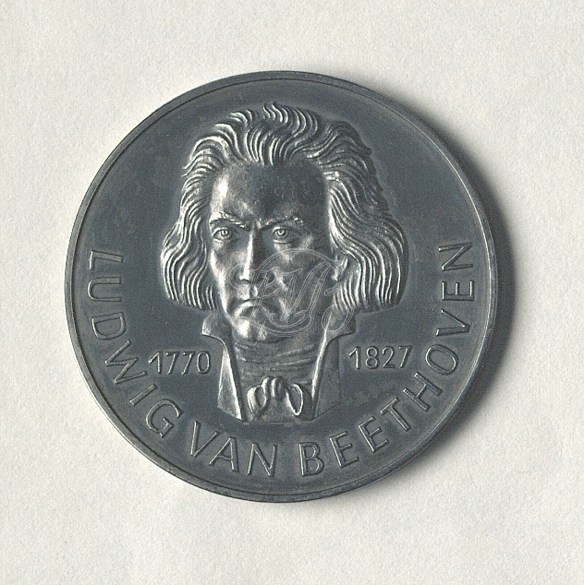
Beethoven medal von Otto Vogt © Beethoven-Haus Bonn

5 2-voice fugues, Hess 236 for piano (1794-5, Beethoven aged 24)

no.1 in D minor
no.2 in E (Phrygian mode)
no.3 in F major
no.4 in B flat major
no.5 in D minor

Dedication not known
Duration 5’30”

Listen

Background and Critical Reception

By 1795, Beethoven was becoming a household name in Vienna – but he was diligently continuing his studies with Salieri and Albrechtsberger.

Salieri was teaching him all about expression in a vocal style, but Albrechtsberger was teaching him the nitty gritty of counterpoint. As anyone studying music for ‘A’ level or beyond knows, this could begin with a musical theme provided by the teacher, with the pupil encouraged to work it into a longer piece through tried and tested methods.

The fugue was one of these methods, perfected by Bach and Handel among many Baroque composers, and seen as the ultimate proof that a composer knew how to work their music. Lesser composers could make it sound like the solving of a mathematical equation, but the good ones knew how to rise above that so that their fugues still had human expression.

Some of the fruits of Beethoven’s ‘homework’ with Albrechtsberger in Vienna were preserved by the musicologist and composer Gustav Nottebohm in his Beethovens Studien, a 19th century publication giving us a fascinating insight into the composer’s background work.

These five two-voice fugues are built on themes written by Albrechtsberger himself, and are realised on the piano.

Thoughts

These musical sketches are fascinating because they sound so dutiful. It is as though Beethoven has taken his art to bits and laid it bare on the music room floor, before picking up the bit marked ‘counterpoint’ and taking it over to the piano.

The music is not always particularly involving but shows the workings of the inner mind – and the fragments are often left unfinished. If it were from the pen another composer it would doubtless be discarded, but because it is Beethoven it stands as an interesting collection of sketches, essential to his later development.

The two minor-key fugues are very solemn.

Recordings used

Tobias Koch (fortepiano) Deutsche Grammophon

Tobias Koch plays a fortepiano in these accounts of Beethoven’s exercises. The approach is a deliberate one, where you can sense the pupil feeling for the notes and not always reaching them.

Spotify links

Tobias Koch

You can chart the Arcana Beethoven playlist as it grows, with one recommended version of each piece we listen to. Catch up here!

Also written in 1795 Haydn – Trio in D major XV:24

Next up O care selve (first version)

Routes to Beethoven – The Teachers: Salieri & Albrechtsberger

by Ben Hogwood
Picture (left to right): Johann Georg Albrechtsberger, Beethoven, Antonio Salieri

In which we briefly explore the music and influence of two of Beethoven’s teachers. In their entry on the composer, The Grove Dictionary of Music and Musicians talk of how the composer initially struggled to find an appropriate teacher. “In his dissatisfaction Beethoven went to another master, Albrechtsberger, a distinguished authority on contrapuntal and sacred music who had been court organist for twenty years”, reads the article. “Beethoven’s lessons with this able teacher continued for an indefinitely recorded period that was more than a year.”

Albrechtsberger was a well respected composer but his music has rather fallen by the wayside. His best-known composition is an unusual one, a Concerto for Jew’s Harp and Orchestra. Once heard, the sound of this unusual instrument is certainly not forgotten, its friendly buzz either appealing or infuriating – a marmite instrument for sure! As you may well hear from the String Quartet included on the Spotify playlist below, Albrechtsberger’s output was extremely accomplished – but not always with especially distinctive material.

Grove then talks of how, from “about 1793 to 1794 he put himself under another specialist, Antonio Salieri, court Kapellmeister, who had for many years been director of the Opera and was himself a flourishing operatic composer.” Beethoven’s aim here was to get a greater understanding of the musical aptitudes required for the stage. As Grove points out, that may seem a bit odd for a composer looking to excel in the supposedly more rigid forms of the symphony and the sonata. Yet Beethoven built on the essence of musical drama, studying with Salieri until 1802 and maintaining strong links with him after that.

Listening to some of Salieri’s large canon of music reveals a composer capable of turning his music into a drama. The Sinfonia in Pantomima, written for Armida, gives an idea of his dramatic instincts, changing mood quite abruptly. It also acknowledges the influence of Gluck in the operatic world at the time. The Overture to Daliso e Dalmino has a rush of violins, uses timpani freely and generates quite a head of steam, which surely would have appealed to his pupil. Likewise the terrific cut and thrust to the Overture to Les Danaides, with flurries of violins.

Again, we will have to wait until the Beethoven listening starts in earnest to gauge the influence of Salieri in particular. Yet the signs are – with Ludwig a dedicated pupil – he will have absorbed important elements from both these teachers. Now to see what Haydn and Mozart could impart!

You can listen to the music of Albrechtsberger and Salieri on the playlist below:

You may also wish to try an acclaimed recent release from Christophe Rousset and Les Talens Lyriques, a thrilling account of Salieri’s opera Les Horaces, written seven years before Beethoven came to call: