
Online concert – Members of Klangforum Wien @ Agrigento 2025 – Jorge E. López: String Quartet

by Richard Whitehouse

Members of Klangforum Wien ([Annette Bik and Judith Fliedl (violins), Paul Beckett (viola), Andreas Lindenbaum (cello)]

Long synonymous with the Valley of the Temples, among the glories of Classical civilization, Agrigento is a city of the present and not least with Teatro dell’Efebo – a venue appropriate to a programme such as Symposion, presented by Klangforum Wien as part of Agrigento 2025.

According to Klangforum’s website, ‘‘The Symposion project takes up the theme of cultural intoxication which goes back to antiquity. This ancient social practice has inspired an evening with music of our time, perceived in the slowly changing conditions of collective and relaxed inebriation…’’. The actual programme was highly wide-ranging as to content and aesthetic (a full listing can be accessed via the link below), taking in pieces by European composers from the mid- or later twentieth century and concluding with Terry Riley’s (over?) influential In C.

Before that, however, came a second hearing (following its premiere in Salzburg last January by the Oesterreichisches Ensemble für Neue Musik) of the String Quartet by Jorge E. López. Written during the winter of 2022-23, this piece follows on from his radiophonic composition Im Innersten: János Bolyai stirbt (previously reviewed on Arcana) while drawing on elements from his Fifth Symphony which, completed in 2023 after a five-year gestation, still awaits its first performance. Each of the Quartet’s two movements duly picks up on elements from either of those in the larger work, though this is not a case of reworking or even paraphrasing earlier material but rather the oblique evoking of it in terms of that creative application of Surrealism which has proved a mainstay of López’s compositional ethos throughout the past half century.

The first movement is prefaced by the title ‘‘Wie man wird, was man is’’ (How one becomes, what one is), which the composer feels appropriate for music that pivots constantly and with increasing desperation between rhetorical aggression and a wrenching eloquence – its motivic elements altering constantly though with a tangible sense of evolution as dynamic as it seems unpredictable. Towards its close this process mutates into a more sustained expression which might have become a ‘slow movement’, had it not opted to close in a becalmed ambivalence.

Barely a third of its predecessor’s length, the second movement is prefaced by the title ‘‘Was denach kommt’’ (What then follows) and picks up on a lengthy fugato such as rounds off the corresponding movement of the composer’s Fifth Symphony. Its musical subject is none other than the nursery rhyme Three Blind Mice – source for orchestral works by Joseph Holbrooke and Havergal Brian – which here unfolds erratically while never haphazardly across the four instruments and on to an unequivocal conclusion the more affecting through its very inanity.

This account from the members of Klangforum Wien was as impressive as it was committed, evidently subtler and more sombre than that by OENM in Salzburg but with an undeniable grasp of the oblique yet always vital logic which is a hallmark of López’s music in ensuring its fascination and overall conviction. One hopes more performances will follow (the highly regarded Chaos Quartet of Vienna has expressed interest) and that the composer, who has recently finished his Variations for Orchestra, will embark on a successor before too long.

Published post no.2,545 – Monday 26 May 2025
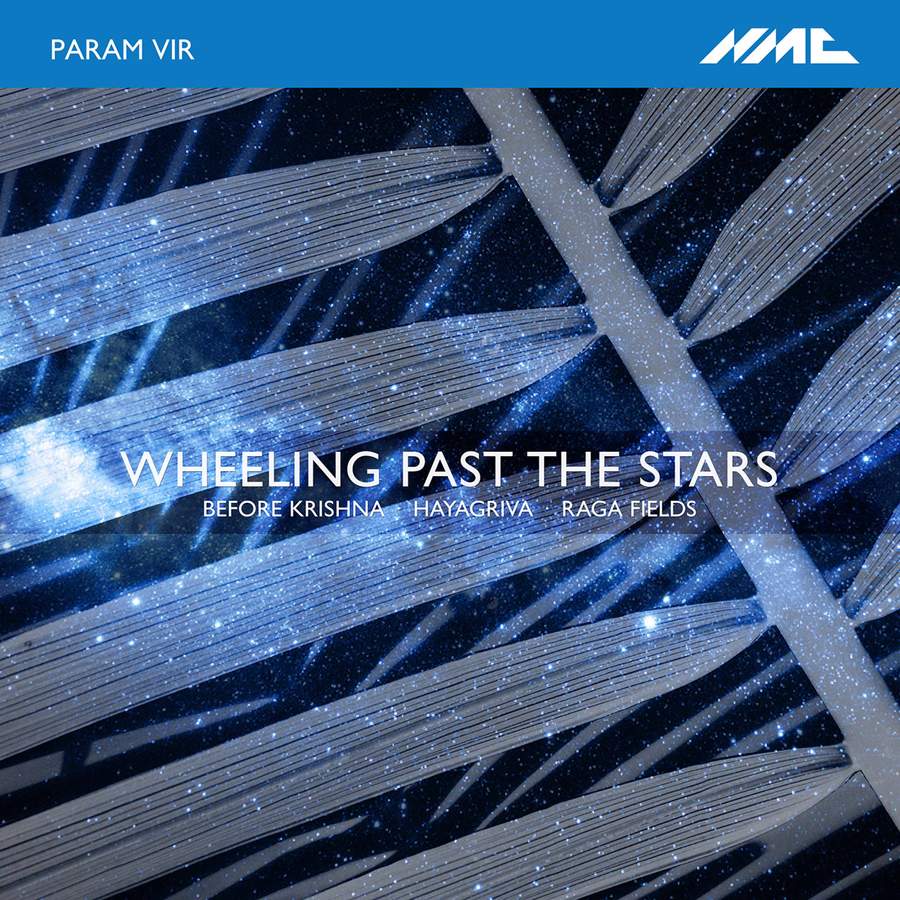
On record – Param Vir: Wheeling Past the Stars (NMC Recordings)

param-vir

cPatricia Auchterlonie (soprano); cUlrich Heinen (cello); aSoumik Datta (sarod), aKlangforum Wien / Enno Poppe; bLondon Chamber Orchestra / Odaline de la Martínez dSchönberg Ensemble / Micha Hamel

Param Vir

Raga Fields (2014)a
Before Krishna (1987)b
Wheeling Past the Stars (2007)c
Hayagriva (2005)d

NMC Recordings NMC D265 [69’07”] 

Producers aFlorian Rosensteiner, bStephen Plaistow, cDavid Lefeber, dAnneke van Dulken, dWim Laman
Engineers aFritz Trondel, dDick Lucas

Recorded b14 December 1988 at BBC Studios, Maida Vale, London; d13 December 2005 at Muziekgebouw, Amsterdam; a23 May at Konzerthaus, Vienna; c10 October 2020 at Henry Wood Hall, London

Written by Richard Whitehouse

What’s the story?

Not a little surprisingly, this release from NMC is the first devoted to Param Vir (b1952), his music a welcome though undervalued presence in the UK over the almost four decades since relocating here from his native India and making for a ‘portrait’ whose appearance is timely.

What’s the music like?

Right from his earliest pieces written in the UK, Vir possessed a distinctive and engaging idiom – as can be heard in Before Krishna, subtitled an ‘Overture for Strings’, in which the narrative leading up to the deity’s birth is evoked through an intensive development of the ‘Krishna row’; heard in the context of string writing as is audibly influenced by (if never beholden to) the sonorist techniques from previous decades. Especially striking are those deftly enveloping chordal harmonics into which the music diffuses during the final bars.

Hayagriva is demonstrably more personal in approach – not least in its evoking the horse-headed being and mythological archetype behind a work whose headlong rhythmic energy gradually moves, via an intricately detailed transition, to a closing section whose subdued manner does not preclude music of fastidious textural variety and expressive nuance from emerging. The colour sequence ‘red/crimson-green/gold-blue’ evolves in parallel, but the aural trajectory pursued by this ‘mixed ensemble of 15 players’ is appreciably more subtle.

The song-cycle Wheeling Past the Stars draws on four poems by Rabindranath Tagore (sung in widely praised translations by William Radice). ‘Unending Love’ opens the sequence with its ecstatic vocal melisma and cello glissandi, while ‘Palm-tree’ portrays night-ride and storm with no mean resourcefulness. The unaffected charm and vivacity of ‘Grandfather’s Holiday’ then provides an admirable foil to ‘New Birth’, its frequently impassioned contemplation of those ‘who come later’ making for an earnest yet always eloquent conclusion to this cycle.

Raga Fields is outwardly a concerto for sarod but one where the orchestral contribution can be perceived as growing out of the soloist – whether in the gradual textural proliferation of ‘Void’; the comparable melodic interplay, notably through a variety of insinuating solos for woodwind, of ‘Tranquil’; then the stealthy rhythmic accumulation of ‘Vibrant’, in which the constant shifting between notated and improvisatory passages is heard at its most intensive. As the coming together of differing concepts, this is a productive and engrossing synthesis.

Does it all work?

Yes, in that Vir’s music exhibits its Indian antecedents distinctly yet always subtly. Allied to unforced harmonic clarity and a keen feeling for textural finesse is a sure sense of where each piece is headed formally, such that the considerable emotional intensity never risks becoming turgid or self-indulgent. It helps that these performances are attuned to the work at hand – not least Patricia Auchterlonie with Ulrich Heinen in the song-cycle, or the three ensembles that are heard in the remaining items. Whatever else, Vir has been well served by his performers.

Is it recommended?

Indeed. The sound has, in some cases, been remastered to mitigate the considerable time-span between performances, while Paul Conway pens his customary reliable notes. Hopefully, a follow-up release, maybe of Vir’s wide-ranging orchestral output, will not be long in coming.

Listen & Buy


You can get more information on the disc at the NMC website, where you can also purchase the album. For more on Param Vir, you can visit the composer’s website