
Listening to Beethoven #170 – Piano Sonata no.15 in D major Op.28 ‘Pastoral’

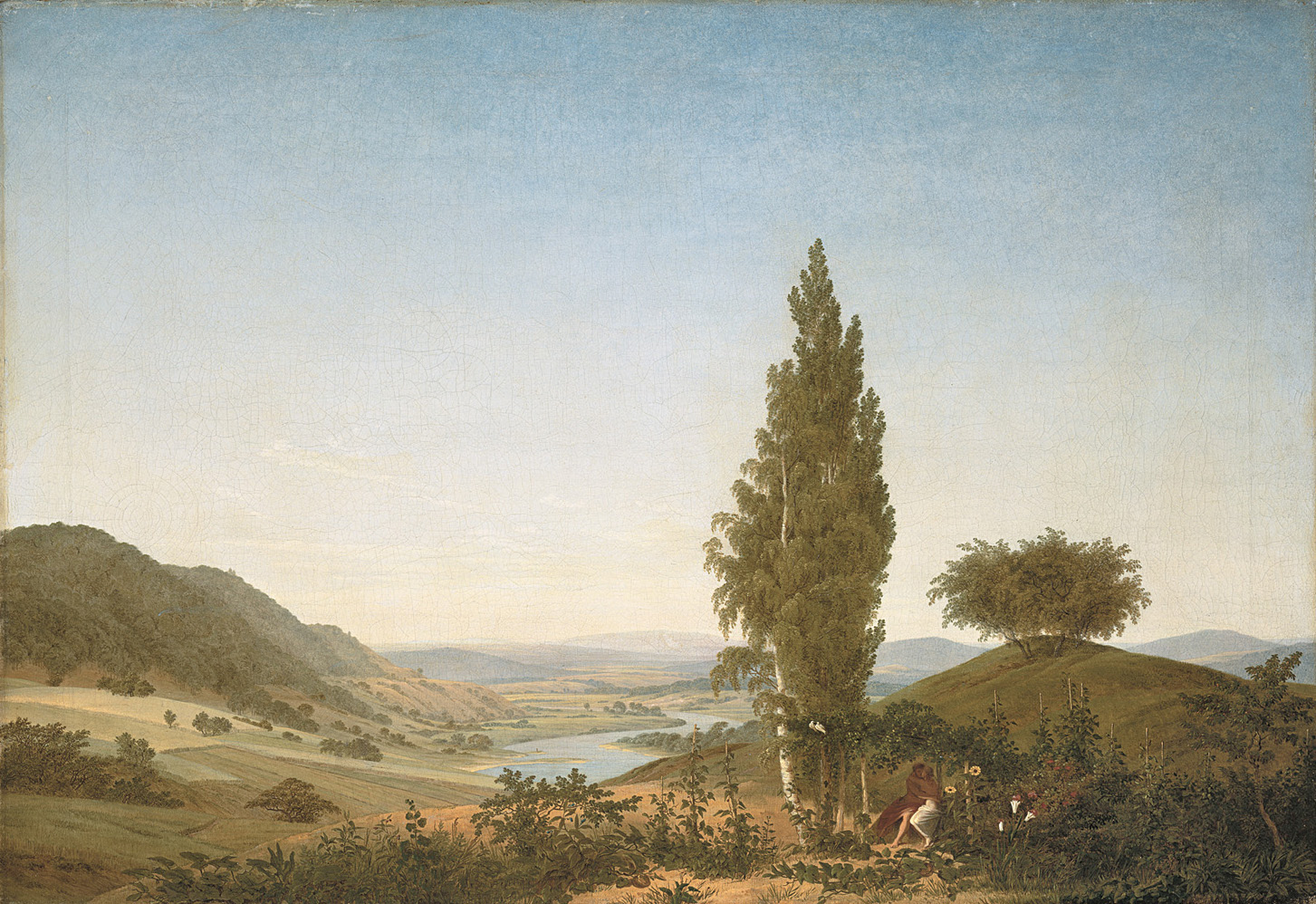
Der Sommer (Landschaft mit Liebespaar) The summer (Landscape with lovers) by Caspar David Friedrich (1807)

Piano Sonata no.15 in D major Op.28 ‘Pastoral’ for piano (1801, Beethoven aged 30)

1. Allegro
2. Andante in D minor
3. Scherzo: Allegro vivace
4. Rondo: Allegro ma non troppo

Dedication Count Joseph von Sonnenfels
Duration 25′

Listen

written by Ben Hogwood

Background and Critical Reception

The fourth piano sonata from Beethoven in the year 1801 is every bit as remarkable as the other three. Having experimented with free forms in the two three-movement works labelled ‘quasi una fantasia’, Beethoven reverts to what initially seems a traditional four-movement format.

In spite of the quiet beginning to the Pastoral, however, commentators are quick to note its poetic qualities and the more radical aspects of its design. Angela Hewitt calls it ‘one of the most beautiful of all beginnings’, observing that the work gained its nickname through a publisher’s reference to the bagpipe-like drones from the start.

‘In the first movement, though it is outwardly so tranquil and friendly, Beethoven is still concerned with construction and conciseness’, writes Hewitt. The contemporary composer Carl Czerny described it as one of Beethoven’s own favourite pieces – and especially the second movement Andante, a solemn march-like movement.

András Schiff is also fulsome in his praise. ‘This is a work that pulsates, it’s full of inner voices, opens up huge spaces of sound, and yet does without any dramatic outbursts throughout’. He draws out several anticipations of Schubert in the third movement, particularly in the way ‘the trio wavers between major and minor’.

On the finale, he writes, ‘To me, the finale has traces of a barcarolle, even though it’s constructed as a genuine sonata-rondo’. Hewitt says how Beethoven ‘preferred a bravura ending…it’s as if he can’t contain his joy’. In conclusion she writes, ‘Beethoven’s love of nature is well documented, and it was his most comforting source of nourishment. In this Pastoral sonata he seems to express his thankfulness for all it gave him’.

Thoughts

If anyone asks you for a definition of serenity in music you could easily play them the first minute of Beethoven’s Pastoral sonata. This is a lovely passage of music, every bit as calm as the close of the Moonlight sonata was turbulent. Yet as the first movement progresses it is clear this is not light music, for as Angela Hewitt observes Beethoven brings in several motifs that contrast with the flowing main subject, helping us appreciate it all the more.

The second movement switches to the minor key and spends more time in the shadows as a result, a slow-ish dance with a steady, march-like tread that gradually reels the listener in. The third movement throws off the shackles and also shows off how Beethoven could make musical motifs out of almost nothing. It is simply a set of repeated F# notes in different octaves of the piano, but is made into a humourous phrase that carries a true scherzo.

The finale brings in reminders of the opening with its flowing discourse, almost like running water, with music of pure exuberance. Again the tune is deceptively simple, but it travels through some impressive and pretty complex development, which can be seen if the listener examines closely – but is not essential to enjoyment.

Small wonder that the Pastoral is one of Beethoven’s most popular piano works. It has an enduring happiness made all the more remarkable given the composer’s health issues at the time, but it shows – as all the sonatas of 1801 do – a renewed mastery of the piano and its power to express.

Recordings used and Spotify links

Emil Gilels (Deutsche Grammophon)
Alfred Brendel (Philips)
András Schiff (ECM)
Angela Hewitt (Hyperion)
Paul Badura-Skoda (Arcana)
Stephen Kovacevich (EMI)
Igor Levit (Sony Classical)
Claudio Arrau (Philips)
Daniel Barenboim (Deutsche Grammophon)

Pianists clearly love this work, and among the very fine versions it was difficult to deviate from the versions by Gilels, Brendel, Schiff and Daniel Barenboim. Paul Badura-Skoda also radiates pure enjoyment in his version using a Viennese piano of the time.

You can hear clips of Hewitt’s recording at the Hyperion website

You can chart the Arcana Beethoven playlist as it grows, with one recommended version of each piece we listen to. Catch up here!

Also written in 1801 Cramer Piano Sonatas Op.25

Next up String Quintet in C major Op.29
Listening to Beethoven #169 – Piano Sonata no.14 in C sharp minor Op.27/2 ‘Sonata Quasi una fantasia’ (‘Moonlight’)

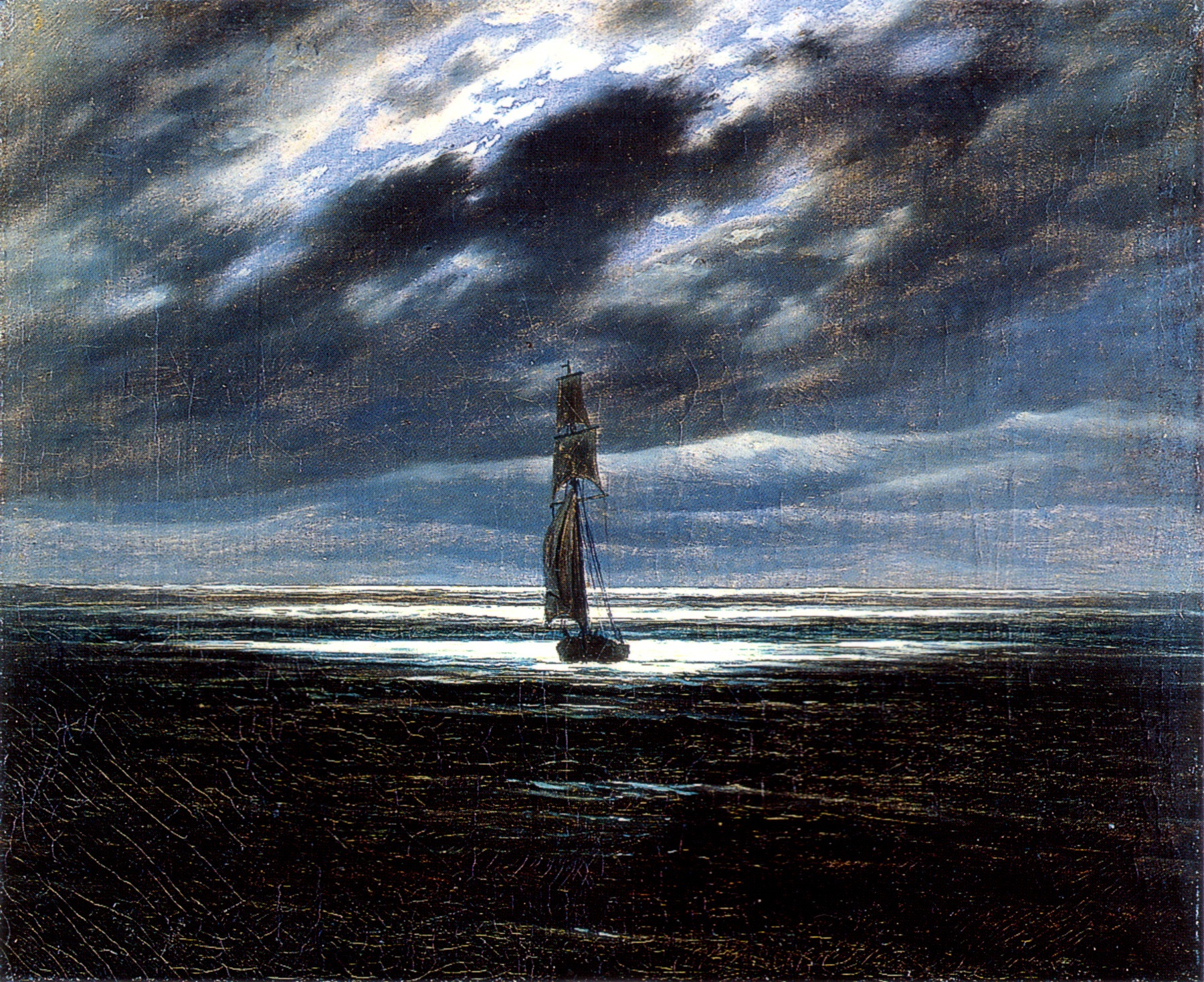
Seascape by Moonlight) by Caspar David Friedrich (c1835)

Piano Sonata no.14 in C sharp minor Op.27/2 ‘Quasi una fantasia’ (‘Moonlight’) for piano (1801, Beethoven aged 30)

1. Adagio sostenuto
2. Allegretto
3. Presto agitato

Dedication Countess Giulietta Guicciardi
Duration 16′

Listen

written by Ben Hogwood

Background and Critical Reception

And so we reach one of the most famous pieces in classical music. The second of Beethoven’s Op.27 sonatas, the Moonlight is the second piece to be published with the qualifying title of Sonata quasi una fantasia, reminding us of Beethoven’s intention to move away from the conventional sonata form.

He did not provide the Moonlight nickname, which was suggested by poet and critic Ludwig Rellstab. For him the first movement represented ‘a boat, visiting, by moonlight, the primitive landscapes of Lake Lucerne’. The dedication, to Countess Giulietta Guicciardi, has prompted much speculation – but although Beethoven was in love with her at the time, the dedication, as Angela Hewitt writes, was ‘an afterthought when another piece he had dedicated to her had to be given to somebody else’.

Critics and musicologists note the power of Beethoven’s writing, from the restraint of the first movement to the turbulent storm of the finale. In between these two lies a balletic central movement set in the major key, described by Liszt as ‘a flower between two abysses’. When it comes to the famous opening movement, Hewitt writes about the importance of refreshing the sustain pedal with each bass note on a modern piano, to avoid clouding the harmonies. On an older instrument this would not be necessary, but ‘the most important thing’, she says, ‘is to capture a magical mood’. But then, ‘all hell breaks loose in the final Presto agitato’.

It was not long before Beethoven was tiring of the airtime his most famous piece was getting. ‘People are always talking about the C sharp minor Sonata’, he said. ‘Really, I have written better things!’

Thoughts

What is there left to say about the Moonlight sonata that hasn’t been said already? It is surely one of the most written-about pieces in musical history, and certainly one of the most famous piano pieces there is – made all the more accessible because the relative beginner can play its most famous theme.

Yet the Moonlight sonata is a vital cog in the 32-strong output of Beethoven’s published piano sonatas. It is another step away from the classical tradition towards a free and much more emotive approach, and it could even be said to contain the first notes of the so-called ‘Romantic’ period in classical music.

It is Beethoven’s first published piece in C sharp minor, a key Mozart did not use for a single published work, and Haydn very little. That is perhaps part of why the music sounds so striking from the start, when the bare arpeggios set the nocturnal scene. No matter how slowly this passage is played it is laden with feeling, and the enchanted atmosphere only deepens as the music progresses.

The second movement is a beautiful contrast, a poised and relatively carefree dance with an attractive lilt. It is the light to the first movement’s shade and points towards something more positive…until we arrive at the gates of the last movement. What an incredible passage of music this is, especially in concert, where you get to witness the pianists’ arms whirring up and down the keyboard as the whirlwind arpeggios take effect. With the suddenly loud interjections from the first movement it must have had an alarming impact on its first audience, by far the most dramatic sonata they had seen. The enchantment of the first movement had been swapped for something altogether more terrifying.

How remarkable that Beethoven could write such music as part of a piano sonata, scaling emotions and technical feats that were out of bounds. Yet it all works within those confines, with music of great tension and drama that is somehow wrapped up in 15 minutes. The composer has scaled new heights.

Recordings used and Spotify links

Emil Gilels (Deutsche Grammophon)
Alfred Brendel (Philips)
András Schiff (ECM)
Angela Hewitt (Hyperion)
Paul Badura-Skoda (Arcana)
Stephen Kovacevich (EMI)
Igor Levit (Sony Classical)
Claudio Arrau (Philips)
Rudolf Serkin (Sony)

Paul Badura-Skoda is very subdued in the first movement but gets the level of sustain just right, helped by his 1790 Viennese instrument. The second movement is a bit laboured, but the third tears along. Sir András Schiff, playing a dfgd, is a full 100 seconds quicker than Emil Gilels in the first movement, a little rushed for some tastes – while Gilels creates an atmosphere where the listener hangs on every note.

Angela Hewitt finds a really nice turn of phrase in the second movement, with a balletic poise, while interpretations of the third movement range from a race to the finish to a stark evocation of terror. Both Hewitt and Schiff are terrific with the dynamic contrasts.

You can hear clips of Hewitt’s recording at the Hyperion website

You can chart the Arcana Beethoven playlist as it grows, with one recommended version of each piece we listen to. Catch up here!

Also written in 1801 Field Piano Sonata in C minor Op.1/3

Next up Piano Sonata no.15 in D major Op.28 ‘Pastoral’