In concert – James Ehnes, CBSO / Finnegan Downie Dear: Cassandra Miller, Britten & Beethoven

©Frank-Bloedhorn-finnegan-downie-dear

Miller La Donna (2021) [UK premiere]
Britten
Violin Concerto in D minor Op.15 (1938-9)
Beethoven
Symphony no.6 in F major Op.68 ‘Pastoral’ (1807-08)

James Ehnes (violin), City of Birmingham Symphony Orchestra / Finnegan Downie Dear (above)

Symphony Hall, Birmingham
Wednesday 6 October 2021

Written by Richard Whitehouse; Picture of Frankie Downie Dear (c) Frank Bloedhorn

Tonight’s concert by the City of Birmingham Symphony Orchestra saw a first appearance with British conductor Finnegan Downie Dear, winner of the 2020 Mahler Competition in Bamberg, and a first hearing in the UK for an orchestral piece by the Canadian composer Cassandra Miller.

Currently based in London, where she is Professor of Composition at the Guildhall, Miller’s output has often drawn on pre-existing sources as are then integrated into the work at hand. Such is the case with La Donna, premiered at Barcelona earlier this year, where a group of Genoese male voices singing La Partenza da Parigi (as recorded by the redoubtable Alan Lomax in 1954) is channelled into music of intensive polyphonic activity and topped by a falsetto melodic line – the eponymous La donna. This builds to an apex as intricate in its texture as it is immediate in expression, then gradually subsides in a resonance of suffused elation. Such was the impression left by this performance, Downie Dear drawing sustained amplitude from relatively modest forces in a visceral demonstration of tension and release.

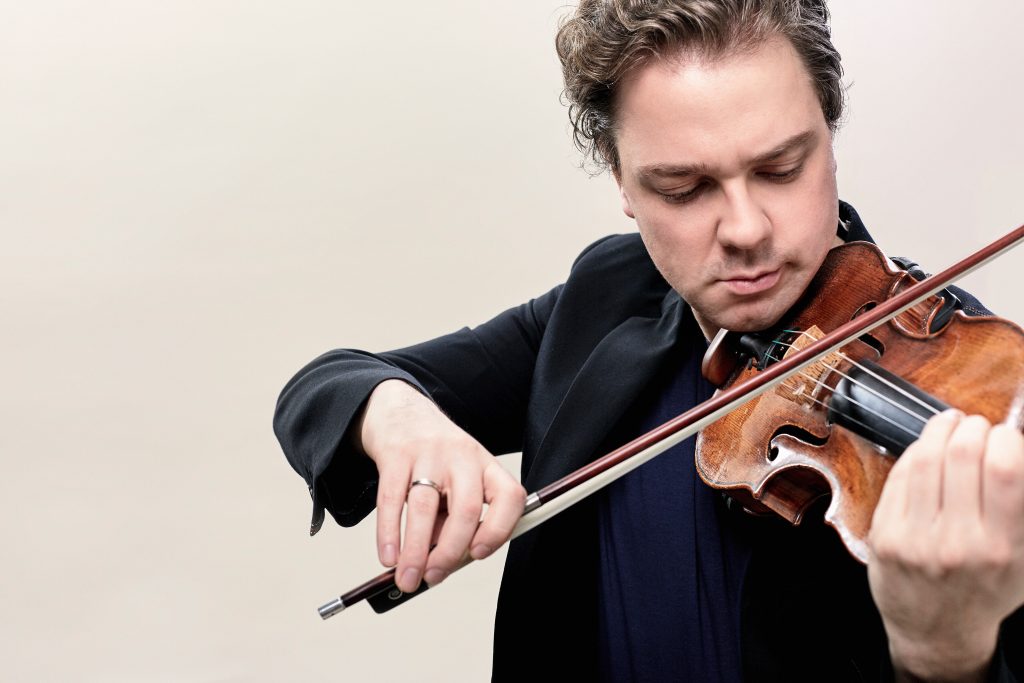
A time there was when Britten’s Violin Concerto enjoyed only a modest presence in British concert halls, though recent years have seen it taken up by leading soloists from around the world. Its edgy yet intense lyricism has a persuasive exponent in James Ehnes (above), who brought out the restless emotion of the initial Moderato – the five-note motto underlining the context of war and unrest from which it emerged. The Vivace’s rhythmic velocity and sardonic tone were no less evident, a tensile reading of the cadenza pointing up its thematic function and leading inevitably into the final Passacaglia. After a superbly shaped orchestral introduction, Ehnes characterized its variations with mounting intensity to a powerfully wrought climax – the final pages exuding a fatalistic eloquence no less affecting now than eight decades ago.

Perhaps this music’s rapt equivocation explains why it has often been programmed in recent seasons with Beethoven’s Pastoral. While by no means revelatory, the present account gave a good indication of Downie Dear’s abilities – not least his emphasis on rhythmic articulation during what was a relatively swift traversal of the opening Allegro, along with his fastidious attention to dynamics as brought the requisite focus and lucidity to the Scene by the Brook with its warmly enveloping string textures and its bird-calls deftly inflected towards the close.

The final three movements unfolded in much the same vein – the peasants lithe if arguably a little too well-behaved in their merrymaking and the thunderstorm forceful if not electrifying in response, though with a seamless diminuendo of volume and energy going into the finale. Without drawing the ultimate gravitas from its interplay of rondo and variation procedures, Downie Dear guided it surely and attentively to a ruminative coda – Beethoven transcending the incipient era of musical romanticism through the (deliberate) absence of any defining ego.

This evening’s programme is repeated tomorrow afternoon – with the Miller being replaced by Mozart’s Idomeneo overture – while the CBSO returns next week for Rossini, Berlioz, and Prokofiev under François Leleux, along with Baiba Skride in Mozart’s Fifth Violin Concerto.

Further information on the CBSO’s current season can be found at the orchestra’s website. For more on Cassandra Miller, click here – and for more information on Finnegan Downie Dear, head to the conductor’s website
Listening to Beethoven #196 – Piano Concerto no.3 in C minor Op.37

piano-concerto-3
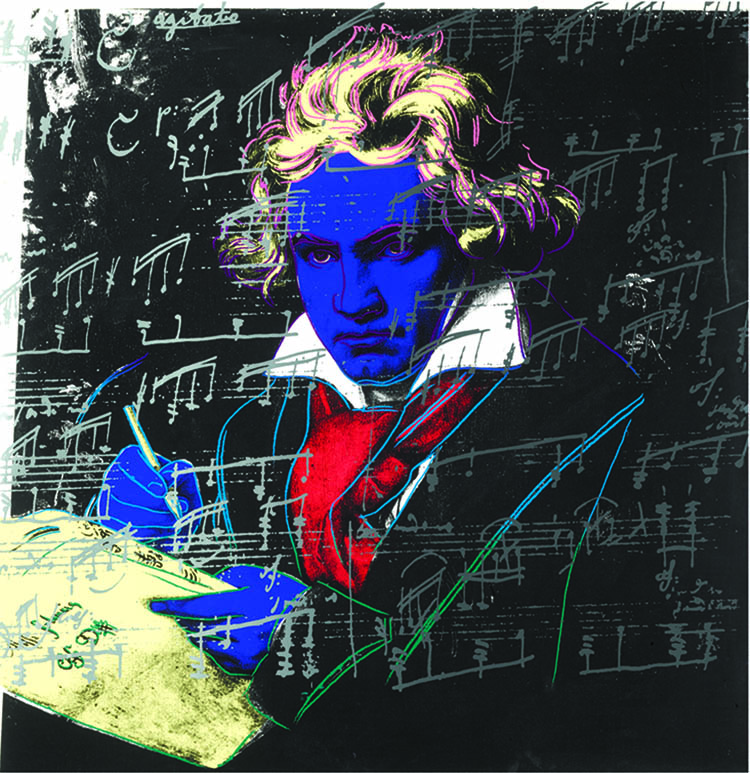
Beethoven (1987) by Andy Warhol – colour screenprint on Lenox Museum Board

Piano Concerto no.3 in C minor Op.37 for piano and orchestra (1796-1803, Beethoven aged 32)

Dedication Prince Louis Ferdinand of Prussia
Duration 37′

Listen

Background and Critical Reception

Beethoven is thought to have begun the third piano concerto as early as 1796, finishing the majority of the work in 1800 but waiting until 5 April 1803 for the first performance at the Theater an der Wien in Vienna. It was quite a concert, beginning with the Symphony no.2 and ending with the newly composed Christus am Ölberge, in its first version.

Beethoven had to rush the concerto to get it ready in time, and as a result the solo part was unfinished. An account from the composer’s friend and page turner Ignaz von Seyfried found him effectively turning empty pages during the first concert, Beethoven having committed the solo part to memory.

Many writers recognise the lineage of this work. Charles Rosen, in The Classical Style writes, “The C minor is full of Mozartean reminiscences, in particular of the concerto in the same key, K491, which Beethoven is known to have admired.” Barry Cooper, writing for Hyperion, notes that ‘there is little, if any, direct influence from Mozart’s work, although the similarities show how thoroughly Beethoven had absorbed Mozart’s style.’

The first movement is Beethoven’s weightiest movement yet, clocking in at over 17 minutes in some performances. It is followed by a Largo in the unexpectedly remote key of E major, which would have come as a surprise to the audience in 1803. This tonality is referred to in a ‘dream-like recall’ in the finale (writes William Kinderman). This movement is a Rondo, where after some tense episodes in the minor key, Kinderman writes how “comic wit and jubilation crown the dénouement of this drama in tones”.

Perhaps surprisingly, one of the most guarded verdicts on the third concerto came from Brahms. Comparing it to the Mozart, “a marvellous work of art and filled with divine ideas”, he said “I admit that the Beethoven concerto is more modern…but it is not significant!”

Thoughts

The third of Beethoven’s five published piano concertos is a different animal entirely from the first two. Confirmation of this is felt in the opening bars, with a tense first theme outlined by the strings. Whereas the first two concertos were light on their feet and relatively frothy, this one has a serious countenance, like its counterpart C minor concerto from Mozart in 1784.

The comparisons made between the two are certainly valid, for they occupy a similar emotional space and use almost identical orchestral forces. Beethoven tends to focus in on daring harmonies, creating tension between his much-used C minor and the major key. The soloist has some juicy discords too, to keep the listener on the edge of their seat.

The drama starts with that first theme on the strings and does not let up in the first movement, which despite its length is tautly argued. The arrival of the piano, with stern scales in C minor, is arresting, and in his own written-out cadenza completed in 1808 Beethoven brings in the intimacy of his sonatas, before a series of trills lead to a sparse conclusion from the orchestra. I think Brahms was doing it a disservice!

Perhaps the biggest raise of the eyebrows, however, comes with the first notes of the slow movement, which introduces a whole new key of E major. It is a surprise to the ear which, taking previous examples from the composer, might expect A flat major or F. Beethoven uses this new area to explore a thoughtful, tender side, giving himself and the solo pianist free reign. There is mystery and poetry here, and some sublime contributions from the orchestra.

The final movement is where Beethoven and Mozart are closer aligned, with quite an oblique melody that becomes surprisingly catchy – and which completes its own ‘darkness to light’ journey in the closing passages. The composer even works in a short fugal episode to the energetic movement with effortless ease. In this piece Beethoven has served notice of his intentions to move the piano concerto on to more Romantic territory, both in musical style and emotion.

Spotify playlist and Recordings used

Wilhelm Kempff, Berliner Philharmoniker / Ferdinand Leitner (Deutsche Grammophon)
Robert Levin, Orchestre Révolutionnaire et Romantique / Sir John Eliot Gardiner (Arkiv)
Mitsuko Uchida, Bavarian Radio Symphony Orchestra / Kurt Sanderling (Philips)
Rudolf Serkin, Bavarian Radio Symphony Orchestra / Rafael Kubelik (Orfeo)
Claudio Arrau, Royal Concertgebouw Orchestra / Bernard Haitink (Philips)
Ronald Brautigam, Die Kölner Akademie / Michael Alexander Willens (BIS)
Stephen Hough, Finnish Radio Symphony Orchestra / Hannu Lintu (Hyperion)
Stephen Kovacevich, BBC Symphony Orchestra / Sir Colin Davis (Philips)

There are some wonderful accounts of this piece. While writing about the work I have especially enjoyed the versions with soloists Mitsuko Uchida, Wilhelm Kempff and Stephen Kovacevich, while on the fortepiano Robert Levin creates lean drama with Sir John Eliot Gardiner. Uchida is magical at the beginning of the slow movement, which becomes the dream Beethoven surely meant it to be.

To listen to clips from Stephen Hough’s new recording on Hyperion, head to their website

You can chart the Arcana Beethoven playlist as it grows, with one recommended version of each piece we listen to. Catch up here!

Also written in 1803 Boieldieu Clarinet Concerto no.1 in E flat major Op.36

Next up Bei labbri, che Amore WoO 99/1

In concert – Alexander Sitkovetsky, English Symphony Orchestra / Kenneth Woods: Beethoven in Hereford

alexander-sitkovetsky

Alexander Sitkovetsky (violin, above), English Symphony Orchestra / Kenneth Woods

Mendelssohn Symphony no.4 in A major Op.90 ‘Italian’ (1833 rev.1834)
Carwithen arr. Woods
: Lento for Strings (1945 arr. 2020)
Beethoven
Violin Concerto in D major Op.61 (1806)

St. Peter’s Church, Hereford
Sunday 26 July 2021 (3.30pm) (Concert reviewed online via ESO Digital)

Written by Richard Whitehouse

For this first concert in its 2021/22 season, the English Symphony Orchestra was heard at St. Peter’s Church, Hereford in a concert combining familiar classics with an arrangement of the kind that has been a hallmark of its programming under principal conductor Kenneth Woods.

The piece in question was a Lento for Strings that began as the slow movement of the First Quartet by Doreen Carwithen. Although she left a notable output of concert and film music, Carwithen (1922-2003) is remembered mainly through her association with William Alwyn – being his amanuensis from 1961 and second wife from 1975 for the final decade of his life. At the time of this quartet, she was a promising composer in her own right, as confirmed by Woods’s adaptation of the slow movement so that its prevailing intimacy and introspection lose none of their acuity. The ESO played it with requisite poise and finesse, not least those plangent solos for viola and violin that were eloquently rendered here by Matt Maguire and Kate Suthers, thereby resulting in an atmospheric miniature which warrants frequent revival.

Mendelssohn was just a year older when he completed his Italian symphony, long among his most popular works even if heard a mere handful of times then withheld from publication in his lifetime. Maybe the touristic nature of its conception or its unlikely tonal trajectory (A to A minor) created issues he was unable to resolve, but in creating this symphonic suite he had unconsciously set a precedent. Woods undoubtedly had its measure – whether in an Allegro (exposition repeat included) whose joyousness did not exclude more combative energy from its development and coda, an Andante whose journeying pilgrims were evoked with no little pathos, an intermezzo deftly revisiting the wide-eyed enchantment of the composer’s youth, or a finale whose interplay of saltarello and tarantella rhythms surged on to a decisive close.

Beethoven’s Violin Concerto is one of a select few in its genre whose weight and substance justifies its occupying the whole second half. Alexander Sitkovetsky responded accordingly – the opening movement long-breathed but sustaining itself at least until the latter stages of the development, when a sense of expectancy rather failed to materialize. Momentum picked up thereafter, not least during a finely projected account of the (Kreisler) cadenza whose tensile rhetoric subsequently made the orchestra’s heartfelt re-entry in the coda seem more telling.

The highlight of this performance came with the Larghetto, slower than is often now the case but its sequence of variations melding into each other with seamless elegance, with a rapport between soloist and conductor at its most tangible in the theme’s hushed reiteration prior to a spirited transition into the Rondo. This did not lack for impetus, and if Sitkovetsky was most perceptive in the intervening episodes, the anticipation generated as the main theme steals in on the approach to the final tutti carried through to the nonchalant pay-off of the closing bars. An appealing and enjoyable concert in which, moreover, the ESO sounded not at all fazed by the vagaries of the acoustic. It continues its current schedule on October 10th with music by Mendelssohn, Mozart and Schubert – plus a mystery piece ‘‘to be announced on the night’’!

Further information on the ESO’s next concert can be found at their website. For more on Doreen Carwithen, visit the MusicWeb International page here

Listening to Beethoven #195 – 6 Variations on Ich denke dein WoO 74

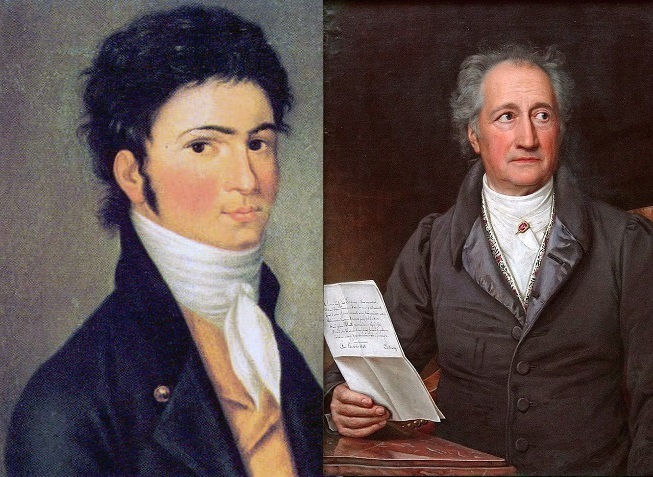
beethoven-goethe-2

Beethoven and Goethe

6 Variations on Ich denke dein WoO 74 for two pianos (1799-1803, Beethoven aged 31)

Dedication Therese, Josephine and Charlotte von Brunsvik
Duration 5′

Listen

Background and Critical Reception

Keith Anderson writes that in 1799, Beethoven ‘wrote a setting of Goethe’s Ich denke dein and four variations for piano duet on the theme for two pupils, the Countesses Therese and Josephine Brunsvik, daughters of a family with which Beethoven remained friendly through much of his life. In 1803 he added two more variations and the song and variations were published in 1805.

Pianist Peter Hill, writing for a recent recording he made with Benjamin Frith on the Delphian label, highlights Beethoven’s affection for Josephine, expressed in a passionate letter later in his life. He notes the romantic mood of the theme and its variations, pointing towards Mendelsssohn in the faster music especially.

Thoughts

As the story implies, this is a domestic piece for use among close friends. It certainly has that intimate, conversational feel, with less obvious opportunities for virtuosic display but plenty to keep the players occupied and impressed with Beethoven’s resourceful working.

The theme itself is warm hearted, the first variation too. Then Beethoven plays around with syncopations, the two players gainfully employed, before a thoughtful, slow third variation, which is unexpectedly deep in feeling. This time out enhances the fourth variation, a fizzy affair with exchanges between the two players which drew the Mendelssohn comparison from Peter Hill. Darker colours appear briefly for an instalment in the minor key, after which the sunlit textures of D major return and the piece ends calmly but warmly, providing a glimpse of an all-too rare warmth and tenderness in Beethoven’s life at the time.

Recordings used and Spotify playlist

Peter Hill & Benjamin Frith (Delphian)
Amy and Sara Hamann (Grand Piano)
Louis Lortie & Hélène Mercier (Chandos)
Jörg Demus & Norman Shetler (Deutsche Grammophon)

All excellent versions, capturing the intimacy of Beethoven’s writing but also the glint in the eye as he writes.

Also written in 1803 von Pasterwicz 300 Themata und Versetten Op.42

Next up Piano Concerto no.3 in C minor Op.37

Listening to Beethoven #194 – Graf, liebster Graf, liebstes Schaf, WoO 101

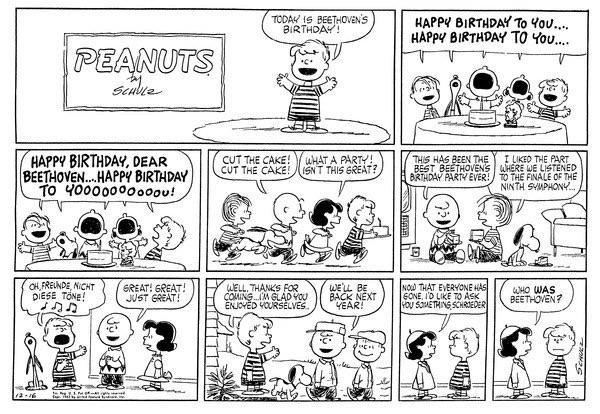
graf-grafPeanuts comic strip, drawn by Charles M. Schulz (c)PNTS

Graf, liebster Graf, liebstes Schaf WoO 101 for three voices (1802, Beethoven aged 31)

Dedication Count Nikolaus Zmeskall von Domanovecz
Text Beethoven
Duration 0’45”

Listen

Background and Critical Reception

This is one of Beethoven’s early musical jokes, which he included in a letter to his friend, Count Nikolaus Zmeskall von Domanovecz. The short text translates as ‘Count, Count, dear Count, best sheep!’

Thoughts

Literally scribbled on the back of an envelope, this is a charming fragment – cleverly working the pronunciations into the melody. Very much a case of less is more!

Recordings used

Cantus Novus Wien / Thomas Holmes (Naxos)

Coro della Svizzera / Diego Fasolis (Arts Music)

Also written in 1802 Reichardt Das Zauberschloss

Next up 6 variations on Ich denke dein WoO 74