Listening to Beethoven #168 – Piano Sonata no.13 in E flat major Op.27/1 ‘Sonata Quasi una fantasia’

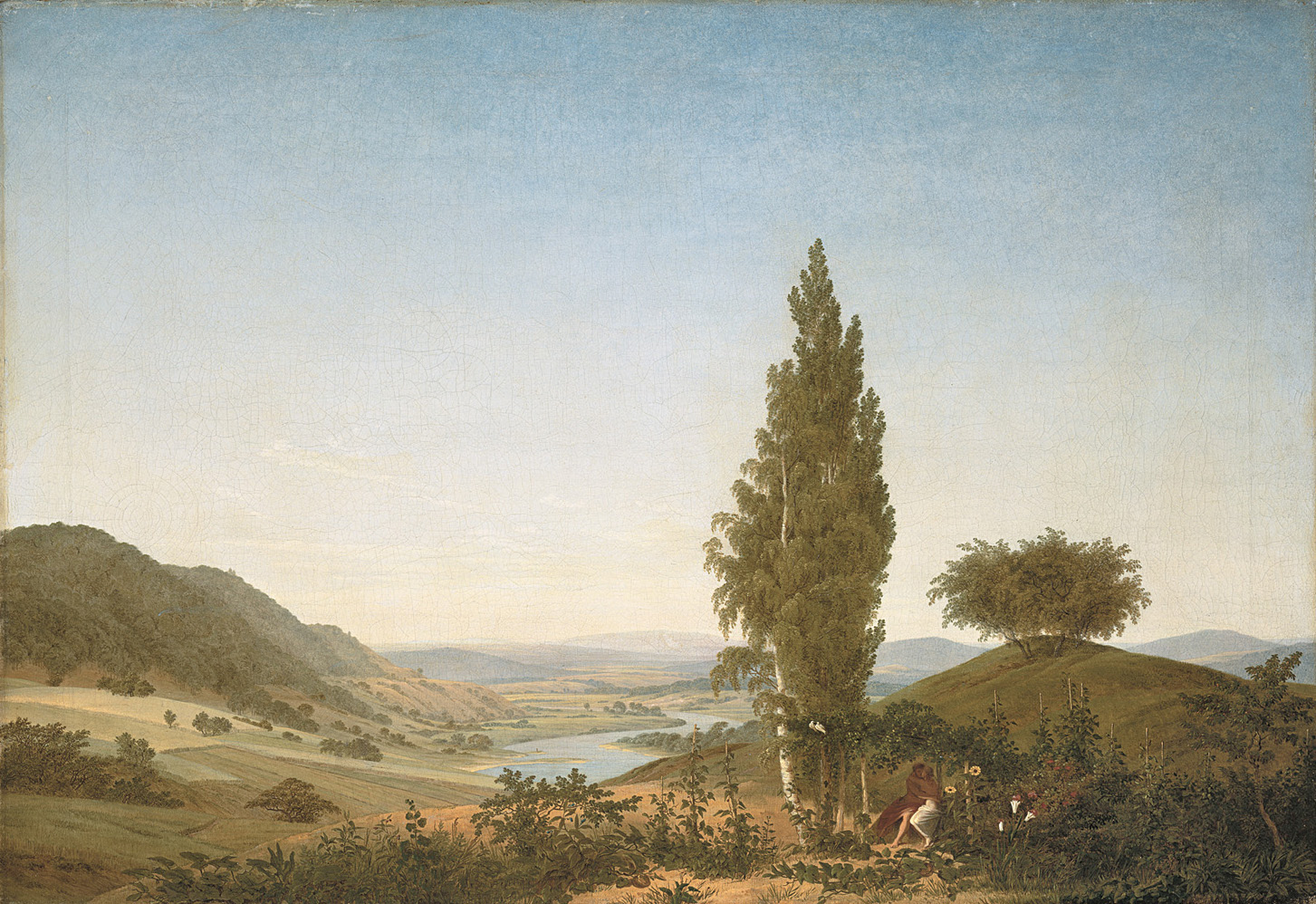
Frau vor untergehender Sonne (Woman before the Rising Sun) by Caspar David Friedrich (1818)

Piano Sonata no.13 in E flat major Op.27/1 ‘Quasi una fantasia’ for piano (1801, Beethoven aged 30)

1. Andante – Allegro – Andante
2. Allegro molto e vivace
3. Adagio con espressione
4. Allegro vivace

Dedication Princess Josephine von Liechtenstein
Duration 16′

Listen

written by Ben Hogwood

Background and Critical Reception

The year 1801 was all about the piano sonata for Beethoven, who expanded the form with each of the four pieces completed in that year. Having stretched formal and expressive boundaries with Op.26, he moved on to a pair of sonatas published as Op.27. Both bore the inscription ‘Sonata quasi una fantasia’, recognising their experimental approach and formal ambiguity. The form was becoming less conventional and more emotional in his hands, and the first of the Op.27 pieces made several new advances.

Unfortunately for the E flat major piece, its neighbour – the rather well-known Moonlight sonata – has stolen all the thunder. Yet as Jan Swafford writes, it is deserving of much higher exposure and regard. ‘Like all his sonatas it has a singular personality, from stately to haunted to ebullient’, he declares. ‘Its opening Andante is something of a blank sheet, offering little in the way of melody or passion but a great deal of pregnant material’. The four movements last around 17 minutes, and are played without a break.

Sir András Schiff, in the notes accompanying his recording on ECM, holds the piece in high esteem. ‘In its freedom, this sonata points the way forward much more clearly than Op.26’, he writes. ‘In its moods it is a psychological piece, but from the point of view of its formal criteria it shows an astonishing interweaving of sonata and fantasy’. He draws a link between this work and later pieces from the Romantic era such as Schubert’s Wanderer Fantasy, Schumann’s Fantasie in C and the Liszt Piano Sonata in B minor. For him it shows ‘a master of experimentation at work’. Angela Hewitt describes it simply as ‘wonderful’.

Thoughts

Beethoven is by now the master of starting a piece with what feels like minimal, inconsequential material. So it is with the measured start to this piece, but soon the deeply expressive side is clear. In it we hear an approach similar to that taken up by Schubert in his Impromptus, and Schumann in his character pieces.

The deceptively gentle start has moments of light when the music moves unexpectedly to C major, but the opening movement is largely thoughtful. Soon, however, we are in a grittier second section, before the slow movement returns us to A flat major, a similar, deeply thoughtful mood to the Op.26 funeral march. The final movement is a celebration, taking off at quite a pace, but just when it seems about to slam into the buffers Beethoven brings back the music of the opening, which is a masterstroke. With some really striking dissonances that only just resolve, this slow music feels more profound the second time around, before the piece signs off with a rush to the finish.

This work benefits from several listens to reveal its workings, but it is a model of economy and, ultimately, genius. Emotive and forward-looking, Beethoven is on a roll.

Recordings used and Spotify links

Emil Gilels (Deutsche Grammophon)
Alfred Brendel (Philips)
András Schiff (ECM)
Angela Hewitt (Hyperion)
Paul Badura-Skoda (Arcana)
Stephen Kovacevich (EMI)
Igor Levit (Sony Classical)
Claudio Arrau (Philips)
Rudolf Serkin (Sony)

This piece works well on the 1790 instrument used by Paul Badura-Skoda. Some of the faster music can sound quite cluttered but it communicates the rush of discovery, linking Beethoven back to the freeform music of C.P.E. Bach.’ Emil Gilels takes the second part of the first movement at a terrific pace, not so much a stream of consciousness as a raging torrent – which contrasts with the return to the soft melody of before. Schiff and Hewitt contribute two of the best versions here – of which there are many.

You can hear clips of Hewitt’s recording at the Hyperion website

You can chart the Arcana Beethoven playlist as it grows, with one recommended version of each piece we listen to. Catch up here!

Also written in 1801 Field Piano Sonata in A major Op.1/2

Next up Piano Sonata no.14 in C sharp minor Op.27/2 ‘Quasi una fantasia’ (‘Moonlight’)

Listening to Beethoven #167 – Piano Sonata no.12 in A flat major Op.26

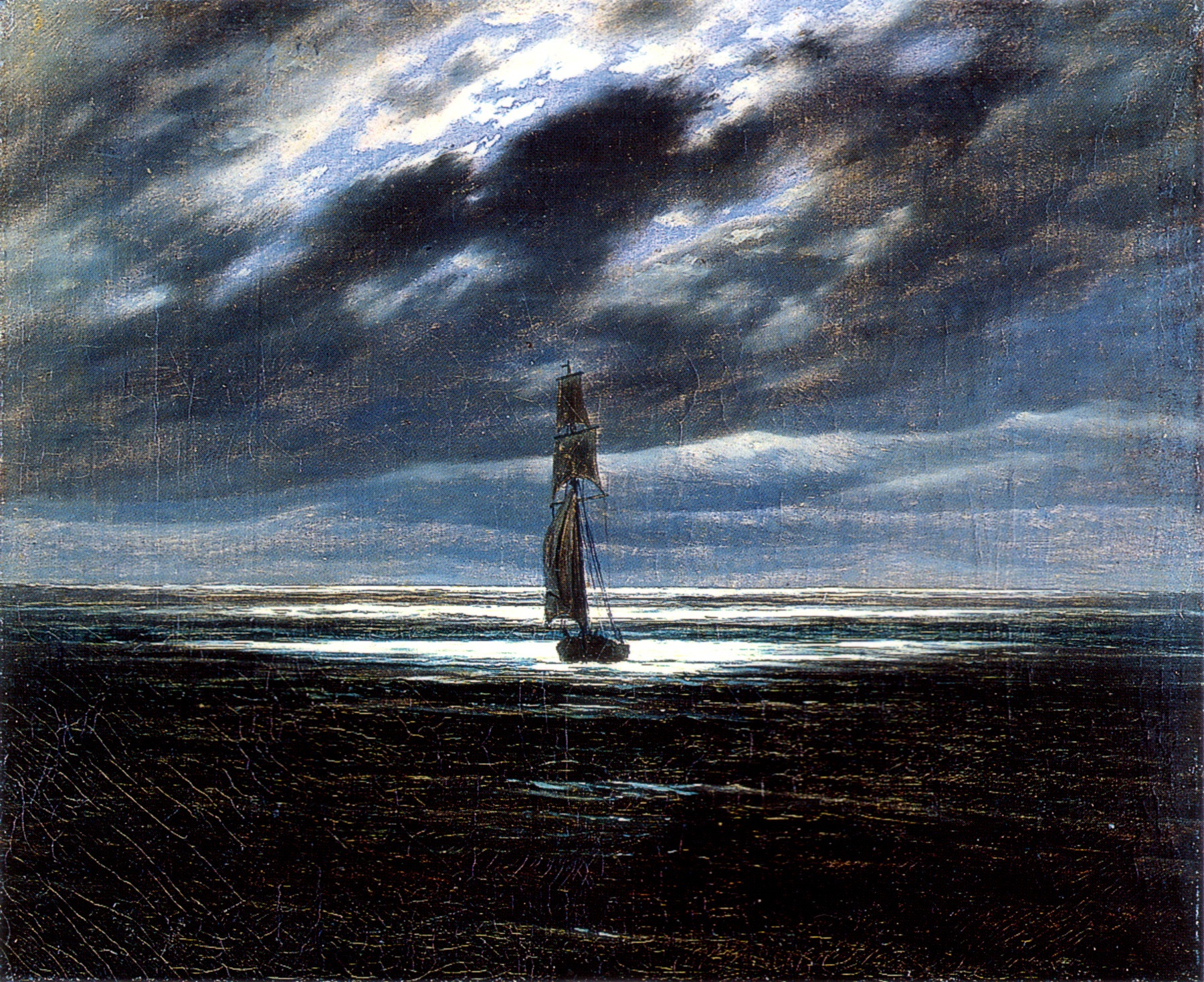
Abend (Sonnenuntergang hinter der Dresdener Hofkirche) (Evening (Sunset behind Dresden’s Hofkirche) by Caspar David Friedrich (1824)

Piano Sonata no.12 in A flat major Op.26 for piano (1801, Beethoven aged 30)

1. Andante con variazioni
2. Scherzo, allegro molto
3. Maestoso andante, marcia funebre sulla morte
4. Rondo

Dedication Prince Karl von Lichnowsky
Duration 27′

Listen

written by Ben Hogwood

Background and Critical Reception

Beethoven was enjoying one of the most productive periods of his life as a composer, yet conversely his health was worsening. He had chronic bouts of diarrhoea and a buzzing in his ears that was gaining in intensity as the years went on – this was the onset of his deafness which sadly was never to leave him.

His response, as Angela Hewitt says in her booklet notes for this piece on Hyperion, was to work hard – and the resultant piano sonatas leave biographer Jan Swafford in no doubt. In The Grand Sonata in A-flat major Op.26, Beethoven fully possessed the voice history would know him by, and at age 30 he was writing music that would place him once and for all in the history of his art. Everything about this sonata seems to be more than anything in the works before: more personal; more innovative in the approach to form (there are no movements in sonata form); more varied in the expressive scope, with fresh kinds of unity. Not least, starting from the gentle beginning, the A-flat major finds heights of individuality and sheer beauty of expression beyond anything he had reached before.’

Hewitt describes Op.26 as ‘a collection of four character pieces put together more under the lines of a divertimento (a title under which many of Haydn’s early sonatas were published)’. Its innovations begin with a theme and variations movement, which Hewitt sees as ‘more than just a show of compositional and technical virtuosity. Without straying far from the theme, Beethoven gives us a satisfying ‘introduction’ to the other movements.’

A ‘lively scherzo’ is next, then a funeral march, Hewitt observing that ‘Chopin loved this Beethoven sonata more than any other and played it frequently. This movement probably inspired him to write his own funeral march, which became the central focus of his Piano Sonata Op.35.’ The march was played at Beethoven’s own funeral in an arrangement.

The last movement is in a rondo form. ‘Instead of going for a brilliant finish’, writes Hewitt, ‘the work simply dissolves into thin air – a remarkable end to a remarkable piece.’

Thoughts

1801 appears to have seen a decisive shift for Beethoven. In pieces like the Serenade in D major he was clearly taking inspiration from the past, enjoying the chance to write in homage to Mozart and to some extent to Haydn. Yet as we move forward one opus number, here is a piece looking only in one direction – forwards.

The twelfth published piano sonata begins a run in this form of four consecutive works, all of them exploring new ways of presenting Beethoven’s ideas. The shock of the new is evident right from the start of this piano sonata,which begins with a theme and variations movement. Not only that, the theme carries a weighty emotional presence, and the subsequent departures from it are tightly but beautifully worked.

A quicker movement follows, with Beethoven in largely ebullient mood. The main melody is catchy, appearing in both higher and lower parts, and is only briefly displaced by a short trio section.

The funeral march, placed third, explores similar emotional depths to the slow movement of the Pathétique sonata, in the same key, but if anything goes for a more sustained darkness and greater tension than that movement. Here is an intensely dramatic passage of play, yet in the middle section Beethoven gives us a darkness to light moment, a glimpse of heaven from the turmoil. The clouds return, but the hope of transformation remains.

After these highs and lows, as Angela Hewitt notes, it is difficult to know what to expect next – so the fourth and final movement feels apt in its ‘straight down the middle’ approach. It is in fact a beautifully worked study of counterpoint that builds up a good deal of momentum

This is by some distance the most emotionally affecting piano piece we have yet heard from Beethoven, a noticeable change in tack from his previous works. The shift is decisive and will, as Jan Swafford says, affect the rest of his output. A willingness to embrace the new and to wear his heart on his sleeve pays many dividends here.

Recordings used and Spotify links

Emil Gilels (Deutsche Grammophon)
Alfred Brendel (Philips)
András Schiff (ECM)
Angela Hewitt (Hyperion)
Paul Badura-Skoda (Arcana)
Stephen Kovacevich (EMI)
Igor Levit (Sony Classical)
Claudio Arrau (Philips)
Rudolf Serkin (Sony)

Angela Hewitt gives the theme plenty of space to start with, and her reading of the sonata is beautifully weighted, taking its lead from the freedom in which Beethoven is operating. Schiff is superb, going at a daringly slow tempo in the first movement before giving it great guns in the faster music. Of the many other fine versions Rudolf Serkin left a lasting impression with his dramatic account.

You can hear clips of Hewitt’s recording at the Hyperion website

You can chart the Arcana Beethoven playlist as it grows, with one recommended version of each piece we listen to. Catch up here!

Also written in 1801 Field Piano Sonata in E flat major Op.1/1

Next up Piano Sonata no.13 in E flat major Op.27/1 ‘Quasi una fantasia’

Listening to Beethoven #166 – Serenade in D major Op.25

A View of the Karlskirche, Vienna by Bernardo Bellotto

Serenade in D major Op.25 for flute, violin and viola (1801, Beethoven aged 30)

Dedication Countess Maria Wilhelmine von Thun
Duration 22′

1. Entrata, Allegro
2. Tempo ordinario d’un Menuetto
3. Allegro molto
4. Andante con Variazioni
5. Allegro scherzando e vivace
6. Adagio – Allegro vivace e disinvolto

Listen

Background and Critical Reception

This attractive trio was initially thought to have been written around the same time as Beethoven’s Trio for clarinet, cello and piano – but as Richard Wigmore observes, writing in a booklet note for Hyperion, its actual date is three years later.

The flute was a very bankable instrument thanks to Frederick The Great, and Wigmore describes how ‘the Serenade, like the Septet, is a delightful late offshoot of the eighteenth-century divertimento tradition’.

There are six movements in a piece which appears not to have been written with any particular person in mind, more for the Viennese domestic market.

Thoughts

Beethoven looks back to Mozart and Haydn with this piece, using the form of a Serenade to its full potential. Like Mozart he brings the most out of seemingly small forces. On the face of it the combination of flute, violin and viola is relatively slight, but not in Beethoven’s hands. Each of the instruments gets a thorough workout in music that is both vivacious and touching.

The air of Spring, so prevalent in the sonata for piano and violin of the same name, is here in abundance too. The bright sound of the flute is one of the reasons for this, but so are the busy parts Beethoven assigns to violin and viola. There are few if any breaks for the instruments, and because of the almost complete lack of a bass instrument the piece has the lightest of textures.

The first movement is fun, the flute imitating a piper with the catchy main theme, but in the second movement Beethoven brings through a number of dance rhythms, with a minuet and two contrasting trio sections. The third movement is a rustic dance, with busy strings and lively flute.

The centrepiece, however, is the theme and variations movement, the strings introducing the theme with double stopping that makes them sound like a full quartet. As the music progresses each of the three protagonists gets their turn in the spotlight, which the audience would have enjoyed.

There is more, too – a scherzo where the instrumentalists are all at play, and a final Rondo where Beethoven heightens the folksy mood with the use of open strings on the violin and viola. The abundance of tunes and good humour in this piece make it a treat for audiences and listeners alike.

Recordings used and Spotify links

Gaudier Ensemble (Jaime Martin (flute), Marieke Blankestijn (violin), Iris Juda (viola) (Hyperion)
Members of the Berliner Philharmoniker (Karlheinz Zoeller (flute), Thomas Brandis (violin), Siegbert Uebershaer (viola) (Deutsche Grammophon)
James Galway (flute), Joseph Swensen (violin), Paul Neubauer (viola) (RCA)
Emmanuel Pahud (flute), Daishin Kashimoto (violin), Amihai Grosz (viola) (Warner Classics)
Melos Ensemble of London (Richard Adeney (flute), Emmanuel Hurwitz (violin), Cecil Aronowitz (viola) (Eloquence)

There are some fine versions of this piece available, the musicians clearly enjoying Beethoven’s high spirits throughout. The two I enjoyed most are from members of the Gaudier Ensemble on Hyperion, beautifully recorded, and the bright tones of three members of the Berliner Philharmoniker on Deutsche Grammophon, a recording made in 1969 that stands up very well.

You can listen to these versions on the playlist below:

You can chart the Arcana Beethoven playlist as it grows, with one recommended version of each piece we listen to. Catch up here!

Also written in 1801 Wranitzky 3 String Quintets Op.8

Next up Piano Sonata no.12 in A flat major Op.26

Listening to Beethoven #165 – Sonata for piano and violin no.5 in F major Op.24 ‘Spring’

joseph-anton-koch-serpentaralandschaft-mit-hirten-und-rindern-an-der-quelle.jpg!HalfHD

Serpentine landscape with shepherd and cattle at a spring (1832-4) by Joseph Anton Koch

Sonata no.5 for piano and violin in F major Op.24 (1801, Beethoven aged 30)

1. Allegro
2. Adagio molto espressivo
3. Scherzo: Allegro molto
4. Rondo: Allegro ma non troppo

Dedication Count Moritz von Fries
Duration 23′

Listen

by Ben Hogwood

Background and Critical Reception

The so-called Spring sonata for violin and piano appears to have acquired its nickname quickly after composition. It is easy to hear why from the very start of the piece, the violin brimming with ideas and a fertile invention that it can barely contain, while the piano burbles its approval.

Simon Nicholls, writing booklet notes to accompany a fine recording from violinist Paul Barritt and pianist James Lisney, notes that the Spring was a partner for the recently-heard Sonata in A minor Op.23, and that its warm F major would ‘highlight the delicious relaxation of tension’ from the ‘winter’ of the earlier piece.

Commentators agree that the work is probably the best known of all Classical violin sonatas, though they note a subtle but telling shift towards the future. It is the first of Beethoven’s sonatas for piano and violin to adopt the four-movement framework, and it gives a noticeably more dominant part to the violin, taking the lead when a lot of the main tunes are heard for the first time.

Beethoven’s contemporary Carl Czerny described the work as ‘holy peace’, while Denis Matthews notes an identical relation between the tonality (F major) of this work and the much later Pastoral symphony. The slow movements, too, share the same key (B flat major), described by Nicholls as a ‘rapt nocturne’. Beethoven then introduces ‘possibly the briefest of scherzi’ before ‘an unfailing flow of melodic invention in the finale’.

All these elements have combined to make the sonata one of the most performed in concert halls today, audiences enjoying its frequent and often dazzling rays of sunshine.

Thoughts

Beethoven’s invention feels as fresh as a daisy when the Spring sonata begins. The violin sings like a bird with both the tunes given to it in the first movement, the first descending from high up, the second ready to take to the air from its perch. The open air calls loudly to the listener, and for the first time in these sonatas there is that shift towards the violin taking the lead, the piano depending on its every move.

The slow movement is indeed rather special, and in a good performance radiates pure musical enjoyment, the two protagonists enjoying spending time together. Soft piano arpeggios complement a hushed melody from the violin, after which Beethoven enjoys moving to keys farther afield. A few shadows reveal themselves in the process but are dissipated by the return to the first theme.

You will blink and miss the scherzo if you are not careful, which would be a shame as it is rather beautifully woven together, with a spring in its step if you pardon the pun! Meanwhile the finale has a lovely theme too, the violin still in songful mood and the rippling piano providing a flowing accompaniment. Some spiky interaction between the two instruments in the develop leads to a return of the theme with pizzicato violin, almost absentmindedly strumming before normal service is resumed. Beethoven can’t resist a few more unusual modulations to far-flung keys before returning to the familiarity of these particularly green pastures.

Recordings used and Spotify playlist

Midori Seiler (violin), Jos van Immerseel (fortepiano) (Zig Zag Classics)
Yehudi Menuhin (violin), Wilhelm Kempff (Deutsche Grammophon)
Josef Suk (violin), Jan Panenka (piano) (Supraphon)
Alina Ibragimova (violin), Cédric Tiberghien (Wigmore Hall Live)
Tasmin Little (violin), Martin Roscoe (piano) (Chandos)
Frank Peter Zimmermann (violin), Martin Helmchen (BIS)
Paul Barritt (violin), James Lisney (piano) (Woodhouse Editions)
Arthur Grumiaux (violin), Clara Haskil (piano) (Philips)

Both Josef Suk and Arthur Grumiaux are notable for the full tone of their interpretations, which suits the Spring sonata rather nicely – as does the florid input of their pianists, Josef Hala and Clara Haskil respectively. Midori Seiler and Jos Van Immerseel give a lovely account of the piece, enjoying the open textures but with the mottled sound of the fortepiano an attractive complement to Seiler’s bright tone. Also of great note in a crowded field is an excellent new version from Frank Peter Zimmermann and Martin Helmchen, bubbling over with enthusiasm.

The Spotify playlist below does not contain the Barritt / Lisney version, but does include a highly powered account by Gidon Kremer and Martha Argerich, recorded for Deutsche Grammophon:

You can chart the Arcana Beethoven playlist as it grows, with one recommended version of each piece we listen to. Catch up here!

Also written in 1801 John Marsh – Symphony no.30 in E minor

Next up Serenade in D major Op.25

Listening to Beethoven #164 – Sonata for piano and violin no.4 in A minor Op.23

joseph-anton-koch-mountain-scene

Mountain Scene (1796) by Joseph Anton Koch

Sonata no.4 for piano and violin in A minor Op.23 (1801, Beethoven aged 30)

1. Presto
2. Andante scherzoso, più allegretto
3. Allegro molto

Dedication Count Moritz von Fries
Duration 20′

Listen

by Ben Hogwood

Background and Critical Reception

A relatively quick return for Beethoven to the duo sonata, with a pair of works for piano and violin. He worked first on Op.23 and then immediately began Op.24, the Spring sonata, its much more famous sibling. The two works were published together, like the Op.12 trio of sonatas, but due to an error in the engraving they were assigned separate opus numbers. Both pieces were written for Count Moritz von Fries, a banker who was an important patron to Beethoven around this time.

Many see the separate publication of the two works as an appropriate move, for commentators regard the Op.23 sonata as the chalk to the Spring sonata’s cheese. Daniel Heartz gives Op.23 a surprisingly wide berth, and his detailed examination of early Beethoven only finds one short paragraph for the work. ‘It seems dour and astringently contrapuntal compared to the lushly endowed siren before us in Op.24’, he writes. ‘In competition with alluring beauties, overt sagacity has rarely won the day, nor does it do so here’. He does however point out that ‘it was the composer’s habit to work simultaneously on works of disparate character’.

William Drabkin is more complimentary, marking the influence of Mozart throughout. Writing in The Beethoven Companion, Nigel Fortune notes the rarity of A minor in Beethoven’s output, before observing that the sonata ‘is unique, too, in being dominated by so much tense and bare linear movement’.

The outer movements are prime examples of this, he says, while the ‘slow’ movement includes – exceptionally – ‘a fugato on a theme that contrasts vividly with the slurred and halting motion of the opening idea’.

Thoughts

This unusual piece has the feeling of a work Beethoven had to get out of his system. The key of A minor was one he very seldom used – nor, incidentally, did Haydn – and in fact this violin sonata is his only large-scale work to use the key. There is a marked tension between A minor and A major throughout, the sort of duel that would become a feature of the mature works of Schubert, who often used ‘A’ as a centre.

The bare opening of the first movement finds both instruments in unison, and though it looks like it should be playful on the page it proves rather acerbic. The movement proceeds with a stern dialogue, unwieldly but still effective.

Signs of warmth appear in the slow movement, where Beethoven switches to the major key. Rhythmically the two instruments are very much in step, with a stop-start feel to the tune, and as Beethoven constructs variations on it the music becomes a little more flowing. The unusual fugue passage would have been a big surprise to the audience of the time, and still feels a little odd here.

The third movement bursts out of the blocks in the same spirit of the first, and again feels more like a duel than a collaboration – but the simplicity of the second theme brings a tender contrast, a reminder of the warmth that can still be found in spite of Beethoven’s lean and slightly mean approach in this piece.

Recordings used and Spotify playlist

Midori Seiler (violin), Jos van Immerseel (fortepiano) (Zig Zag Classics)
Yehudi Menuhin (violin), Wilhelm Kempff (Deutsche Grammophon)
Josef Suk (violin), Jan Panenka (piano) (Supraphon)
Alina Ibragimova (violin), Cédric Tiberghien (Wigmore Hall Live)
Tasmin Little (violin), Martin Roscoe (piano) (Chandos)
Frank Peter Zimmermann (violin), Martin Helmchen (BIS)
Paul Barritt (violin), James Lisney (piano) (Woodhouse Editions)

Once again the fresh approach of Midori Seiler and Jos van Immerseel is invigorating, and the relative lack of vibrato from Seiler’s violin suits the character of the music without making it too dark. Yehudi Menuhin has a much fuller sound by contrast, but this brings a welcome warmth to the slow movement in particular, as does the responsive playing of Wilhelm Kempff. Josef Suk and Jan Panenka have a similar profile, while the newest version – from Frank Peter Zimmermann and Martin Helmchen – is quite a powerhouse, sweeping forward impressively.

The Spotify playlist below does not contain the Barritt / Lisney version, but does include a highly powered account by Gidon Kremer and Martha Argerich, recorded for Deutsche Grammophon:

You can chart the Arcana Beethoven playlist as it grows, with one recommended version of each piece we listen to. Catch up here!

Also written in 1801 Vanhal – Clarinet Sonata in C major

Next up Sonata for piano and violin no.5 in F major Op.24 ‘Spring’