Listening to Beethoven #123 – Piano Sonata no.4 in E flat major Op.7


Emilias Kilde by Caspar David Friedrich (c1797)

Piano Sonata no.4 in E flat major Op.7 for piano (1797, Beethoven aged 26)

1 Allegro molto e con brio
2 Largo con gran espressione
3 Allegro
4 Rondo. Poco allegretto e grazioso

Dedication Countess Babette von Keglevics
Duration 28′

Listen

Background and Critical Reception

‘If any proof was needed to show that early Beethoven is not just imitation Haydn or Mozart’, writes Angela Hewitt, ‘then surely the Piano Sonata in E flat major Op.7 would be the best example.’

This is a work of formidable size, lasting nearly half an hour and second only to the Hammerklavier Sonata in Beethoven’s 32 published piano sonatas. Yet it has a common thread running through it, as Daniel Heartz observes. ‘The whole cycle is remarkable for its unified tone, which is both stylistic and motivic. No sonata of the Op.2 trilogy quite succeeded in achieving this feat.’

Hewitt has a special affection for the piece. ‘The colour change to C major for the Largo…startles us but immediately calls our attention to expect something different and exceptional’, she says of the second movement, finding the third ‘full of humour and charm’. The finale, however, works as ‘one of the last examples of his early style’, and ‘the movement ends in the most unassuming way. Perhaps if it ended loudly, she muses, this piece would be performed more often.’

The sonata is dedicated to Countess Babette von Keglevics, one of Beethoven’s most gifted piano pupils of the time.

Thoughts

Op.7 certainly is a substantial piece, but – as agreed above – a unified one. The flowing interaction between right and left hand of its opening pages set the tone. The piano writing is dense for its time, with lots going on, and in the middle (development) section of the first movement Beethoven travels far harmonically before suddenly deciding to go back to the first theme.

This proves to be a feature of the other movements. The slow movement, beautifully simple in its hymn-like theme, enjoys the sound of C major but suddenly takes a darker turn, where it really feels like Beethoven is using the piano as an orchestra. The left hand (lower strings) has an ominous figure which turns the music colder. Then we return to the safety of C major and all is forgotten.

The third movement is initially graceful, with a little stop-start motion in triple time, but its central section is a complete contrast, a turbulent episode in the minor key. The finale looks to resolve this, beginning in serenity, before it too succumbs to a stormy central section. Finally peace is completely restored, and Beethoven ends in quiet peace.

Recordings used and Spotify links

Emil Gilels (Deutsche Grammophon)
Alfred Brendel (Philips)
András Schiff (ECM)
Angela Hewitt (Hyperion)
Paul Badura-Skoda (Arcana)
Stephen Kovacevich (EMI)
Igor Levit (Sony Classical)

Claudio Arrau captures the full drama and exploration of the first movement development section. It takes a little while for the ear to adjust to Paul Badura-Skoda’s instrument but the sonorous tones suit chords that are close together. His is an intimate account if slightly jumpy on occasion, and he achieves considerable turbulence in the stormy trio of the third movement. It’s lovely to hear the piano itself creaking as he plays it. Emil Gilels is superb in the slow movement but perhaps a bit too grand in the outer two, and so it is Alfred Brendel who finds arguably the best combination of expanse and gracefulness.

The playlist below accommodates all the versions described above except that by Angela Hewitt:

You can hear clips of Hewitt’s recording at the Hyperion website

You can chart the Arcana Beethoven playlist as it grows, with one recommended version of each piece we listen to. Catch up here!

Also written in 1797 James Hewitt Piano Sonata in D major ‘The Battle of Trenton’

Next up Piano Sonata no.19 in G minor Op.49/1

Listening to Beethoven #122 – Allegretto in C minor, WoO 53 (second version)


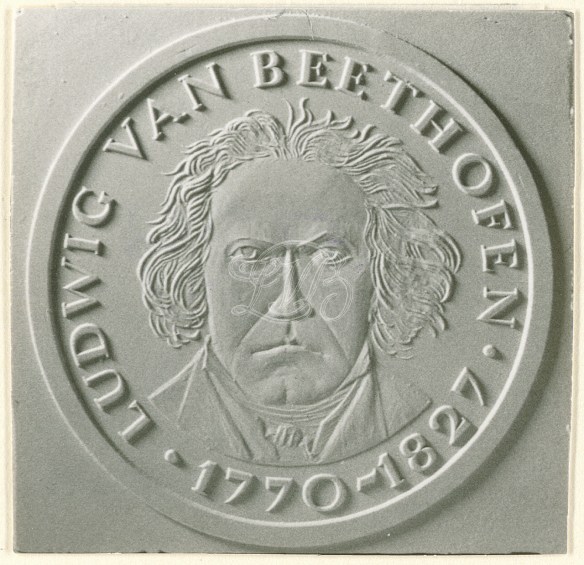
Design for a Beethoven commemorative coin worth 5 Deutsche Mark, 1969, Stuttgart. Reproduced from the Beethoven-Haus Bonn with thanks.

Allegretto in C minor WoO 53 for piano (second version, published as Hess 66) (thought to be from 1796-7, Beethoven aged 26)

Dedication not known
Duration 3’15”

Listen

Background and Critical Reception

There is very little written about this piece, but the few surviving notes suggest it might be an unpublished movement intended for the Piano Sonata no.5 in C minor, published as the first in the Op.10 set around this time.

Thoughts

As noted in the original version, the mood is serious and a little pensive for the Allegretto. The revision appears to be a compression of the original form, giving it the leaner profile the sonata also inhabits. Yet the fact Beethoven spent time on a revision of the piece suggests he held it in high esteem.

The ‘parting of the clouds’ for the C major theme is not quite so obvious here, the music more obviously heading back to the minor key.

Recordings used and Spotify links

Sergio Gallo (Naxos)

You can chart the Arcana Beethoven playlist as it grows, with one recommended version of each piece we listen to. Catch up here!

Also written in 1797 James Hewitt Piano Sonata in D major ‘The Battle of Trenton’

Next up Piano Sonata no.4 in E flat major Op.7

Listening to Beethoven #121 – Kriegslied der Österreicher WoO 122


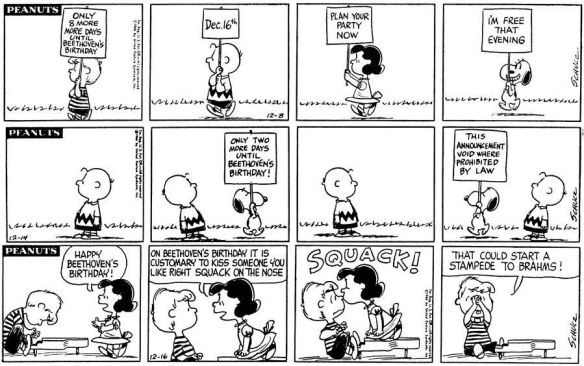
Peanuts comic strip, drawn by Charles M. Schulz (c)PNTS

Kriegslied der Österreicher WoO 122 for voice and piano (1797, Beethoven aged 26)

Dedication not known
Text Josef Friedelberg

Duration 3’15”

Listen

Background and Critical Reception

There is no official translation of Friedelberg’s text – at least none that I could find – but a loose interpretation via Google reveals something of a hymn to Germany, while inspiring his newish home countrymen too. ‘Man, woman and child in Austria. feel deeply your own worth’, runs the last verse.

The song draws out the point made by the unknown writer of the booklet notes for Capriccio’s set of the complete songs, who notes that ‘Beethoven’s songs are not music for the concert hall, but, for the large part, house music for the sophisticated entertainment or the edification of the educated classes.’

Thoughts

As with his previous setting of Friedelberg’s poetry, Beethoven offers a full bodied setting of a celebratory text. As noted in that setting, the piano functions to double the melody and provide a bit of punctuation between verses. It is the sort of song you can imagine being sung after a few drinks!

Recording used and Spotify link

Hermann Prey (baritone), Leonard Hokanson (piano), Berlin Heinrich Schütz Choir / Wolfgang Matkowitz

Hermann Prey is brilliant here, a wonderful tone complemented by the Heinrich Schütz Kreis, Berlin, in the refrains.

You can chart the Arcana Beethoven playlist as it grows, with one recommended version of each piece we listen to. Catch up here!

Also written in 1797 Dussek La Consolation Op.62

Next up Piano Sonata no.4 in E flat major Op.7

Listening to Beethoven #120 – Sonata for piano duet in D major Op.6


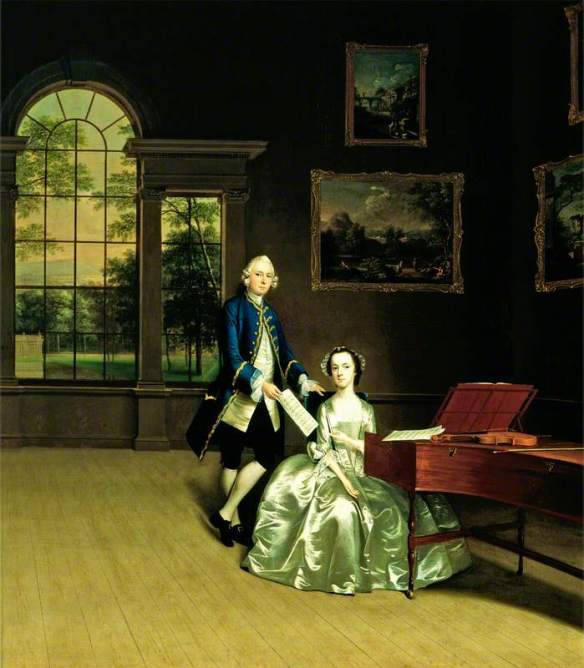
The duet by Arthur Devis. Photo credit: Victoria and Albert Museum, London

Sonata for piano (four hands) in D major Op.6 (1796-97, Beethoven aged 26)

Dedication not known
Duration 6′

1. Allegro molto
2. Rondo: Moderato

Listen

Background and Critical Reception

If it’s not too confusing a statement, Beethoven’s output for piano duet could be counted on the fingers of one of those four hands. We have already seen how imaginatively he writes for this combination in the Variations on a theme of Count von Waldstein, but here he returns for a short, two-movement sonata.

It is thought this brief piece, at little more than five minutes, was used for teaching. Peter Hill, who recorded the piece with Benjamin Frith for Delphian Records in 2019, writes that ‘the duet Sonata’s opening Allegro molto could be used as a textbook examples of how to write a classical first movement.’ He also writes affectionately of ‘the exchanges between the pianists that culminate (at the ends of the exposition and recapitulation) in arpeggios that ripple between and across the four hands.’ He also notes the ‘operatic feel’ of the second movement Rondo.

Thoughts

There is an impish quality about this piece, as though Beethoven wanted to have some fun with whoever was chosen to be by his side at the piano. A simple theme, a call to arms, leads to some fun between the parts in the first movement, with a few mischievous asides.

The Rondo has an elegant main subject, while its second theme is suddenly loud, as though it wants to grab your attention and talk over your conversation. It proceeds very naturally.

Recordings used and Spotify playlist

Peter Hill & Benjamin Frith (Delphian)
Amy and Sara Hamann (Grand Piano)
Louis Lortie & Hélène Mercier (Chandos)
Lang Lang & Christoph Eschenbach (Deutsche Grammophon)

A stylish and fun interpretation from Hill and Frith. Even if you hadn’t seen the cover of their recording you would guess how much fun they had putting it together! The Hamann sisters are very good too, if a bit jarring with their dynamic contrasts in the second movement. Their second version, on a fortepiano after J.A. Stein from 1784, is almost comical as the ear adjusts – but ultimately good fun.

Also written in 1797 Eberl 2 Sonatas for piano four hands Op.7

Next up Kriegslied der Österreicher WoO 122

Listening to Beethoven #119 – Serenade in D major Op.8

Ignaz Schuppanzigh, Austrian violinist, teacher and friend of Beethoven

Serenade in D major Op.8 for string trio (violin, viola and cello) (1796-7, Beethoven aged 26)

Dedication unknown
Duration 30′

1. Marcia: Allegro
2. Adagio
3. Menuetto: Allegretto
4. Adagio – Scherzo: Allegro molto – Adagio – Allegro molto – Adagio
5. Allegretto alla Polacca
6. Andante quasi allegretto – Variations 1-4 – Allegro – Tempo I
7. Marcia: Allegro

Listen

Background and Critical Reception

Beethoven returned to the string trio for a love letter to Vienna – possibly echoing his feelings after returning to the city. He chose the form of a serenade, and followed many of its conventions, including a March which ushers the players in and takes them out after a series of dance movements.

Choosing a string trio to perform the Serenade was quite unusual. In Mozart’s case the string ensemble would have been more substantial, with wind instruments possibly included.

Beethoven biographer Lewis Lockwood is quite dismissive of this work, implying it is lightweight when compared with the ‘higher level’ of the three string trios that follow as Op.9. Daniel Heartz notes this, but makes a strong claim for the Serenade’s endearing humour. ‘For three solo string instruments to produce such a big, pompous sounds as this Marcia in common time is already funny and portends a good show to come’. He notes how each of the three instruments gets a good solo in the theme and variations movement, placed fourth of six.

He also reveals that the work was advertised alongside another E flat major composition, the Piano Sonata no.4 Op.7, in the Wiener Zeitung on 7 October 1797. Stephen Daw, in his notes for the Leopold Trio recording on Hyperion, observes how ‘the Serenade was challenging material to play by the apparent standards of the time, but it looks as though Beethoven was already acquainted with the great violinist Schuppanzigh (above) at this time.

The use of a Polacca for the fifth movement is unusual, for Daw ‘one of the few real polonaises to survive from the period between those of W. F. Bach and Chopin.

Thoughts

The Serenade is a bright and breezy work, but an ambitious one too, far from the lightweight piece of fluff suggested by Lewis Lockwood.

The Marcia theme that forms the outer casing of the sandwich is hefty, and deceptive with it – Beethoven could easily have four or five instruments on stage rather than three. The contrast with the tender Adagio is rather affecting, and this movement takes its time, looking back longingly when it moves into the minor key.

A brisk Menuetto takes us back for a whirlwind stint on the dancefloor, and fades out rather cleverly with pizzicato. The fourth movement is one of extremes, with a slow section that threatens to spoil the mood, but ends up being a po-faced foil for a capricious Scherzo, taken at a breakneck speed.

The Polacca is next, tripping along with an enjoyment of the dance, and with a catchy tune. Then the theme and variations, which Beethoven turns over beautifully, showcasing each of the trio’s instruments in significant solo episodes – with a special place for the viola in the middle and the cello at the end. After this the reappearance of the Marcia theme ensures the Serenade signs off with a flourish – and everyone can go home!

The Serenade is a thoroughly enjoyable piece, not to be taken too seriously – but with plenty of emotion under its often frivolous surface. It is definitely not a Beethoven work to be thrown away.

Recordings used and Spotify links

L’Archibudelli (Vera Beths (violin), Juergen Kussmaul (viola), Anner Bylsma (cello)
The Grumiaux Trio (Arthur Grumiaux (violin), Georges Janzer (viola), Eva Czako (cello) (Philips)
Anne-Sophie Mutter, Bruno Giuranna and Mstislav Rostropovich (Deutsche Grammophon)
Leopold String Trio Isabelle Van Keulen (violin), Lawrence Power (viola), Kate Gould (cello) (Hyperion)
Trio Zimmermann (Christian Tetzlaff (violin), Antoine Tamestit (viola), Christian Poltéra (cello) (BIS)

You can listen to the versions from L’Archibudelli, the Grumiaux Trio and the Mutter-Giuranna-Rostropovich trio on this playlist:

There are some very fine recordings of the Serenade, with three standing out as excellent – the Grumiaux Trio, who are quite luxurious in their thick sound, the Leopold Trio for a strongly characterised account, and Trio Zimmermann for an equally musical recording. All of them capture Beethoven straining at the leash, offering a Serenade but much more besides.

You can chart the Arcana Beethoven playlist as it grows, with one recommended version of each piece we listen to. Catch up here!

Also written in 1797 Wranitzky Symphony in C minor, Op. 31 “La paix”

Next up Sonata for piano (four hands) Op.6