Listening to Beethoven #113 – Duo for viola and cello in E flat major WoO 32, ‘Eyeglass Duo’


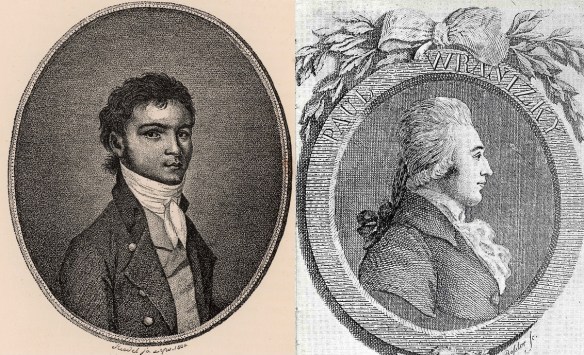
Nikolaus Zmeskall von Domanovecz, courtesy of Beethoven-Haus, Bonn

Duo for viola and cello in E flat major WoO 32, ‘Eyeglass Duo’ (1797, Beethoven aged 26)

1 Allegro
2 Minuetto

Dedication Nikolaus Zmeskall
Duration 14′

Listen

Background and Critical Reception

This is a title to raise the eyebrows – and is one of the curious corners of Beethoven’s output for sure. Perhaps fortunately the eyeglasses are not used to make any music – not directly, at any rate – rather, they refer to the wearers of the eyeglasses, Beethoven himself (viola) and Nikolaus Zmeskall (cello).

Baron Zmeskall was an accomplished cellist and a good friend of Beethoven, and the piece seems to have been written for domestic use only. It is in two lopsided movements, with a substantial first movement full of interaction between the players and a much shorter Minuetto. Richard Wigmore writes of how ‘in the minuet, with its pawky canonic trio, Beethoven suddenly pulls the rug from under the listener’s feet, by veering from E flat to a remote C flat – just the kind of comic-mysterious effect he had learnt from Haydn’.

Thoughts

Beethoven would surely have been aware that Mozart wrote two accomplished – and underrated – duos for violin and viola, and possibly of the four sonatas Michael Haydn published for the combination in the same year, 1797. Working lower down the range, Mozart also wrote a Sonata for bassoon and cello, lasting roughly the same length as this piece.

Perhaps Beethoven was aware of these when writing this highly amenable duo – which presumably appeared in large print, given the sight limitations of the players! Listening to the bright and busy Allegro, the first movement of this piece, the listener can imagine how much pleasure it brought to the bespectacled music makers. It is a lively discourse where the two instruments are treated completely as equals. The writing could easily be lifted from a string quartet, and several times I found my ear was expecting two violins to appear in harmony. The Minuetto is good fun too, including the harmonic trick noted above.

It may be intended for domestic music making only but Beethoven’s craft is all too evident, and his wit too, in this enjoyable miniature.

Recordings used

Veronika Hagen (viola), Clemens Hagen (DG)
Lawrence Power (viola), Paul Watkins (Hyperion)
Jürgen Kussmaul (viola), Anner Bylsma (cello) (Sony Classical)

Three excellent performances, bringing through the elegance of the piece, its genial nature, and also its humourous touches. Kussmaul and Bylsma, on period instruments, have a relatively grainy sound which is still appealing.

Spotify link

Veronika & Clemens Hagen

Jürgen Kussmaul, Anner Bylsma

You can listen to clips from Lawrence Power and Paul Watkins’ version on the Hyperion website

written by Ben Hogwood

You can chart the Arcana Beethoven playlist as it grows, with one recommended version of each piece we listen to. Catch up here!

Also written in 1797 Michael Haydn 4 Sonatas for Violin and Viola

Next up 12 Variations on the Russian Dance from ‘Das Waldmädchen’

Listening to Beethoven #112 – Piano Sonata no.5 in C minor Op.10/1


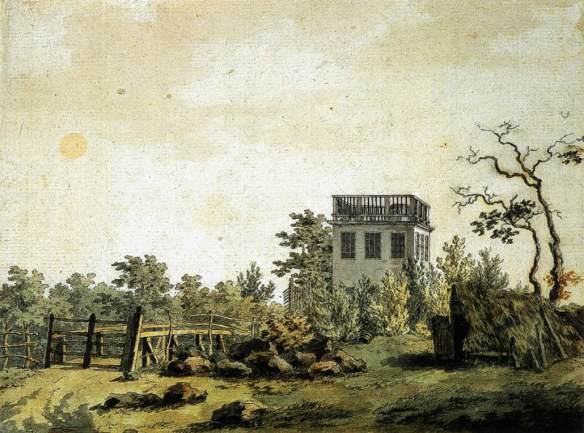
Landscape with Pavilion by Caspar David Friedrich (c1797)

Piano Sonata no.5 in C minor Op.10/1 for piano (1797, Beethoven aged 26)

1 Allegro molto e con brio
2 Adagio molto
3 Finale (Prestissimo)

Dedication Countess Anna Margarete von Browne
Duration 19′

Listen

Background and Critical Reception

Beethoven turns once more to the piano sonata, with the first of a triptych eventually published in September 1798. This work, completed almost a year earlier, sees a swift return to C minor. For the pianist András Schiff, the three works published as Op.10 ‘are more concentrated…they turn outwards, towards connoisseurs and amateurs. Perhaps for that reason they are slightly easier to play.’ From experience, the C minor is still a tough nut to crack if you haven’t reached Grade 8!

Schiff and Daniel Heartz note the pointers towards a sonata yet to be composed. ‘The Adagio molto in 2/4 time that follows is in A flat’, notes Heartz, ‘a key that, when joined with the song-like character and coming right after fretful C minor, will make an unforgettable impression in the Pathétique.

This comes after a first movement where Schiff speaks of ‘drama and turmoil. Its opening theme is a so-called ‘Mannheim rocket’, as in Op.2/1, but it is sharpened by the dotted rhythm’. Other qualities are the thick scoring, an extreme contrast between very quiet (pianissimo) and very loud (fortissimo), and increased gaps between high and low registers.

Although the ending is in C major, ‘we hear it as minor’, says Schiff, the whole movement ‘secretive and urgent’. There is a ghostly conclusion where ‘the work disappears mysteriously and rapidly’.

Thoughts

On one hand, the first movement of this sonata could feel like a ‘regulation’ piece of Beethoven – especially if you are familiar with his other works in C minor (the Fifth Symphony, Pathétique Sonata, or the First Piano Trio to pick just three examples). On the other, with closer inspection, there is still plenty going on. The beefy C minor chords show how much Beethoven’s piano writing is filling out, while the use of silence allows the composer to pop in a few witty asides for his audience, as Haydn or Clementi might have done.

Time slows to a near standstill for the second movement, the anticipation of what Beethoven would do with his Pathétique sonata. Expressive licence is given to the free right hand, which is allowed to wander in the way a C.P.E. Bach Fantasia might have done, but by the end the mood is calm and meditative. Not so the third movement, a flurry of notes with more crunchy chords in the lower end of the piano. Beethoven is off the leash again, contrasting the bold first theme with the slight lilt of the second, reflecting perhaps his work on German Dances around the time of composition. This theme moves to C major for its second statement, after which the piece hurries to the finish line – but, as Schiff notes, ends in a puff of smoke.

Recordings used and Spotify links

Emil Gilels (Deutsche Grammophon)
Alfred Brendel (Philips)
András Schiff (ECM)
Angela Hewitt (Hyperion)
Paul Badura-Skoda (Arcana)
Stephen Kovacevich (EMI)
Igor Levit (Sony Classical)

Paul Badura-Skoda gives an engaging performance on a Johann Schantz piano, dating from Vienna in 1790. The mottled tones of the left hand work nicely in the Adagio, though textures are more ragged in the faster music. Emil Gilels takes a broad view of the slow movement, complementing a commanding account of the outer two. Schiff is typically engaging, as is Hewitt, who shapes the melodic phrases beautifully.

The playlist below accommodates all the versions described above except that by Angela Hewitt:

You can hear clips of Hewitt’s recording at the Hyperion website

You can chart the Arcana Beethoven playlist as it grows, with one recommended version of each piece we listen to. Catch up here!

Also written in 1797 Viotti Violin Concerto no.22 in A minor

Next up Duo for viola and cello in E flat major WoO 32, ‘Eyeglasses Duo’

Listening to Beethoven #111 – 12 German Dances WoO 13

Redoutensaal with masked ball, engraving by Weimann Photo (c) Julia Teresa Friehs

12 German Dances, WoO 13 for piano (1796, Beethoven aged 25

no.1 in D major
no.2 in B flat major
no.3 in G major
no.4 in D major
no.5 in F major
no.6 in B flat major
no.7 in D major
no.8 in G major
no.9 in E flat major
no.10 in D major
no.11 in A major
no.12 in D major

Dedication possibly Vienna Artists’ Pension Society
Duration 14′

Listen

Background and Critical Reception

The general feeling among Beethoven commentators is that this set of 12 German Dances, like the previous ones we have heard, were written for orchestra. It is reasonable to assume they would have been a repeat commission for the masked charity ball of the Viennese Artists’ Pension Society, given the success of the previous year’s commission in 1795, but on this occasion no orchestral scoring survives; just a short score for piano.

Thoughts

These are lively pieces and good fun to listen to – and no doubt good fun in the ballroom too. Their full value would be revealed there, for to listen to them without the dancing means they start to blend in to one after a while.

Recordings used and Spotify links

Gianluca Cascioli (DG)
Jenõ Jandó (Naxos)


You can chart the Arcana Beethoven playlist as it grows, with one recommended version of each piece we listen to. Catch up here!

Also written in 1796 Cimarosa I nemici generosi

Next up Piano Sonata no.5 in C minor Op.10/1

Listening to Beethoven #110 – 6 German Dances for violin and piano WoO 42

La Trénis, Contredanse by PIerre La Mésangère, British Museum

6 German Dances WoO42 for piano and violin (1796, Beethoven aged 25)

Dedication The ‘Countesses Thun’
Duration 5′

Listen

Background and Critical Reception

William Drabkin, writing in the booklet notes for the Complete Beethoven on DG, confirms the background behind these six short dances for violin and piano.

Beethoven describes them as ‘German dances, to which the two Countesses Thun and other people might dance on their heads and thereby think of their Ludwig Van Beethoven who honours them’. Drabkin confirms Beethoven sent the completed work to Vienna while he was on his concert tour of Berlin and Prague during 1795-96. He writes that ‘One of the two unnamed countesses Beethoven is likely to have intended in the dedication is Christiane, wife of his foremost patron during his first years in Vienna, Prince Karl Lichnowsky.’

The dances could be performed by piano alone, but the violin grows into its role as co-melodist as the dances progress.

Thoughts

Beethoven uses ‘safe’ homes for each of these short dances, all in a major key: F – D – F – A – D – G. They are all perky numbers that prove to be good fun, lightening the mood as they would doubtless have done of an evening.

Piano and violin share the load, the violin often using double stopping as in the drone of the rustic second dance or the attractive no.5. The fourth dance has a nice lilt to it, while no.6, the most substantial, finishes on a high.

Recordings used

David Garrett (violin), Bruno Canino (piano) (Deutsche Grammophon)
James Ehnes (violin), Andrew Armstrong (piano) (Signum Classics)

Both performances are thoroughly enjoyable. Ehnes and Armstrong have their collective foot on the accelerator that bit more, dancing with quick feet!

Spotify links

David Garrett, Bruno Canino

James Ehnes, Andrew Armstrong

Also written in 1796 Kreutzer Études ou caprices

Next up 12 German Dances WoO 13

Listening to Beethoven #109 – “Ah! Perfido”, Op.65

Portrait of Josepha Duschek in 1796

“Ah, perfido!”, Op.65 for soprano and orchestra (1796, Beethoven aged 25)

1. Scena: Ah! perfido, spergiuro
2. Aria: Per pietà, non dirmi addio

Dedication Josepha Duschek
Text Pietro Metastasio / Anonymous
Duration 14′

Listen

Background and Critical Reception

Beethoven wrote Ah! Perfido as a two-part concert scene and aria, with the Czech soprano Josepha Duschek in mind. He met the singer and her husband on his visit to Prague in 1796, but in the end had to entrust the debut on 21 November to Countess Josephine Clary, because of a clash of engagements. Despite its relatively early genesis the work was not published until 1807, and it appeared on the programme of Beethoven’s famous Akademie concert in 1808.

Many commentators see the roots in Ah! Perfido from Mozart’s writing for voice and orchestra. Writing in The Beethoven Companion, Leslie Orrey sees a clear prototype for the work in Mozart’s Bella mia fiamma, K528 – itself a scene and an aria written for Duschek. Daniel Heartz, in his comprehensive appraisal of early Beethoven, is not so sure.

He writes in typically revealing detail. “Since the text is pathetic, his (Beethoven’s) choice of E flat is appropriate, and so is the form, that of the two-tempo rondo, still the height of fashion in 1796 and just the sort of piece a professional like La Duschek would want to sing. Its languid first part, Adagio in 3/4 time, has a theme that returns after contrast, while the second part, Allegro assai in common time, has a gavotte-like theme that also returns after contrast. The faster transition between the two parts, which appears later, is unusual. It has been claimed that Beethoven modelled Op.65 on Mozart’s Bella mia fiamma. Yet there is little in common between them aside from the form, which Mozart treats more freely still.” 

Thoughts

Beethoven puts our emotions through the wringer with this dramatic scene. The orchestra’s brisk introduction sets the picture for our soloist, who is given some powerful and declamatory high notes. Seen live, the effect is arresting, the dialogue with the orchestra like a recitative from a Handel opera, with comments made in quick bursts.

Yet with the solo aria the mood changes markedly. A slow introduction from the orchestra leads to a beautiful melody from the soloist, which requires great control but fully conveys the emotion of the unknown author. Beethoven provides subtle orchestral complements from clarinet and woodwind, and in the middle of the aria we pull back to just the singer and soft pizzicato, a moving moment indeed. Our protagonist is resigned to a troubled end, with fresh drama through a burst from tremolo strings and another heartfelt plea. Finally the slow music returns, rather beautifully.

Recordings used

Elisabeth Schwarzkopf (soprano), Philharmonia Orchestra / Herbert von Karajan (EMI)

Janice Watson (soprano), English Chamber Orchestra / Matthew Best (Hyperion)

Chen Reiss (soprano), Academy of Ancient Music / Richard Egarr (Onyx)

Charlotte Margiono (soprano), Orchestre Révolutionnaire et Romantique / John Eliot Gardiner

Camilla Tilling (soprano), Gabrieli Players / Paul McCreesh (Archiv)

In her interview with Arcana, Chen Reiss talked about approaching Ah! Perfido from two different historical directions. Elisabeth Schwarzkopf brings the romantic drama in a commanding performance, singing with fulsome tone and vibrato. Herbert von Karajan’s sleek orchestral accompaniment makes the piece sound around 70 years younger.

By complete contrast, the leaner tones of the Academy of Ancient Music under Richard Egarr have the excitement of the new, as the strings burst from the blocks. Reiss’s voice is clear and urgent, the words still fresh off the page. Hers is a dramatic account indeed, and Egarr ensures the detail from the orchestra is beautifully shaded.

A mention, too, for Charlotte Margiono, whose clear singing matches John Eliot Gardiner’s detailed account – and for Camilla Tilling, who makes an excellent partnership with Paul McCreesh and the Gabrieli Players. Not quite as dramatic as Reiss and the AAM though!

Spotify links

This playlist collects most of the available versions mentioned above:


You can chart the Arcana Beethoven playlist as it grows, with one recommended version of each piece we listen to. Catch up here!

Also written in 1792 Cimarosa – Gli Orazi e i Curiazi

Next up 6 German Dances for violin and piano