Erlkönig for voice and piano (1794-6, Beethoven aged 25)
Dedication not known
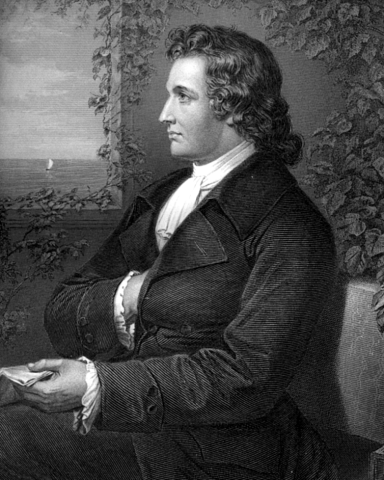
Text Johann Wolfgang von Goethe
Duration 3’30”
Listen
Background and Critical Reception
Those readers who know the songs of Schubert will recognise Erlkönig as one of the composer’s most popular songs, a tumultuous setting of Goethe’s heroic poem. Yet here is a response from Beethoven some twenty years earlier, a fragment completed for publication by Reinhold Becker.
The Unheard Beethoven site helpfully goes into detail on Becker’s amendments and extensions to Beethoven’s work, adding a downloadable score and audio. It also presents the original, unmodified sketch, as written by Beethoven and transcribed by Gustav Nottebohm.
Thoughts
Beethoven’s setting is a pretty dramatic one, a turbulent piano introduction then shadowing the baritone’s bold melody. The key is D minor, which until now we have not heard Beethoven use. It is the ideal vehicle to convey the tragic-heroic text, and the composer keeps a keen air of occasion running throughout. The end is hollow on the part of the singer, who signs off with a whisper.
Recording used and Spotify link
Paul Armin Edelmann (baritone), Bernadette Bartos (piano) (Naxos)
You can compare notes with the Schubert setting below:
You can chart the Arcana Beethoven playlist as it grows, with one recommended version of each piece we listen to. Catch up here!
Also written in 1796 HaydnSaper vorrei se m’ami Hob.XXVa:2
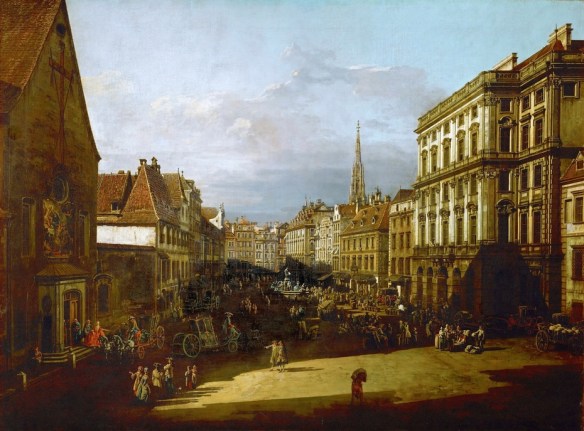
Vienna, Panorama from Palais Kaunitz by Bernardo Bellotto (1759)
Quintet in E flat major Hess 19 for 3 horns, oboe and 2 bassoons (1796, Beethoven aged 25)
1. Allegro 2. Adagio maestoso 3. Minuetto
Dedication unknown Duration 15′
Listen
Background and Critical Reception
Beethoven’s preoccupation with wind instruments continues with this incomplete quintet, written for the unusual combination of three horns, oboe and bassoon. The unfinished work sits in three movements, the bones of which were seemingly sketched out in 1796 or 1797. The first movement autograph score begins at bar 158, the second movement is complete but only a fragment of the third, a Minuet, remains.
Keith Anderson, writing in the booklet notes for Naxos’ recording of the Quintet, details how the first movement was reconstructed by Leopold Zellner and first played in 1862, while the celebrated Beethoven scholar Willy Hess edited the work for publication. In its surviving form it is top heavy, with a first movement more than double the length of the second and third combined.
Thoughts
We are once again in E flat major, Beethoven’s ‘key of choice’ for wind instruments – and his most-used up until now. The colouring is slightly different here though, the full-bodied horns dominating in a largely mellow texture, until the oboe pokes its head above the parapet. The melodic material is less distinctive than the preceding Sextet but is pleasant all the same.
The slow movement stays in the ‘home’ key and again has lovely sonorities but feels lacking in the craft a finished version from the composer would surely have brought. A perky Minuetto tails off all too soon.
Recording and Spotify link
Jeno Keveházi, János Keveházi, Sándor Berki (horns), Ottó Rácz (oboe), Jozsef Vajda (bassoon)
A nicely balanced account from the Hungarian soloists, recorded by Naxos in Budapest in 1994.
You can chart the Arcana Beethoven playlist as it grows, with one recommended version of each piece we listen to. Catch up here!
Also written in 1796BoieldieuDuo no.2 in B flat major for harp and piano
Beethoven wrote his Sextet for an established combination of clarinets, bassoons and horns – two of each – in 1796. However it appears not to have been performed until 1805, at a concert for the benefit of his violinist friend Ignaz Schuppanzigh, and another five years elapsed until it was published.
Reviewing the benefit concert, Allgemeine musikalische Zeitung spoke of ‘lively melodies, unconstrained harmonies, and a wealth of new and surprising ideas.’
When handing it over to his publisher, Beethoven is said to have described it as ‘one of my earlier works, written in one night, and one can only say that it is written by an author who has brought out at least some better works’.
The quick composition time explains the fluent writing through four traditional movements, Beethoven thinking in a form that would please Viennese audiences.
Thoughts
The Sextet starts with what feels like a very basic introduction, a slow and simple statement of the notes of the E flat triad. From these less memorable beginnings comes a first movement of charm, rooted in the dance – which the bassoons are intent on reminding us about with a spring in the step of their accompaniment. Burbling clarinets help the inner workings as the piece trips along, the sonority of the ensemble in itself a lovely tonic to the ear. Beethoven gradually develops his material, moving to keys further afield, before reasserting E flat with the jauntier fast theme.
The slow movement is lovely, giving the bassoon an unusual prominence for its songlike first them, echoing the male baritone voice. The Menuetto brings the horns forward, and is more staccato in tone as a result, with a central trio section of lovely colours that is the ideal complement. Finally a Rondo, easy on the ear, makes the most of ensemble teamwork with its busy exchanges.
Recordings used and Spotify links
Academy of St. Martin-in-the-Fields Chamber Ensemble (Philips) Scottish Chamber Orchestra Winds (Linn) L’Archibudelli (Sony Classical) Gerd Seifert, Günter Piesk, Henning Trog, Karl Leister, Manfred Klier, Peter Geisler (Deutsche Grammophon)
Some very fine performances here. The ASMF winds are immaculate, and so too are the Scottish Chamber Orchestra ensemble, who benefit from Linn’s superb recording. L’Archibudelli, playing on period instruments and a slightly lower pitch, have a coarser sound that proves every bit as enjoyable as their modern counterparts. The starry team of soloists from the Berlin Philharmonic on DG are not as consistent with their use of Beethoven’s repeated sections.
The Spotify playlist below collects the recordings used:
You can chart the Arcana Beethoven playlist as it grows, with one recommended version of each piece we listen to. Catch up here!
Also written in 1796 HaydnTrumpet Concerto in E flat major Hob. VIIe/1
Ludwig Gleim, author to the melody Ich hab’ ein kleines Huettchen nur (portrait by Johann Heinrich Ramberg) and the young Beethoven
Variations on ‘Ich hab ein kleines Hüttchen nur’ WoO Anh.10 for piano (1795, Beethoven aged 24)
Dedication not known
Duration 6′
Listen
What’s the theme like?
Bright and quite breezy. A memorable tune that could easily have been whistled while walking down the street!
Background and Critical Reception
Another 1795 set of variations…but there is a little more doubt over the authenticity of these ones. If they were indeed from Beethoven’s pen they were not published until 1830 – and are thought to have been written in 1795.
The Unheard Beethoven website gives a characteristically detailed and involving commentary to the work, deducing the original tune to have been a popular melody that was ‘frankly a little creepy to a modern reader’!
The esteemed Beethoven scholar Willy Hess classed the piece as ‘doubtful’ rather than ‘spurious’, with no helpful evidence for or against its authenticity.
Thoughts
Beethoven or not, the eight variations are quickly despatched. Arguments in favour of Ludwig’s authorship would be the by now familiar pattern of a minor key fourth variation and a vigorous fifth, and a coda which allows itself to roam free in both mood and tempo.
The variations fit snugly alongside the other three sets we have heard so far from 1795, with passages suitable for the amateur pianist but others – the fifth especially – that are much more demanding. The soft end is a nice touch too.
Recordings used and Spotify links
Rudolf Buchbinder
Rudolf Buchbinder clearly enjoys his time with these variations, bringing the tune out nicely and applying some impressive virtuosity where required.
The Portaits of Giovanni Paisiello (left) and the young Beethoven
6 Variations on ‘Nel cor piu non mi sento’ WoO 70 for piano (1795, Beethoven aged 24)
Dedication not known
Duration 6′
Listen
What’s the theme like?
Paisiello’s theme has a nice lilt to it, with a softly undulating accompaniment set in the left hand of the piano. The mood is amiable, set in G major. Beethoven pauses deliberately near the end, creating some very valid, stage-derived tension!
Background and Critical Reception
Beethoven operated with a remarkably quick turnaround for these variations, which explains their instinctive feel. Barry Cooper, writing in the booklet notes for DG’s Complete Beethoven Edition, tells of how ‘a lady whom he greatly admired once told him she used to own a set of variations on this theme but had lost them’. Beethoven ‘promptly composed his set for her and delivered them the next morning! He could, when necessary, compose extremely fast despite his reputation as a slow and painstaking worker’.
Thoughts
The six variations have an easy flow, the left and right hands often exchanging their melodic lines to keep things on the move. Beethoven’s first three variations move along effortlessly, before a slightly sorrowful fourth in the minor key, where the pronounced pause is really evident. Throughout the emphasis is on a vocal line, staying true to the context of Paisiello’s original.
As he often does Beethoven provides a direct contrast immediately after this, with an effervescent fifth variation and similarly bright sixth. The stream of consciousness, which works as a whole rather than six parts, is wrapped up very quickly.
Recordings used and Spotify links
Mikhail Pletnev
Rudolf Buchbinder
Cécile Ousset
Pletnev takes these variations at quite a lick, showing off his technical prowess but occasionally constricting the phrasing. Buchbinder and Ousset feel more natural in this respect, and again it is Ousset who has the most natural application, staying true to the theme’s origins as a vocal melody.
Also written in 1795 Hummel Piano Sonata no.8
Next upVariations on ‘Ich hab ein kleines Hüttchen nur’


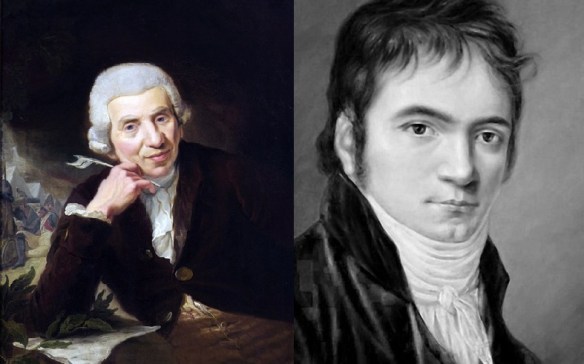 Ludwig Gleim, author to the melody Ich hab’ ein kleines Huettchen nur (portrait by Johann Heinrich Ramberg) and the young Beethoven
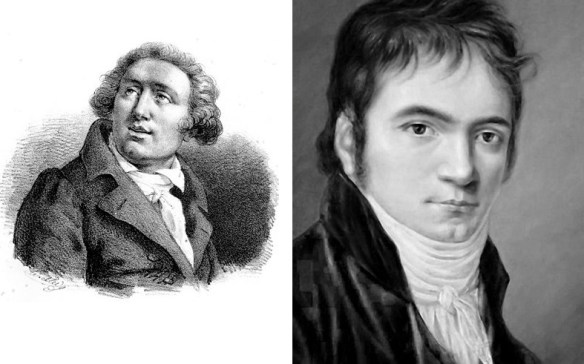 The Portaits of Giovanni Paisiello (left) and the young Beethoven
