Im Arm der Liebe ruht sich’s wohl WoO 159, canon for three voices (1795, Beethoven aged 24)
Dedication not known
Text Hermann Wilhelm Franz Ueltzen
Duration 1’20”
Listen
Background and Critical Reception
First, a reminder that a canon is a melody assigned to more than one part / singer – and the melody of that part / singer follows the original at a set distance. Beethoven used the technique for a number of short pieces, both for instruments and for voices, honing his craft from his early twenties in Vienna.
This example for three voices, setting a text by Hermann Wilhelm Franz Ueltzen, is only just over a minute but works several repetitions of what proves to be a catchy melody. The text, interpreted by the Unheard Beethoven website, translates as the following:
In the arm of love one rests well,
In the bowels of the earth one rests well,
Wherever it may be, for the tired it is all the same
Thoughts
These short pieces are fascinating when set against Beethoven’s longer works. They feel like small building blocks of a much bigger construction, illustrating the composer’s ability to quickly establish a tune and even its development in the shortest space of time. As a result even a piece this short is not entirely throwaway, and is quite profound.
Recordings used and Spotify links
Kammerchor der Berliner Singakademie / Dietrich Knothe (Brilliant)
Ensemble Tamanial (Naxos)
Ensemble Tamanial state the whole theme first, then proceed with Beethoven’s working into a canon. Meanwhile the Kammerchor der Berliner Singakademie under Dietrich Knothe add a generous helping of vibrato.
Also written in 1795 Haydn150 Scottish Songs, Hob.XXXIa:1–150
Canon in C major Hess 248 for four voices (1795, Beethoven aged 24)
Dedication not known Duration 1’10”
Listen
Background and Critical Reception
This short canon is for four ‘voices’ – as in four separate parts. It is the second canon of Beethoven’s we have heard to date, but as we listen to more of his music this aspect of his output will be more fully revealed.
Thoughts
A bold, confidently written piece – with a motif whose repetitions become a little trying after a while! It is however a good example of Beethoven’s rigorous training and ability to work with an ever-increasing number of techniques.
Recording used and Spotify link
Benjamin Lichtenegger, Lara Kusztrich, Luka Kusztrich, Dominik Hellsberg (violins) (Naxos)
An attractively performed and brightly lit version.
You can chart the Arcana Beethoven playlist as it grows, with one recommended version of each piece we listen to. Catch up here!
Also written in 1795Hyacinthe Jadin – 3 String Quartets Op.1
Engraved portrait of Gottlieb Stephanie dem Jüngeren
2 Arias for Umlauf’s Singspiel Die schöne Schusterin oder Die pücefarbenen Schuhe for tenor, soprano and orchestra (1795, Beethoven aged 24)
1 O welch ein Leben (tenor) 2. Soll ein Schuh nicht drücken (soprano)
Dedication Ignaz Umlauf Text Gottlieb Stephanie dem Jüngeren Duration 9′
Listen
Background and Critical Reception
These two songs were written for Ignaz Umlauf’s Singspiel Die schöne Schusterin oder Die pücefarbenen Schuhe (The Beautiful Shoemaker’s Wife or The Puce-Coloured Shoes). They were completed in 1795 for the composer Umlauf, who sadly died the following year. Beethoven provided an aria each for tenor and soprano, the singers accompanied by a small orchestra of woodwind and strings.
Andrew Stewart, in his sleeve notes for a recent recording of the second aria by Chen Reiss, gives a helpful overview of the story. “Die schöne Schusterin revolves around Lehne, a shoemaker’s wife, subject of a prank played on her husband, the aptly named Sock, by the boisterous yet good-natured Baron von Pikourt. Beethoven’s interpolations complement the work’s genial humour: Sollein Schuh celebrates the pleasures of a pair of fine new shoes, even if they demand the pain of do-it-yourself chiropody.”
Reiss herself describes the soprano Magdalena Willmann, for whom the second aria was written – and with whom Beethoven was briefly infatuated: “She was famous for her unusually deep low register, which may explain the many low passages in both arias.”
Thoughts
The two arias are a contrast. The tenor aria, O welch ein Leben, ein ganzes Meer von Lust (‘Oh! What a life, a whole ocean of pleasure’) proceeds in a relatively straightforward manner, with Beethoven’s control of the vocal line and orchestra interaction resembling Mozart. The approach is an elegant one, with a hint of playfulness.
Soll ein Schuh nicht drücken (‘For shoes not to pinch’) is a different story. After an extended orchestral introduction the soprano really gets a chance to let herself loose in a wide-ranging aria. Beethoven moves from the depths to the heights, asking his singer to really extend herself. The bravura takes her centre stage, the orchestra supplying the punctuation.
Recordings used
Chen Reiss (soprano), Academy of Ancient Music / Richard Egarr (Onyx Classics) DanKarlström (tenor), Reetta Haavisto (soprano), Turku Philharmonic Orchestra / Leif Segerstam (Naxos) Nicolai Gedda (tenor), Anneliese Rothenberger (soprano), Convivium Musicum München / Erich Keller (Deutsche Grammophon)
On a new recording for Naxos, with the Turku Philharmonic Orchestra sensitively conducted by Leif Segerstam, DanKarlström sings with great clarity, while Reetta Haavisto gives her aria plenty of gusto in the higher passages.
Nicolai Gedda and Anneliese Rothenberger are both very good in a recording that shows its age a little. Chen Reiss gives a wonderful account of Soll ein Schuh with the Academy of Ancient Music and Richard Egarr, supplying the brio and full dose of passion that this aria really needs. The high notes are sensational.
Spotify links
This playlist collects the available versions mentioned above:
You can chart the Arcana Beethoven playlist as it grows, with one recommended version of each piece we listen to. Catch up here!
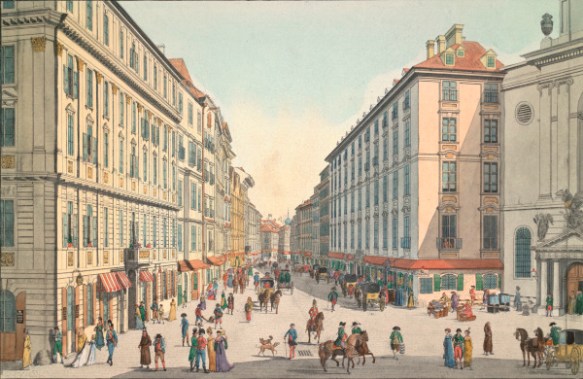
View of the Kohlmarkt from Michael-platz by Karl Schütz (18th century)
String Quintet in E flat major Op.4 (1795, Beethoven aged 24)
1. Allegro con brio
2. Andante
3. Menuetto più Allegretto – Trio
4. Presto
Dedication unknown Duration 29’30”
Listen
Background and Critical Reception
In which Beethoven returns to his Octet for wind in E flat major, eventually published as Op.103. At this point however the work was only privately known, so Beethoven followed the example of Mozart in reworking a work for wind ensemble for string quintet, part of a response to a double commission from Count Apponyi. Mozart’s revised work was the conversion of the Serenade in C minor K388, also for octet, into the String Quintet published as K406.
In spite of their acknowledged quality, Beethoven’s two string quintets are relatively neglected, in spite of their acknowledged quality. In them Beethoven skirts around the string quartet, writing for it directly but disguising his efforts either with the addition of two horns or an extra viola. In a sense he was playing it safe until fully ready to enter a pressurised arena.
Lewis Lockwood notes how Beethoven’s String Quintet makes considerable advances on the music of the Octet. “Especially revealing of Beethoven’s musical growth from the final apprentice years to his first true maturity in Vienna is his revision of the Wind Octet as a String Quintet”, he writes. “The whole revision – which is no mere arrangement but a true recomposition – exemplifies Beethoven’s command even more than does his use of Bonn material in the piano sonatas of Op.2.”
Richard Wigmore writes perceptive notes for the recording made by the Nash Ensemble for Hyperion. He notes Beethoven’s new-found maturity to be ‘not least because of his intensive contact with Haydn’s latest symphonies and string quartets’, and shows how those encounters are manifested in the Quintet. “No-one could guess”, he says, “that this music – or large tracts of it – was not originally conceived for strings.”
Thoughts
The neglect in which the Op.4 string quintet is held is surprising, given its obvious quality. Pleasant though the material for the wind octet is, this feels like a real step up in terms of structural command and instrumental invention. The mood is much more purposeful, the dialogue between the strings containing music of deep substance and featuring impressive development of Beethoven’s themes.
The first movement is tautly argued, its ten minutes passing quickly with concentrated musical thought. The second movement finds a much more tender spot, a lovely Andante where time slows and the subject becomes more lyrical.
The scherzo is closely linked to the Octet, and its theme flits across the five instruments, an insistent rhythm working away like a persistent insect. The big difference is in the two trio sections. The first is what seems like a throwaway phrase that Beethoven works between the parts beautifully, while the second – for quartet alone – is quite chromatic, the melody sliding by step but very fluid in its execution.
The finale is quick and wraps up the quintet with a nice balance of wit and purpose.
Recordings used and Spotify links
Nash Ensemble [Marianne Thorsen, Malin Broman (violins), Lawrence Power, Philip Dukes (violas), Paul Watkins (cello)] (Hyperion)
Endellion String Quartet [Andrew Watkinson, Ralph de Souza (violins), Garfield Jackson (viola), David Waterman (cello)], David Adams (viola) (Warner Classics)
Two excellent recordings.
You can chart the Arcana Beethoven playlist as it grows, with one recommended version of each piece we listen to. Catch up here!
Also written in 1795 HaydnSymphony no.103 in E flat major ‘Drum Roll’
University square in Vienna by Bernardo Bellotto (18th century)
Sextet in E flat major Op.81b for 2 horns and string quartet (1795, Beethoven aged 24)
1. Allegro con brio
Dedication unknown Duration 17′
Listen
Background and Critical Reception
In his early twenties Beethoven wrote a good deal of music for wind instruments, staying close to the ‘Serenade’ and ‘Divertimento’ forms perfected by Mozart. The combination for this particular work is quite unusual, with the two horns and string quartet unmatched in any other composition. The only comparable instrumentation would seem to be Mozart’s Horn Quintet in E flat major from 1782.
Peter Holman, in his booklet notes for the Gaudier Ensemble’s recording on Hyperion, speculates that the work may have been written for performance by Nicholas Simrock, a friend of Beethoven’s since their days at the orchestra in Bonn in 1789. Simrock published the work in 1810 with the misleading Op.81b, suggesting a composition date much later than the actual year of 1795.
The work brings the two horns to the front, giving them plenty of opportunity for display – and often has the horns and string quartet as opposing or complementary forces.
Thoughts
This is a light-hearted work, very undemanding for the listener – but pleasant too, with plenty of easy natured tunes. Sometimes it feels like Beethoven is just trying out the agility of the horns, while other times he writes unexpectedly moving music. Some of the horn lines in the slow movement in particular, a lovely reverie in A flat major, are sublime, as are the colours Beethoven achieves with the richness of the horns and the strings.
The third movement has something of the hunt about it, from the opening theme on the horn, but it also shifts to the minor key for quite a big section in the middle, exposing a mournful theme from one of the horns. There are some lovely low notes towards the end, part of a pretty rigorous technical challenge for both horn players.
Overall though the Sextet has a lovely communal feel, an undemanding but quite substantial work – and occupies quite a unique spot with its instrumental combination.
Recordings used and Spotify links
Members of the Berlin Philharmonic Octet (Philips) Academy of St. Martin-in-the-Fields Chamber Ensemble (Philips) L’Archibudelli (Sony) Gewandhaus Quartet, Hermann Baumann, Vladimir Dshambasov (horns) (Deutsche Grammophon)
The older recordings from the Members of the Berlin Philharmonic Octet and the Gewandhaus Quartet show their age a little, with quite grainy string sound, and with the DG recording the two groups feel very separate. The L’Archibudelli version, on period instruments, is really enjoyable, and the slightly unpredictable horn tuning adds a touch of authenticity. The ASMF Chamber Ensemble are excellent in this repertoire, beautifully poised and balanced.
The Spotify playlist below collects the recordings used:
You can chart the Arcana Beethoven playlist as it grows, with one recommended version of each piece we listen to. Catch up here!
Also written in 1795 Frederich WittHorn Concerto in E flat major