Listening to Beethoven #86 – 12 German Dances

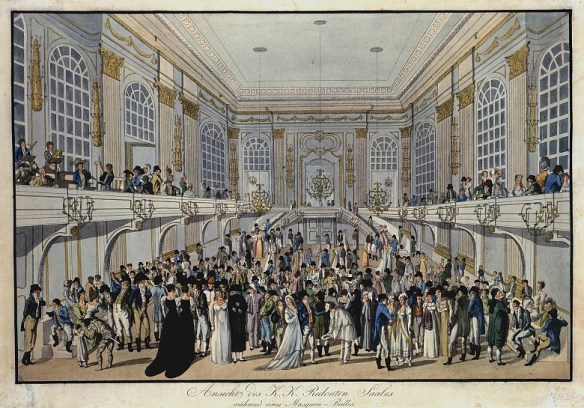
The panel of Leopold II after the wedding ceremony in the Redoutensaal, 1790 by Hieronymus Löschenkohl (c) Wien Museum

12 German Dances, WoO 8 for orchestra (1795, Beethoven aged 24

no.1 in C major
no.2 in A major
no.3 in F major
no.4 in B flat major
no.5 in E flat major
no.6 in G major
no.7 in G major
no.8 in C major
no.9 in A major
no.10 in F major
no.11 in G major
no.12 and Coda in C major

Dedication Vienna Artists’ Pension Society
Duration 20′

Listen

Background and Critical Reception

Beethoven’s increased standing in Vienna could be comfortably summed up by his commissions for the masked charity ball, held on 22 November 1795 by the Viennese Artists’ Pension Society. There were two balls, one held in the Large Redoutensaal and one in the smaller hall. Both required a set of 12 dances which were commissioned by leading composers of the day, including Haydn and Dittersdorf.

In 1795 the honour fell to Franz Xaver Süssmayr in the big hall, and Beethoven himself for the smaller venue. He delivered a set of 12 German Dances and 12 Minuets WoO7, up next. In the notes to DG’s Complete Beethoven Edition these are praised by Hans-Günter Klein, who notes Beethoven’s ability to ‘avoid any sense of monotony by his varied deployment of brass and woodwind and by his skilful choice of tonality. The use of piccolo and ‘Turkish’ percussion is for special effects, while the extended final dance, roughly twice the length of the other eleven, ‘sounds like a pre-echo of the ‘Pastoral’ symphony’.

Daniel Heartz tells a great story in his book Mozart, Haydn and Early Beethoven of the event and its context – and how composers would respond to the commission with deliberately ‘safe’ keys. He goes into impressive detail of the form Beethoven uses, which is simple but functional, and is topped off by pure melodic invention.

Thoughts

The dances are good fun – and most have a spring in their step, as though Beethoven relished writing for the ball. The second has an urgent demeanour and the fourth has a few witty glances. Each time Beethoven’s scoring is attractive, giving plenty of room for the tune to be heard but using short bass notes to keep the dancers on their toes.

Sometimes the scoring is thicker, such as in the fifth dance, or the seventh, which brings out heavier percussion. These return in the last dance, where Beethoven brings out the artillery, and the coda, which begins gracefully before getting carried away with trumpet fanfares. The tenth dance has a surprise in store too, with a brief minor-key central section. You can sense Beethoven having fun with his audience’s expectations, having successfully persuaded them all onto the dancefloor.

Recordings used and Spotify links

The playlist below includes recordings from Philharmonia Hungarica / Hans Ludwig Hirsch (Warner Classics), the Swedish Chamber Orchestra conducted by Thomas Dausgaard on Simax and the Academy of St. Martin-in-the-Fields under Sir Neville Marriner (Philips)

Thomas Dausgaard’s sprightly versions feel as though they have been plucked from the centre of the Viennese dancefloor, with the crisp bass giving extra lift to each step. Sir Neville Marriner and the Academy of St. Martin-in-the-Fields are more measured, which makes the final coda all the more enjoyable with its added humour. The Philharmonia Hungarica and Hans Ludwig Hirsch are on the slow side tempo-wise.

You can chart the Arcana Beethoven playlist as it grows, with one recommended version of each piece we listen to. Catch up here!


Also written in 1795 Gyrowetz Three Flute Quartets Op.11

Next up 12 Minuets WoO7

Listening to Beethoven #85 – 6 Minuets for string trio

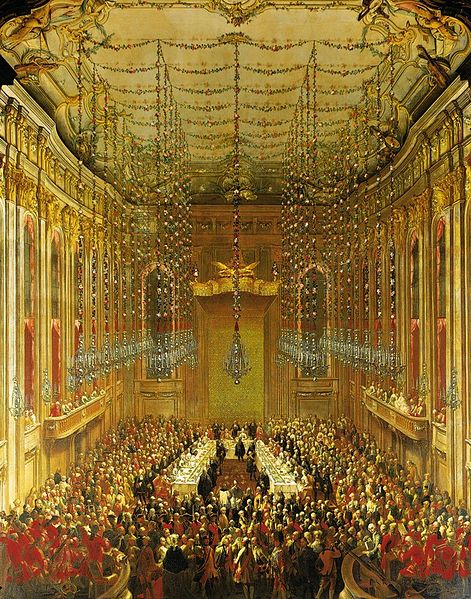
The Grosse Redoutensaal (Grand Ballroom) of the Hofburg Imperial Palace in Vienna by Joseph Schütz

6 Minuets, WoO 9 for two violins and cello (1795, Beethoven aged 24)

no.1 in E flat major
no.2 in G major
no.3 in C major
no.4 in F major
no.5 in D major
no.6 in G major

Dedication not known
Duration 12′

Listen

Background and Critical Reception

Here we have some more of Beethoven’s music for dancing – another set of six minuets that showed the young composer was really getting into the spirit of Vienna’s social culture. With Haydn looking further afield to London, there was definitely room for him to grow – and as we will see, the mid 1790s were Beethoven’s time to provide these social soundtracks.

Beethoven appears to have had small scale dancing in mind with these six dances, originally scoring them for two violins and cello. There is an unnamed version of them for full orchestra too.

Thoughts

Once again these are attractive pieces with easy melodies and amiable rhythms that make them ideal for communal merrymaking. Beethoven continues writing in ‘safe’ major keys, and the dances all last for around two minutes with a slightly contrasting ‘trio’ section in the middle.

This set begins with a stately and genial E flat major minuet, which moves on to a more legato dance in G major.

The third minuet has some more vigorous steps in a style that sounds almost Schubertian in the orchestral version, and it has a lovely central ‘trio’ section with pizzicato from the violins. We move to F major for some regal gliding across the floor, then to D for a jaunty and quite spiky number, a faster minuet.

The sixth minuet channels the spirit of Mozart with its deceptively simple phrases and interplay between instruments.

Recordings used and Spotify links

Lukas Hagen, Alois Posch, Rainer Schmidt


Tristan Segal, Noa Sarid, Isabel Kwon

Philharmonia Hungarica / Hans Ludwig Hirsch

Three attractive versions here, though naturally the ones for string trio sound much more intimate and homely. The orchestral versions have more weight but are nicely scored.

You can chart the Arcana Beethoven playlist as it grows, with one recommended version of each piece we listen to. Catch up here!


Also written in 1795 Gyrowetz Three Flute Quartets Op.11

Next up 12 German Dances WoO8

Listening to Beethoven #84 – Im Arm der Liebe ruht sich’s wohl WoO 159


Beethoven’s Eyeglass. Photo (c) Beethoven-Haus, Bonn

Im Arm der Liebe ruht sich’s wohl WoO 159, canon for three voices (1795, Beethoven aged 24)

Dedication not known
Text Hermann Wilhelm Franz Ueltzen
Duration 1’20”

Listen

Background and Critical Reception

First, a reminder that a canon is a melody assigned to more than one part / singer – and the melody of that part / singer follows the original at a set distance. Beethoven used the technique for a number of short pieces, both for instruments and for voices, honing his craft from his early twenties in Vienna.

This example for three voices, setting a text by Hermann Wilhelm Franz Ueltzen, is only just over a minute but works several repetitions of what proves to be a catchy melody. The text, interpreted by the Unheard Beethoven website, translates as the following:

In the arm of love one rests well,
In the bowels of the earth one rests well,
Wherever it may be, for the tired it is all the same

Thoughts

These short pieces are fascinating when set against Beethoven’s longer works. They feel like small building blocks of a much bigger construction, illustrating the composer’s ability to quickly establish a tune and even its development in the shortest space of time. As a result even a piece this short is not entirely throwaway, and is quite profound.

Recordings used and Spotify links

Kammerchor der Berliner Singakademie / Dietrich Knothe (Brilliant)

Ensemble Tamanial (Naxos)

Ensemble Tamanial state the whole theme first, then proceed with Beethoven’s working into a canon. Meanwhile the Kammerchor der Berliner Singakademie under Dietrich Knothe add a generous helping of vibrato.

Also written in 1795 Haydn 150 Scottish Songs, Hob.XXXIa:1–150

Next up 6 Minuets WoO9

Listening to Beethoven #83 – Canon in C major

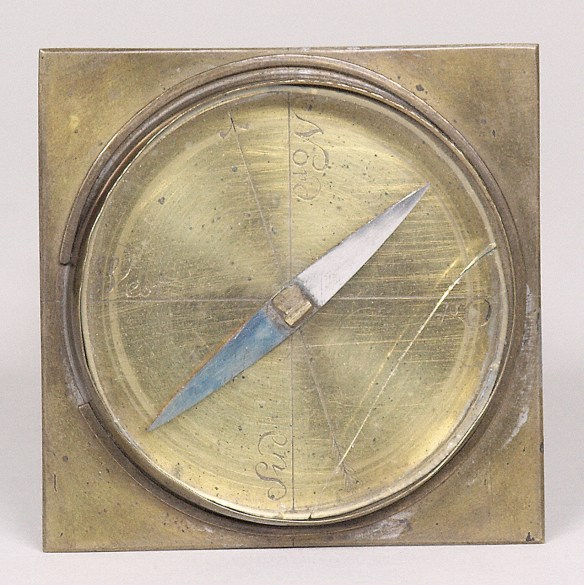
Beethoven’s compass © Beethoven-Haus Bonn

Canon in C major Hess 248 for four voices (1795, Beethoven aged 24)

Dedication not known
Duration 1’10”

Listen

Background and Critical Reception

This short canon is for four ‘voices’ – as in four separate parts. It is the second canon of Beethoven’s we have heard to date, but as we listen to more of his music this aspect of his output will be more fully revealed.

Thoughts

A bold, confidently written piece – with a motif whose repetitions become a little trying after a while! It is however a good example of Beethoven’s rigorous training and ability to work with an ever-increasing number of techniques.

Recording used and Spotify link

Benjamin Lichtenegger, Lara Kusztrich, Luka Kusztrich, Dominik Hellsberg (violins) (Naxos)

An attractively performed and brightly lit version.

You can chart the Arcana Beethoven playlist as it grows, with one recommended version of each piece we listen to. Catch up here!

Also written in 1795 Hyacinthe Jadin 3 String Quartets Op.1

Next up Im Arm der Liebe ruht sich’s wohl

Listening to Beethoven #82 – 2 Arias for Die schöne Schusterin oder Die pücefarbenen Schuhe

Engraved portrait of Gottlieb Stephanie dem Jüngeren

2 Arias for Umlauf’s Singspiel Die schöne Schusterin oder Die pücefarbenen Schuhe for tenor, soprano and orchestra (1795, Beethoven aged 24)

1 O welch ein Leben (tenor)
2. Soll ein Schuh nicht drücken (soprano)

Dedication Ignaz Umlauf
Text Gottlieb Stephanie dem Jüngeren
Duration 9′

Listen

Background and Critical Reception

These two songs were written for Ignaz Umlauf’s Singspiel Die schöne Schusterin oder Die pücefarbenen Schuhe (The Beautiful Shoemaker’s Wife or The Puce-Coloured Shoes). They were completed in 1795 for the composer Umlauf, who sadly died the following year. Beethoven provided an aria each for tenor and soprano, the singers accompanied by a small orchestra of woodwind and strings.

Andrew Stewart, in his sleeve notes for a recent recording of the second aria by Chen Reiss, gives a helpful overview of the story. “Die schöne Schusterin revolves around Lehne, a shoemaker’s wife, subject of a prank played on her husband, the aptly named Sock, by the boisterous yet good-natured Baron von Pikourt. Beethoven’s interpolations complement the work’s genial humour: Sollein Schuh celebrates the pleasures of a pair of fine new shoes, even if they demand the pain of do-it-yourself chiropody.”

Reiss herself describes the soprano Magdalena Willmann, for whom the second aria was written – and with whom Beethoven was briefly infatuated: “She was famous for her unusually deep low register, which may explain the many low passages in both arias.”

Thoughts

The two arias are a contrast. The tenor aria, O welch ein Leben, ein ganzes Meer von Lust (‘Oh! What a life, a whole ocean of pleasure’) proceeds in a relatively straightforward manner, with Beethoven’s control of the vocal line and orchestra interaction resembling Mozart. The approach is an elegant one, with a hint of playfulness.

Soll ein Schuh nicht drücken (‘For shoes not to pinch’) is a different story. After an extended orchestral introduction the soprano really gets a chance to let herself loose in a wide-ranging aria. Beethoven moves from the depths to the heights, asking his singer to really extend herself. The bravura takes her centre stage, the orchestra supplying the punctuation.

Recordings used

Chen Reiss (soprano), Academy of Ancient Music / Richard Egarr (Onyx Classics)
Dan Karlström (tenor), Reetta Haavisto (soprano), Turku Philharmonic Orchestra / Leif Segerstam (Naxos)
Nicolai Gedda (tenor), Anneliese Rothenberger (soprano), Convivium Musicum München / Erich Keller (Deutsche Grammophon)

On a new recording for Naxos, with the Turku Philharmonic Orchestra sensitively conducted by Leif Segerstam, Dan Karlström sings with great clarity, while Reetta Haavisto gives her aria plenty of gusto in the higher passages.

Nicolai Gedda and Anneliese Rothenberger are both very good in a recording that shows its age a little. Chen Reiss gives a wonderful account of Soll ein Schuh with the Academy of Ancient Music and Richard Egarr, supplying the brio and full dose of passion that this aria really needs. The high notes are sensational.

Spotify links

This playlist collects the available versions mentioned above:

You can chart the Arcana Beethoven playlist as it grows, with one recommended version of each piece we listen to. Catch up here!

Also written in 1792 Salieri – Palmira

Next up Canon in G major Hess 248