Listening to Beethoven #55 – Rondo in G major for piano and violin

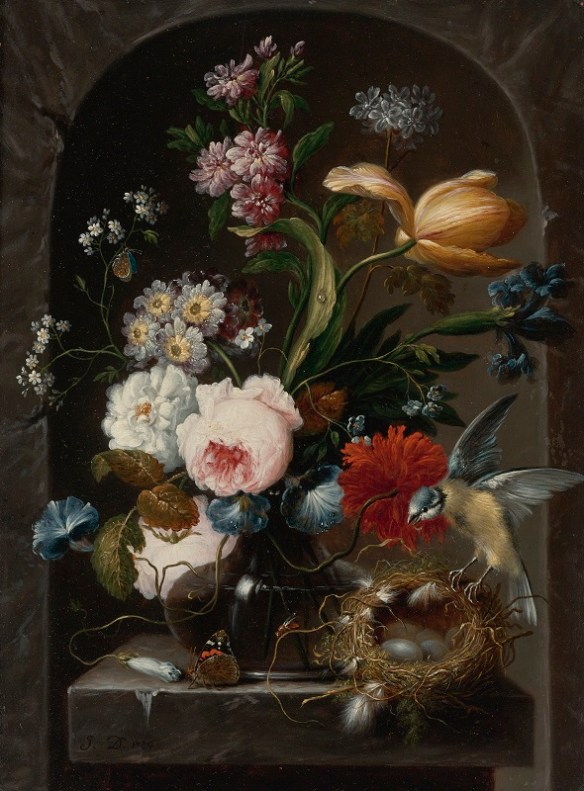
Still life by Viennese artist Johann Baptist Drechsler, 1789

Rondo in G major WoO41 for piano and violin (1794, Beethoven aged 23)

Dedication Elenore von Breuning
Duration 5′

Listen

Background and Critical Reception

Variations and rondos were part of Beethoven’s development as a composer, and this short piece for piano and violin is another example of the composer’s development in the ‘rondo’ form. Traditionally this would involve a main theme (‘A’), a secondary one (‘B’) and a contrasting third section in the middle (‘C’).

Writing in the booklet of the Deutsche Grammophon recording by Wilhelm Kempff and Yehudi Menuhin, Bernhard Uske notes how in writing rondos Beethoven ‘absorbed the pattern of the ‘rondello’ from Italian folk music with its broad appeal into the process of variational development.’

Technically the piece is straightforward, indicating a design for domestic use – and Beethoven thought enough of it to dedicate it to his dear Bonn friend Eleonore von Breuning, along with the Variations on Mozart’s Se Vuol Ballare

Thoughts

The Rondo is easy on the ear. A nice, limpid piano introduction presents the theme, which has a straightforward profile but becomes more memorable with its repetitions in the rondo structure. The violin takes over, and the two instruments are closer together to present the second theme.

The central section (the ‘C’ of the rondo’s A – B – A – C – A – B – A) moves to G minor for a simple triple-time waltz, where a slight shadow falls over the music. It does not last, however, the ‘A’ theme returning to leave us in its warm glow.

Recordings used

Wilhelm Kempff (piano), Yehudi Menuhin (violin) (Deutsche Grammophon)
James Lisney (piano), Paul Barritt (violin) (Woodhouse Editions / Regent)

Paul Barritt and James Lisney present quite a nippy account of the Rondo, nicely dovetailed and brightly voiced. Wilhelm Kempff and Yehudi Menuhin proceed at a much more leisurely pace, taking nearly two minutes longer but playing gracefully and evoking a triple-time dance.

Spotify links

Wilhelm Kempff, Yehudi Menuhin

Also written in 1794 Benjamin Carr The Federal Overture

Next up String Trio in E flat major Op.3

Listening to Beethoven #54 – Giura il nocchier (1st version)


Beethoven stamp, issued in Hungary to mark the bicentenary of the composer’s birth, 1970

Giura il nocchier Hess 230 for four unaccompanied voices (1794, Beethoven aged 23)

Dedication not known
Text Pietro Antonio Domenico Bonaventura Trapassi (1698 – 1782), as Pietro Metastasio
Duration 0’45”

Listen

Background and Critical Reception

Beethoven’s began setting Italian texts in 1793, just as he was beginning to study with Antonio Salieri in a calculated move to bring more operatic elements of composition to his attention. The new teacher would offer his own musical thoughts which the composer kept for posterity.

This particular text, setting Pietro Metastasio, has no fewer than three version – of which this is the first. The translated first verse of two reads, ‘The helmsman swears that he will no longer trust the ocean, but if he sees it calm, he hastens to set sail again’.

Thoughts

This song feels like an exercise, as though Beethoven were feeling his way back into choral composition, after his only previous settings in the big cantatas of the Bonn days.

This setting is foursquare, close harmonies between the voices in the purity of C major – and a very straightforward piece of writing.

Recordings used

Cantus Novus Wien (Naxos)

This recently released version is nicely sung in quite a reverberant setting. It is part of a valuable recent release from Naxos bringing together Beethoven’s secular works for voice. Recorded in Vienna, it highlights the more ‘functional’ side of his writing, with pieces for weddings, name days or departures of a friend.

Spotify links

Cantus Novus Wien

You can chart the Arcana Beethoven playlist as it grows, with one recommended version of each piece we listen to. Catch up here!

Also written in 1794 William Billings The Continental Harmony

Next up Rondo for piano and violin in G major WoO 41

Listening to Beethoven #53 – Der freie Mann


Peanuts comic strip, drawn by Charles M. Schulz (c)PNTS

Der freie Mann WoO 117 for voice and piano (1792-94, Beethoven aged 23)

Dedication not known
Text Gottlieb Conrad Pfeffel
Duration 1’30”

Listen

Background and Critical Reception

“Who is a free man? He on whom only his own will and no despot’s whim can impose laws; that man is free!”

So runs the translation of this very short setting of Pfeffel. Very little is written about this setting, but the text obviously appealed to the composer as he wrote an earlier version before settling on this in 1794. The entry for this piece on the Unheard Beethoven website writes, “One may even say it expresses one of his basic beliefs: the right of individuals to be free, and take destiny in their own hands”.

The notes for DG’s Complete Beethoven edition class this song as a ‘Gesellscaftslieder’ – joining the two drinking songs we heard recently. This is a sober, political alternative.

Thoughts

This may be a short song but it has a bracing blast from the ensemble at the outset, followed by a wholesome melody from solo singer in response.

For the listener it is good fun – completely lacking in subtlety but all the better for it!

Recordings used

Hermann Prey (baritone), Heinrich Schütz Kreis Berlin, Leonard Hokanson (piano) (Capriccio)
Peter Schreier (tenor), Walter Obertz (piano) (Brilliant Classics)

Hermann Prey and the Heinrich Schütz Kreis, Berlin throw their all into this with impressive heft, supported by the fullbodied piano of Leonard Hokanson. As though to stress the text they repeat it too. Peter Schreier gives a really strong account also, and in the tenor register the song acquires greater upward reach.

Spotify links

Hermann Prey, Heinrich Schütz Kreis Berlin, Leonard Hokanson

Peter Schreier, Walter Obertz

Also written in 1794 Hummel 3 Fugues Op.7

Next up Giura il nocchier

Listening to Beethoven #52 – Piano Trio in C minor Op.1/3


The Cafe Griensteidl, on Michaelerplatz, Vienna by Reinhold Völkel

written by Ben Hogwood

Piano Trio in C minor Op.1 no.3 for piano, violin and cello (1792-94, Beethoven aged 23)

Dedication Prince Charles Lichnowsky
Duration 32′

Listen

Background and Critical Reception

Beethoven was already leading his audiences into new sound worlds and structures with the first two piano trios of his Op.1 set – but with the third installment he cut many of the cords tying him to the past. In his booklet notes accompanying the Florestan Trio’s recordings of the trios on Hyperion, Richard Wigmore takes up the story.

“In the first two trios Beethoven’s subversiveness was still cloaked in the language of the classical comedy of manners. But in the Piano Trio in C minor Op.1 no.3, it erupted in a work of startling explosive vehemence and dark lyric beauty.” Haydn, who had recently returned to Vienna from London, was in the audience with the work’s dedicatee Prince Lichnowsky. He was full of praise for the first two works in the set but had reservations around the third. Those reservations, according to a diary entry from Beethoven’s pupil Ferdinand Ries, led Haydn to advise his pupil not to publish the work. The truth, it seems, was more subtle – Haydn not necessarily critical of the musical content but airing doubts about its difficulty for the musicians of the day and its challenging content for the Viennese audiences. They were not accustomed to hearing music of such assertiveness and drama in the form of the piano trio.

Beethoven was his own man here – with the influences of Mozart less keenly felt. As Wigmore writes, “the music is profoundly Beethovenian in its abrupt, extreme contrasts, with violent rhetoric (the first page alone is peppered with sforzando accents) alternating with intense pathos and yearning lyricism”.

Thoughts

A very different atmosphere inhabits the third of Beethoven’s Op.1 piano trios. From the outset there is a chill down the spine of the music, a shiver as the bare octaves from the three instruments announce the opening theme. The mood is similar to that of Mozart’s Piano Concerto no.24, also in C minor – which gives an idea of the orchestral concepts behind Beethoven’s writing. It sets the tone for further outings in this key, with foreboding tones and a repressed energy suggesting the music could erupt at any minute. In contrast to the first two works in the set, it grabs the initiative and looks forward with every opportunity.

The ‘coiled spring’ is kept largely intact in the first movement, though the music does threaten to run away at times, often countered by the calmer second theme. The next movement is serene but retains a serious demeanour to start with, loosening up as its theme and variations format unfold – shaking off its ‘slow’ tag, too, with variations such as the driving third, with lots of attack on the piano, and the jaunty fifth. The fourth variation, set in E flat minor, is laden with melancholia.

The Scherzo finds Beethoven setting a relatively sombre mood, with the first real smile on the face of the music arriving in the tumbling piano figure that opens the ‘trio’ section. This is where he moves from minor key to major, moving from shade to sunlight.

For many the Finale provides a telling shift in Beethoven’s expression, with the sudden outbursts and syncopated rhythms of its main theme. Here the ensemble sounds so much more than violin, cello and piano, as though a whole orchestra were punching out the statement. This is where the no-holds barred approach has its roots, and the energy levels remain high through towards the end. This makes the closing bars even more striking, a brooding coda only heightening the feeling that this is a beginning, a statement of clear intent. Even at the end there is little resolution, the performers’ emotional energies spent, what little solace, there is clouded by what has gone before.

One can only imagine the atmosphere when the first audiences in Vienna heard it, and Haydn’s relative shock at such a bold, aggressive tone. What a striking piece it is, reaching moods barely hinted at in Beethoven’s output until now. The Piano Trio no.3 sets a precedent for all the other ‘traditional’ forms – symphony, piano concerto, string quartet and instrumental sonatas – combining formal innovation with deeply expressed emotions which liable to change like the wind.

Recordings used

Castle Trio (Lambert Orkis (piano), Marilyn McDonald (violin), Kenneth Slowik (cello) (Warner Classics)
Florestan Trio (Susan Tomes (piano), Anthony Marwood (violin), Richard Lester (cello) (Hyperion)
Beaux Arts Trio (Menahem Pressler (piano), Daniel Guilet (violin), Bernard Greenhouse (cello) (Philips, 1964 recording)
Wilhelm Kempff (piano), Henryk Szeryng (violin), Pierre Fournier (cello) (Deutsche Grammophon)

The Castle Trio are great to listen to here, as they capture the sense of originality that first audience would have experienced. Their account features some very impressive fingerwork from Lambert Orkis and intense expression from the string players. Another recording on ‘period’ instruments to mark up is that by Andreas Staier, Daniel Sepec and Jean-Guihen Queyras. It is superbly played, taken at daring speeds and arguably plumbing even greater emotional depths.

Szeryng, Fournier and Kempff inhabit the drama of the outer movements in particular but there is a great intensity between them throughout. The slow movement variations are more expansive but tastefully so.

Once again the Florestan Trio have the measure of this music but also its inherent drama – where they are well-matched by the superb Beaux Arts Trio.

Spotify links

The playlist below compiles the recordings made by the Castle Trio, Beaux Arts Trio and the ensembles of Kempff-Szeryng-Fournier and Staier-Sepec-Queyras:

You can chart the Arcana Beethoven playlist as it grows, with one recommended version of each piece we listen to. Catch up here!

Also written in 1794 Haydn Symphony no.101 in D major ‘Clock’

Next up Der freie Mann WoO 117

Listening to Beethoven #51 – Piano Trio in G major Op.1/2


Vienna coffee house (18th century) (Anonymous painter)

written by Ben Hogwood

Piano Trio in G major Op.1 no.2 for piano, violin and cello (1792-94, Beethoven aged 23)

Dedication Prince Charles Lichnowsky
Duration 33′

Listen

Background and Critical Reception

The second of Beethoven’s three piano trios, Op.1, is a substantial work. As with the first it sets out a number of innovations in the form – structured in four movements rather than three, and giving the strings much more say in the melodic material so that they are on an even footing with the piano. This time Beethoven adds an expansive introduction to the first movement, taking it even closer to the profile of a Haydn symphony.

While the first piece in this triptych of piano trios had its origins in Bonn, this second instalment appears to wholly originate from Vienna, Beethoven working at it through 1793 and 1794. Its choice of key, G major, presents it as a complement to the oft-used E flat major of the first trio, meaning the set of three could be performed in a sequence if the performers had the stamina!

The extra demands on the performers are noted, however. Susan Tomes, talking to Arcana about this work, noted that “Op.1/2 is extremely difficult for the piano particularly, and it has to sound so effervescent, like a Mozart opera in piano trio form. It’s actually very difficult.”

Richard Wigmore, in his notes for the Florestan Trio’s recording on Hyperion, writes how the G major trio ‘immediately establishes its symphonic scale with an imposing slow introduction – something unheard of in a piano trio, and rare even in a string quartet’. Of the slow movement, he writes, ‘It is characteristic of the young Beethoven’s search for an increased profundity of expression that the second movement…combines a siciliano lilt with an unprecedented hymn-like solemnity.’ Meanwhile the finale ‘is another movement that infuses Haydn’s spirit with Beethoven’s own brand of boisterousness.’

Thoughts

The expansive first movement shows Beethoven completely at home in this medium. He allows plenty of time to set out the key and allow a few decorative but meaningful flourishes from the piano, harking back a little to the Baroque period. Soon however he becomes more impatient, and the music moves smoothly into the main body of the movement. A charming statement from the piano is picked up by the strings and the three instruments have fun developing its dance-like qualities.

There is often the sense that Beethoven is playing with his listener, and this comes through in the exchanges that close out the first movement. Elsewhere the music softens, nowhere more so than the second movement, marked Largo con espressione, where the composer opts for the more exotic key of E major to express his feelings. This is a beautiful and restful ten minutes of music, with both violin and cello given plenty of melodic material in their higher registers.

A pure sense of musical enjoyment comes through in the last two movements. The cello takes the lead in the third movement Scherzo, possibly for the first time in this form, while the trio section hints at a darker diversion but quickly returns to the light courtesy of trills on the piano. This is a slightly furtive movement, but gives way to a sparkling finale, emulating Haydn with some of its jokes. The running theme resembles Rossini’s William Tell overture (still 35 years away)

Beethoven’s second is the most substantial Piano Trio to date – but little would have prepared his listeners on what was to follow.

Recordings used

Castle Trio (Lambert Orkis (piano), Marilyn McDonald (violin), Kenneth Slowik (cello) (Warner Classics)
Florestan Trio (Susan Tomes (piano), Anthony Marwood (violin), Richard Lester (cello) (Hyperion)
Beaux Arts Trio (Menahem Pressler (piano), Daniel Guilet (violin), Bernard Greenhouse (cello) (Philips, 1964 recording)
Wilhelm Kempff (piano), Henryk Szeryng (violin), Pierre Fournier (cello) (Deutsche Grammophon)

The Castle Trio are again invaluable guides on how this music might of sounded in its first performance. Their sound can be brittle (to our ears at least) in the slow movement especially, no matter how affectionately it is played. Again the Florestan Trio are excellent in this music, with an affectionate ear for Beethoven’s inventions and in the finale a tempo which really does justice to the composer’s marking of Presto. Wilhelm Kempff, Henryk Szeryng, Pierre Fournier clock in at just over 35 minutes in a very expansive version, lovingly played if offering a lot more heart-on-sleeve. Again the Beaux Arts Trio are excellent guides in their long-established recording from 1964.

Spotify links

The playlist below compiles the recordings made by the Castle Trio, Beaux Arts Trio and the Szeryng-Fournier-Kempff trio:

You can chart the Arcana Beethoven playlist as it grows, with one recommended version of each piece we listen to. Catch up here!

Also written in 1794 Viotti Violin Concerto No.27 in C major

Next up Piano trio in C minor Op.1 no.3