Listening to Beethoven #46 – Que le temps me dure (1st version)


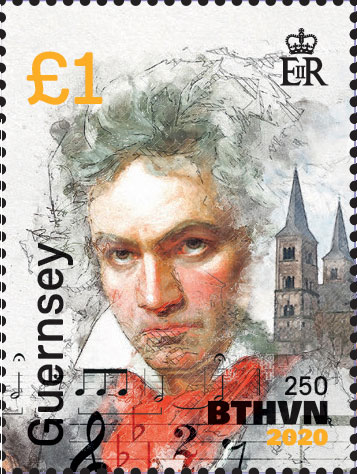
Beethoven stamp, issued by Guernsey Post – part of a series of four
Design: The Potting Shed

Que le temps me dure WoO116a for voice and piano (1793, Beethoven aged 22)

Dedication not known
Text Jean-Jacques Rousseau
Duration 3’30”

Listen

Background and Critical Reception

“How slowly time passes, when I spend it far from you!”

So runs the English translation of the first line of Jean-Jacques Rousseau’s short poem, which Beethoven appears to have set soon after arrival in Vienna. An interesting choice of words, which might suggest a concentrated bout of homesickness. Unfortunately nothing could be found in writing about this setting, which suggests it was kept hidden and maybe only performed in private.

The text evidently meant something to Beethoven, for he made two settings. The first of these, for high voice and piano, is in the key of C minor – a key in which he was spending a good deal of time, with the third piano trio of his forthcoming Op.1 sharing this ‘home’.

Thoughts

This setting is a short one, but it is quite poignant. A sombre if elegant introduction from the piano brings in the singer, with a simple and largely stepwise melody (one note per syllable). There are two verses which are more or less identical, before the music moves into the major key (in Hermann Prey’s version but not Peter Schreier’s).

Schreier’s finishes with a piano postlude that keeps the downcast mood of the song.

Recordings used

Peter Schreier (tenor), Walter Olbertz (piano) (Brilliant Classics)
Hermann Prey (baritone), Leonard Hokanson (piano) (Capriccio)

Hermann Prey’s version is almost twice as long as Peter Schreier – and rather more sorrowful, given its much slower pace. This offers greater meaning when the music moves into the major key. By comparison the tenor Schreier feels more matter of fact in his reflections, especially without the coda that Prey uses.

Spotify links

Peter Schreier (tenor), Walter Olbertz (piano)

Hermann Prey (baritone), Leonard Hokanson (piano) (Capriccio)

Also written in 1793 Beauvarlet-Charpentier Variations on La Marseillaise

Next up Ein Selbstgespräch WoO114

Listening to Beethoven #45 – Oboe Concerto in F major, second movement


The Beethoven-Haus, Bonn Picture by Dr. Avishai Teicher

Oboe Concerto in F major (slow movement) Hess 12 (1792-3, Beethoven aged 22)

Dedication not known
Duration 7′

Listen

Background and Critical Reception

The Oboe Concerto is one of the works sent by Haydn to the Elector of Cologne, showing the progress of his pupil Beethoven since he started with him in Vienna. What he did not realise at the time was that most of the works, including the Octet previously heard, had already been written in Bonn and were all but complete.

Sadly only the slow movement of the concerto, in B flat major, has survived in full, and even then only in sketch form. There is an outline of melody from the beginning to the end, but the piece needed extensive revision for any performance to be possible. This came from a couple of sources, but the one finished by Charles Joseph Lehrer, and orchestrated by Willem, is the only one to be recorded so far.

Daniel Heartz, in his superb book Mozart, Haydn and Early Beethoven 1781-1802, writes that ‘incipits of the three movements survive on a sheet in the Beethoven Archive at Bonn. The two oboists in electoral service were Georg Libsich and Joseph Welsch. From them the young composer could have learned the instrument’s strengths and limitations. His experiences in Bonn, including playing in the court orchestra, endowed him with a fine feeling for the technical and timbral possibilities of all the instruments.’

Thoughts

This fragment is an intriguing listen, even with the knowledge that a good deal of this work is not by Beethoven himself. Initially the tone is serious but relaxes as the strings expand with a soft-voiced introduction, teeing up the oboe nicely.

The main melody is attractive, and soon the oboe is reaching into the upper end of its register, well above the strings. The soloist has plenty of opportunity to show off, especially in a cadenza towards the end, which is nicely cued up by some spicier harmony from the strings. After the cadenza a short statement of the tender theme is all that is required.

Recordings used

Bart Schneemann, Radio Chamber Orchestra / Jan Willem de Vriend (Channel Classics)

Bart Schneemann gives an excellent account, with Jan Willem de Vriend balancing the small Radio Chamber Orchestra nicely. The slow movement of the concerto is tagged on to a second volume of oboe concertos by the German 18th century composer oboist and composer Ludwig August Lebrun, who died three years before Beethoven’s concerto was sent back to Bonn.

Spotify links

Bart Schneemann, Radio Chamber Orchestra / Jan Willem de Vriend

You can chart the Arcana Beethoven playlist as it grows, with one recommended version of each piece we listen to. Catch up here!

Also written in 1793 Haydn 3 String Quartets, Op.71

Next up Que le temps me dure (version 1)

Listening to Beethoven #44 – Octet in E flat major Op.103


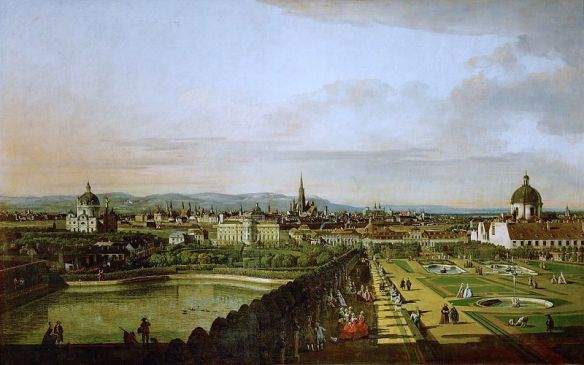
View of Vienna during the Baroque era by Bernardo Bellotto (18th century)

Octet in E flat major Op.103 for wind octet (2 oboes, 2 clarinets, 2 horns and 2 bassoons) (1792-93, Beethoven aged 22)

Dedication Maximilian Franz, Elector of Cologne
Duration 21′

Listen

Background and Critical Reception

The Octet dates mostly from 1792, when Beethoven was still in Bonn – where author Daniel Heartz confirms it was written as Tafelmusick for the Harmonie band of the elector. The Harmonie band had a specific instrumentation mirroring the one written for by Mozart in Vienna – two each of oboes, clarinets, horns and bassoons.

When Beethoven had arrived in Vienna and was studying under Haydn, the elder composer unwittingly submitted the completed work back to the Elector in Bonn. It was covered in the enclosure of ‘a few pieces of music, a quintet, an eight-voiced parthie, an oboe concerto, variations for the piano, and a fugue composed by my dear pupil Beethoven, who was so graciously entrusted to me’. The Octet was finally published as Op.103, three years after Beethoven’s death.

In his appraisal of the piece, Anthony Burton writes that ‘some of the accomplishment of this work may be due to its revision in 1793, after Beethoven had moved to Vienna and begun studying with Haydn. He complements the first movement as ‘particularly well constructed, with intensive treatment of its opening idea’, saying that ‘Beethoven yields nothing to Mozart in his handling of the instruments. If anything, he makes more effective use of the contrast between the full band and groups of two or three players’. He gives the bassoon in the second movement as an example of this, and in the fourth movement applauds the way in which Beethoven ‘spreads the arpeggio figuration of the first theme around the group, including – spectacularly – the horns.’

Thoughts

The Octet is an attractive and entertaining piece, with all the first principles of communal chamber music. Beethoven’s part writing is inclusive, passing his melodies and their development between the groups of oboes, clarinets, horns and bassoons.

The lively first movement explores the lovely sonorities of the wind ensemble, with lively exchanges and imaginative working of the melodies. The second movement is effectively pared down to bring out the solo qualities of oboe and bassoon, who pass Beethoven’s graceful writing between each other, the rest of the ensemble content to accompany from afar.

The Minuet (really a scherzo in all but name) has a nervous energy running through it, generated from the four-note motif the instruments share, with a few unexpected minor-key harmonies and occasional pauses. The trio section of this movement has fragments of melody from the clarinet and bassoon, punctuated by horns.

The last movement is the standout, ending on a high with some virtuosic writing for the horns amongst the bright and characterful writing, while the clarinets bubble to the surface too. Beethoven’s wit comes out smiling here.

Given this is one of his early works for wind ensemble the assurance of Beethoven’s writing is striking, taking the piece close to the world of Mozart’s serenades for wind of around 11 years earlier. The Viennese audiences would surely have been impressed, and it’s no wonder Haydn made a case in favour of the Octet.

Recordings used

Members of the Berlin Philharmonic Orchestra (Deutsche Grammophon)
L’Archibudelli (Sony Vivarte)
Sabine Meyer Bläserensemble (Warner Classics)
The Albion Ensemble (Helios)

Like the Rondino previously heard, there are some fine versions of the Octet. The Members of the Berlin Philharmonic Orchestra, a starry cast, give a strong account from 1969 for Deutsche Grammophon. There is a greater lightness of touch from the Sabine Meyer Bläserensemble, who are especially fluent in the first movement. The rougher contours of the L’Archibudelli horns are appealing, as is their expansive approach to the second movement, taken at a slower tempo. The finale is an eventful quickstep.

Spotify links

L’Archibudelli

Sabine Meyer Bläserensemble

You can chart the Arcana Beethoven playlist as it grows, with one recommended version of each piece we listen to. Catch up here!

Also written in 1793 Cimarosa Concerto for 2 flutes in G major

Next upOboe Concerto in F major (fragment)

Listening to Beethoven #43 – Rondino in E flat major


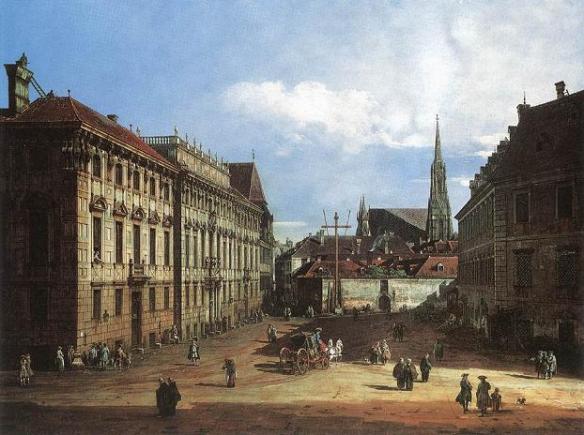
The Lobkowitzplatz, Vienna by Bernardo Bellotto (18th century)

Rondino in E flat major WoO 25 for wind octet (2 oboes, 2 clarinets, 2 horns and 2 bassoons) (1793, Beethoven aged 22)

Dedication
Duration 6’30”

Listen

Background and Critical Reception

The Rondino is thought to have been written around the same time as the Octet for wind Op.103, and may even be a discarded movement from it, given that it shares the same key (E flat major), instrumentation and composition period (either very late in the Bonn period or 1793).

It is for a pair each of oboes, clarinets, horns and bassoons, with the horn writing in particular coming in for special mention. Martin Harlow, writing in the booklet notes for the Albion Ensemble’s recording on Hyperion, describes the Rondino as ‘a marvellously economical work whose brevity belies the intensity of invention contained within’.

The Unheard Beethoven website’s entry for the work notes its close relationship to Mozart’s Serenades, ‘at one level with his masterpiece for the same instruments’ and sharing the same instrumentation. The conclusion is that the Rondino is an ‘amazing, early masterpiece’.

Thoughts

How lovely it is to hear the sonorities of a wind ensemble in the Beethoven listening. This is a lovely piece, the strong implication being that the composer has already mastered writing for such a group but this is the first we properly hear of it.

The title (given by the publisher after Beethoven’s death, possibly) conjures up ideas of a light, frivolous piece, but in the event this Rondino is a tender affair. Its main theme is an attractive one, and lingers in the memory, but the middle sections are elegiac and quite sorrowful, moving as they do through minor keys.

The colours are beautiful, the use of horns particularly masterful – Beethoven seemingly one of the first to use mutes on the instrument as a form of expression. It may be small, but this is a perfectly formed and rather gorgeous piece.

Recordings used

Netherlands Wind Ensemble (Deutsche Grammophon)
L’Archibudelli (Sony Vivarte)
Sabine Meyer Bläserensemble (Warner Classics)
The Albion Ensemble (Helios)

Four fine versions here. The L’Archibudelli version – on instruments of the period – feels slightly woolly with its recorded sound to begin with, before the ensemble passages blossom. It is taken at a slower tempo than the other versions. Both the Sabine Meyer Bläserensemble and The Albion Ensemble are notable for their affection for the piece.

Spotify links

L’Archibudelli

Netherlands Wind Ensemble

Sabine Meyer Bläserensemble

You can chart the Arcana Beethoven playlist as it grows, with one recommended version of each piece we listen to. Catch up here!

Also written in 1793 Haydn Andante with variations in F minor HXVII:6(

Next upOctet in E flat major Op.103

Listening to Beethoven #42 – 12 Variations on ‘Se vuol ballare’

Wolfgang Amadeus Mozart (left) and the young Ludwig van Beethoven

12 Variations on Mozart’s aria ‘Se vuol ballare’ WoO40 for piano and violin (1793, Beethoven aged 22)

Dedication Elenore von Breuning
Duration 12’30”

Listen

What’s the theme like?

Mozart’s theme is from the first act of Le nozze de Figaro – Se vuol ballare being an aria for Figaro himself, on discovering the count’s schemes.

Background and Critical Reception

‘I should never have written down this kind of piece, had I not already noticed fairly often how some people in Vienna after hearing me extemporize of an evening would note down on the following day several peculiarities of my style and palm them off with pride as their own. Well, as I foresaw that their pieces would soon be published, I resolved to forestall these people’.

Beethoven’s statement, made in a letter in 1794, confirms he was now in Vienna – and already attracting great interest. In the covering note with the piece, he also makes reference to the extra prominence for the violin in the work – now seen alongside the piano. ‘The variations will be rather difficult to play, and particularly the trills in the coda. But this must not intimidate or discourage you. For the composition is so arranged that you need only play the trill and can leave out the other notes, since these appear in the violin part as well.’

Nigel Fortune, writing in The Beethoven Companion, suggests Beethoven included these features in his work to embarrass the pianists who tried to play his music, giving them music of extra difficulty.

Thoughts

Beethoven’s statement of the theme is unusual, choosing to announce the tune through pizzicato violin with the softest of piano accompaniments. In this way he imitates a guitar, mirroring the way the tune is first heard in the opera.

As the variations unfold the piano takes the lead, particularly in a thrilling fourth variation which has the mood of a Bach sonata with its bubbling counterpoint, passed back and forward between the instruments. The fifth variation enjoys subtle humour with the figure of a trill exchanged, but then the mood darkens.

The sixth variation moves to the minor key, and the violin plays a mournful melody as the piano adopts a slow, bell-like toll. The roles are reversed for the seventh variation, the music still in the minor key but with a few longer dissonances. Soon the sun returns, the music flowing forward through variations eight and nine, the latter generating terrific energy in its fast moving writing for piano alone, the violin taking a brief rest.

The final variations find the instruments close together, the music flowing and in affirmative mood, but then in the coda Beethoven unexpectedly moves into a new key (D major), which takes the listener by surprise and opens up the music completely. This is however shortlived, the false ‘departure’ quickly coming home to rest with a rather touching finish led by soft trills on the piano.

Beethoven’s first Viennese work is a strong statement, and a very enjoyable one at that. Anyone wishing to capture his music on paper would have had a hard time, for his music is starting to show invention and imagination at every turn.

Recordings used

Yehudi Menuhin (violin), Wilhelm Kempff (piano) (Deutsche Grammophon)
Takako Nishizaki (violin), Jenő Jandó (piano) (Naxos)

Menuhin and Kempff are delightful in this piece, playing as though they were at the opera themselves. The minor key variation has a strong pull. Takako Nishizaki and Jenő Jandó are excellent, too – they pull the tempo around less but that works well in the longer scheme of things.

Spotify links

Yehudi Menuhin, Wilhelm Kempff

Takako Nishizaki, Jenő Jandó

Also written in 1793 Haydn Piano Trio in G major Hob.XV:32

Next up Octet in E flat major Op.103