
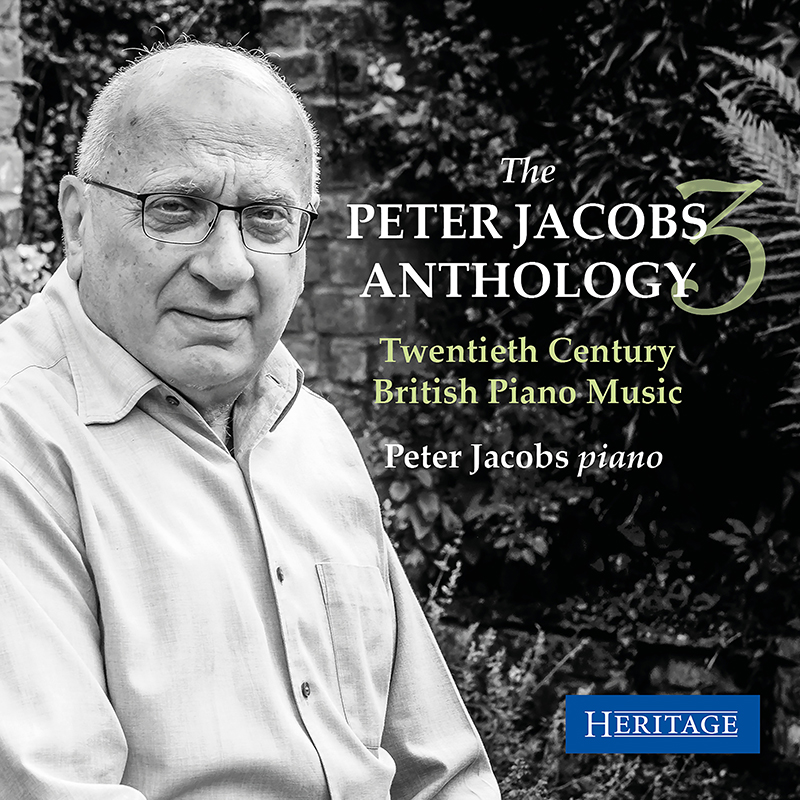
On Record – The Peter Jacobs Anthology Volume 3 (Heritage Records)

Peter Jacobs (piano)

Allum Nocturne in C sharp minor; Prelude No. 24 in D minor (both c.1950)
Bantock (arr. composer) Omar Khayam (1906-09) – Prelude and March
Fenney Au Printemps (pub. 1915)
MacDonald Waste of Seas (1976)
Purcell arr. Stevenson The Queen’s Dollour (pub. 1710, arr. 1958)
Simpson Variations and Finale on a Theme of Haydn (1948)
Truscott Prelude and Fugue in E flat minor; Prelude and Fugue in C major (1957)

Heritage Records HTGCD127 (67’25”)
Recorded live at London College of Music, April 1979

Reviewed by Richard Whitehouse

What’s the story?

Heritage continues adds to its extensive Peter Jacobs discography with this recital focussing on music by British composers mainly of the early and mid-twentieth century, each rendered with that combination of fluency and insight which this pianist brings to all his performances.

What’s the music like?

According to his booklet note, Jacobs gave this recital at an Annual General Meeting for the Havergal Brian Society in 1979, though the present writer remembers a pretty much identical programme being given at this event in 1982. The seeming unavailability of works by Brian (Four Miniatures then Prelude and Fugue in C minor) played on this occasion is regrettable, but these are easily available elsewhere while the recital’s purpose in drawing together music by various of Brian’s contemporaries, colleagues or advocates remains essentially unchanged.

Granville Bantock’s choral epic Omar Khayam has numerous excerpts worthy of autonomous status – not least its evocative Prelude and quizzical March. Apparently written in a weekend, Harold Truscott’s brace of Preludes and Fugues – that in E flat minor as methodical as that in C is impetuous – makes one regret he did not attempt a complete cycle. An amateur composer in the most professional sense, Walter Allum’s piano music wears its indebtedness to Chopin but deftly – witness his intricately designed Nocturne or Prelude in D minor which brings to a vividly decisive end a cycle likely worth hearing in its entirety. William J. Fenney enjoyed a modest reputation just after the First World War with Au Printemps (also known as ‘In Early Spring’) a trilogy the more affecting in its emotional restraint – ‘light’ music but never facile.

Forward to what was then the present, Malcolm MacDonald’s Waste of Seas (also known as Hebridean Prelude) sustaining a plangent atmosphere and of a pianistic resourcefulness to suggest his modest output as worth further investigation. A relatively early work, Variations and Finale on a Theme of Haydn has Robert Simpson drawing a wide but integrated range of moods from the innocuous Minuet of Haydn’s 47th Symphony (its palindromic aspect more intensively mined in Simpson’s Ninth Quartet), prior to an extended final section more akin to the iconoclastic fugal writing in late Beethoven. Such exhilaration needs a brief touchdown such as Jacobs supplies in Ronald Stevenson’s lucid take on one of Purcell’s most poignant inspirations; a reminder the former is often at his most creative in the realm of transcription.

Does it all work?

Indeed so, not least when those pieces by Bantock, Allum, Fenney and MacDonald have yet to receive commercial recordings. Jacobs himself has recorded the Truscott (Heritage) while there are studio accounts of the Simpson by Raymond Clarke (Hyperion) and of the Purcell/ Stevenson transcription from Murray McLachlan (Divine Art) or Christopher Guild (Toccata Classics). To hear these works in close proximity and so perceptively realized is, of course, its own justification and no one interested in this music need hesitate to acquire this release.

Is it recommended? Very much so. Whatever its provenance, the recording sounds entirely satisfactory thanks to Heritage’s expert remastering and one only hopes further such releases from Peter Jacobs’s doubtless extensive archive will be possible. This latest anthology is warmly recommended.

Listen / Buy

You can hear excerpts from the anthology at the Presto Music website, and explore purchase options at the Heritage Records website. Click on the composer names to read more about Robert Simpson, Ronald Stevenson and Harold Truscott

Published post no.2,761 – Thursday 8 January 2026
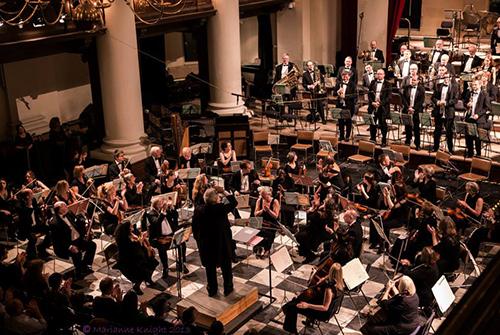
In concert – Josephine Lappin, Salomon Orchestra / Edmon Colomer – Gerhard’s Soirées de Barcelone, Falla & Turina

Josephine Lappin (piano), Salomon Orchestra / Edmon Colomer

Turina Ritmos Op.43 (1927)
De Falla Noches en los jardines de España G49 (1915)
Gerhard (ed. MacDonald) Soirées de Barcelone (1936-9, comp. 1995-6)

St. John’s, Smith Square, London
Sunday 21 May 2023

Reviewed by Richard Whitehouse

The Salomon Orchestra celebrates its 60th anniversary this season with three concerts of real ambition. The second saw a collaboration with Edmon Colomer, whose advocacy of Spanish music in general – and Roberto Gerhard especially – was evident throughout this programme.

His second ballet, Soirées de Barcelone was also Gerhard’s largest project before the collapse of Spain’s republican government forced him into exile. A piano suite from the 1950s was the only realized portion of a work otherwise known through an orchestral suite made soon after the composer’s death. At least until 1996, when musicologist Malcolm MacDonald finished the orchestration of the whole ballet and so enabled its broadcast during Gerhard’s centenary. MacDonald’s edition was duly receiving its first public performance in the UK this afternoon.

Set in the Pyrenees at the St John’s Eve festivities, with rituals of fire purification and fertility as its scenario, Soirées… falls into three substantial tableaux where the prevalence of Catalan folk songs and dances is imbued with a motivic density and orchestral virtuosity anticipating Gerhard’s maturity. The first of these, The Crowd, features three of the items from the suite and finds this score at its most immediate; the second, Eros contains the deepest and most imaginative music – notably the sombre initial Notturno and vividly evocative Apparition of Eros. Emotional intensity falters slightly in the third tableau, The Weddings, but there is no want of impetus as the work builds to its culmination in an eloquent Sardana that resolves scenic and musical issues, then a Coda which sees the piece through to its effervescent close.

At just over 50 minutes, Soirées… is a tough assignment for any orchestra, so all credit to the Salomon for rendering its many intricacies with unfailing commitment and no little panache. It helped to have Colomer at the helm, his understanding and empathy being evident through the care over phrasing and frequent textural finesse. Only on occasion were tempi marginally under-speed to accommodate the exacting rhythmic syncopation though, as he steered a fine reading to its close, there was little doubt as to the sheer power and imagination of this music.

A dependable pianist in the Gerhard, Josephine Lappin impressed as soloist with Manuel de Falla’s Nights in the Gardens of Spain, whose pervasive concertante writing often benefitted when heard from the rear of the platform. A steady yet flexible tempo for In the Generalife brought out some mysterious and even ominous undertones, while the alluring lilt of Distant Dance ensured this headed seamlessly into In the Gardens of the Sierra de Cordóba with its interplay of energy and eloquence before the performance ended in a mood of gentle rapture.

Few of Joaquín Turina’s orchestral works are revived these days, which seems more the pity as this composer was arguably the deftest Spanish orchestrator of his generation. Subtitled a ‘Choreographic Fantasy’, Ritmos made for a scintillating curtain-raiser – its six continuous sections demonstrating unforced musical logic as well as an appealing overall atmosphere. The Salomon players rendered it with infectious enjoyment, reminding one that such pieces – indeed, those in this concert as a whole – are all too infrequently heard in UK concert halls. Colomer provided an extensive spoken introduction to the Gerhard, hopefully a work he will yet record in its entirety. He rounded off this memorable concert with a breezy medley from the Zarazuela, notable for principal flautist Roy Bell taking the solo spot with his castanets.

You can read all about the 60th anniversary season and book tickets at the Salomon Orchestra website Click on the names for more on conductor Edmon Colomer and composer Roberto Gerhard – and for an article on this concert visit the composer’s publisher Boosey