

Brian Eno (vocals, instruments), Melanie Pappenheim (vocals), Leo Abrahams (guitar), Peter Chilvers (instruments, software), Peter Serafinowicz (vocals), Baltic Sea Philharmonic Orchestra / Kristjan Järvi
Brian Eno
The Ship [The Ship, Fickle Sun (I), Fickle Sun (II) The Hour Is Thin, Fickle Sun (III) I’m Set Free]
By This River, Who Gives A Thought, And Then So Clear, Bone Bomb, Making Gardens Out Of Silence, There Were Bells
Royal Festival Hall
Monday 30 October (9 pm concert)
by Ben Hogwood photos (c) Ben Hogwood, not to be reproduced without permission
The estimable Setlist website, documenting the concert history of artists and bands, has a notable seven-year gap between Brian Eno’s last live appearances and this new tour, in which he has been bringing an orchestral perspective to his 2016 album The Ship.
Many artists in Eno’s ambient sphere have looked at the orchestra as a vehicle for original composition, but more recently the tendency has been for artists to use it to regenerate past material, and – perish the thought – boost awareness and bank balance by association through touring. This tactic is clearly not for Eno, who invested a great deal of time in finding the right ensemble before even looking at the layout of this tour. Seeking fresh talent and players with flexibility, he alighted on the Baltic Sea Philharmonic Orchestra, a ten-year-old ensemble conducted by the dynamic Kristjan Järvi. It is fascinating to think that Kristjan, part of a remarkable Estonian conducting trio after father Neeme and elder brother Paavo, is creating new directions for his family, stepping out on ever more adventurous voyages into contemporary music.

This one – on the banks of the Thames – takes its lead from the most famous voyage of the 20th century, the Titanic. Yet Eno chooses not to tell the story in graphic detail, portraying the ship instead through shades of orchestration, atmospheric noise and folk-like utterances. These are made through his own sonorous tones, which worked in this concert to vivid effect. The sonic picture was surely aided by the inclement weather in the UK, the audience becoming part of the vessel as the sea spray splashed against the side. Meanwhile the creaks of the orchestra’s wooden instruments portrayed the boat’s natural bowing and bending.
Eno’s music for The Ship reflects his ambient work, in which the music makes incremental changes in its own sweet time, but it shows how ambient music can also be loud. As time progressed this performance assumed a dramatic intensity way above that of the home listening experience. The orchestra’s control was a key aspect, with Järvi ensuring the musicians had as much freedom as they wanted. He walked around the stage to cajole individual players or sections, then faced the audience as though looking out to sea himself. Dressed in colour-co-ordinated t-shirts, the players could see each other and their conductor in the dark – not to mention the cerise shirt of Eno, a point of vivid colour in the middle.

Eno’s vocal was complemented by the understated yet versatile voice of Melanie Pappenheim, and the thoughtful input of guitarist Leo Abrahams and keyboard player / software designer Peter Chilvers. Also present was the actor and comedian Peter Serafinowicz, reading a monologue on war through rich bass tones.
The Ship, a three-movement suite, had at its heart Fickle Sun, itself in three parts. Here the onward motion of the orchestra was irresistible, still moving slowly like the Titanic but flattening everything in its path. Then, the struggle over, Eno reached for the Velvet Underground cover I’m Set Free, its heart-shifting chord progression nudging at the emotions with every repetition, providing an tidal swell for the audience.
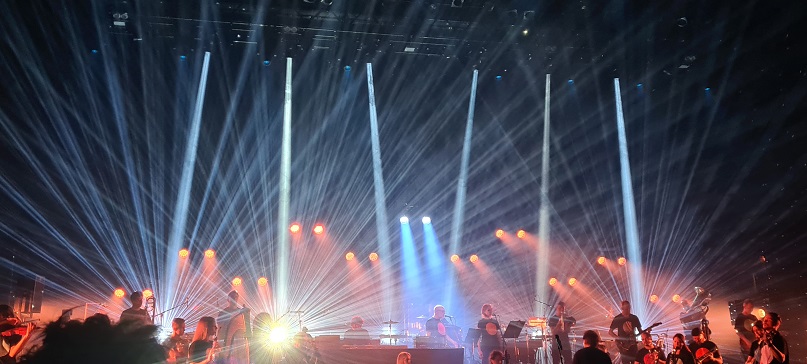
This performance was a triumph of spirit and resolve, a warming combination in these troubled times. The encores continued in the same vein, though the deeply uncomfortable Bone Bomb, from 2005 album Another Day On Earth, provided painful relevance with its response to an article on a suicide bomber in Palestine. Eno paused the music after this to give his own unstinting views on the conflict with Israel, declaring proceeds from the Ships gigs would go to help those suffering from the war in Gaza.
Of the other encore items Making Gardens Out Of Silence, from last year’s ForeverAndEverNoMore, reached a more obvious inner peace, before There Were Bells, found Eno’s music once again reaching beyond the ambient to find notes of sustainable emotional power. Equal strength was found in By This River, the earliest music of the night (from 1977), and the track that stayed with the audience long after the concert had finished.
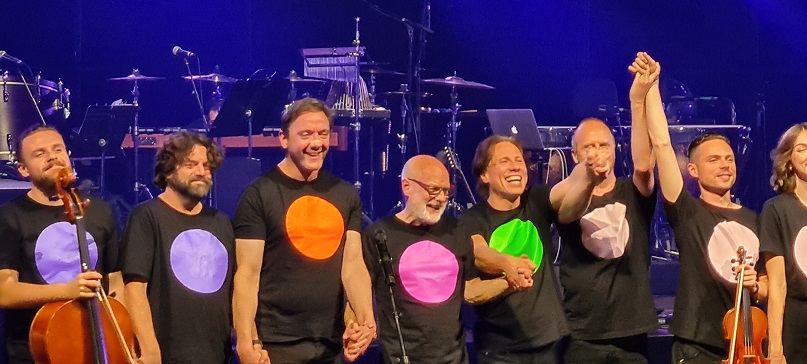
At the end Eno and Järvi generously credited the band and orchestral musicians, looking beyond to single out those responsible for monitoring and lighting, two crucial overlooked b but crucial elements of any performance. The lighting was wholly suitable, the relative darkness allowing the audience to use their mind’s eye in response to Eno’s resolute constructions. Thus was a memorable evening, and one in which the main man himself was also deeply moved.
 Arcana.fm