
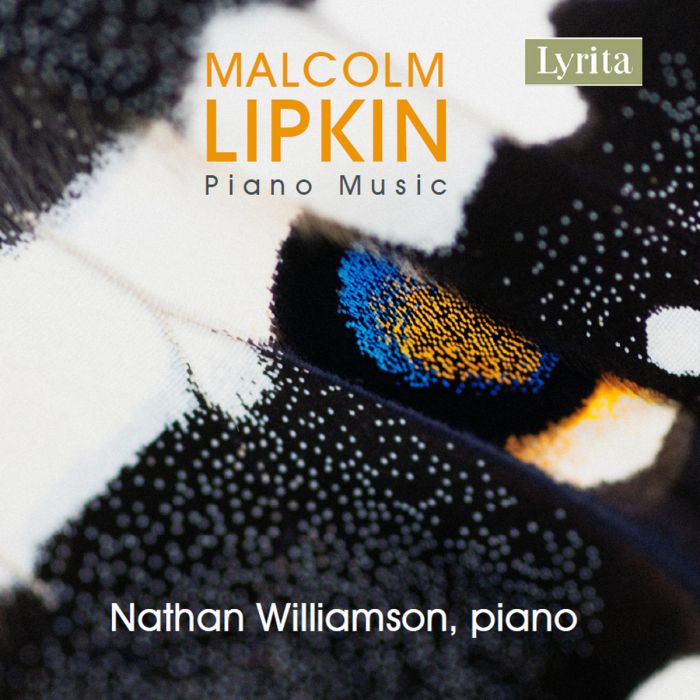
Malcolm Lipkin
Nocturne no.1 (1987, rev. 2000)
Nocturne no.2 (1995)
Nocturne no.3 (1999)
Sonata no.5 (1986)
Nocturne no. 4 ‘…heard in the stillness…’ (2000)
Nocturne no.5 ‘…interrupted melody…’ (2001)
Sonata no.6 ‘Fantasy Sonata’ (2002)
Nocturne no.6 ‘…glint and shadow…’ (2002)
Nocturne no.7 ‘…dancing figures…’ (2004)
Nocturne no. 8 ‘…recollections…’ (2006)
Nathan Williamson (piano)
Lyrita SRCD.414 [68’55’’]
Producer/Engineer Adrian Farmer
Recorded 13-15 October 2021 at Wyastone Concert Hall, Wyastone Leys, Monmouth
written by Richard Whitehouse
What’s the story?
Following on from his three symphonies (SRCD.349), Lyrita here continues its coverage of Malcolm Lipkin (1932-2017) with this release featuring piano music from his later years – a cohesive body of work such as benefits from the insightful playing of Nathan Williamson.
What’s the music like?
While not lacking performances from the early 1950s onward, Lipkin remained a peripheral figure on the UK music scene until the premiere of his 1977 chamber work Clifford’s Tower (Divine Art DDA25202) – its powerfully humanist response to racial atrocity typifying the music from his maturity. The pieces on this new release appear dissimilar given their overt abstraction, but even a cursory hearing reveals many subtleties of expression arising directly out of the musical content which come increasingly into focus with each successive listen.
It was with his Third Sonata that Lipkin first came to attention, but there was a 32-year gap between its successor and the Fifth Sonata. Its two movements contrast with each other in every respect: the first, marked ‘Extremely slow’, starts then ends with a rapt inwardness that makes its ferocious central eruption more unnerving; the second, marked ‘Quite fast’, emerges as a toccata whose jazzy syncopation and technical virtuosity are carried forward to a decisive close. If the ‘Fantasy’ of the Sixth Sonata seems anti-climactic by comparison, its integrating of the nominal four movements (the ‘scherzo’ placed third) as a continuous discourse is brought off with absolute assurance. There is also a growing sense the outcome of its intriguing 15 minutes is unlikely to be that anticipated, which indeed proves the case.
It was none the less with his series of Nocturnes, composed over virtually two decades, that Lipkin made his defining contribution to piano literature. These take their cue from Chopin and Fauré, while adding a vein of ambiguity which is unique to this composer. Not least the First Nocturne with its distanced opening, hazy yet lucid evolution and ethereal close. The Second and Third pieces are respectively wistful and elegiac, then the remaining five each has a descriptive subtitle. Hence the Fourth Nocturne in its juxtaposing of the otherworldly and ominous, the Fifth with its winsome elegance, and the Sixth in its intuitive interplay of expressive types. The Seventh Nocturne has a more capricious demeanour, then the Eighth ends the series with its veiled allusiveness: ‘recollections’ in the fullest yet obliquest sense.
Does it all work?
Absolutely. Right from his first acknowledged pieces, Lipkin evinced craftsmanship of the highest order but it took time and experience to channel this into a wholly personal idiom. Such is everywhere evident in the piano music heard here, which also calls on pianism of the highest order. This it receives from Nathan Williamson (himself a composer of note), who has clearly devoted much time to evolving an all-round interpretive stance. With the Nocturnes in particular, it would hard to imagine more authoritative or sensitive readings.
Is it recommended?
Indeed. The spacious though focussed sound is up to Wyastone studio’s customary standard, and there are typically comprehensive annotations from Paul Conway. It is to be hoped that Lyrita will continue its Lipkin exploration with more of the chamber and orchestral output.
Listen
Buy
You can explore purchase options for this album at the Wyastone website. For more information, click on the links for performer Nathan Williamson and composer Malcolm Lipkin
Published post no.1,983 – Thursday 19 October 2023
 Arcana.fm